


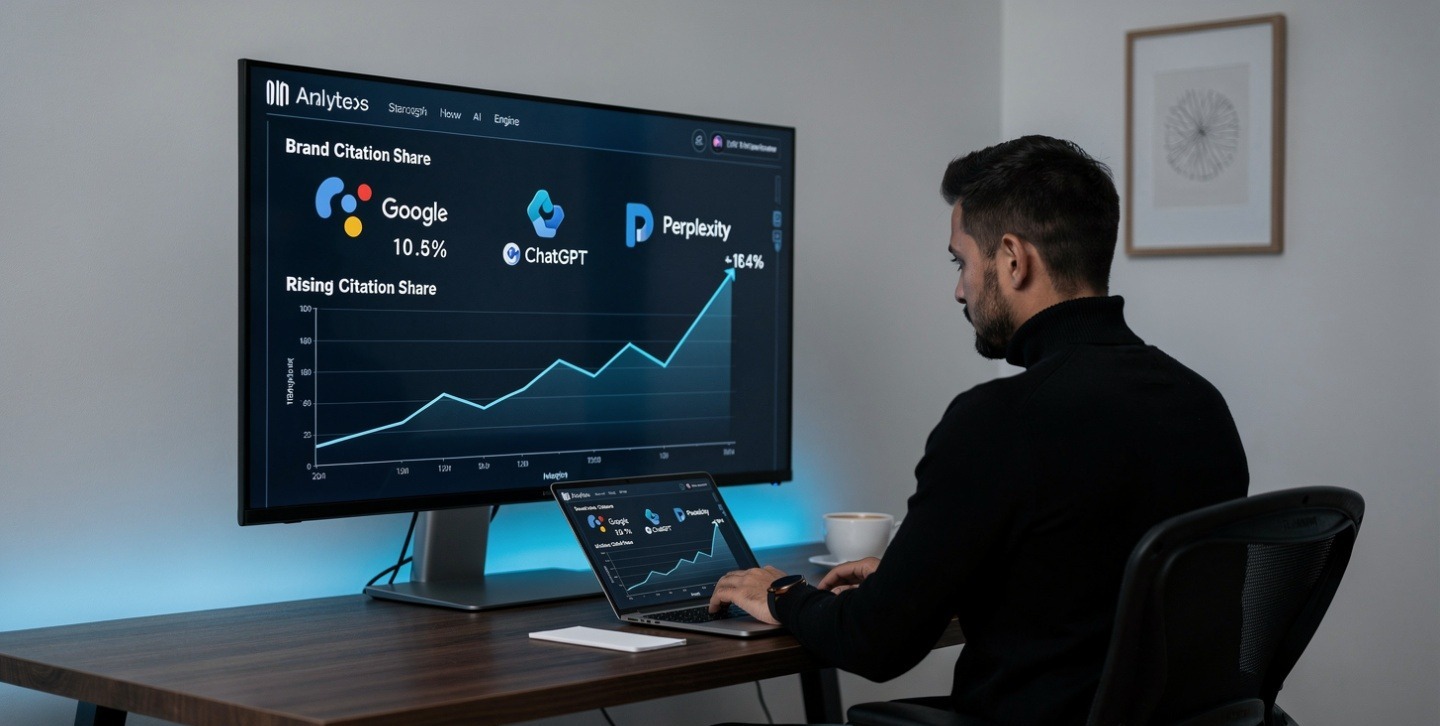
Your traditional rank tracker can’t tell you if ChatGPT recommends your competitor instead of you. That’s the blind spot Ziptie AI search analytics was built to close. Here’s the full breakdown — what it actually tracks, how it works technically, what it costs, where it falls short, and whether you need it right now.
- Ziptie AI search analytics is a Generative Engine Optimization (GEO) platform that monitors your brand’s citation presence across Google AI Overviews, ChatGPT, and Perplexity — replacing traditional rank positions with metrics like Citation Share and AI Success Score.
- Best for SEO professionals, content strategists, and digital agencies managing brands where AI-generated answers are already eating into organic traffic; skip it if you’re pre-revenue or still building basic on-page fundamentals.
- The metric that matters most is Citation Share — the percentage of relevant AI answers where your domain gets cited as a source; anything above 35% is dominant, below 15% signals active threat.
- Biggest mistake: treating Ziptie as a replacement for Google Search Console or Semrush — it’s a companion tool for AI visibility, not a full SEO suite.
- If you need Claude, Gemini, or Copilot tracking, Ziptie doesn’t cover those yet — Geoptie or Otterly AI fill that gap.
What Ziptie AI Search Analytics Actually Is
Ziptie AI search analytics was built by the team behind SEO agency Onely — Tomasz Rudzki, Bartosz Góralewicz, and Sebastian Skowron — with a specific focus on monitoring brand visibility within AI-driven search environments. That origin matters. These aren’t SaaS founders who spotted a trend. They’re practitioners who built this because their own client work demanded it.
The core problem it solves: traditional SEO tools don’t attempt to measure Citation Share — the percentage of relevant AI answers in which your domain is cited as a source. Semrush tells you where you rank. Ziptie tells you whether the AI even acknowledges you exist.
By focusing squarely on AI Overviews — the concise, algorithm-generated summaries that appear for many queries — Ziptie gives SEOs visibility into an area traditional rank reports don’t cover. That used to be an edge. In 2026, it’s closer to a necessity. AI Overviews now appear in one in four Google searches, and organic click-through rate is down 61% on affected queries.
The platform doesn’t replace your existing stack. Think of it as a new instrument panel for a different kind of flight — one where the question isn’t “do I rank?” but “does the AI cite me, mention me positively, and prefer me over my competitors?”
The Core Metrics Ziptie Tracks (And Why Each One Matters)
Most SEO tools give you data you already understand intuitively. Ziptie introduces a vocabulary that’s genuinely new — and worth learning correctly before you run your first report.
Citation Share
Citation Share is the percentage of relevant AI answers in which your domain is cited as a source. A Citation Share above 35% in your niche is considered dominant in 2026. Below 15% signals high risk of competitor displacement. This is the headline metric. Run a competitor’s domain through it and you’ll immediately see whether they’re eating your lunch in AI search.
AI Success Score
Ziptie’s AI Success Score blends mention frequency, citation presence, answer placement, and sentiment into a single ranking. Prompts where you get mentioned but never cited surface as authority gaps. Prompts where you get cited but buried low in the answer surface as structure problems. That distinction is actually useful. “Mentioned but not cited” means the AI knows you exist but doesn’t trust you as a source. That’s a content credibility issue. “Cited but buried” means you need to restructure how you present information so AI models pull it up higher in generated answers.
Sentiment Polarity
Beyond citations, Ziptie tracks brand mentions when AI refers to your company by name without necessarily linking to you, and the sentiment of those mentions — positive, neutral, or negative. AI can technically mention you while framing you unfavorably, and you need to know when that’s happening.
This one surprised me when I first dug into it. You can have solid Citation Share and still be losing ground because ChatGPT consistently frames your product as “a lower-cost alternative” or “better suited for beginners.” That’s not a compliment in B2B. Sentiment data turns a vague awareness into an actionable content fix.
Information Gain
This is the diagnostic layer. Ziptie maps what entities and topics your content is missing compared to pages AI platforms consistently cite. It’s not about keywords — it’s about whether your content answers the questions AI models are being trained to trust. In practice, this usually comes down to specificity: your competitors have hard numbers, named examples, and cited sources. Your content has general advice. Ziptie surfaces that gap directly.
How Ziptie AI Search Analytics Actually Works Under the Hood
Ziptie sends automated queries to each AI platform, captures the full generated response, and parses the text to identify brand mentions, product references, and contextual citations. Simple concept. Non-trivial execution.
Most AI tracking tools rely on static API responses, which often differ from what a real user sees on their screen. Ziptie uses headless browser automation to simulate actual human behavior across 14+ countries, ensuring that the brand citations and rankings in reports are identical to the live AI Overviews being served to real customers.
That matters more than it sounds. API responses from ChatGPT or Perplexity can vary significantly from what a browser user actually sees. If you’re pulling raw API data to track AI visibility, you’re measuring a slightly different thing than your target audience experiences. Ziptie’s browser-simulation approach closes that gap.
One technical challenge is rate limiting. ChatGPT’s API has usage limits, and repeatedly querying the same prompts can trigger throttling. Ziptie spaces out queries, varies prompt structures slightly to avoid detection as automated traffic, and caches results to minimize redundant requests.
Tracking frequency depends on your plan. Starter plans track weekly, Pro plans track every three days, and Enterprise plans can run daily monitoring. For most teams, three-day tracking is sufficient unless you’re in a fast-moving category where competitor content is being published and indexed daily.
For Google AI Overviews specifically, the methodology differs. Because these are query-dependent and tied to live Google search results rather than a static model, Ziptie has to simulate actual search sessions rather than API calls. This is why the platform’s data on Google AIO tends to be the most reliable across GEO tools — the headless browser approach was built for this exact use case.
What Ziptie Monitors: The Three Platforms and Their Gaps
Ziptie focuses on three platforms: Google AI Overviews, ChatGPT, and Perplexity. That covers the majority of AI-driven search queries happening right now. But it’s not the full picture.
Google AI Overviews: Google remains a dominant force, and its search interface now heavily features AI Overviews. Ziptie tracks how often a domain appears in these summaries and whether the AI provides a direct link back to the source material — vital for maintaining organic traffic in an era of zero-click searches. This is Ziptie’s strongest data layer. The real-browser simulation is particularly effective here.
ChatGPT and Perplexity: Beyond traditional search engines, ChatGPT and Perplexity have become primary research tools for consumers. Ziptie monitors these conversational AI platforms to see how they describe products or services. Check out how Perplexity Pro handles enterprise search queries — these platforms are increasingly where high-intent research starts.
What’s missing: The platform doesn’t track Claude, Gemini, Google AI Mode, Copilot, Grok, or DeepSeek. Depending on your industry, that could be a meaningful gap. B2B SaaS buyers using Copilot in Microsoft 365 won’t show up in Ziptie’s data at all. If that’s your audience, this limitation is worth taking seriously before you subscribe.
Ziptie’s Competitive Intelligence Feature
You can see exactly which competitors AI platforms prefer for your target queries, how their AI Success Score compares to yours, and which pages are being cited when they appear. SEO professionals including Lily Ray and Aleyda Solís have publicly recommended Ziptie specifically for this competitive intelligence capability.
Here’s the part that actually changes how you work: instead of guessing why a competitor outranks you on Google, you can see exactly which piece of their content ChatGPT cited, for which query, and with what framing. That’s a research shortcut that used to take hours of manual testing across platforms.
The workflow that clicks for most teams — run your top 20 queries, pull the citation sources for any competitors appearing above you, analyze what those pages have structurally that yours don’t. Nine times out of ten it’s one of three things: more specific data, better-defined entities, or a clearer direct answer in the first 100 words. Ziptie surfaces this fast. Fixing it still takes work, but at least you know exactly where to start.
For a broader view of how AI platforms are shifting market dynamics, the competitive intelligence angle in Ziptie becomes even more useful when you’re tracking category-level trends rather than just individual brand mentions.
Pricing: What You Actually Pay
Pricing is tiered: Starter at $69/month covers one brand and 100 queries, Pro at $159/month covers three brands and 500 queries, and Enterprise is custom pricing for unlimited brands with 5,000+ queries.
Ziptie offers a 14-day free trial and roughly 15% off with annual billing. The free trial includes most features except Google Search Console integration.
Real talk on pricing: the $69 Starter plan is genuinely limiting. 100 queries per month runs out fast if you’re tracking any meaningful keyword set. Most active SEO teams end up on Pro within 60 days. Budget for $159/month if you want to use this seriously.
This pricing sits in the middle of the market — cheaper than enterprise tools like Profound but more expensive per engine than platforms that cover five or more AI models at similar price points.
The honest cost-benefit: if AI Overviews are already visible for your target queries and you’re not tracking citations, the revenue impact of missing that data almost certainly exceeds the subscription cost. If you’re in a niche where AI Overviews rarely trigger (some local service categories, highly specialized B2B), the ROI math gets harder.
Where Ziptie Falls Short
No tool in this category is perfect, and pretending otherwise wastes your time.
Platform coverage is the biggest gap. Three engines sounds reasonable until you realize Claude and Gemini are now embedded in enterprise workflows at scale. If your buyers are in Microsoft Teams using Copilot or research-heavy teams using Gemini Deep Research, Ziptie won’t capture that exposure. Geoptie covers Claude and Gemini, which Ziptie doesn’t currently support, and includes technical site audits to identify what’s blocking AI visibility.
No attribution to revenue. Ziptie tells you your Citation Share went up. It doesn’t connect that to whether more people actually bought from you as a result. Connecting AI visibility to real traffic and conversions is a gap the platform hasn’t solved. You’ll need to build that bridge manually through GA4 and GSC data alongside Ziptie reports.
Query credits limit depth. The Basic plan uses “AI Search checks” as its metric, starting at 500/month. For agencies managing multiple clients or brands with large keyword sets, this constraint forces either an Enterprise upgrade or prioritization that cuts out potentially important queries.
Tracking frequency on Starter is weekly. That’s too slow if you’re in an active content publishing sprint or responding to a competitor’s GEO push. You won’t see the impact of content changes for up to seven days.
Ziptie vs. Traditional SEO Tools: What Actually Changes
You don’t swap Ziptie for Semrush, Ahrefs, or Moz. These tools answer fundamentally different questions.
Traditional SEO tools tell you where your pages rank on Google’s blue-link results. Ziptie tells you whether generative AI systems cite your content as authoritative when users ask questions. In 2026, both layers matter because both drive traffic — just through completely different mechanisms.
The best ChatGPT SEO analysis tools cover the generative angle, while platforms like Semrush still own technical auditing and backlink analysis. Running one without the other creates a blind spot in either traditional or AI search performance. What Ziptie adds isn’t redundancy — it’s a genuinely new measurement layer.
The practical setup most teams land on: Ahrefs or Semrush for keyword research, technical audits, and backlink tracking. Ziptie for AI citation monitoring, GEO competitive intelligence, and identifying content gaps that affect AI answer inclusion. Google Search Console as the ground truth for actual traffic. These three together give you coverage that no single tool provides alone.
For a direct comparison of AI-assisted research tools and how they complement GEO strategies, Perplexity vs ChatGPT for research in 2026 gives useful context on how these platforms prioritize sources differently.
Who Actually Needs Ziptie Right Now
Straight answer: not everyone.
If your target queries already trigger AI Overviews consistently and you’re seeing organic CTR decline despite stable rankings — Ziptie gives you the diagnostic layer to understand why. That’s the clearest use case.
Content teams at brands where thought leadership and topical authority matter, particularly in SaaS, finance, health, and B2B tech, will find the competitive intelligence features immediately useful. Knowing that a competitor’s specific blog post is getting cited by Perplexity for your core product queries is the kind of intelligence that changes your editorial calendar the same week you see it.
Agencies get strong ROI from the Pro plan specifically because multi-brand management and client reporting benefit from the structured data exports and AI Success Score visualizations.
Skip it if: you’re still building foundational SEO (fixing crawlability, building domain authority, writing your first round of content). GEO optimization is a layer on top of solid SEO fundamentals — it doesn’t replace them. The free trial includes most features except GSC integration, so you can validate whether your target queries even trigger AI Overviews before paying.
For context on how Grok’s search capabilities approach AI-generated answers differently, understanding the platform diversity helps you decide whether Ziptie’s three-engine focus covers your audience adequately. And for a full picture of what the Ziptie AI search performance tool covers technically, that deep-dive is worth reading before you start your trial.
The One Setup Step Most People Skip
Everyone who starts with Ziptie makes the same mistake: they monitor their brand name. That’s not where the value is.
The high-leverage setup is tracking the questions your buyers ask before they know your brand exists. Category-level queries. Problem-framing queries. Comparison queries (“best X for Y”). These are the prompts where AI platforms are actively shaping purchase consideration, often weeks before a user ever hits your site.
Build your query set around buyer intent stages: problem-aware queries first, then solution-aware, then brand-aware. Map your current Citation Share at each stage. The gaps you find at the top of that funnel are almost always larger — and more commercially important — than the gaps near your brand name.
ZipTie identifies why your brand is missing from Google AI Overviews by tracking Citation Share and Information Gain metrics — providing a direct roadmap to reclaim zero-click traffic through entity-based optimization. That roadmap only becomes actionable when your query set reflects real buyer intent, not just brand vanity metrics.
Run the 14-day trial with one clear goal: map your Citation Share across your 20 highest-intent queries. Don’t optimize anything yet. Just establish the baseline. Then identify the three queries where competitor Citation Share is highest — those are your first content update targets. Pull the exact pages Ziptie shows getting cited for those queries, analyze what they have that you don’t, and ship one updated or new piece within 10 days. Check your Citation Share change at the two-week mark. That’s the whole initial workflow. Everything after that is iteration.
