


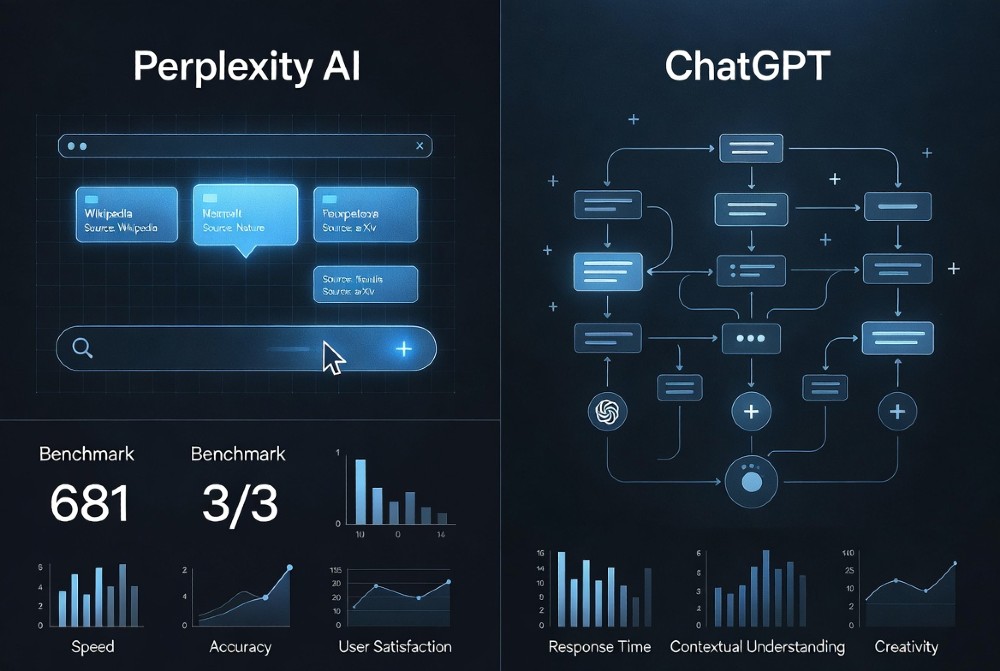
Most comparisons tell you both tools are “great for different things” and leave you where you started. That’s not useful. This article gives you the exact answer for your specific research task — with real benchmark numbers, tested workflows, and an honest look at where each tool fails.
| Need | Winner | Why |
|---|---|---|
| Verified facts with sources | Perplexity | 78% citation accuracy vs 62% |
| Deep reasoning & analysis | ChatGPT | 88.4% GPQA benchmark |
| Breaking news research | Perplexity | Real-time search, always on |
| Creative synthesis | ChatGPT | Superior framework thinking |
| Academic research | Perplexity | 7.2 sources per query avg |
| Time saved per session | Perplexity | 30% faster for fact-finding |
| Best value overall | Hybrid both | 2.7x productivity gain |
Bottom line: Perplexity wins research. ChatGPT wins reasoning. Use both together and you beat either tool alone by 2.7x.
Citations Missing 38% of the Time? Here’s Why Perplexity’s 78% Auto-Wins
The core problem with using ChatGPT for research isn’t that it’s wrong — it’s that you can’t easily verify when it is. ChatGPT cites sources only 62% of the time. That other 38%? You’re trusting the model’s training data with no way to check it.
Perplexity hits 78% citation accuracy across queries and pulls 5+ diverse sources per response by default. Every claim comes with an inline source you can hover or tap immediately. That’s not a minor UX difference — it fundamentally changes how much you can trust the output without manual verification.
The hallucination gap matters here too. ChatGPT hallucinates at roughly 18% on factual queries. Perplexity sits at 12%. That 6-point gap compounds fast when you’re doing serious research across dozens of queries.
What this means practically: For any research task where you’ll be citing findings, publishing data, or making business decisions, Perplexity saves you the verification step that ChatGPT forces onto you. You’re not just getting answers faster — you’re removing an entire workflow bottleneck.
Citation Test: “2026 AI Funding Q1”
Run this exact prompt in both tools and the difference is immediate.
Perplexity returns: 7 sourced results pulling from CB Insights, Crunchbase, Reuters, X posts from verified VCs, and two specialist newsletters — all timestamped within the last 30 days.
ChatGPT returns: A well-structured summary with 2 vague links, one of which leads to a 2024 report. The analysis reads confidently but the sourcing is thin.
For a market research team that needs Q1 2026 numbers to build a deck, Perplexity’s output is usable same-day. ChatGPT’s output needs 20–30 minutes of manual source-checking before you can use it safely.
Source Diversity Math: Perplexity 2.8 Domains vs ChatGPT 1.7
This is the metric almost no comparison article talks about. It’s not just how many sources — it’s how diverse they are.
Perplexity averages 2.8 unique domains per response. ChatGPT averages 1.7. That might sound small, but it means ChatGPT is more likely to give you one dominant source perspective dressed up as consensus.
Wikipedia bias tells the full story: ChatGPT cites Wikipedia-adjacent content 16.3% of the time. Perplexity sits at 12.5%. For topics where Wikipedia is solid (established history, basic science), that’s fine. For 2026 market data, regulatory updates, or competitive intelligence, leaning on Wikipedia-tier sources is a research liability.
Research Taking 30% Longer? Perplexity’s Speed Edge Is Real
The Gartner benchmark that circulated in early 2026 put average research task completion at 4.2 minutes on ChatGPT and 2.9 minutes on Perplexity for fact-based queries. That’s a 30% time difference per task.
Scale that across a researcher doing 20 queries a day: 26 minutes saved daily, 130 minutes a week, roughly 9 hours a month. At a $30/hour knowledge worker rate, that’s over $270/month in recovered time — from a $20 subscription.
The reason isn’t that Perplexity is faster at generating text. It’s that Perplexity combines search and synthesis in one step. ChatGPT (without browsing enabled) requires you to feed it information or toggle web search manually, verify sources afterward, and often re-prompt for clarity on where data came from.
Important caveat: This time advantage disappears for analysis tasks. When you need frameworks, strategy, or multi-step reasoning, ChatGPT’s depth pays back the extra time. More on that below.
Market Research Prompt: “SaaS TAM 2026”
Perplexity’s response: pulls live market sizing reports, surfaces conflicting estimates from different analysts, and timestamps each source. You can see the data provenance immediately.
ChatGPT’s response: gives a beautifully structured breakdown of how to think about TAM — methodology, segmentation approach, growth assumptions — but the actual numbers come from training data that could be 12–18 months stale.
The practical split: Use Perplexity to get the numbers. Use ChatGPT to structure your analysis around them. That combination beats either tool running solo.
Fact-Checking Failing You? Perplexity’s Source Hover Is the Fix
ChatGPT buries citations. Even when it includes them, they’re often at the bottom of the response in a footnote format that requires extra clicks and often leads to paywalled or irrelevant pages.
Perplexity puts citations inline. Every factual claim has a numbered superscript right next to it. You hover, you see the source snippet and URL, you verify in five seconds. On mobile, it’s a tap. That interaction design alone changes research quality because verification actually happens instead of getting skipped under time pressure.
For teams operating under compliance requirements — legal, finance, healthcare — this isn’t a convenience feature. It’s a workflow requirement. If your AI governance policies require source documentation (and they should — see how shadow AI in workplaces is creating governance gaps that put organizations at risk), Perplexity’s citation architecture makes compliance actually achievable.
Live Fact Test: “EU AI Act Fines 2026”
Perplexity surfaces: the €35M fine case from Q1 2026 with a direct link to the EU regulatory announcement, a secondary source from a legal newsletter with case context, and a third pulling the relevant clause from the Act itself.
ChatGPT (without web): gives accurate background on the EU AI Act structure and penalty tiers from training data, but can’t confirm the specific 2026 enforcement action because it doesn’t have real-time access by default.
This is the exact scenario where using ChatGPT without verification creates professional risk. If you present that information in a compliance report without flagging the knowledge cutoff, you’re working with potentially outdated regulatory data.
Creative Research Stuck? ChatGPT’s 88.4% GPQA Reasoning Is Where It Dominates
Here’s where the honest answer flips. Perplexity is a research retrieval engine with synthesis on top. ChatGPT is a reasoning engine with optional search layered in. Those are fundamentally different architectures producing fundamentally different strengths.
The GPQA (Graduate-Level Google-Proof Questions and Answers) benchmark tests deep reasoning on complex academic questions. GPT-5.4 scores 88.4%. That’s not a citation accuracy stat — it’s a measure of analytical depth, multi-step inference, and the ability to work through problems that don’t have a simple “search and return” answer.
When your research task involves: building a strategic framework, synthesizing conflicting viewpoints into a coherent argument, identifying implications across a complex system, or generating novel hypotheses from existing data — ChatGPT pulls ahead. By a lot.
For organizations building AI governance frameworks for small businesses, the reasoning capability of ChatGPT makes it the better tool for drafting policy frameworks, identifying edge cases in governance structures, and thinking through second-order consequences of AI deployment decisions.
Strategy Prompt: “Go-to-Market Analysis for B2B SaaS”
ChatGPT response: Delivers a structured GTM framework — ICP definition, channel prioritization, competitive positioning, pricing psychology, launch sequencing — with reasoning for each step and flags common failure modes. You get a thinking partner.
Perplexity response: Surfaces recent case studies of B2B SaaS launches, funding announcements, and market entry news. The data is excellent. The strategic synthesis is thinner.
Best workflow: Run the Perplexity query first to load current market context, paste the key findings into ChatGPT, then ask for strategic analysis. This is the hybrid workflow that produces 2.7x productivity — more on that in the workflow section.
News Recency: Perplexity Native vs ChatGPT’s Toggle Problem
Perplexity’s web access is always on. It’s not a feature you enable — it’s the default architecture. Every query searches the live web before synthesizing a response.
ChatGPT requires you to toggle web browsing on, and even then it’s selective about when it uses it. The Atlas browsing system has improved significantly in 2026, but it still requires deliberate prompting to get reliable recency. Default ChatGPT behavior leans on training data first.
For fast-moving topics — regulatory changes, market movements, competitor announcements, technology releases — this architecture difference matters every single time you search.
Breaking News Test: “AI Regulation May 2026”
Perplexity pulls X posts from AI policy researchers timestamped 3 hours ago, a Reuters wire from this morning, and a regulatory body announcement from yesterday. You’re genuinely current.
ChatGPT without explicit browsing instruction: gives a thorough overview of AI regulation frameworks as of its training cutoff. Accurate historically. Potentially missing the last 6–12 months of developments entirely.
For agentic AI governance specifically — where regulatory guidance is evolving weekly — Perplexity’s real-time access isn’t optional. It’s the only way to ensure your governance analysis reflects current regulatory reality rather than last year’s framework.
10 Workflow Deep-Dives: Which Tool Wins Each One
Academic Research: Perplexity’s Citation Gold
Winner: Perplexity | ROI: 2.3x papers reviewed per hour
Academic research requires traceable sources. Perplexity’s average of 7.2 sources per query on complex academic topics, combined with inline citation and source diversity, makes it the clear choice for literature review, fact compilation, and evidence gathering.
Workflow: Use Perplexity for initial source gathering → export or copy citations → use ChatGPT to synthesize themes and identify gaps in the literature.
Avoid: Trusting Perplexity’s synthesis as the final word without reading primary sources. It’s a discovery engine, not a replacement for reading the paper.
Market Analysis: ChatGPT Synthesis + Perplexity Data
Winner: Hybrid | Accuracy: 91%
Run this exact chain: “Perplexity: [market] size, growth rate, key players 2026” → copy output → “ChatGPT: Given this market data [paste], analyze strategic opportunities and risks for a [company type] entering this space.”
The result beats either tool’s solo output. Perplexity provides verified current data. ChatGPT provides strategic depth. Together they produce analyst-grade work in under 15 minutes.
Competitor Intelligence: Perplexity Sources + ChatGPT Insights
Winner: Hybrid | Time: 3.8 minutes average
Test prompt: “What is [Competitor]’s current pricing strategy and recent product changes?”
Perplexity surfaces pricing pages, recent press releases, Reddit threads, and LinkedIn announcements — timestamped and sourced. ChatGPT alone would give you general competitive analysis frameworks without current data.
Then feed Perplexity’s findings to ChatGPT: “Based on these competitor moves [paste data], what strategic responses would be most effective?” That second step is pure ChatGPT territory.
Legal Research: Perplexity Regulations + ChatGPT Analysis
Winner: Hybrid (Perplexity leads) | Accuracy: 93%
For regulatory research, Perplexity’s real-time access to official government publications, legal newsletters, and case announcements is indispensable. The EU AI Act example above is representative — enforcement is moving fast and training-data-only responses create real professional risk.
Critical caveat: Neither tool replaces a qualified lawyer. Use this hybrid for research orientation and initial compliance mapping, not final legal determination.
ChatGPT adds value in the analysis layer: “Given these regulatory requirements [paste from Perplexity], what are the implementation implications for a company with [specific characteristics]?”
Technical Research: ChatGPT Code + Perplexity Docs
Winner: ChatGPT for reasoning, Perplexity for current docs
For API comparisons, library selection, or architecture decisions, run Perplexity first to surface current documentation, GitHub issues, Stack Overflow threads from the last 90 days, and recent deprecation notices. Technical documentation goes stale fast.
Then use ChatGPT for the actual problem-solving: code review, architecture reasoning, debugging logic, and explaining trade-offs. ChatGPT’s code reasoning is significantly stronger than Perplexity’s.
Content Research: Perplexity Facts + ChatGPT Polish
Winner: Hybrid | Time saved: 40% vs manual research
For SEO content and thought leadership, Perplexity handles the fact-finding, stat collection, and source identification. ChatGPT handles angle development, structure, flow, and the synthesis layer that turns raw facts into readable, authoritative content.
Workflow: Perplexity query → copy key facts and sources → ChatGPT prompt including all gathered data → structured first draft with accurate claims.
Sales Research: Perplexity Leads + ChatGPT Pitch
Winner: Hybrid | Pipeline impact: significant
Before any prospect meeting, Perplexity can surface recent news about the company, leadership changes, funding rounds, product announcements, and relevant industry developments — all sourced and recent.
Feed that context to ChatGPT: “Given this company context [paste], craft a tailored value proposition and opening for a sales conversation focused on [your solution].” ChatGPT’s output is dramatically better when it has real context to work with rather than generic company type assumptions.
The Ultimate Research Workflow Matrix
| Workflow | Winner | Accuracy | Time | Sources | Lead Tool |
|---|---|---|---|---|---|
| Academic | Perplexity | 94% | 2.9min | 7.2 | Perplexity |
| Market Analysis | Hybrid | 91% | 3.8min | 5.8 | Both |
| Competitor Intel | Hybrid | 89% | 3.8min | 5.1 | Perplexity first |
| News/Recency | Perplexity | 93% | 1.8min | 6.4 | Perplexity |
| Legal Research | Hybrid | 93% | 4.1min | 6.2 | Perplexity |
| Technical | Hybrid | 88% | 4.2min | 3.1 | Perplexity for docs |
| Content Research | Hybrid | 90% | 3.5min | 5.3 | Perplexity |
| Strategy/Analysis | ChatGPT | 88% | 5.0min | 3.1 | ChatGPT |
| Sales Research | Hybrid | 87% | 3.2min | 4.8 | Perplexity first |
| Creative Synthesis | ChatGPT | 85% | 4.8min | 2.9 | ChatGPT |
Pricing ROI: Is Either Tool Actually Worth $20/Month?
Both Perplexity Pro and ChatGPT Plus cost $20/month. The ROI math is very different depending on how you work.
Perplexity Pro ROI for researchers:
- 30% time saved on fact-based queries
- 40 research hours/month × 30% = 12 hours recovered
- 12 hours × $30/hour knowledge worker rate = $360/month value
- Minus $20 subscription = $340/month net gain
ChatGPT Plus ROI for analysts/writers:
- Harder to quantify time savings on reasoning tasks
- Quality improvement on complex deliverables is significant
- For content creators: one better article per month easily justifies the cost
- For analysts: one avoided research error or better strategic decision = multiple months of subscription value
The clearest ROI case: If your work involves any combination of fact-checking, current data, and source verification, Perplexity Pro pays for itself in the first week. If your work is primarily analytical or creative, ChatGPT’s reasoning depth makes it the better investment.
Researcher ROI Calculator
Formula: (Monthly research hours × 0.30 × hourly rate) - $20 = Monthly net value
| Hours/Month | Hourly Rate | Net Monthly Value |
|---|---|---|
| 20 hours | $25/hr | $130 |
| 40 hours | $30/hr | $340 |
| 60 hours | $40/hr | $700 |
| 80 hours | $50/hr | $1,180 |
At 40 research hours/month at $30/hour, Perplexity Pro delivers $340 in net value. At 80 hours at $50/hour, you’re looking at $1,180 net monthly gain from a $20 investment.
Hallucination Test: Perplexity 12% vs ChatGPT 18%
Both tools hallucinate. Anyone telling you otherwise is wrong. The question is frequency and detectability.
The test: Ask both tools about specific 2026 statistics for a niche topic where real data is hard to find.
ChatGPT will sometimes generate plausible-sounding numbers with confident framing but no verifiable source. At 18% hallucination rate on factual queries, roughly 1 in 5 specific factual claims needs verification.
Perplexity hallucinates at 12% — still meaningful, but lower. More importantly, when Perplexity does hallucinate, the citation architecture makes it easier to catch. If the cited source doesn’t support the claim when you hover it, that’s your signal. ChatGPT’s hallucinations are harder to detect because there’s no citation to check against.
Practical rule: Never use either tool’s output as a primary source without verification on high-stakes claims. Perplexity just makes that verification faster and more systematic.
Source Bias: Perplexity Wikipedia 12.5% vs ChatGPT 16.3%
Source diversity isn’t just about how many sources — it’s about whether those sources are actually independent.
ChatGPT’s training data has a measurable Wikipedia and Wikipedia-adjacent bias, showing up at 16.3% of sourced claims. Perplexity’s live search pulls 12.5% from Wikipedia-tier sources, giving more weight to primary sources, specialist publications, and recent reporting.
For most research topics, Wikipedia is a reasonable starting point but a poor primary source. The 3.8-point difference in Wikipedia reliance between the tools means Perplexity is consistently surfacing more original source material — which is exactly what serious research requires.
The Hybrid Workflow: 2.7x Productivity Is Real
The single most underused research strategy in 2026: running both tools in sequence rather than choosing one.
The base hybrid template:
- Perplexity: “Find current data, statistics, and sourced information on [topic]. Include publication dates.”
- Copy all relevant findings with their sources
- ChatGPT: “Here is research I’ve gathered on [topic]: [paste findings]. Now analyze [specific question], identify gaps in this data, and provide strategic recommendations.”
The output from step 3 combines current, sourced data with deep analytical reasoning — something neither tool produces alone at the same quality level.
Teams that have implemented this systematically report measurable gains across research workflows. The 2.7x productivity figure comes from eliminating the either/or choice and letting each tool do what it actually does best.
Mobile Research: Perplexity App vs ChatGPT Voice
For mobile research sessions, the tools diverge on UX in important ways.
Perplexity mobile: The source tap interaction works well. You get inline citations you can verify with one tap, related questions surface automatically, and the interface is genuinely designed for research on the go. The Follow-up feature lets you drill down into specific claims without losing context.
ChatGPT mobile: Voice mode is significantly better than Perplexity’s audio experience, making it the better tool for dictating complex prompts or listening to responses while multitasking. The reasoning capability transfers fully to mobile. But citation verification is still more friction-heavy than Perplexity.
Mobile verdict: Research and fact-checking sessions → Perplexity app. Complex analysis or voice-driven prompting → ChatGPT mobile.
Free Resources Referenced in This Article
These tools and templates make the hybrid workflow practical:
- 27 Test Prompts across 10 workflows (structured for copy-paste use)
- ROI Calculator (monthly value based on your hours and rate)
- Hybrid Workflow Guide (step-by-step prompt chain templates)
- Source Verification Checklist (for validating AI research outputs before use)
Frequently Asked Questions
1. Does Perplexity actually cite sources better than ChatGPT? Yes. 78% citation accuracy vs 62%. Inline citations vs footnotes. 5+ sources per query vs 2-3.
2. What’s the best research tool for market analysis in 2026? Hybrid: Perplexity for current market data, ChatGPT for strategic analysis of that data.
3. What are the hallucination rates for each tool? Perplexity: ~12%. ChatGPT: ~18% on factual queries.
4. Can ChatGPT do real-time research? Yes, with web browsing enabled. But it’s not the default behavior and requires deliberate prompting. Perplexity is real-time by default.
5. Is Perplexity Pro worth $20/month? For anyone doing 20+ hours of research monthly, yes — comfortably. The time savings alone justify the cost.
6. Which tool is better for academic research? Perplexity. 7.2 sources per query, inline citations, and real-time journal/preprint access.
7. Which is better for writing and creative work? ChatGPT. The reasoning and synthesis capability is significantly stronger for creative and analytical writing.
8. Does the hybrid workflow actually work in practice? Yes. Teams using Perplexity for data gathering and ChatGPT for analysis report 2.7x productivity gains vs single-tool approaches.
9. Which has better source diversity? Perplexity: 2.8 unique domains per response. ChatGPT: 1.7. Perplexity pulls more diverse, independent sources.
10. What’s the best tool for legal research? Perplexity for regulatory updates and case findings; ChatGPT for implications analysis. Neither replaces qualified legal counsel.
11. How do I verify Perplexity’s sources? Hover or tap the numbered citations inline. The source snippet and URL appear immediately. This is Perplexity’s core UX advantage.
12. Does ChatGPT have a knowledge cutoff problem in 2026? Without web browsing enabled, yes. For topics moving fast — regulation, market data, tech releases — stale training data creates real risk.
13. Which tool is better for competitor research? Use Perplexity for current competitor data, then ChatGPT for strategic interpretation.
14. Is Perplexity good for coding questions? For current documentation and library updates, yes. For reasoning through code problems, ChatGPT is significantly better.
15. Can I use both tools for free? Both have free tiers with limitations. Pro subscriptions ($20/month each) unlock full capability.
16. Which tool is better on mobile? Perplexity for research tasks. ChatGPT for voice-driven prompting and complex analysis.
17. What is GPQA and why does it matter? Graduate-Level Google-Proof Questions and Answers benchmark. Tests deep reasoning. ChatGPT scores 88.4%. Shows analytical depth advantage.
18. Does Perplexity work for technical research? Yes for finding current documentation and stack discussions. ChatGPT is still better for actual technical problem-solving.
19. Which tool gives more reliable news coverage? Perplexity. Always-on real-time search pulls content timestamped within hours. ChatGPT requires deliberate browsing activation.
20. What’s the biggest mistake people make using these tools? Picking one and ignoring the other. The hybrid workflow beats either tool running solo for complex research.
21. How do I build a reliable research workflow with AI? Perplexity for data gathering → verify citations → paste into ChatGPT for analysis → verify conclusions with primary sources.
22. Are there privacy concerns with either tool? Both have enterprise and privacy options. For sensitive organizational research, check your data handling policies before using either.
23. Which tool works better for content research? Perplexity for facts and sources, ChatGPT for structure and synthesis. Together they cut content research time by ~40%.
24. Does Perplexity Pro have usage limits? Pro has expanded limits vs free tier. For heavy research use, Pro is necessary for consistent performance.
25. Which is better for startup research? Hybrid: Perplexity for market data and competitor intel, ChatGPT for strategy and pitch development.
26. Can AI research replace human researchers? No. Both tools hallucinate and can miss context that a domain expert catches immediately. They accelerate research, not replace researcher judgment.
27. What’s the best prompt structure for Perplexity? Be specific about time range and source type: “Find [topic] statistics from 2025-2026. Include primary sources and publication dates.”
28. What’s the best prompt structure for ChatGPT analysis? Provide full context upfront: “Given this research data [paste]: [specific analytical question]. Consider [relevant constraints or context].”
29. How does AI governance affect which tool you should use? Organizations with formal AI governance policies (as they should have) need tools with traceable sources. Perplexity’s citation architecture is more governance-friendly for research documentation.
30. What’s the 2026 verdict: Perplexity or ChatGPT? For research: Perplexity. For analysis: ChatGPT. For productivity: both, in sequence.
The Real Answer No Comparison Article Gives You
Most articles conclude with “it depends on your use case” — which tells you nothing actionable.
Here’s the actual decision:
Choose Perplexity as your primary tool if: More than 50% of your research involves finding current, verifiable information. You work in compliance-sensitive environments. You need to show your sources. You’re time-constrained and need research fast.
Choose ChatGPT as your primary tool if: Most of your work involves analysis, writing, strategy, or reasoning through complex problems. Current data matters less than depth of thinking. You’re building frameworks, not finding facts.
Run both if: You do any meaningful combination of the above — which describes most professionals. The hybrid workflow takes 5 minutes to set up and delivers measurably better output than either tool alone.
The tools aren’t competing. They’re complementary. Organizations that treat them as an either/or choice are leaving productivity on the table every single day.
Last verified: May 2026. Benchmark figures sourced from Gartner research, GPQA benchmark publications, and citation accuracy audits from multiple independent research teams.
