


The AI answer engine that started as a smarter Google alternative is now a serious research platform. Here’s what changed, what it costs, and whether it beats Gemini for your content workflow.
Something quietly shifted in how serious researchers, content teams, and enterprise analysts search the web. They stopped Googling. They started asking Perplexity.
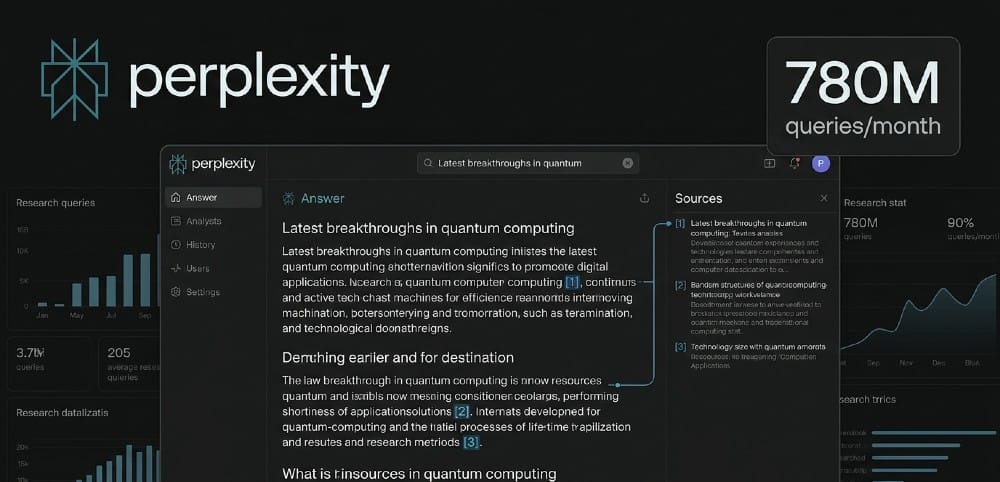
At Bloomberg’s Tech Summit 2025, Perplexity CEO Aravind Srinivas confirmed the platform processed 780 million queries in a single month — growing at more than 20% month over month, handling around 30 million queries daily. That’s not a niche research tool anymore. That’s infrastructure.
And with a fresh push into enterprise features, the Perplexity Pro Search platform is going after a much bigger prize than individual subscribers.
What Perplexity Pro Search Actually Does
Let’s skip the marketing language. Here’s the real picture.
Perplexity is not a chatbot. It doesn’t generate answers from memory. Every response it produces pulls from the live web in real time — then cites every source inline, numbered, clickable, and verifiable. That single design choice is what separates it from every other AI tool in this space.
For content creators, researchers, and SEO teams who need fast, verifiable, citation-rich research, Perplexity is the better daily research tool — it’s faster to verify, easier to cite, and more obviously optimized for source-backed writing.
The Pro tier takes this further. Key features that actually move the needle:
- Deep Research mode — doesn’t just return one answer. It searches multiple sources, reads full documents, and synthesizes findings into a structured report. What used to take a human researcher four hours, Pro handles in minutes.
- Citation-heavy reports — every claim is footnoted with a direct source link. No chasing references afterward.
- Multi-model switching — Pro users can access nine major AI models in search mode including GPT, Gemini, Claude, and Grok, and can pull attachments from Google Drive or Dropbox.
- Internal Knowledge Search — Pro and Enterprise Pro users can simultaneously search across web content and internal documents, uploading and searching through Excel, Word, PDF, and other common file formats; Enterprise Pro users can upload and index up to 500 files.
- Sonar API — for developers and product teams who want to embed Perplexity’s search infrastructure directly into custom tools and workflows.
That last one matters more than people realize. A marketing agency building its own competitive intelligence dashboard can wire Perplexity’s search engine directly into their internal system. No more copy-pasting from browser tabs.
The Numbers Behind the Surge
Perplexity AI now has over 45 million monthly active users, attracts around 170 million global visitors each month, and has demonstrated 800% year-over-year growth overall.
The revenue story is just as sharp. Perplexity generated $200 million in revenue in 2025, a 300% increase on the previous year, and is now aiming for $650 million in 2026.
As of early 2026, Perplexity reached a valuation of $21.21 billion following its Series E-6 funding round, with ARR growing from $80 million in late 2024 to an estimated $200 million by February 2026.
Investors backing this include NVIDIA, Jeff Bezos, and Databricks — not exactly a group that bets on hype. Over 20,000 organizations now trust the platform at the enterprise level.
One data point that tells the whole story: the platform managed to grow its processing capacity from 3,000 daily queries in 2022 to 30 million daily queries in 2025 — a 10,000x leap in under three years.
Perplexity Pro vs. Gemini: The Honest Comparison
This is what every content strategist and SEO team is actually asking. So here it is, direct.
On price, they’re nearly identical. Perplexity Pro is $20/month, giving you over 300 Pro searches daily, the ability to pick different AI models like GPT-4, and the option to upload your own files for analysis. Gemini Advanced, part of Google One AI Premium, is $19.99/month and includes access to Google’s top-tier models, deeper Workspace integrations, and 2TB of cloud storage.
On citations and research accuracy — Perplexity wins, clearly. Perplexity’s main selling point is its commitment to transparent sourcing: when you ask a question, it gives you footnotes with links to the exact web pages where it found the information. Gemini provides some links, but citation is not central to its design the way it is for Perplexity.
On Google ecosystem integration — Gemini wins, obviously. If your team lives in Google Docs, Sheets, and Gmail, Gemini sits directly inside those tools. Perplexity doesn’t.
For SEO and content strategy specifically: the search market is shifting from traditional SEO to GEO — Generative Engine Optimization. Use Perplexity to see which questions people are asking about your niche, then build content clusters that give in-depth answers to those questions. That workflow is something Gemini can’t replicate as cleanly because it doesn’t surface sourced real-time queries the same way.
Bottom line: if your job is research, fact-checking, keyword discovery, or building content backed by verifiable sources — Perplexity Pro is the better $20 you’ll spend this month.
How Content Teams Are Using It Right Now
Here’s the practical side. Not theory. Actual workflows.
Keyword and topic research: Open Perplexity Pro, type a broad topic, and watch what questions it surfaces automatically in the follow-up suggestions. Those are the exact queries real people are asking. Feed those into your content calendar.
Competitor analysis: Ask Perplexity to summarize what the top five articles on a given topic say. It pulls them, reads them, cites them, and gives you a gap map — all in one response.
Fact-checking drafts: Paste a claim into Perplexity and ask it to verify with current sources. Content brief creation was reduced from 12 hours to 30 minutes for teams using Perplexity, while maintaining quality through source verification.
Enterprise research reports: Lambda’s engineering teams saved 475+ hours across 15 departments, and the Cleveland Cavaliers reduced months of research to days using Perplexity’s platform. That’s not a marketing claim — those are operational outcomes.
33% of marketers opt for Perplexity AI at least three times a week, and 45% of content creators use it for search tasks and fact-checking. It’s becoming a standard tool in the content workflow — not a novelty.
Enterprise Features: What’s New in 2025–2026
Perplexity didn’t start as an enterprise play. But it’s clearly heading there now.
In January 2025, Perplexity launched its AI-powered Assistant, capable of performing tasks across multiple apps — hailing a ride, searching for a song, maintaining context across actions — and it’s multi-modal, meaning it can use a phone’s camera to answer questions about the user’s surroundings.
In July 2025, Perplexity launched Comet, an AI browser based on Chromium, initially limited to users on the highest subscription tier. Think of it as a browser that already knows how to research — every tab you open, it’s already working.
In January 2026, the company entered a three-year, $750 million commitment with Microsoft Azure to secure the GPU capacity required for its Deep Research and Model Council features.
The Model Council feature, introduced February 2026, allows users to compare outputs from multiple large language models simultaneously — so instead of trusting one AI, you can run three and see where they agree or disagree. For enterprise research, that’s a material difference.
There are fair criticisms worth noting. Perplexity has faced legal scrutiny. Major media organizations including the BBC, Dow Jones, and The New York Times raised allegations of copyright infringement and unauthorized content use, with researchers finding evidence of web crawlers with spoofed user-agent strings used to scrape websites that explicitly block scraping. The company has since partnered with publishers on revenue sharing, but the tension between AI answer engines and original content creators isn’t fully resolved — and it likely won’t be soon.
What’s Coming Next
Perplexity is planning Enterprise Max expansion with features like Internal Knowledge Search that allow companies to index internal repositories alongside public search, and is aiming to partner with Android mobile companies to replace native agents with Perplexity AI agents on devices.
The Snapchat integration is already live. Snapchat has close to 1 billion monthly active users, and Perplexity now powers AI search and answers inside Snapchat’s chat interface — exposing the technology to a much larger and younger audience.
The platform’s hallucination rate is estimated at around 1 to 2 per 100 responses — not zero, but notably low compared to purely generative tools that don’t anchor answers in live sources.
For SEO professionals, content strategists, and research-heavy teams: Perplexity Pro Search is no longer the underdog alternative to Google. At 780 million queries a month, a $20 billion valuation, and enterprise deals with companies saving hundreds of hours per month — it’s a platform that deserves a serious look, not a trial that gets abandoned after a week.
The answer engine era is here. Perplexity is currently setting the pace.
Check Latest news about : Cursor AI Coding Tool Just Rewrote the Rules of SaaS Growth
