



You want a sales job inside an AI company. Not a vague “tech sales” role, an actual position at a company building or deploying artificial intelligence, where the comp is real, the growth is real, and the work is not just selling software with an “AI” badge slapped on the marketing page.
This article breaks down every layer of that goal: which job titles to target, which companies actually pay well versus which ones burn their sales teams, what qualifications matter, where these jobs are located, and exactly how to position yourself to get hired, even without a computer science degree.
AI Sales Jobs at a Glance
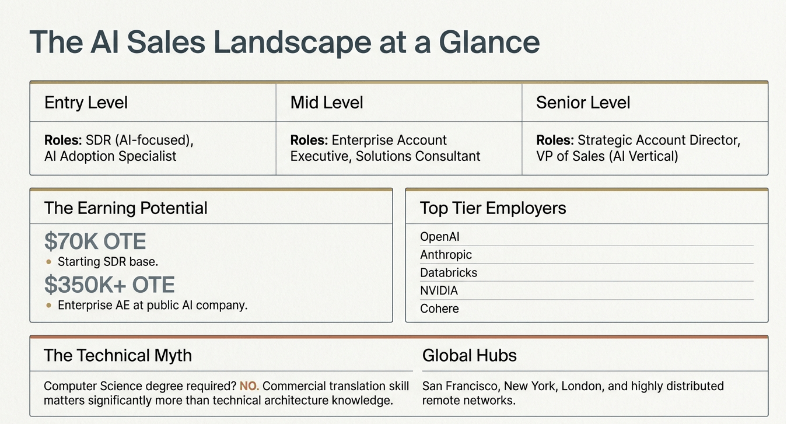
| What You’re Looking For | Direct Answer |
|---|---|
| Best entry-level title | Sales Development Representative (AI-focused), AI Adoption Specialist |
| Best mid-level title | Enterprise Account Executive, Solutions Consultant |
| Best senior title | Strategic Account Director, VP of Sales (AI vertical) |
| Salary range | $70K (SDR) to $350K+ OTE (Enterprise AE at public AI company) |
| CS degree required? | No — commercial translation skill matters more |
| Top-paying employers | OpenAI, Anthropic, Databricks, NVIDIA, Cohere |
| Fastest way in without AI background | Start at a horizontal AI company (Notion AI, HubSpot AI) |
| Job locations | San Francisco, New York, London, remote (varies by company) |
Table of Contents
1. Which Exact Job Titles Get You Hired Fastest at OpenAI, Anthropic, and NVIDIA Without a Computer Science Degree?
Direct answer: The titles that hire for commercial skill over technical background are Enterprise Account Executive, Solutions Consultant, AI Adoption Specialist, and Partnerships Lead. These roles pay well, do not require coding, and are actively hiring right now.
Let’s be specific about each one because the differences matter for your strategy.
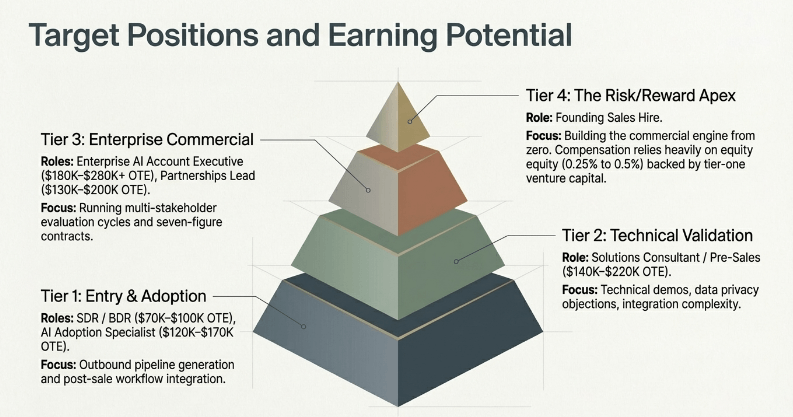
Enterprise AI Account Executive is the highest-volume commercial role at companies like Anthropic, Cohere, and Databricks. This is a quota-carrying sales role, you own a territory or a set of named accounts, you run the full sales cycle from first call to signed contract, and your OTE (on-target earnings, meaning base + commission if you hit quota) lands between $180K and $280K at a well-funded Series C company. At OpenAI or a publicly valued company, that number goes higher.
The hiring bar here is not whether you understand transformer architecture. It is whether you have closed complex enterprise deals — ideally seven-figure contracts with multi-stakeholder buying processes involving procurement, legal, IT, and the C-suite. If you have done that in SaaS, cloud infrastructure, cybersecurity, or data platforms, AI companies will talk to you.
Solutions Consultant (also called Solutions Engineer or Pre-Sales Consultant at some companies) sits at the intersection of sales and product. You run technical demos, answer buyer questions during the evaluation phase, and help the Account Executive close deals that require technical validation. This role does not require you to build anything, but you need to understand the product deeply enough to demo it convincingly and handle objections about things like data privacy, model accuracy, and integration complexity. Pay range: $140K–$220K OTE.
AI Adoption Specialist is newer and still underrated as a career entry point. Companies like Moveworks, Writer, and Copy.ai hire people for this role to sit between the initial sale and the customer’s actual successful use of the product. You help customers integrate the AI into their workflows, track adoption metrics, and expand usage, which generates expansion revenue. The pay is slightly lower ($120K–$170K OTE) but the product exposure makes future jumps into enterprise AE or sales leadership much more credible.
Partnerships Lead manages relationships with system integrators, resellers, and referral partners. At AI companies, this often means working with consulting firms like Accenture, Deloitte, or McKinsey who are embedding AI tools into client engagements. The commercial skill required is relationship management and deal structuring, not technical depth. Pay: $130K–$200K OTE.
Founding Sales Hire is what early AI startups (Series A, sometimes seed-stage) post when they need someone to build the entire commercial function from zero. The upside is real equity, sometimes 0.25% to 0.5% of the company, but so is the risk. Half of these companies will not exist in three years. Only pursue this if the company has named venture capital backing from a firm you recognize (Andreessen Horowitz, Sequoia, Index Ventures, Lightspeed) and at least a handful of paying customers, not just pilots.
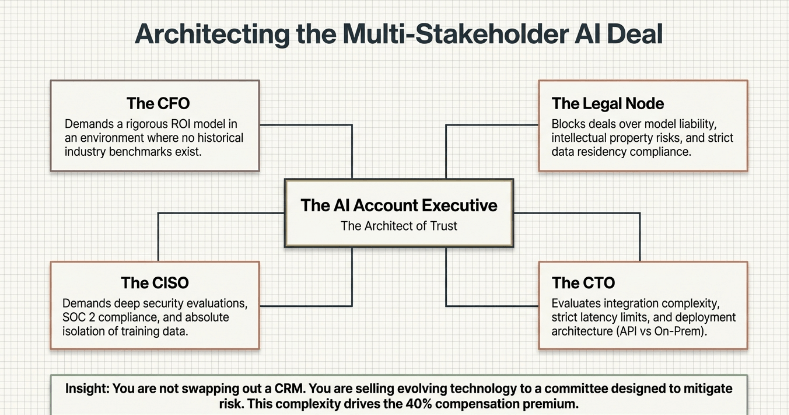
Now, why does “Technical AI Sales” pay 40% more than standard SaaS sales? Because the sale is harder. You are not just convincing a Sales VP to swap one CRM for another. You are asking a CTO, a data science team, a legal team worried about data residency and model liability, and a CFO who has no existing ROI benchmark to all agree to a multi-year commitment on something that is still evolving. That complexity drives compensation up for the salespeople who can navigate it.
2. How Do You Bypass ATS Filters and Get Your Application Directly in Front of the Hiring Manager?
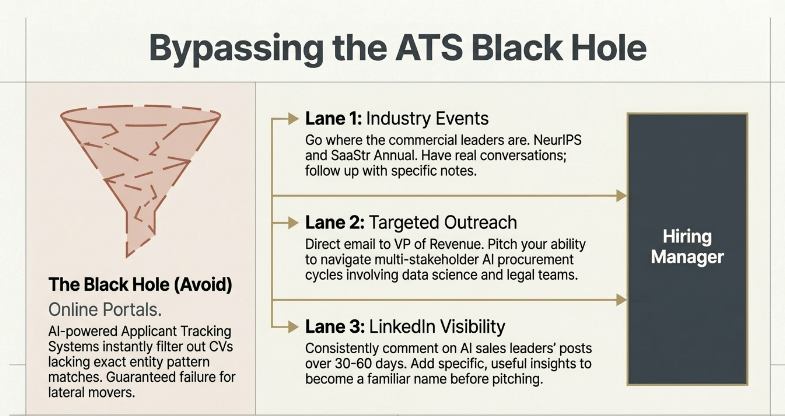
The fastest path into an AI sales role is a warm introduction from someone inside the company, not a cold application through the careers page. The ATS (Applicant Tracking System) filters at most AI companies are now partially AI-powered themselves, and a resume that does not match the entity patterns the system is trained on gets rejected before a human reads it.
Here is the practical breakdown of what actually moves applications forward.
Three specialized recruitment agencies with direct lines to AI company hiring managers:
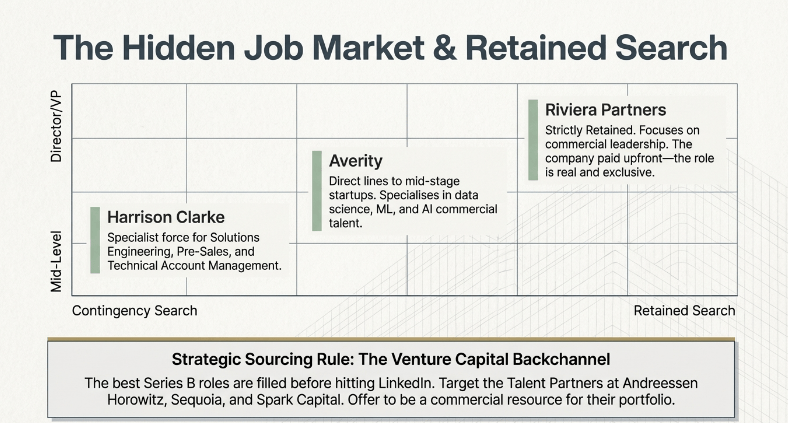
Averity places data science, machine learning, and AI commercial talent. They have placed candidates at DataRobot, Databricks, and several mid-stage AI startups. Their process takes 2–4 weeks but the introductions are genuine, not mass-submitted.
Riviera Partners focuses on VP and Director-level commercial leadership at tech and AI companies. If you are targeting Director of Sales or VP of Sales at an AI company, this is the right firm. They work on retained search — the company paid upfront, which means the role is real and the hiring manager is actively engaged.
Harrison Clarke is specifically strong for solutions engineering, pre-sales, and technical account management roles in AI. They understand the specific skills those roles require and their shortlists are actually relevant.
The warm intro strategy — three specific channels:
AI industry events: NeurIPS (December, usually in Vancouver or New Orleans), SaaStr Annual (February, San Francisco), and MLOps Community events attract both AI researchers and the commercial leaders who hire sales talent. Attending, having a real conversation about a problem you have been thinking through in AI sales, and following up with a specific note will stick in someone’s mind far longer than a LinkedIn connection request. The goal is not to pitch yourself, it is to be someone worth remembering.
LinkedIn content: commenting meaningfully on posts from AI company sales leaders, not just “great insight” but a specific addition to what they said, gets your profile in front of them over 30–60 days. This feels slow. It works.
Direct email to the Head of Sales or VP of Revenue: AI sales outreach requires a different value proposition than standard SaaS. Generic: “I’ve hit $5M ARR at a SaaS company.” AI-specific: “I’ve closed six-figure deals where the technical evaluation involved a data science team and a legal review of model liability, I know how to navigate multi-stakeholder AI procurement cycles.” That immediately signals you understand what makes AI sales different.
3. Which AI Companies Offer $180K–$350K Total Compensation Versus Those That Underpay at $90K?
Direct answer: Compensation in AI sales is almost entirely determined by two factors — the company’s funding stage and whether it builds its own AI technology or just resells someone else’s.
The honest compensation breakdown by stage:
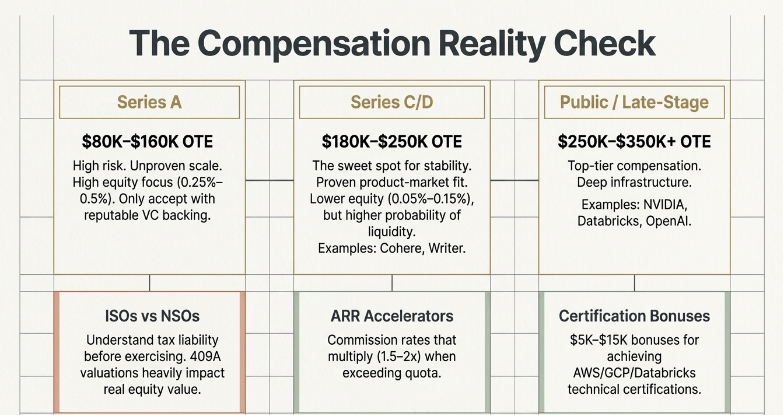
Series A AI startups ($80K–$160K OTE): You are taking early-stage risk. Cash comp is limited because the company has not yet proven it can sell at scale. If you are a founding sales hire with equity (0.25%–0.5%), the long-term upside can be significant, but only if the company reaches a liquidity event, which many do not. Only accept this comp level if the equity terms are clearly documented and the company has reputable VC backing.
Series C/D AI companies ($180K–$250K OTE): This is the strongest combination of compensation and stability. Companies like Cohere, Writer, and Moveworks operate in this range. Product-market fit is mostly proven, the sales motion is defined, and you are joining a team rather than building one from scratch. Equity at this stage (0.05%–0.15%) is less spectacular than an early-stage grant but more likely to have actual value at exit.
Public companies and late-stage ($250K–$350K+ OTE): NVIDIA’s enterprise AI sales division, Databricks (valued at $43B pre-IPO as of mid-2024), Snowflake’s AI platform team, and OpenAI’s commercial organization pay at the top of this range. Anthropic, which raised $7.3B through 2024 from Google and others, offers competitive base salaries plus RSUs that carry real upside if the company reaches a liquidity event.
The hybrid compensation structures unique to AI sales:
Beyond standard base + commission, several AI companies now offer:
- Technical certification bonuses: $5K–$15K for completing certifications like AWS Machine Learning Specialty, Databricks Certified Associate, or Google Cloud AI certificates. These signal product fluency and are achievable without a CS background.
- ARR-linked accelerators: at some Series B and C companies, your commission rate increases when you exceed quota. If you close $2M against a $1.5M quota, your commission on the excess might be 1.5–2x your base rate.
- Expansion revenue commission: AI products that grow in usage after the initial sale generate expansion ARR. Some companies pay commission on that expansion, which means your income grows as your customers grow, not just when you close new logos.
Red flags in job postings that signal underpaid or broken roles:
- “Competitive base salary” with no number — almost always below market. In the US and EU, most jurisdictions now require salary range disclosure. A company hiding the number knows it will lose candidates if they see it upfront.
- “Rockstar,” “ninja,” or “10x” in the job description, signals a culture that rewards individual heroics over process, which usually means the sales motion is not built yet and you will be improvising constantly.
- “5x revenue target” with no historical data, ask any potential employer: “What percentage of your AEs hit quota last year?” Below 50% means the quota is broken, not the salespeople.
- No named investors anywhere, check Crunchbase before applying to any AI startup. If the funding is from angels or a fund you have never heard of, the runway may be limited.
4. What Specific Skills Make You “Technical Enough” for AI Sales Without Learning Python?
You need to understand five technical concepts well enough to explain them in business terms. You do not need to build anything, write code, or pass a technical interview.
This is where most people transitioning into AI sales overthink it. You are not being hired to train models. You are being hired to convince skeptical buyers that your company’s AI product solves a real problem, handle their objections intelligently, and close deals. That requires understanding what the product does and why buyers push back, not how the underlying mathematics work.
The five concepts you must understand:
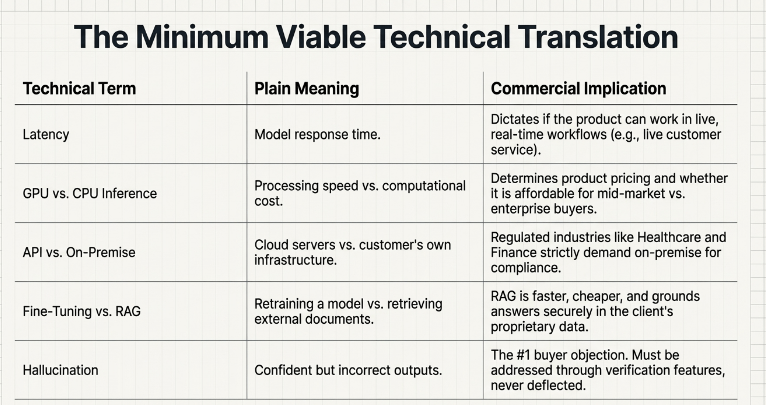
1. LLM latency and why buyers care about it. Large language models generate responses token-by-token. Faster response time (lower latency) matters when the product is embedded in a real-time workflow , like a live customer service conversation or a fraud detection system. Slow latency means the product cannot be used in those contexts. In a sales conversation, a buyer asking “how fast does this respond?” is actually asking “can this work in our live environment?” Knowing the answer, and knowing the business implications, closes that objection.
2. GPU vs CPU inference. Models run faster on GPUs (graphics processing units) but at higher cost. Some products use CPUs for smaller models to reduce pricing. This affects the pricing conversation, specifically whether your product is affordable for a mid-market buyer versus only enterprise. As a salesperson, you need to understand why your product is priced the way it is and how to justify it.
3. API vs on-premise deployment. Most AI products are delivered via API, the customer’s application calls your company’s server. On-premise means the AI runs inside the customer’s own infrastructure. Healthcare and financial services buyers almost always require on-premise deployment for data privacy and regulatory compliance reasons. Knowing which deployment model your product supports, and why certain industries require one over the other, prevents you from wasting time pitching the wrong product to the wrong buyer.
4. Fine-tuning vs RAG (Retrieval-Augmented Generation). Fine-tuning means retraining a model on specific data, expensive, time-intensive, but highly accurate for narrow tasks. RAG means giving a model access to a company’s documents at query time, without retraining, faster and cheaper, but the model only knows what is in the retrieved documents. When a buyer asks “how do you handle our proprietary data?” you need to know whether your product uses fine-tuning, RAG, or both, and you need to explain why that matters in plain language.
5. Hallucination and how your product addresses it. AI models sometimes generate confident- sounding wrong answers. This is called hallucination and it is the most common objection in AI sales right now, especially in legal, medical, and financial use cases. You need a specific, credible answer to “what happens when your model is wrong?” not a deflection.
30-day learning plan to become conversationally fluent:
- Week 1: Listen to the “Latent Space” podcast (practical AI for people building products, accessible without a technical background). Read every edition of “The Batch” by deeplearning.ai. Follow Andrej Karpathy and Ethan Mollick on LinkedIn or X for plain-language AI commentary.
- Week 2: Read the homepage documentation of three products you might sell, Anthropic’s Claude API docs, OpenAI’s API docs, and Cohere’s developer portal. Do not try to build with them. Just understand what each product does, who it is for, and what the limitations are.
- Week 3: Shadow a pre-sales or solutions consultant for at least two customer calls. Take notes on exactly what questions buyers ask and what objections come up most frequently.
- Week 4: Practice explaining the five technical concepts above to a non-technical friend. If they understand it, you are ready to explain it to a buyer.
5. How Do You Spot the Difference Between a $5B AI Company and a Wrapper Startup That Will Fold in 6 Months?
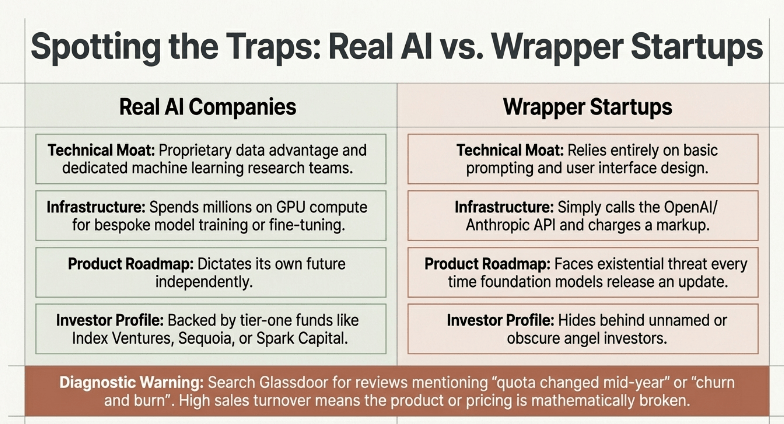
Ask one question, does this company own the model it sells, or does it just call OpenAI’s API and charge a markup? If it is the latter, it is a wrapper startup, and your career stability there is significantly lower.
This matters directly to your job security and earning potential. Wrapper startups are entirely dependent on OpenAI, Anthropic, or another foundation model provider not changing their pricing, not releasing a competing feature, and not revoking API access. When OpenAI releases a new version of GPT that does natively what the wrapper charged for, the wrapper’s product becomes obsolete overnight.
Signs a company has real AI technology:
- They have a research or ML engineering team — even two or three people publishing papers or contributing to open-source projects signals genuine technical depth.
- They have significant compute infrastructure — real model training costs millions per month in GPU spend. Ask: “Do you train your own models or fine-tune existing foundation models?”
- They have a proprietary data advantage — the best AI companies have training data that competitors cannot replicate. A legal AI company trained on 50 million court documents has a moat. A “content generation tool” using standard GPT-4 does not.
- They have named, reputable investors — Anthropic has Google and Spark Capital. Cohere has Index Ventures and NVIDIA. These investors do serious due diligence before writing checks.
Signs a company is a wrapper (use caution):
- The entire product roadmap depends on what OpenAI releases next quarter
- The founding team has no ML, data science, or AI research background
- They cannot explain how their output is different from asking GPT-4 the same question directly
- The “technical moat” is the UI design or the prompt template
Checking sales team stability before you join:
Go to Glassdoor, search the company, filter reviews by “Sales” department, and look for two patterns: reviews mentioning quota changed mid-year (means the company panicked and reset expectations), and reviews using the phrase “churn and burn” (means the company replaces sales staff constantly because the product or quota is broken). High sales turnover at an AI startup almost always means one of three things — the product does not work as marketed, the pricing model makes quota mathematically difficult, or the sales leadership is inexperienced.
Why “AI safety” companies offer more stability than “AI automation” startups:
Anthropic is built around AI safety as a mission. Their funding is partially institutional and partially government-adjacent, which makes them less exposed to the hype cycles that push up and collapse valuations of automation-focused startups. AI automation companies — those promising to automate customer service, content creation, or outbound sales, are more directly exposed to commoditization as foundation models get cheaper and more capable. Selling for Anthropic versus selling for a generic “AI automation” startup are structurally different career bets.
6. Which Specialized Agencies Can Get You Interviewed for AI Sales Roles Within a Week?
Direct answer: Three agencies specialize specifically in AI commercial talent — Averity, Riviera Partners, and Harrison Clarke — and the one you should approach depends on the seniority of the role you are targeting.
Understanding the difference between contingency and retained search will save you from having your resume mass-submitted to companies without your knowledge.
Contingency search means the agency only gets paid when they place someone. This sounds fine from your perspective, but in practice it means agencies working on contingency often submit the same candidate to five or ten companies simultaneously to maximize their chances. You lose control over where your name goes, and hiring managers who see the same candidate from three different agencies start to wonder why they are being shopped so aggressively.
Retained search means the company paid a fee upfront (usually one-third of first-year comp) to work exclusively with one agency. Roles filled through retained search are almost always more senior, better defined, and more seriously funded. If you are placed through retained search, you were specifically selected — not mass-submitted.
For roles under $180K OTE, contingency is workable. For Director-level and above, push to work with retained-search firms — their introductions carry more weight.
How to get yourself onto the shortlist before roles go public:
The best placement agencies maintain a “warm bench” — candidates who have been pre-vetted and can be submitted within 48 hours of a new mandate. To get on that list:
Reach out with specificity: “I have closed $X in enterprise ARR at [previous company], I am targeting Enterprise AE or Solutions Consultant roles at Series B–D AI companies focused on enterprise productivity or data infrastructure, and my timeline is 60 days.” That message tells the recruiter exactly who you are and whether you fit any of their current or upcoming mandates.
Follow up every 30 days with something useful — a note about a company you just saw raise a round that might be hiring, or a question about what they are seeing in the market. This keeps you present without being irritating.
Ask directly when you speak with any agency: “Have you placed candidates at OpenAI, Anthropic, Cohere, or Databricks in the past 12 months?” A credible agency will be able to describe the role and the general outcome without naming the person. If they deflect, they probably have not worked with those companies recently.
7. What Is the Exact Career Path From Junior AI Sales Role to Director of Revenue in 5 Years?
Direct answer: The progression is real, accelerating faster in AI than in traditional SaaS, and the people who move fastest are the ones who build technical fluency alongside commercial results — not one or the other.
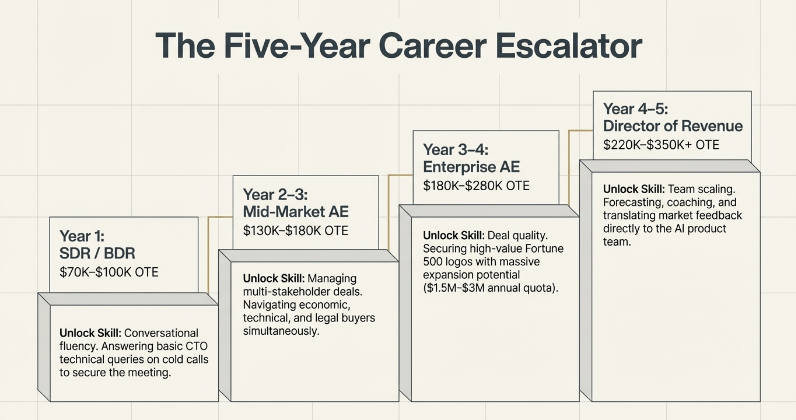
Year 1 — SDR or BDR at an AI company ($70K–$100K OTE):
Sales Development Representative or Business Development Representative is the entry point for people without an existing enterprise AE track record. Your job is outbound prospecting — finding potential customers, making initial contact, qualifying them, and handing the conversation to an Account Executive. The learning curve in AI is steeper than in standard SaaS because you are calling on buyers who are simultaneously intrigued and skeptical about AI in general.
What accelerates you at this stage: being the SDR who can have a genuinely intelligent conversation about the product, not just read from a script. If a CTO asks you a basic technical question during a cold call and you can answer it credibly — even simply — that call turns into a meeting. Most SDRs cannot do that. The ones who can get promoted faster.
Year 2–3 — Account Executive (Mid-Market or SMB initially, $130K–$180K OTE):
After demonstrating that you can generate qualified pipeline as an SDR, the jump to closing your own deals is standard at most AI companies within 12–18 months. You start with smaller accounts (SMB or mid-market) and work toward enterprise territory as you develop the skills to navigate longer, more complex sales cycles.
The skill that separates good AI AEs from great ones at this stage: the ability to run a multi-stakeholder deal. An enterprise AI purchase involves the economic buyer (the person with budget), the technical buyer (the person who evaluates the product’s capabilities), the legal team (data privacy, liability, contract terms), and often a procurement committee. Managing four to six distinct conversations simultaneously and keeping the deal moving is the real job.
Year 3–4 — Senior or Enterprise Account Executive ($180K–$280K OTE):
You own large enterprise accounts — Fortune 500 or mid-market companies in specific verticals. Your quota is typically $1.5M–$3M ARR annually. At this stage, what gets you promoted further is not just closing deals — it is the quality of the customers you bring in (logo value, expansion potential, reference value) and your ability to mentor and help junior AEs on the team.
Year 4–5 — Team Lead, Sales Manager, or Director of Revenue ($220K–$350K+ OTE):
The jump from individual contributor to sales leadership in AI is happening faster than in traditional software because the market is growing faster than the supply of experienced AI sales managers. Companies are promoting AEs with three to four years of AI-specific sales experience into management roles that would previously have required eight to ten years in SaaS.
At Director level, your focus shifts from closing deals to building and running a team — quota setting, hiring, coaching, forecasting, and working with the product team on what the market is telling you buyers actually need.
Pivot opportunities that are realistic, not hypothetical:
- VP of Sales Operations — if you have built deep knowledge of how AI sales cycles work and how comp plans should be structured, this lateral move is achievable. Several people have made this exact move at Databricks and Snowflake.
- Chief Revenue Officer at an early-stage AI startup — with four to five years of enterprise AI sales experience, you are qualified to be the first sales leader at a Series A company. The equity upside (0.5%–2%) is the real appeal.
- AI startup founder — specifically a vertical AI product in a domain where your sales experience gives you deep understanding of the buyer’s problem. Former AI AEs who sold to healthcare systems, for example, are well-positioned to build healthcare AI products.
8. How Do You Negotiate an AI Sales Compensation Package When Companies Offer Equity That Could Be Worth Millions or Nothing?
Direct answer: Equity negotiation is mostly won before the offer stage — the people who get the best packages have multiple real conversations happening simultaneously and understand the math before they sit down to negotiate.
Understanding what the equity numbers actually mean:
0.1% of a company valued at $1B sounds like $1M. In practice, what you receive at exit depends on the liquidation preference structure (investors get paid first, often at 1x or 2x their investment before common shareholders receive anything), the 409A valuation (the IRS-assessed fair market value, usually significantly lower than the VC headline valuation), and your strike price (what you pay to exercise your options).
If the 409A valuation on your grant date is $200M and the company exits at $800M, you are not making 0.1% of $800M. You are making 0.1% of whatever remains after liquidation preferences are paid out and after taxes on the spread between your strike price and the exit price. Talk to a CPA who specializes in startup equity before you accept any offer with options.
What you can negotiate beyond base salary:
- Signing bonus — often easier to negotiate than base because it does not affect the ongoing salary budget. $15K–$40K signing bonuses are standard at well-funded AI companies for experienced hires. Ask for it directly.
- Commission accelerators — if you exceed quota by 20%, your commission rate should increase, not stay flat. Get the accelerator structure in writing before you sign.
- Double trigger acceleration — if the company is acquired and you are subsequently let go, standard agreements often mean unvested equity disappears. Negotiating “double trigger acceleration” (you accelerate vesting if the company is acquired AND you are terminated) is reasonable to ask for at Series C and above.
- Remote work flexibility — for AI sales roles, this is negotiable more often than companies admit publicly. Enterprise AE roles in particular are largely client-facing, which means physical proximity to the company’s office matters less than proximity to your territory’s key accounts.
Using competing offers in negotiation:
You do not need to lie. If you are in genuine conversations with another company — even early-stage discussions — mentioning “I am in late-stage conversations with another AI company and expect to have an offer within two weeks” creates real urgency. What you cannot do is fabricate a specific number. If they ask you to share the competing offer in writing and you cannot, the tactic breaks down. The practical solution is to keep two or three processes active simultaneously so that the competing offer is real.
ISOs vs NSOs — why this matters to your actual take-home:
Incentive Stock Options (ISOs) are taxed as capital gains at exit if handled correctly — a much lower tax rate than ordinary income. Non-Qualified Stock Options (NSOs) are taxed as ordinary income at the point of exercise, regardless of when you sell. Many public and late-stage companies issue NSOs. If you are offered NSOs with a high strike price, model the tax cost of exercising before accepting, because a significant portion of your paper gain goes to the IRS at exercise, not at exit.
9. What Interview Questions Are You Likely to Face for AI Sales Roles — and How Do You Answer Them?
Direct answer: AI sales interviews test three things — your ability to explain technical concepts in plain language, your ability to handle objections about AI reliability, and your ability to demonstrate you understand how the sales cycle is different from standard software sales.
The five scenarios that come up in almost every AI sales interview:
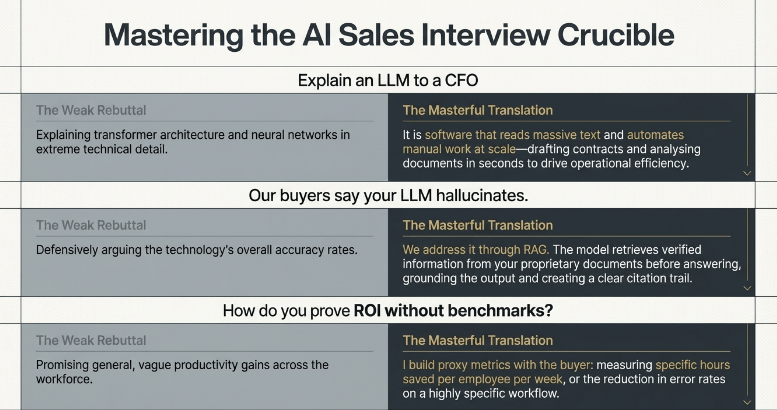
Scenario 1: “Explain what an LLM is to a CFO who has no technical background.”
A weak answer explains what a large language model is technically. A strong answer says: “It is software that has read an enormous amount of text and learned the patterns of language well enough to generate useful responses to questions or instructions. For your business, that means it can draft contracts, summarize meetings, answer customer questions, or analyze documents without a human doing the manual work — at scale, in seconds.” The CFO does not need to know what a transformer architecture is. They need to know what it does for their business.
Scenario 2: “A buyer says our LLM hallucinates. How do you respond?”
This is the most common objection in AI sales right now. A weak answer defends the technology. A strong answer says: “That is a legitimate concern and it comes up in almost every technical evaluation. For your use case, we address it through RAG — the model retrieves information from your verified documents before generating a response, so the output is grounded in your data, not in the model’s general training. We can show you exactly how that works and demonstrate the citation trail for every answer it produces.” This acknowledges the problem, explains the solution in plain language, and moves the conversation forward.
Scenario 3: “Walk me through a complex deal you closed with multiple stakeholders.”
AI interviewers are specifically listening for whether you can manage a deal that involves a CTO evaluating the technical product, a legal team reviewing the data processing agreement, a CISO asking about security, and a CFO wanting an ROI model, all simultaneously. Structure your answer around how you managed each stakeholder, what each cared about, and how you kept the deal moving when any one of them became a blocker.
Scenario 4: “How did you establish ROI when the buyer had no benchmark to compare to?”
This is the hardest part of AI sales right now, there is no established industry-standard ROI benchmark for many AI applications. Strong candidates describe helping the buyer build a proxy metric: hours saved per employee per week, reduction in error rate on a specific process, volume of documents processed per day versus the manual current state. The answer should include a specific number, not just the concept.
Scenario 5: “Why do you want to work in AI sales specifically?”
The answer that works at companies like Anthropic is genuine. They are specifically looking for people who have thought seriously about what AI is changing, what the risks are, and why commercial success at an AI company matters beyond the financial reward. Candidates who say “AI is the future and the comp is great” do not pass culture fit at the companies that take responsible AI seriously. Candidates who say “I want to be part of shaping how enterprises adopt AI in a way that actually works and does not create the problems buyers are afraid of” are the ones who get offers.
10. How Do You Build a Personal Brand That Attracts AI Sales Roles Instead of Chasing Them?
Direct answer: Publish one specific, useful piece of content per week for six months. Everything else, the inbound messages, the speaking invitations, the referrals, follows from that.
The trap most people fall into is publishing generic content: “AI is changing sales.” That adds nothing. What works is specific: “I spent three months selling an LLM product to financial services buyers. Here is the exact objection that killed deals most often and the answer that resolved it.” That content gets shared by sales leaders, read by hiring managers, and remembered by the people who can refer you.
LinkedIn profile optimization that works for AI sales job seekers:
Your headline should contain the entities that AI sales hiring managers search for: “Enterprise AI Sales | LLM / Foundation Model Products | Technical Sales, B2B.” Not “Results-driven sales professional with a passion for technology.” That tells a search algorithm nothing and tells a human even less.
Your About section should lead with a specific claim and a number: “Over the last 18 months, I have closed $X in enterprise ARR selling AI products to buyers in [specific vertical]. Here is what I have learned about how AI procurement actually works at the enterprise level.” That is something a hiring manager bookmarks.
Building visibility in the communities where AI sales jobs circulate:
- SaaStr Community: the largest B2B sales community; increasingly focused on AI. Contributing to their forums, attending their events, and being referenced by their speakers puts you in front of the people building AI sales teams.
- LinkedIn AI sales conversations: find three to five AI company sales leaders who post regularly. Comment meaningfully on their content over 60 days. You will become a familiar name before you ever send them a message about open roles.
- Product-led AI communities: communities around products like Notion, HubSpot, and Salesforce Einstein have active sales and revenue members. Being a recognized voice in these communities signals AI product familiarity to hiring managers.
The salary survey play:
Every year, AI sales compensation shifts significantly. If you collect 50–100 anonymous data points from your network (current OTE, base, equity percentage, company stage, role title) and publish a clean, honest summary, it becomes a reference document. Reference documents get shared. The right people find you through the shares. This positions you as a market expert before you have the job title to prove it.
11. Which Job Postings Signal Toxic Culture or Impossible Quotas Before You Even Apply?
Certain phrases appear in AI sales job descriptions specifically when the company is in trouble, the quota is broken, or the culture burns through salespeople quickly.
Phrases to treat as immediate caution signals:
“Unlimited PTO” at face value, this sounds like a benefit. In practice, it is often used by companies that want to avoid paying out accrued vacation at termination. Ask specifically during the interview: “What is the average number of PTO days your sales team takes per year?” Below 10 days means the culture does not actually support taking time off, regardless of the policy.
“Build the plane while flying it” this is acceptable in a Founding Sales Hire role where you have equity and real ownership. It is a red flag in any other context because it means there is no defined ICP (ideal customer profile), no repeatable sales motion, and no existing pipeline. You will be improvising from day one.
“Competitive base salary” with no range ,in 2025, most US states and the UK require salary range disclosure. A company not providing a range either knows the number will lose candidates or is testing whether you will negotiate against an unknown.
“Rockstar,” “ninja,” or “10x” in the job description, this language signals that the company values individual heroics over process. In AI sales, where the product is complex, the sales cycle is long, and the buyer is skeptical, individual heroics do not scale. A broken sales process is not fixable by a “rockstar.” Walk away.
The “founder sales” problem — and how to spot it before you join:
Some AI companies, particularly ones where a technically brilliant founder personally closed the first ten enterprise deals, never successfully transition to a sales-led growth model. The founder knows the product better than any AE ever will, and they unconsciously undermine the sales team by jumping into active deals, discounting contracts the AE has already priced, or making promises at a conference that the sales team then has to deliver on.
Before accepting an AI sales role, ask: “What percentage of deals in the last two quarters were closed without the founder’s direct involvement?” If the number is low, the founder has not yet given up control of the commercial function. This does not automatically mean the role is bad,but you need to understand it going in.
AI sales professionals often collaborate with HR teams implementing AI people analytics solutions to understand workforce transformation needs.
12. How Do You Transition Into AI Sales From a General Tech Sales or Non-Sales Background?
Start with “horizontal” AI companies that sell to buyers you already know, then move to “vertical” AI once you have built credibility in the space.
The lateral move strategy explained:
Horizontal AI companies sell productivity tools that have an AI layer added to a product buyers already purchase, Notion AI, HubSpot’s AI features, Salesforce Einstein, or Microsoft Copilot. The buyers are familiar (Sales Ops, Marketing, HR), the procurement process is similar to standard SaaS, and the AI component is incremental rather than the entire product. Starting here means you are learning the language and the objections of AI sales without jumping directly into infrastructure AI or deep-tech vertical AI.
After 12–18 months in horizontal AI, you have enough vocabulary, enough deal history, and enough product fluency to make a credible case for roles at vertical AI companies, companies selling specifically to one industry. Healthcare AI (ambient clinical documentation, diagnostic imaging), financial services AI (fraud detection, trading analysis), or logistics AI (route optimization, demand forecasting). These roles require understanding the compliance, procurement, and regulatory specifics of one industry, but the compensation is higher and the competitive differentiation is greater.
For people coming from completely outside sales:
If you are moving from a non-sales background, consulting, product management, data analysis, customer success, the fastest bridge into AI sales is the Solutions Consultant or AI Adoption Specialist role. These roles leverage domain expertise and communication skill more than a traditional sales quota history. A consultant who understands enterprise software evaluation processes, for example, is credible as a Solutions Consultant for an AI company selling to enterprise buyers.
90-day transition plan:
- Days 1–30: Build vocabulary. Read “The Alignment Problem” by Brian Christian (non-technical, explains what AI actually does and why it is genuinely complex). Subscribe to “The Batch” by deeplearning.ai. Follow five AI company sales leaders on LinkedIn and study what they say about their buyers and their sales motion.
- Days 31–60: Build network. Attend one AI industry event or online community. Connect with three people currently in AI sales roles and ask for a 20-minute conversation about their day-to-day. Offer something in return, your perspective from your previous industry if you came from a vertical that AI companies sell to.
- Days 61–90: Build proof. Take the AWS Cloud Practitioner or Google Cloud AI certification (both accessible without a technical background, both demonstrable on a resume). Write one LinkedIn post or article applying something from your background to the AI sales context. Apply for two or three target roles using the framework from section 15 below.
Understanding the AI tools businesses actually use in 2026 helps sales reps speak credibly about customer tech stacks.
13. What Specific Tools and Knowledge Do AI Sales Professionals Use That Non-AI Sales Professionals Do Not?
The tools and knowledge that distinguish AI sales professionals are the ones that address the unique complexity of selling AI, specifically, handling technical evaluations, navigating data privacy concerns, and demonstrating ROI on something that does not yet have established industry benchmarks.
Tools used in AI sales cycles that you need to be familiar with:
Demo environments for AI products: unlike a SaaS product demo where you click through a predefined flow, AI product demos often require live generation. Understanding how to run a credible live demo of an LLM product, including knowing how to set up prompts that consistently show the product’s strengths rather than its weaknesses, is a skill that separates effective AI AEs from ineffective ones.
ROI calculators specific to AI: standard SaaS ROI models (calculate seats times productivity gain equals payback period) do not work for AI because the productivity gain is harder to measure and the baseline varies significantly by buyer. AI companies are increasingly building custom ROI calculators for their sales teams that account for variables like number of tasks automated, error rate reduction, and cost of human labor displaced. Learning how to run these calculations with a buyer, not at them, is a core AI sales skill.
Security and compliance documentation: enterprise buyers in regulated industries require documentation on how training data is handled, where inference happens, whether customer data is used to retrain the model, and what the company’s SOC 2 and ISO 27001 status is. AI AEs who can walk a technical security review without escalating every question to the engineering team close deals faster.
LLM evaluation frameworks: some enterprise buyers run their own technical evaluations using benchmarks like MMLU (Massive Multitask Language Understanding) or custom test suites. Knowing what these evaluations measure and how your product performs on them prevents you from being blindsided in a technical evaluation call.
Knowledge sources that give you an ongoing edge:
- “Import AI” newsletter by Jack Clark, weekly summary of AI research developments, written for practitioners but accessible to non-researchers
- “Latent Space” podcast, practical discussions of how AI products are built and what problems they solve
- Anthropic, OpenAI, and Cohere product blogs, read every major product announcement so you understand what the competitive landscape looks like from your buyers’ perspective
- EU AI Act updates, the regulatory environment is directly shaping what enterprise buyers can and cannot do with AI, which affects your sales conversations in Europe and with global enterprises with European operations
Top AI consulting firms frequently partner with AI vendors—knowing this landscape helps sales professionals identify channel opportunities.
14. How Do You Evaluate an AI Company’s Sales Team During the Interview to Avoid Joining a Failing Organization?
You are also interviewing them. The questions you ask reveal more about the company’s commercial health than anything on their website, and asking them well signals to the hiring manager that you are a sophisticated hire.
Questions to ask every AI company during your own interview process:
“What percentage of your AEs hit quota last year?” below 50% is a significant red flag. An AI company whose majority of salespeople miss quota either has a broken product, a pricing problem, or a quota-setting process that is not grounded in reality.
“What is your average sales cycle length, and has it gotten shorter or longer over the past 12 months?” a lengthening sales cycle means the market is getting more skeptical or the evaluation process is getting more complex. Both require specific strategies. If the company’s sales leadership cannot tell you this number, the sales operations function is not mature enough to support you.
“What percentage of your revenue last year came from expansion of existing customers versus new logos?” AI companies with strong product-market fit should see meaningful expansion revenue, existing customers using more of the product as they realize value. Heavy reliance on new logos means the product is not delivering ongoing value after the initial deployment, which makes renewals and expansion far harder.
“What does your sales team’s average tenure look like?” if the average is below 18 months, something is structurally wrong. Either the quota is impossible, the product does not work as sold, or the management is bad. All three are problems you inherit the moment you join.
Spotting “AI washing” in your own interview:
Ask: “How many people are on your research or machine learning engineering team?” A company with a credible AI product has researchers or serious ML engineers. Ask: “Do you train your own models or build on top of foundation models like GPT-4 or Claude?” There is nothing wrong with building on foundation models, but you need to understand what the company’s actual differentiation is. Ask: “What is your product’s performance benchmark against the leading alternative in a head-to- head test?” If they cannot answer this or deflect to marketing language, the product may not be competitive.
Evaluating the sales leadership background:
The most predictable indicator of a functional AI sales organization is whether the sales leadership has previously built and scaled commercial teams at companies with a similar sales motion, complex, multi-stakeholder, enterprise B2B with a technical product. Former MuleSoft, Databricks, Snowflake, or Twilio sales leaders have seen this type of sales cycle work before. A first-time VP of Sales at a company selling a technically complex AI product to risk-averse enterprise buyers is a much higher-risk situation.
Sales reps must explain why AI agents differ from chatbots to justify premium pricing in enterprise deals.
15. What Is the Exact Resume Format That Gets AI Sales Interview Calls at Top-Tier Companies?
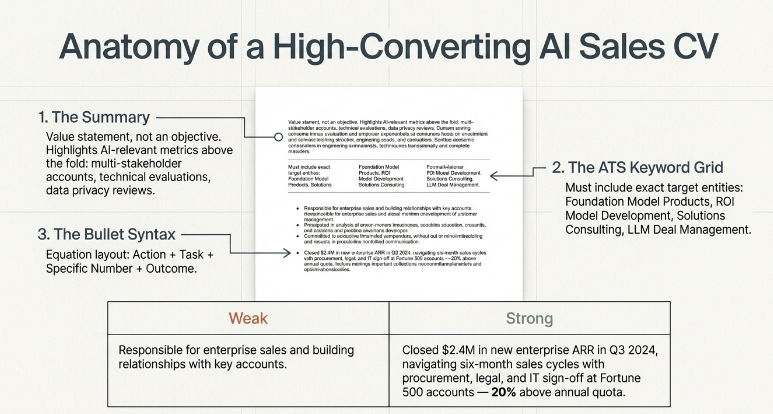
Your resume needs a specific professional summary with AI-relevant metrics above the fold, a tight keyword-optimized competency section, and experience bullets that follow one format: action + task + specific number + outcome.
The format that gets through ATS and reads well to humans:
Header: Name, location (city only, not full address), LinkedIn URL, email.
Professional summary (two to three sentences maximum): Do not write an objective statement. Write a value statement. “Enterprise B2B sales professional with 5 years closing complex software deals, including $X in ARR from multi-stakeholder accounts in [vertical]. Specializing in AI and machine learning product sales to [buyer type], experienced navigating technical evaluations, data privacy reviews, and enterprise procurement.” This is specific, measurable, and immediately signals relevance to an AI sales role.
Core competencies (8–10 items in two columns): This is where ATS matching happens. Include: Enterprise AI Sales, SaaS and Cloud Platform Sales, Technical Product Demonstrations, Multi- Stakeholder Deal Management, ROI Model Development, Solutions Consulting, LLM and Foundation Model Products, Data Privacy and Security Objection Handling. These are the entities AI company ATS systems are scanning for.
Experience section: Each role gets three to five bullets. Every bullet follows the same format.
Strong: “Closed $2.4M in new enterprise ARR in Q3 2024, navigating six-month sales cycles with procurement, legal, and IT sign-off at Fortune 500 accounts, 20% above annual quota.”
Weak: “Responsible for enterprise sales and building relationships with key accounts.”
The difference is not style, it is specificity. The strong version gives a hiring manager three specific data points (deal size, timeline, outcome relative to quota) in one sentence.
Successful AI sales requires understanding how businesses integrate AI into existing workflows and procurement processes.
AI-specific additions that most candidates miss:
- Technical fluency evidence: list any AI or cloud certifications (AWS Cloud Practitioner, Google Cloud AI Fundamentals, Databricks Lakehouse Fundamentals, all achievable without a CS degree)
- Deal type specificity: if you have sold data, analytics, or infrastructure products before, name them explicitly, Snowflake, Databricks, Palantir, or similar names in your experience section are recognized entities for AI company ATS systems
- Vertical expertise: if you have sold into a vertical that AI companies target (healthcare, financial services, legal, manufacturing), name the specific compliance or procurement nuances you navigated — this signals domain expertise that transfers directly
16. How Do You Handle the “You’re Not Technical Enough” Objection When Interviewing for AI Sales Roles?
Direct answer: Reframe the skill being asked about. Technical knowledge is not what makes an AI salesperson effective — commercial translation is. Make that reframe clearly, confidently, and with a specific example.
The rebuttal: “My job is not to train the model: it is to help buyers understand what the model does for their business and close the deal. That requires knowing what a skeptical CTO is going to ask, what a legal team needs to see, and how to build an ROI model when no benchmark exists yet. I have done that successfully X times in the last Y months.” That answer is not defensive. It is specific and confident.
Enterprise buyers increasingly prioritize AI hyperautomation initiatives—sales reps who understand this trend close larger deals.
Non-technical backgrounds that actually help in AI sales:
Consulting or professional services background: people who have sold consulting engagements understand multi-stakeholder enterprise relationships, long sales cycles, and the challenge of selling outcomes rather than features. AI sales requires all three.
Customer success or implementation background: people who have run enterprise software implementations understand the post-sale process deeply, which makes them more credible when discussing deployment complexity and ROI realization timelines with technical buyers.
Financial services, legal, or healthcare background (as a buyer): if you previously worked in a regulated industry that is now a major AI buyer, your domain expertise is a direct advantage. You understand the compliance concerns, the procurement process, and the language of the buyer in a way that a career salesperson with no domain expertise does not.
Building technical credibility over time:
Attend one AI industry conference per year, not to understand the research, but to observe how AI practitioners talk about their work, what excites them, and what frustrates them. That observational knowledge makes you better at demos, better at handling objections, and more credible in conversations with technical buyers. Hiring managers at AI companies notice when a sales candidate has been to NeurIPS or a serious AI product conference. It is a differentiator.
17. Which AI Sales Roles Offer Remote Work Versus Requiring Relocation to San Francisco or London?
Direct answer: Fully remote AI sales roles exist but are concentrated at specific companies, and the most senior and highest-paying roles still often favor geographic proximity to the sales organization or the territory you are covering.
Remote-friendly AI companies:
- Cohere: fully distributed globally, strong remote culture, competitive enterprise AI pay
- Stability AI: distributed across US, UK, and APAC
- Mistral AI: Europe-based, remote-friendly with Paris as the primary hub for European roles
- Writer: remote-first culture, enterprise AI product, actively hiring commercial talent
Hybrid AI companies (2–3 days in office expected for senior roles):
- OpenAI: San Francisco HQ, hybrid expected for Enterprise AE and Director level
- Anthropic: San Francisco primary, some roles in London and New York, hybrid culture
- Cohere: Toronto headquarters with distributed teams, flexible on remote for most commercial roles
Office-centric (expect relocation requirements for senior positions):
- NVIDIA: Santa Clara headquarters; senior enterprise sales roles often require Bay Area presence
- Google DeepMind: London and Mountain View primary locations; commercial roles tied to DeepMind products typically require in-person
The geographic arbitrage reality:
A $250K OTE role in Austin, Texas working remotely for a San Francisco-headquartered AI company is effectively more valuable than a $300K OTE role requiring relocation to San Francisco when you account for cost of living differences (approximately 40% lower in Austin). The key is finding AI companies that have not adopted geographic pay differentials, many early-stage and mid-stage AI companies still pay San Francisco rates regardless of where you live because they are competing globally for commercial talent.
AI sales roles that genuinely require physical presence:
Enterprise AE roles covering financial services or healthcare accounts, particularly at the Fortune 500 level still benefit meaningfully from in-person relationship development. Your company’s office location matters less than your proximity to your key accounts. An enterprise AE covering financial services clients in New York should expect to be in New York frequently, regardless of where the company is headquartered.
No-code AI automation tools demonstrate how technical fluency without coding expertise drives AI adoption across business units.
18. How Do You Use AI Tools Yourself to Become a More Effective Sales Professional?
Direct answer: The highest-leverage use of AI tools for a salesperson is not writing emails faster, it is doing the research and preparation that used to take hours in minutes, so you can spend more of your actual selling time on the human parts of the job that AI cannot replace.
Using Claude or ChatGPT for pre-call research:
Before a discovery call with a prospect, use an AI assistant to summarize the company’s recent annual report or earnings call, identify their stated technology priorities, and generate five intelligent questions based on what you know about their industry and the problems your product solves. This preparation used to take 45–90 minutes. With AI, it takes 10. The quality of your first conversation improves significantly when you walk in with specific, relevant knowledge rather than generic product pitch.
Using AI for objection preparation:
Paste your product description and the common objections you face into Claude and ask: “What are the most technically rigorous objections a CTO at a healthcare company would raise to buying this product, and what would be the strongest possible response to each?” The output gives you a practice framework for your toughest conversations.
Using AI for follow-up and proposal drafting:
After a discovery call, use an AI assistant to draft your follow-up email with a specific summary of what you discussed, what problem you agreed to solve, and what the next step is. Review and edit before sending, the AI draft should be the foundation, not the final output. Sending an AI-generated email that sounds AI-generated is a trust signal in the wrong direction.
The meta-advantage of using AI fluently:
When you reference specific AI tools in your interview “I use Claude for call prep and proposal drafting, I use Gong for call analysis, and I have done my own testing of the product against competitors” you are demonstrating product fluency. For an AI company, a salesperson who actively uses AI in their own sales process is a credible advocate for the product in a way that someone who avoids AI tools is not.
19. Where Are the AI Sales Job Opportunities That Never Get Posted on LinkedIn?
Direct answer: The best AI sales roles are filled through investor referrals, founder networks, and executive search firms before they reach any job board. Accessing this market requires different tactics than applying through career pages.
How the backchannel hiring process actually works:
When an AI company at Series B needs an Enterprise AE for their financial services vertical, the VP of Sales often starts by calling three people: their lead investor’s talent partner, a former colleague who has hired for similar roles, and an executive search firm they have used before. The role might be posted on LinkedIn two weeks later after those three channels have already produced three or four candidates who are in the process.
Every major VC fund with AI portfolio companies, Andreessen Horowitz, Sequoia, Index Ventures, Spark Capital, has a talent team whose job is to source candidates for portfolio companies. These talent partners are actively looking for qualified commercial professionals to introduce to their portfolio. Finding the talent partner at two or three AI-focused VC funds and sending a specific, brief note, “I specialize in enterprise AI sales with X in closed ARR; I am interested in roles at Series B–D AI companies in [vertical]; happy to be a resource for your portfolio”, is one of the highest-leverage outreach moves available to an AI sales job seeker.
Events where off-market roles emerge in conversation:
- NeurIPS (December): the largest ML research conference; heavily attended by AI company commercial and product leadership. The conversations at side events and dinners around the conference regularly surface role discussions.
- SaaStr Annual (February, San Francisco): the dominant event for B2B commercial leadership. More directly commercial than NeurIPS and specifically attended by people who are building and scaling AI sales teams.
- AI company-specific events: Anthropic, OpenAI, Cohere, and Databricks all host or sponsor customer and partner events. Attending these as a prospective employee not just a buyer is a less-common tactic that puts you in direct contact with the commercial teams that are hiring.
When to look for roles at newly funded companies:
AI companies typically build their internal sales teams when they reach Series B roughly $15M– $30M raised. Before that, they rely on the founders for sales. After Series B, they need to hire three to eight commercial professionals within 12 months. If a company you are targeting just announced a Series B round, reaching out within 30 days puts you in front of a VP of Sales who is actively building a team and has not yet spent their recruiting budget on agency fees.
20. How Do You Future-Proof Your AI Sales Career Against Automation and Market Shifts?
Direct answer: Focus on the parts of AI sales that AI itself cannot replace complex relationship development, trust-based enterprise deals, and the strategic advisory role that comes with deep domain expertise. Those are the last to be automated and the most valued when budgets tighten.
What automation will replace in AI sales (and what to stop spending time on):
Basic outbound sequencing, meeting scheduling, CRM data entry, and initial lead qualification are already being partially automated by tools like Outreach, Salesloft with AI features, and Clay. The salespeople who are automating these tasks themselves are not losing their jobs they are handling three times the pipeline with the same effort. The salespeople who are not adapting are being replaced by those who are.
The work that does not automate: building genuine trust with a CTO who has been burned by an AI product before, navigating a politically complex enterprise deal involving five stakeholders with conflicting priorities, and advising a customer on how to deploy AI in their organization in a way that actually sticks. These require human judgment, relationship depth, and situational intelligence that current AI cannot replicate.
The verticals that are recession-resistant:
AI in healthcare (clinical documentation, diagnostic support, operational efficiency) is protected by multi-year regulatory tailwinds and buyer urgency that does not follow the same economic cycles as enterprise productivity tools. AI in financial services (fraud detection, compliance, risk modeling) is driven by regulatory requirements that do not pause in downturns. AI in government and defense is funded by appropriations cycles that are largely insulated from commercial market fluctuations.
Horizontal AI productivity tools the ones promising to automate generic content creation or general task management are the most exposed to commoditization and budget cuts when companies tighten spending.
The evolution from individual contributor to strategic advisor:
The ceiling in AI sales is not Enterprise AE or even VP of Sales. The people who command the highest long-term compensation and influence in the AI economy are the ones who accumulate enough domain expertise and commercial credibility to advise companies on how to build and scale their commercial functions from scratch. That role Chief Revenue Officer, CRO Chief of Staff, or strategic advisory is built on ten years of pattern recognition in a specific market, not on any single job title or certification.
The practical path there: pick a vertical you want to own. Stay in it long enough to be the person other AI companies in that vertical want to hire. Build a public presence that reflects that expertise. The opportunities find you.
