



You’re already late. Stop pretending you’re the first one to think about Integrate AI into Your Business. Right now, 71% of organizations are actively using generative AI in some capacity—up from 33% just last year. The window for a “first-mover advantage” is closed. This isn’t a speculative technology anymore; it’s a competitive tax. You pay it or you fade out.
But here is the truth that venture capitalists and glossy consulting brochures won’t tell you: 42% of AI projects deliver exactly zero measurable Return on Investment (ROI).
Think about that. Nearly half the teams trying to integrate AI into business are lighting money on fire. They build solutions that don’t scale, are fed by garbage data, or simply sit unused because no one was trained to run them. The technology isn’t the problem. The strategy is.
As someone who’s watched countless technology cycles crash and burn, I can assure you: AI is not a magic wand. It is a highly specialized, power-intensive piece of infrastructure. If you approach adopting AI in business with a clear head, a focused goal, and an engineering-first mindset, you win. If you chase the hype, you join the 42% club.
This isn’t a feel-good piece. This is a cold, hard blueprint for successful AI implementation.
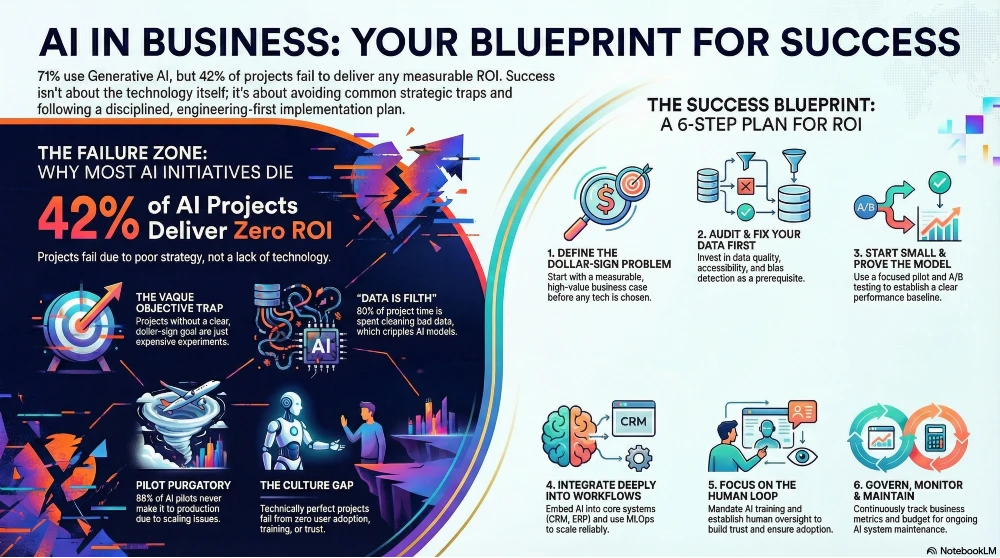
Why 85% of AI Initiatives Die in the Sandbox
Before we talk about success, we have to talk about failure. Most companies treat AI like a bolt-on application—a shiny new feature you can plug into an existing, broken workflow. That mindset guarantees failure.
When I review failed internal projects, the same critical mistakes show up again and again. These are the technical and organizational flaws that turn a promising pilot into an expensive PowerPoint slide.
- The Vague Objective Trap: Most projects start because “we need AI,” not because the company has a $5 million pain point. If you cannot articulate the project’s success in dollars saved, revenue generated, or risk mitigated, it’s not an AI project—it’s a science experiment. And your CFO doesn’t fund science experiments.
- Data is Filth: This is the big one. AI models live and die by the quality of their training data. In my experience testing these tools, 80% of project time is spent cleaning, normalizing, and labeling data. If your CRM is a decade old, your product IDs rotate weekly, and half your records are missing, your AI will be biased, inaccurate, and useless.
- The Pilot Purgatory: A whopping 88% of AI pilots never make it to production. They work fine on a controlled dataset with 10 users, but the moment you try to scale to 10,000 users or link to your legacy ERP system, the whole thing collapses. The absence of a robust MLOps (Machine Learning Operations) strategy kills scale.
- The Culture Gap: Data science teams build algorithms in isolation. Business units—the people who actually need to use the tool—don’t trust it, aren’t trained on it, and feel threatened by it. If you skip change management, the project might be technically flawless, but it will suffer a fatal case of zero adoption.
The goal is to avoid these traps. You need a strategy that is less about coding and more about corporate alignment.
The Six-Step Engineering Blueprint to Successfully Integrate AI into Your Business
Successfully adopting AI in business is a disciplined, step-by-step organizational change process. It demands clarity, investment in boring infrastructure, and a maniacal focus on the human element.
Step 1: Define the Dollar-Sign Problem (The “Use Case Zero”)
Forget moonshot ideas for now. AI should fix a clear, expensive, and measurable business problem.
Your first move isn’t hiring a data scientist. Your first move is talking to the business owner with the biggest headache. Where is the most human time wasted? Where are decisions inconsistent?
- Bad Goal: “We want to improve customer service with AI.” (Too vague, zero ROI).
- Good Goal: “Implement an AI-driven routing and summary tool to reduce average customer service ticket resolution time by 30 seconds, saving us $1.2 million annually in labor costs.” (Clear, measurable, high ROI).
This focused approach is why organizations that invest in AI for productivity gains—like improving individual employee efficiency—see some of the fastest returns. The ROI is direct and easy to track.
Step 2: The Data Audit: Fix the Foundation First
AI is a reflection engine. If you feed it sewage, it spits out toxic sludge. Before selecting a model, you must audit the data you plan to use. If you refuse to invest in data governance, stop reading now.
The Data Quality Checklist:
- Accessibility: Is the data consolidated, clean, and easily accessible via modern APIs? AI projects fail when they have to spend months trying to pry data out of decades-old silos.
- Completeness and Accuracy: Are fields filled? Are labels correct? Inaccurate data leads to model drift and faulty predictions in production. A financial model trained on incomplete historical data will misclassify risk—a very expensive mistake.
- Bias Detection: Does your historical data reflect societal biases? A hiring AI trained only on data from male-dominated engineering roles will be biased against female candidates. You must proactively audit your datasets for gender, racial, or regional skew.
If your data is not up to par, the project budget needs to be allocated to Data Engineering, not Machine Learning. This is non-negotiable.
Step 3: Start Small and Prove the Model (The Pilot Phase)
I’ve seen too many large enterprises attempt a monolithic AI build. It always stalls. The smart move is to pick a micro-process—a low-hanging fruit—and prove the concept end-to-end.
- Build an MVP (Minimum Viable Product): Focus on a limited scope, such as automating the triage of Tier 1 support tickets or generating initial drafts for routine legal documents.
- Establish a Baseline: Before you deploy, you need a precise measurement of the current human performance. If your sales team converts leads at 10% today, your AI needs to hit 11% or better to justify its existence. Without a clear baseline, there is no ROI.
- A/B Testing is Mandatory: Never, ever, launch an AI solution without a controlled A/B test. Run the human-only workflow alongside the AI-assisted workflow. This discipline separates the successful 58% from the noise.
Step 4: The AI Integration Strategy: Connect or Die
This is where the engineers take over. An AI that lives on a disconnected cloud server and requires manual file uploads is a glorified toy. Successful AI integration steps require deep embedding into core business systems—your CRM, ERP, and internal communications tools.
This isn’t just about API calls; it’s about workflow augmentation.
- Legacy Systems are the Killer: Many companies underestimate the cost and complexity of connecting a modern, fluid AI application to ancient internal systems. Budget for significant work here. Poor integration causes system friction, forcing employees to switch between apps, which immediately kills productivity gains.
- Adopt MLOps: This isn’t just a buzzword; it’s a necessity for scaling. MLOps creates continuous integration/continuous deployment (CI/CD) pipelines specifically for machine learning models. It ensures that when your model starts showing “drift” (when performance degrades because real-world data changes), it is automatically retrained and redeployed without human intervention.
- Use the Right Tool for the Job: Don’t use a billion-parameter Large Language Model (LLM) for a simple classification task. That’s like using a fighter jet to buy groceries. Over-specifying models leads to cost spirals—a common reason AI budgets run out before they show value. Use smaller, purpose-built models where possible.
Step 5: The Human Loop: Talent, Training, and Trust
Technology moves fast; human behavior moves slow. Resistance to change is one of the biggest bottlenecks. If employees view AI as a threat to their job, they will find ways to sabotage adoption.
The leadership team must position AI not as a replacement, but as augmentation. It handles the boring 80% of administrative work, freeing up human workers for the creative, strategic, and high-empathy 20%.
- Mandate AI Fluency: AI ROI Leaders—the companies actually making money from this stuff—are far more likely to mandate AI training across the organization. This goes beyond knowing how to prompt a chatbot. It means training managers on how to interpret model output, identify bias, and understand when to override an automated decision.
- Establish Human Oversight: Every high-risk AI decision (finance, legal, HR) must have a human checkpoint. AI systems, particularly generative ones, will occasionally “hallucinate” or provide incorrect data with extreme confidence. A human-in-the-loop is your legal and financial kill switch.
Step 6: Govern and Monitor (Beyond the Launch)
AI is not a “set it and forget it” system like a traditional software installation. It is a living, breathing component of your business logic that requires continuous maintenance.
- Continuous Value Tracking: Monitoring must extend beyond uptime. You must track the core business metrics defined in Step 1 (e.g., ticket resolution time, conversion rate, cost per lead). If the model’s ROI drops, you need an alert, not a surprise.
- Establish an AI Governance Body: This cross-functional group (IT, Legal, Operations, Data Science) must oversee ethics, compliance (GDPR, CCPA, etc.), and overall strategy. This centralized control prevents random, siloed pilot projects that dilute resources and create regulatory risk.
- Budget for Maintenance: AI systems depreciate. The maintenance budget for an AI system—retraining, re-platforming, and optimization—is often significantly higher than for traditional software. Treat it like infrastructure, not a feature.
Editor’s Analysis: What Comes Next Is Agentic
For the past couple of years, the focus has been on Generative AI—systems that create content (text, code, images). It’s powerful, but it’s fundamentally reactive: you prompt it, it responds.
The next true technical leap is Agentic AI.
An AI Agent is a system that can reason, plan multi-step actions, execute tools, and iterate on its own. It doesn’t just write code; it can analyze a GitHub repository, identify a bug, write the fix, test the fix, and submit a pull request without direct human command.
Right now, many companies are still experimenting with these agents, but the proof points are emerging. This is how AI moves from a powerful assistant to a proactive manager of tasks.
I’m cynical about most corporate tech predictions, but this shift is grounded in engineering reality. It requires moving from simple RAG (Retrieval-Augmented Generation) setups to complex, multi-modal workflows tied directly to transactional systems. The early winners are using agents to fundamentally rethink their business models—not just improve existing efficiency. They are looking for new revenue streams, not just cost cuts.
This transition makes the initial steps in this guide—especially data quality and integration strategy—more critical than ever. If your foundation is solid, your agent will thrive. If it’s shaky, your autonomous system will just fail faster and more expensively.
FAQ: Getting Started with AI Implementation
What is the difference between AI integration and AI adoption?
Adoption is the business and cultural step—getting your employees to actually use the tool and weaving it into company workflows. Integration is the technical step—physically linking the AI model (or a vendor tool) with your existing data warehouses, CRM, and internal software systems so data flows automatically. You cannot succeed at one without the other.
Can a small business integrate AI successfully?
Absolutely. Small businesses often have a huge advantage: cleaner data and less legacy infrastructure. You can skip the massive engineering overhead. Focus on narrow, high-impact use cases like automated customer support (using conversational AI on your website) or generating hyper-personalized marketing copy. Start with cloud-based, off-the-shelf tools and scale from there.
How do I measure AI success if the benefits are “soft,” like employee morale?
While hard ROI (cost savings, revenue growth) is paramount, soft benefits can be quantified. Measure employee satisfaction (e.g., using pulse surveys) related to tedious work before and after AI deployment. Track time savings (e.g., “The sales team saved 15 hours per week on manual data entry”). These hours saved can then be tied to a new strategic output, which translates back into hard ROI. Everything must be tracked.
The time for theoretical discussions is over. If you haven’t moved beyond pilots, you’re not implementing AI; you’re playing catch-up.
Ask yourself this right now: Can you name the three processes in your business that, if automated with 90% accuracy, would save your company a seven-figure sum next year?
If the answer is no, stop reading tech blogs and start talking to your finance team. You don’t have a technology problem; you have a strategy problem. Fix that first.
