


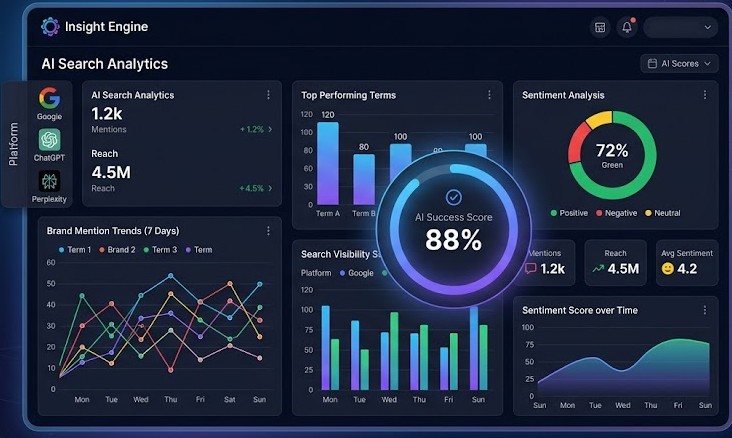
If you’re tracking keyword rankings in 2026 and wondering why traffic keeps slipping, here’s the honest answer: AI search answers are replacing blue links for millions of queries — and your standard SEO tools can’t see any of it. ZipTie AI Search Analytics is built specifically for that blind spot.
It’s a platform that monitors how your brand appears inside AI-generated answers — Google AI Overviews, ChatGPT, and Perplexity — and turns what it finds into scores, trends, and specific actions you can take. If you’ve been wondering whether you even exist in the AI answer layer of search, this tool answers that question. For a broader look at what ZipTie does as a performance tool, this breakdown covers the full platform in detail.
| Question | Answer |
|---|---|
| What is it? | An AI search analytics platform tracking brand visibility in AI-generated answers |
| Who needs it? | SEO teams, brand managers, agencies working in competitive niches |
| Replaces SEO tools? | No — it complements them |
| Key metric? | AI Success Score (mentions + citations + sentiment combined) |
| Platforms tracked | Google AI Overviews, ChatGPT, Perplexity |
| Best use case | Finding where competitors appear in AI answers but you don’t |
How ZipTie AI Search Analytics Works in Simple Terms
The core mechanic is straightforward: ZipTie sends queries to AI answer engines on your behalf, collects the responses, and analyzes them for brand presence, source citations, and sentiment. It then structures all of that messy, hard-to-read AI output into clean analytics you can actually use.
Think of it this way — if you typed 200 of your most important keywords into ChatGPT every week and manually noted every time your brand was mentioned, which domains were cited, and whether the tone was positive or negative, you’d have the raw data ZipTie collects. The platform automates that entirely and layers reporting on top of it.
The reason this matters: AI answers don’t pull from a live index the same way Google’s organic results do. They rely on training data, trusted sources, and retrieval patterns that work completely differently from what moves a page from position 8 to position 3. You can’t optimize for something you’re not measuring.
Tracking Your Brand Inside AI-Generated Answers
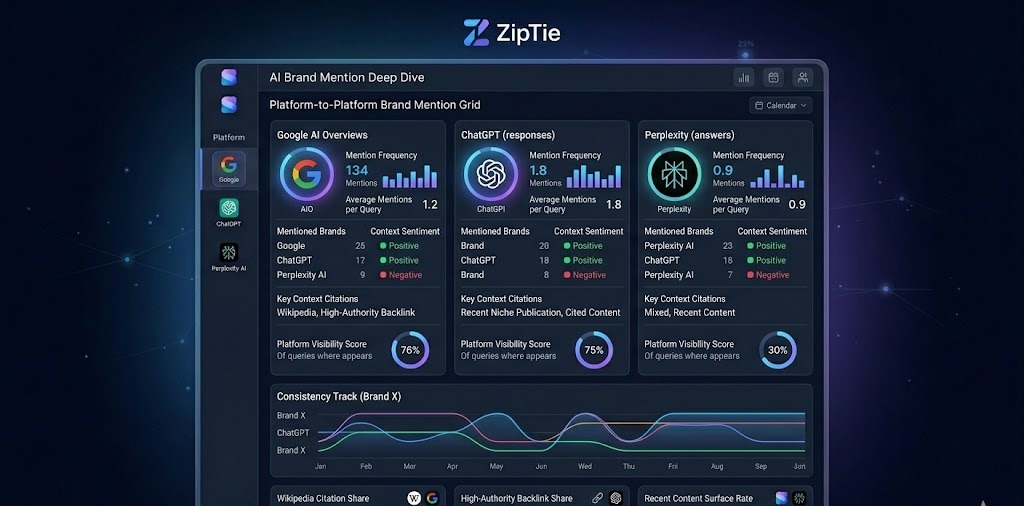
ZipTie checks whether your brand is mentioned across Google AI Overviews, ChatGPT responses, and Perplexity answers for your defined query set. It tracks mention frequency (how often does your brand name show up?), context (what’s being said around it?), and consistency across platforms (are you appearing in ChatGPT but invisible in AI Overviews?).
The platform-to-platform variation is genuinely interesting. Brands that dominate AI Overviews often have strong Wikipedia presence, high-authority backlinks, and heavily cited content. ChatGPT and Perplexity sometimes surface different sources — particularly more recent content and niche publications. ZipTie shows you those differences side by side instead of forcing you to test manually.
Measuring Mentions, Citations, and Sentiment
These three metrics are distinct and each tells you something different:
Mentions — your brand name appears in the AI answer. This is visibility. It means the AI is aware of you and includes you in the conversation around a topic.
Citations — your actual domain is referenced as a source. This is authority. The AI isn’t just mentioning your brand; it’s treating your website as credible enough to send people to.
Sentiment — whether the mention is positive, neutral, or negative. This is reputation. An AI Overview that mentions your brand while comparing it unfavorably to a competitor is worse than not being mentioned at all.
Tracking all three separately matters because you can have high mentions and terrible sentiment, or strong citations but low mention frequency. Each combination points to a different fix.
Key Features of ZipTie AI Search Analytics
No feature list bloat here — these are the modules that actually drive decisions.
AI Search Visibility Dashboard
The central dashboard gives you a real-time snapshot of how often you appear in AI answers, broken down by platform and query. It shows performance over time so you can see whether a content change or PR push actually moved the needle in AI answers — something that was genuinely impossible to measure before tools like this existed.
The competitor overlay is where it gets immediately useful. You can see your appearance rate versus two or three competitors on the same query set, which quickly surfaces the topics where you’re losing the AI answer game even if you rank well organically.
Brand Performance and Competitive Landscape
The brand-level reporting goes deeper than simple mention counts. It shows which queries are driving your AI visibility, how that splits across platforms, and where competitors consistently appear while you don’t. That gap view — “here are 40 queries where your top competitor gets mentioned and you’re invisible” — is more actionable than almost any other competitive report in SEO.
The honest limitation worth knowing: competitive data is only as good as the query set you define. If you track narrow branded queries and your competitor is dominating problem-style queries, you’ll miss the gap. Building a broad, well-structured query set matters.
AI Sources and Influential Domains
This feature identifies which websites AI tools consistently cite as sources when answering questions in your niche. It’s the source-trust map for your topic area — and it directly tells you where to focus link building, content partnerships, or PR outreach.
If three industry publications are cited in 70% of AI answers about your product category and your site isn’t on that list, that’s a concrete, fixable problem. You either need content that gets picked up by those publications, or you need to build the kind of authoritative content that earns its own citations directly.
The AI Success Score: One Number for Your AI Search Performance
The AI Success Score is ZipTie’s composite metric — a single number that rolls up mention frequency, sentiment quality, and citation rate across all tracked platforms and queries.
What the AI Success Score Measures
The score combines three weighted inputs:
- How often you’re mentioned across your tracked query set (frequency component)
- Whether those mentions are positive versus neutral or negative (sentiment component)
- How often your domain is cited as a source (authority component)
A high score means you appear often, you’re talked about well, and AI tools are actively using your content as a reference. A low score could mean you’re invisible, mentioned negatively, or present in passing but not cited. The breakdown tells you which problem you’re actually solving.
How to Use the AI Success Score in Your Reporting
For monthly marketing reports, it works as a top-line KPI alongside organic traffic and conversion metrics. The score gives executives a clean headline number without requiring them to understand the mechanics of AI answer engines — which is genuinely useful because most stakeholders aren’t ready to engage with raw mention-count tables.
For tactical work, compare the score across platforms. If your score in Perplexity is strong but Google AI Overviews is low, the fix is usually different content formats and source types. Perplexity tends to weight recent content and niche sources; Google AI Overviews heavily favors high-authority, established domains. That split tells your team where to focus.
ZipTie AI Search Analytics vs Traditional SEO Analytics
This comparison comes up constantly, so let’s be direct about it.
Rankings and Clicks vs AI Answers and Mentions
Traditional SEO tools — Ahrefs, SEMrush, Google Search Console — measure positions, impressions, and clicks in the classic blue-link results. That data is still valuable and isn’t going anywhere. But it tells you nothing about the AI answer layer.
An AI Overview appears above the blue links. If a user reads it and gets their answer, they often don’t click anything. Your ranking tool shows zero impressions for the AI layer. Your traffic drops but your rank stays the same. That’s the specific scenario where AI search analytics earns its place in the stack.
Why AI Search Analytics Matters Even If Your Rankings Are Strong
The displacement effect is real in 2026. For informational queries especially — “what is,” “how does,” “best way to” — AI Overviews are getting the engagement that used to flow to the top organic result. A brand that ranks #1 organically but never appears in AI Overviews for the same query is losing a meaningful share of attention.
The deeper issue is trust-building. When AI answers consistently mention competitors and ignore your brand, that repetition shapes perception over time. Users see your competitor named in five AI answers before they ever visit either site. That’s brand awareness being built against you.
The broader shift in how AI companies are growing and competing is something worth tracking — understanding who’s investing where shapes which AI platforms grow and which sources they favor. Anthropic’s recent $30 billion revenue trajectory and infrastructure deals are a signal of how the underlying models powering these answers are evolving.
Core Use Cases for ZipTie AI Search Analytics
For SEO and Content Teams
The primary workflow is gap identification. Run your full query set, look at the queries where you have zero mentions, and cross-reference with the sources that are getting cited instead. That tells you either: (a) you need content covering that topic, (b) your existing content isn’t authoritative enough on the topic, or (c) you need third-party publications writing about you in the context of that query.
The “topics you own” view is equally useful. If you’re appearing in 80% of AI answers about a specific product feature, you have an authority signal worth defending — and worth building adjacent content around.
For Brand and Communications Teams
Sentiment monitoring is the high-value use case here. AI answers can generate inaccurate or outdated brand descriptions that get surfaced millions of times before anyone notices. ZipTie flags negative sentiment in AI mentions so your team can respond — whether that means updating source content, pursuing corrections with publications that AI tools cite, or producing better-positioned content that displaces the problematic sources.
Early detection of misleading AI summaries about your product is genuinely useful from a reputation management standpoint. An AI that consistently describes your product as more expensive than it is, or incorrectly categorizes what it does, creates real friction in the sales cycle.
For Product and Strategy Teams
The competitive positioning data is directly useful for messaging work. If AI tools consistently describe a competitor’s product as “the most trusted” or “easiest to use” in answers about your category, that framing is worth examining — either it reflects a real gap or it reflects better content strategy on their part. Either way, you need to know it.
Main Reporting Views Inside ZipTie AI Search Analytics
Project-Level View: Overall AI Visibility
The top-level view gives you aggregate performance across all tracked queries and platforms. This is the “how are we doing in AI search overall” answer — useful for quarterly reviews and high-level trend tracking.
Platform-Level View: Google AI Overviews vs ChatGPT vs Perplexity
The platform split is where strategy decisions get made. These three platforms have different source preferences, different answer formats, and different user bases. A consumer-facing brand might prioritize Google AI Overviews because that’s where their customers start. A B2B SaaS brand might find Perplexity more relevant because their buyers use it for research.
The platform comparison also shows which improvements transfer. If you increase your citation rate on one platform, does it correlate with improvement elsewhere? Sometimes yes — strong authoritative content tends to lift all platforms. But often the tactics are platform-specific.
It’s worth noting that the AI search space is actively consolidating and expanding. Microsoft’s Azure AI infrastructure plays a role in how some of these answer engines access and process web content — understanding those infrastructure layers gives context for why platform behavior differs.
Category and Query-Level Views
Zooming to the individual query level shows you the exact AI response that was generated, with your brand’s presence highlighted. This is where you stop looking at aggregates and start reading what AI is actually saying about you in specific contexts — which is often more revealing than any metric.
Insights and Recommendations: From Data to Clear Action Steps
Content Optimization Suggestions Based on AI Answers
ZipTie doesn’t just show you what’s happening — it surfaces specific optimization ideas. If a query where you’re invisible shows the AI consistently citing how-to-format content, that’s a signal your existing page-level content isn’t structured for AI extraction. The recommendation might be to restructure content with clearer definitions, add FAQ schema, or break out a standalone page rather than embedding the answer inside a long guide.
The actionability gap is actually one of the bigger weaknesses in most AI search analytics tools — they show you data but leave the “so what” to you. ZipTie’s recommendations layer helps bridge that, though like any automated suggestion system, the outputs need human judgment to prioritize correctly.
Watching Trends and Shifts in AI Search Over Time
AI answer engines update their behavior, change source weighting, and alter response formats frequently — more frequently than Google’s core algorithm updates historically moved organic rankings. A trend view that shows your mention rate dropping over three weeks might reflect an AI model update, a competitor publishing strong new content, or a PR story that shifted how your brand is described in third-party sources.
Tracking trend data means you’re not flying blind when these shifts happen. You can correlate timing with external events and respond faster.
How ZipTie AI Search Analytics Collects and Analyzes Data
Query Sets and Scenario-Based Tracking
Users build query sets that reflect how real people search for their product or category. Good query sets include: brand name variations, product category terms, problem-style questions (“how to [problem your product solves]”), comparison queries (“vs competitors”), and feature-specific terms.
The scenario-based approach means you can also track how AI describes you in specific purchase situations — “best [product type] for small teams” versus “enterprise [product type] options” — which maps directly to how AI answers influence different buyer segments.
Parsing AI Overviews and Chat Responses
The parsing layer extracts structured data from inherently unstructured text. AI answers don’t come with labels — ZipTie’s analysis identifies brand entities, domain references, and sentiment signals from natural language. The quality of that extraction directly affects the quality of the analytics, which is worth keeping in mind when you see results that seem off. Edge cases in brand name recognition (abbreviations, common words that double as brand names) can occasionally affect accuracy.
ZipTie AI Search Analytics for Competitive Intelligence
Identifying Competitors That Dominate AI Answers
The competitor dominance report shows which brands appear most frequently across your tracked query set in AI answers. This is different from organic share of voice — it reflects which brands AI systems have been trained to associate with authority in your topic area.
Brands that dominate AI answers typically: have strong Wikipedia pages, are frequently cited in major industry publications, have structured content that’s easy for AI to extract, and have been establishing authority for long enough that the training data reflects it. Understanding which competitors meet those criteria helps explain why they’re winning and what the path to competing looks like.
Finding Content and Source Gaps in Your Space
The source gap analysis is arguably the most immediately actionable feature. It identifies which websites AI tools trust in your niche where you currently have no presence — no coverage, no citations, no mentions.
That list is your outreach and content partnership roadmap. Getting coverage on a publication that AI consistently cites in your category has a different value calculation in 2026 than it did in 2022. It’s not just about referral traffic or backlink authority — it’s about directly influencing the source layer that AI answers draw from.
Who Should Consider Using ZipTie AI Search Analytics?
Best Fit: Brands Already Investing in SEO and Content
The platform makes the most sense for organizations already producing content regularly and tracking organic performance. If you’re not yet investing in SEO, you’ll get more value from foundational content and link building before layering in AI-specific analytics. But if you have an active SEO program and you’re not measuring AI visibility, you have a significant measurement gap.
The value scales with query volume and competition level. High-competition categories with lots of AI Overview coverage (health, finance, software, e-commerce) benefit most. Local service businesses with narrow query sets benefit less.
Agencies and Consultants Offering AI Search Visibility Services
ZipTie reports create a natural deliverable layer for agencies. Monthly AI visibility reports alongside standard organic performance reports position agencies as forward-looking and give clients a metric most competitors aren’t tracking yet.
The honest agency consideration: AI search visibility is still emerging as a client priority. Some clients will immediately see the value; others need education before the metric means anything to them. Having clear case examples of AI visibility improvements correlating with traffic or brand outcome changes helps make the business case.
The competitive landscape for AI analytics tools is also shifting quickly — Meta’s moves in the AI space and OpenAI’s funding trajectory both signal that the number of AI answer surfaces is likely to increase, which expands the monitoring challenge and the value of tools that track across multiple platforms.
Getting Started With ZipTie AI Search Analytics
Setting Up Your First Project and Query Set
The setup sequence: sign up, add your domain, then build your first query set. The query set is where most users underinvest — spending ten minutes here saves weeks of incomplete data.
Build it in layers: start with branded queries (your company name, product names), add category queries (the terms describing what you do), then add problem queries (the questions your buyers ask before they know your brand exists). Aim for at least 30-50 queries to get statistically meaningful data; 100+ is better for competitive niches.
Connect competitor domains so the platform tracks them in parallel from day one. Retroactively adding competitors means you lose the baseline comparison.
First 30 Days: Quick Wins to Look For
Week one: identify zero-visibility queries. These are the highest-priority gaps — you have no presence at all for queries that matter to your business.
Week two: look at negative sentiment mentions. If AI is describing you poorly somewhere, find the source of that framing (usually a specific article or review that AI is over-weighting) and address it.
Week three: run the source gap report. Pick the top three publications consistently cited in AI answers where you have no coverage and start planning outreach or content.
Week four: establish your baseline AI Success Score across platforms. This is your benchmark — every optimization going forward gets measured against it.
FAQ About ZipTie AI Search Analytics
Is ZipTie a Replacement for Traditional SEO Tools?
No, and it shouldn’t be positioned that way. Traditional SEO tools measure organic rankings, traffic, backlinks, and technical site health. ZipTie measures a different layer entirely — what AI answer engines say about you. You need both. A full SEO stack in 2026 tracks organic performance and AI answer visibility as parallel channels.
If you’re looking at how AI compliance and governance are shaping how brands should think about their digital presence, this AI compliance resource is worth reviewing alongside your analytics setup.
Which AI Platforms Does ZipTie Support?
Currently: Google AI Overviews, ChatGPT, and Perplexity. These three represent the dominant AI answer surfaces for most commercial queries. Coverage is likely to expand as new AI search products mature — the pace at which new AI products are reaching significant user bases means the monitoring landscape will keep broadening.
How Often Should You Check AI Search Analytics?
Weekly check-ins for trend monitoring; monthly deep reviews for strategy work. AI answer behavior shifts faster than organic rankings — a model update or a wave of new content from competitors can move your visibility within days. Weekly monitoring catches those shifts while they’re still actionable. Monthly reviews are where you connect the data to content planning, outreach priorities, and reporting.
The weekly cadence is more important for brands in fast-moving categories (software, finance, health) where AI answers are particularly high-stakes. More stable categories can often operate on a bi-weekly or monthly review cycle without missing critical shifts.
ZipTie AI Search Analytics solves a real, growing measurement gap. If AI answer engines are getting engagement for queries that matter to your business — and in 2026, they almost certainly are — you need to know whether you’re in those answers, how you’re described, and who’s appearing instead of you. The platform makes that visible and actionable. The alternative is optimizing blind while a portion of your most valuable search traffic gets allocated before a user ever sees your organic result.
