


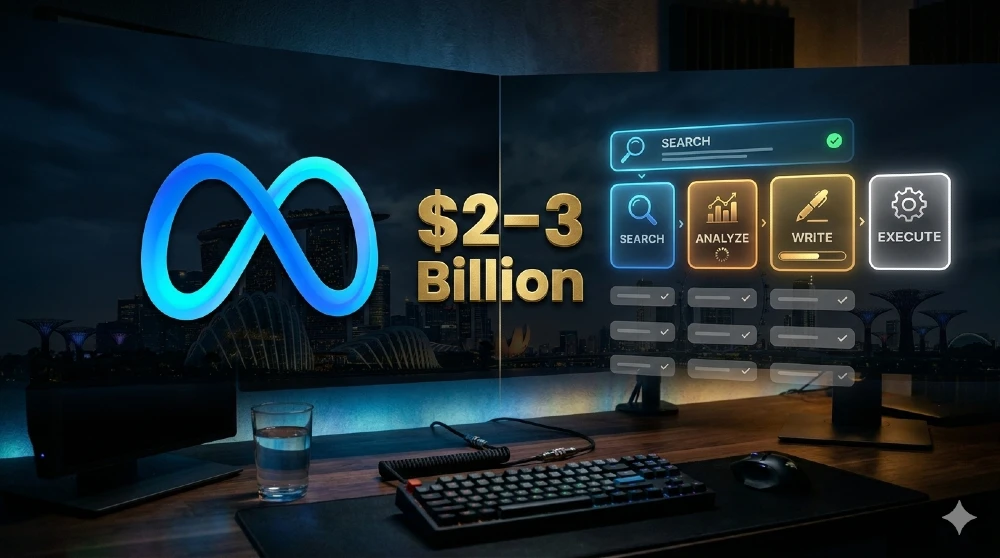
Meta Acquiring is not just acquiring a startup. It is buying the autonomous agent that made OpenAI look slow — and it plans to put it inside WhatsApp.
If this deal closes, it will be one of the most consequential AI acquisitions of 2026. Not because of the price tag — though $2 to $3 billion is significant — but because of what Manus AI actually is and where Meta plans to deploy it.
Meta is reportedly in advanced discussions to acquire Manus, the Singapore-based AI startup that went viral in early 2025 for building a general-purpose autonomous agent capable of executing complex, multi-step tasks with minimal user input. The deal is valued between $2 billion and $3 billion. Meta’s plan, according to reports, is to integrate Manus technology directly into Meta AI products and WhatsApp business tools — putting advanced agentic capabilities in front of potentially billions of users almost overnight.
This is not Meta experimenting with AI agents. This is Meta buying the one that beat OpenAI on its own benchmarks and deploying it at a scale no AI agent has ever operated before.
Who Manus AI Actually Is — And Why Meta Wants It
Manus did not become notable because of funding rounds or media coverage. It became notable because of what it could do.
The startup, founded and based in Singapore, built a general-purpose autonomous AI agent — a system that receives a high-level goal from a user and executes the full sequence of tasks required to achieve it, independently, without step-by-step human guidance.
The demonstration that made Manus go viral was specific: the agent received a complex research and analysis task, broke it into sub-tasks, searched the web, gathered data from multiple sources, synthesized findings, formatted a structured output, and delivered a complete result — with minimal prompting from the user. Not a chatbot conversation. Not a prompt-and-response loop. An agent that took a goal and ran with it.
What got the enterprise AI world’s attention was the benchmark comparison. Manus outperformed OpenAI’s Deep Research tool on certain tasks — a direct comparison against one of the most publicized autonomous research agents in the market. Deep Research is OpenAI’s own multi-step research agent, embedded in ChatGPT Pro. Manus beating it on specific benchmarks was not a minor footnote. It was a statement about where the capability ceiling sat for a relatively young startup operating outside the US AI hub.
For Meta, the acquisition logic is straightforward. Building a general-purpose autonomous agent from scratch — at a quality level that competes with OpenAI — would take years and hundreds of millions in research investment with uncertain outcomes. Manus has already done it. The technology exists. The team that built it exists. The benchmarks proving it works exist. At $2 to $3 billion, Meta is buying a proven capability, a proven team, and a head start measured in years.
The WhatsApp Angle — Where This Gets Genuinely Significant
Meta’s reported integration plan is what makes this acquisition different from a standard AI talent or technology buy.
WhatsApp has over 2 billion active users globally. WhatsApp Business — the platform’s commercial tier used by small businesses, enterprises, and brands to communicate with customers — operates across markets where it is the dominant business communication channel. In India, Brazil, Indonesia, and across much of Southeast Asia, Africa, and Latin America, WhatsApp Business is not one of several options for customer communication. It is the channel.
Embedding Manus-level autonomous agent capabilities into WhatsApp Business tools means a small business owner in Mumbai or São Paulo could instruct a WhatsApp AI agent to handle customer inquiries, process orders, manage appointment bookings, generate product recommendations, follow up with leads, and execute multi-step customer service workflows — all through the messaging platform they already use daily.
That is not a marginal improvement to WhatsApp Business. That is a fundamental expansion of what a small business can do without hiring additional staff or adopting new software.
At the enterprise level, the implications extend further. Large organizations already use WhatsApp Business API for customer communication at scale. An agentic layer that can handle complex, multi-step customer interactions autonomously — not just send templated responses — changes the entire economics of enterprise customer service on the platform.
What This Means for Meta AI
Beyond WhatsApp, Meta AI — the company’s consumer-facing AI assistant embedded across Facebook, Instagram, Messenger, and the standalone Meta AI app — has been competitive but not leading in the autonomous agent space.
Meta AI currently handles conversational queries, content generation, image creation, and basic information retrieval reasonably well. What it has not offered at the level of its competitors is genuine multi-step autonomous task execution — the ability to take a complex goal and work through it independently across multiple tools, sources, and actions.
Manus technology directly addresses that gap.
Integrating Manus’s autonomous agent architecture into Meta AI would mean users across Facebook and Instagram could assign tasks rather than ask questions. Plan a marketing campaign. Research a business opportunity. Analyze competitors. Draft and schedule a content calendar. Tasks that currently require multiple tools, multiple prompts, and significant user involvement could become single-instruction workflows handled by the agent autonomously.
Given Meta AI’s existing distribution — hundreds of millions of users across its social platforms — a genuine autonomous agent upgrade would immediately give Meta one of the largest agentic AI deployments in the world, measured by active user base.
The Competitive Context — Why Meta Needed to Move Now
The autonomous agent space in early 2026 is moving at a speed that punishes delay.
OpenAI has Deep Research embedded in ChatGPT and Operator — its autonomous web agent — in active deployment. Google has Gemini Ultra with deep research capabilities and is building agentic features across its Workspace and Cloud products. Anthropic’s Claude is increasingly used in multi-agent pipelines through its API. Microsoft Copilot is integrating agentic behavior across the entire Office 365 ecosystem.
Meta, despite its significant AI investment — including its Llama open-source model family and substantial compute infrastructure — has not had a flagship autonomous agent product that competes at the level its rivals are operating.
The Manus acquisition is not an incremental improvement to Meta’s AI roadmap. It is a step-change designed to close a capability gap that was becoming more visible with every OpenAI and Google agent announcement.
The timing of the reported deal also matters. Manus went viral in early 2025. A year later, Meta is reportedly closing the acquisition. That timeline suggests Meta was watching closely, waited to validate the technology’s production readiness, and moved when it was confident enough in the team and product to commit at the $2 to $3 billion level.
Singapore’s AI Ecosystem Gets a Moment
It is worth pausing on the geography here.
Manus is a Singapore-based startup. Singapore has been building its AI ecosystem deliberately through government investment, research institution partnerships, and talent attraction programs — but it has not yet produced a globally viral AI product that attracted acquisition interest at billion-dollar valuations from a US tech giant.
If this deal closes, it becomes a reference point for the entire Southeast Asian AI startup ecosystem. Not because the acquisition validates Singapore specifically — Manus’s founders and research team likely represent international talent assembled in Singapore rather than a homegrown research tradition — but because it demonstrates that frontier AI capability can be built and recognized outside the Bay Area and London corridors that dominate AI investment attention.
That signal matters for venture capital allocation, talent retention decisions, and government AI investment programs across the region.
The Risks Meta Is Taking On
No acquisition at this scale is without risk. Several deserve direct attention.
Integration complexity. Manus built a product in a startup environment. Integrating its technology into Meta’s infrastructure — across multiple consumer platforms serving billions of users in diverse regulatory environments — is an engineering challenge of entirely different scale. The gap between a viral AI demo and a production-grade feature inside WhatsApp is significant.
Regulatory scrutiny. Meta’s acquisitions draw regulatory attention as a default. The company’s history of acquisitions — Instagram, WhatsApp itself — means antitrust regulators in the US, EU, and UK will examine this deal. A $2 to $3 billion acquisition in the AI sector, in 2026, in a regulatory environment that is actively trying to shape AI market structure, will not pass quietly.
Talent retention. The Manus team is the asset. The technology matters, but the people who built it matter more for the next generation of capability. Post-acquisition talent retention in AI companies is a consistent challenge — founders and key researchers often leave once acquisition lockup periods expire. Meta will need to structure incentives carefully to keep the team building inside a large corporation rather than returning to startup environments.
Autonomous agent safety. Deploying an autonomous agent at WhatsApp’s scale introduces failure modes that simply do not exist at smaller deployments. An agent that occasionally makes an error in a research task is a minor inconvenience for a power user. An agent making errors in customer-facing business communications, financial transactions, or healthcare-adjacent interactions at two billion user scale is an operational and reputational risk of a different order entirely.
What Happens If the Deal Closes
Assuming the acquisition completes and integration proceeds on a reasonable timeline, the practical outcomes take shape across three horizons.
In the short term — 6 to 12 months — Meta will likely ship incremental agentic upgrades to Meta AI and WhatsApp Business using Manus technology, with careful scope limitation. Task execution for simple, bounded workflows: appointment scheduling, order status handling, FAQ resolution.
In the medium term — 12 to 24 months — more complex autonomous task handling becomes available to WhatsApp Business API users and Meta AI subscribers. Multi-step research, lead qualification, content drafting, customer journey management.
In the longer term — beyond 24 months — if integration succeeds and safety guardrails hold at scale, Meta could have the largest deployed autonomous AI agent platform in the world, measured by active users. Not the most capable. Not the most technically advanced. But the most widely used — by a margin that no competitor can close through product development alone.
Distribution is Meta’s advantage. Manus is the capability. Together, the combination is genuinely difficult for any competitor to replicate quickly.
The Bottom Line
Meta buying Manus AI for $2 to $3 billion is a calculated move to close a real capability gap at a moment when the autonomous agent race is accelerating too fast for organic development to keep pace.
The WhatsApp integration angle is what makes this more than a talent acquisition or a technology bet. It is a deployment strategy with a built-in audience of billions. If it works — and that is a meaningful if, given the integration and safety challenges — it puts advanced autonomous AI agents in the hands of small business owners, entrepreneurs, and consumers across markets that most AI agent products have not yet reached.
The deal is not confirmed. The integration is not complete. The risks are real and significant.
But the direction is clear. Meta is not watching the autonomous agent revolution from the sidelines anymore.
Check Latest news about: Google Nano Banana 2: Instant AI Image Generation
