


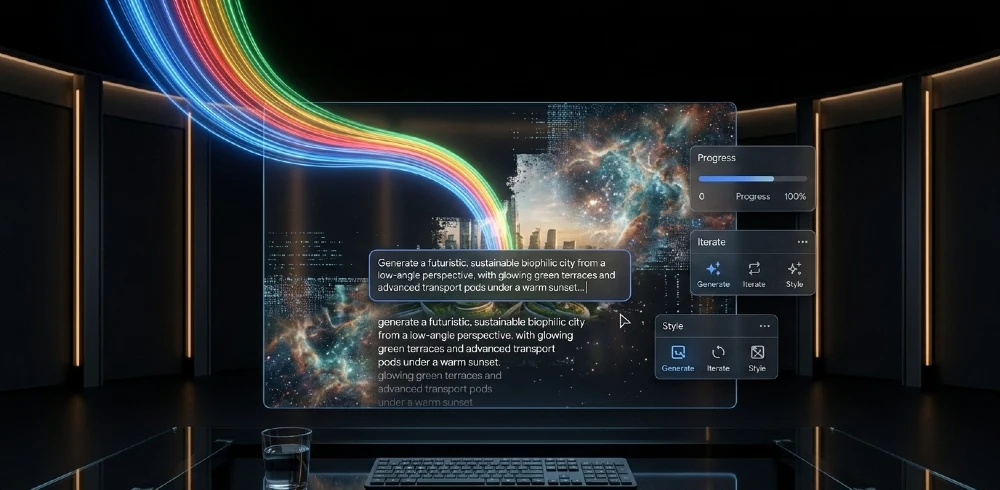
Near-instant visuals. Complex prompt handling. SynthID authentication. Google just made professional image generation accessible to every entrepreneur with a browser.
Speed has always been the bottleneck in AI image generation. You write a detailed prompt, wait, get something close, adjust, wait again. For businesses trying to move fast — producing marketing visuals, product mockups, pitch deck graphics, social content — that friction adds up quickly.
Google just addressed it directly. The company has launched Nano Banana 2, part of the Gemini 3.1 Flash Image suite, a new image generation model built specifically for near-instant, high-quality visual output at a level of prompt complexity that previous fast models could not handle. It integrates natively across Google AI Studio and Vertex AI, ships with SynthID watermarking for content authentication, and targets exactly the audience that has been priced out of professional visual production — entrepreneurs, small business owners, and in-house marketing teams.
This is not Google’s most powerful image model. It is built to be its most practical one.
What Nano Banana 2 Actually Is
The name needs unpacking before anything else.
Nano Banana 2 sits inside the Gemini 3.1 Flash Image suite — Google’s family of fast, lightweight, production-ready AI models. The “Flash” designation across Google’s Gemini lineup consistently signals the same priority: speed and efficiency over maximum capability, optimized for real-world deployment rather than benchmark performance.
Nano Banana 2 follows that pattern. It is not competing with Google’s highest-end image generation research models. It is competing with the practical question every business owner asks: can I generate a usable, professional-quality visual in the time it takes to write a prompt?
The answer, according to Google, is yes — at near-instant speeds, with the ability to handle complex, multi-element prompts that simpler fast models typically struggle with. A prompt asking for a specific product in a specific environment with a specific lighting style and brand color palette is exactly the kind of request that breaks lower-tier fast generators. Nano Banana 2 is built to hold up under that complexity without sacrificing the speed advantage.
Complex Prompt Handling — Why This Is the Real Breakthrough
Speed alone is not new. Several image generation tools can produce output quickly. The consistent tradeoff has been that fast models handle simple prompts well and fall apart on complex ones.
A marketing team generating a social post background can use almost any fast model. A business generating a product lifestyle image with specific props, background style, brand color adherence, and compositional requirements typically needs a slower, more capable model — or multiple rounds of iteration with a fast one.
Nano Banana 2 targets that gap directly. The model is designed to process detailed, layered prompt instructions and return coherent, high-quality outputs without requiring the user to simplify their creative brief.
For entrepreneurs and small businesses, this matters practically. They rarely have the time or budget to iterate through 10 variations to get something usable. They need the first or second output to be close enough to deploy. Complex prompt handling with fast execution is what makes that realistic — not just possible in theory.
SynthID Authentication — The Trust Layer Most Tools Skip
Every major AI image generation launch in 2025 and 2026 faces the same question from enterprise and business users: how do we prove this image is AI-generated when we need to, and how do we protect against misuse?
Google’s answer is SynthID — its proprietary digital watermarking technology that embeds an invisible, cryptographically verifiable signature directly into the pixel structure of every generated image. The watermark survives standard editing operations — cropping, color adjustments, format conversion — and can be detected by Google’s verification tools even after the image has been modified.
For businesses, this serves two distinct purposes.
First, it provides content provenance. A marketing team can verify that an image came from their AI generation pipeline, not from an external or unauthorized source. In regulated industries where content origin matters — financial services, healthcare marketing, legal communications — that verification trail has real compliance value.
Second, it creates accountability in publishing. Businesses that disclose AI-generated content in their marketing — increasingly required by platform policies and, in some regions, by emerging regulation — have a verifiable record of generation origin. SynthID is not just a trust feature. It is infrastructure for responsible AI content deployment.
This is an area where many competing image generation tools still operate without adequate provenance systems. Google shipping SynthID as a default — not an optional add-on — positions Nano Banana 2 ahead of that curve.
Native Integration With AI Studio and Vertex AI
Where a model lives inside a workflow is often more important than what it can do in isolation.
Nano Banana 2 integrates natively with two of Google’s primary AI development and deployment environments.
Google AI Studio is Google’s browser-based interface for experimenting with and deploying Gemini models. It requires no code, no infrastructure setup, and no API configuration to access. An entrepreneur with a Google account can open AI Studio, access Nano Banana 2, and generate production-quality visuals within minutes of the account being active. The barrier to entry is essentially zero.
Vertex AI is Google Cloud’s enterprise AI platform — the environment where businesses build, deploy, and scale AI-powered applications. Nano Banana 2’s integration with Vertex AI means that development teams can embed the model directly into existing product workflows, marketing automation pipelines, e-commerce systems, and content management platforms through a standard API. No separate integration layer. No third-party middleware.
Together, these two integration points cover both ends of the user spectrum. Individuals and small teams access it through AI Studio with no technical overhead. Engineering teams and enterprise deployments access it through Vertex AI with full programmatic control. That dual access model is one of Google’s consistent advantages in AI tooling — the same underlying capability available to both a solo founder and a Fortune 500 development team.
Who This Is Built For — And What It Replaces
Google positioned Nano Banana 2 explicitly toward entrepreneurs and businesses. That targeting is deliberate and it points directly at a real market gap.
Professional visual production is expensive. A single custom illustration from a freelance designer typically runs $150 to $500. A product lifestyle photo shoot involves photographer fees, location costs, props, and editing time — routinely $1,000 to $5,000 for a small campaign. Stock photography subscriptions solve some of the cost problem but create a different one: generic, non-differentiated visuals that look identical to what every competitor is using.
Nano Banana 2 targets all three of those pain points at once.
For marketing visuals — social media graphics, ad creative, email headers, blog featured images — it produces deployment-ready output fast enough to support a daily publishing schedule without a dedicated design resource.
For prototyping — product mockups, UI concept visuals, pitch deck graphics, landing page imagery — it removes the design bottleneck from early-stage product development entirely. A founder can visualize a product concept before writing a single line of code or briefing a single designer.
For campaign testing — generating multiple visual variations of the same concept to A/B test creative performance — it turns a process that previously required designer time into something a marketing manager can run independently in an afternoon.
How It Compares to the Current Market
The fast AI image generation space in early 2026 is genuinely competitive.
Midjourney remains the quality benchmark for artistic and stylized output, but it operates outside standard enterprise workflows and has no native integration with business tooling. DALL-E 3 through OpenAI’s API offers strong prompt adherence but sits inside the OpenAI ecosystem rather than Google Cloud infrastructure. Adobe Firefly focuses on commercial safety and Creative Cloud integration but is slower on complex prompts than Flash-tier models.
Nano Banana 2’s specific combination — near-instant speed, complex prompt handling, SynthID authentication, and native Vertex AI integration — does not have a direct equivalent in the current market. Each competitor covers two or three of those properties. Google is claiming all four simultaneously.
The enterprise integration angle is where the competitive moat is clearest. Businesses already running infrastructure on Google Cloud do not need to evaluate a new vendor, negotiate a new contract, or build a new integration. Nano Banana 2 is available inside the environment they already operate in, on the billing relationship they already have.
The Responsible AI Angle Google Is Leaning Into
It is worth noting that Google is shipping SynthID as infrastructure, not as a compliance checkbox.
The broader context is that AI-generated imagery is moving faster than the regulatory and platform policy frameworks designed to govern it. The EU AI Act includes provisions on synthetic media disclosure. Major social platforms are implementing detection systems for AI-generated content. Brands are increasingly under pressure to disclose AI in their creative workflows.
SynthID positions Google — and by extension, businesses using Nano Banana 2 — on the right side of that trajectory. Building with a model that automatically embeds verifiable provenance means compliance with emerging disclosure requirements is architectural, not retrofitted.
That is a meaningful differentiator for enterprise buyers who are already thinking about AI governance in their content operations.
What Comes Next
Nano Banana 2 is a Gemini 3.1 release. Gemini 4 is on Google’s roadmap.
The pattern across Google’s model releases suggests that Flash-tier models continue improving in both capability and speed with each generation cycle. What Nano Banana 2 delivers in early 2026 will likely look like a baseline capability within 12 to 18 months, as the next generation raises the floor on what fast image generation can produce.
For businesses adopting now, the practical implication is that the tool improves without requiring a workflow change. Integration built on Vertex AI today will access improved model versions as Google releases them — without rebuilding the pipeline.
The broader market implication is harder to ignore. If near-instant, complex-prompt, authenticated AI image generation becomes a standard capability inside cloud platforms — not a specialized tool requiring separate procurement — the professional visual production market faces structural pressure it has not fully priced in yet.
The Honest Assessment
Google did not launch the most powerful image generation model available. It launched the most practically useful one for the businesses that have been waiting for AI image generation to stop being a hobbyist tool and start being a production workflow.
Near-instant speed with complex prompt handling. SynthID authentication built in by default. Native access through AI Studio for individuals and Vertex AI for enterprise teams. A direct answer to the cost and speed bottlenecks in professional visual production.
Nano Banana 2 is not a research demo. It is infrastructure for how businesses produce visual content going forward.
That shift — from AI image generation as experimentation to AI image generation as production workflow — is what makes this launch matter beyond the feature list.
Check Latest news about ServiceNow Autonomous Workforce Platform
