


Three months. A 3x revenue jump. And the biggest infrastructure deal in Anthropic’s history.
This isn’t a slow build. Anthropic’s revenue run rate has now topped $30 billion, up from $9 billion at the end of 2025 — a number that, frankly, would be hard to believe if it weren’t coming directly from the company’s own announcement. That’s a more than threefold increase in roughly one quarter.
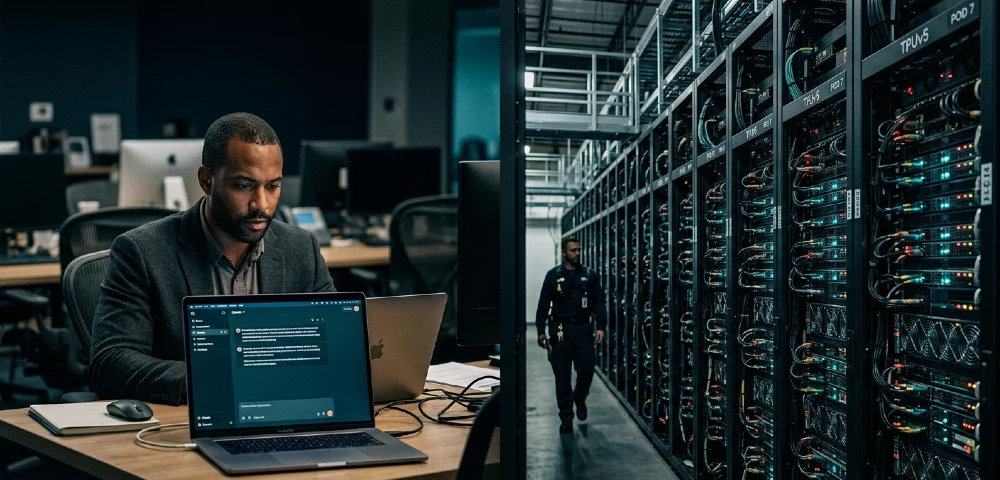
Alongside that number, the company just announced a compute deal with Google and Broadcom that gives it access to more raw AI infrastructure than almost any company on the planet — with most of it not even coming online until 2027.
Both pieces of news landed on April 6, 2026. And together, they tell a very specific story: Anthropic is not playing defense. It’s scaling hard.
The Revenue Numbers — Let’s Slow Down Here
Anthropic’s run-rate revenue has now exceeded $30 billion, up from approximately $9 billion at the end of 2025 — a more than threefold increase in roughly three months, the result of a compounding enterprise sales motion that accelerated sharply after Anthropic closed its Series G funding round on February 12, 2026.
For context: OpenAI, with 900 million weekly users, is at $2 billion per month in actual revenue. Anthropic is disclosing a run-rate — annualized projection based on current momentum — but the trajectory here is genuinely striking.
The enterprise signal is even cleaner than the top-line number.
More than 1,000 business customers are now spending over $1 million on an annualized basis — a figure that has more than doubled since February. In under two months. That’s not slow-burn adoption. That’s a wave.
The Google-Broadcom TPU Deal — What’s Actually Happening
Here’s what got announced, stripped of the jargon.
Anthropic has secured approximately 3.5 gigawatts of Google TPU capacity via Broadcom, starting in 2027 — building on 1 gigawatt already being supplied in 2026.
That 3.5 gigawatts figure needs a moment. For reference, a typical data center runs on around 20-50 megawatts. Anthropic is reserving capacity nearly 100 times that size — specifically to train and run frontier Claude models.
Broadcom had first signalled the scale of this relationship in September 2025, when CEO Hock Tan disclosed during an earnings call that a mystery customer had placed a $10 billion order for custom TPU racks. In December 2025, he confirmed the customer was Anthropic, and that an additional $11 billion order had followed.
So April’s announcement is the third chapter of an ongoing story — a partnership that’s grown from a rumoured $21 billion commitment to a locked-in, multi-gigawatt infrastructure deal with a defined timeline.
Anthropic’s CFO Krishna Rao said: “We are making our most significant compute commitment to date to keep pace with our unprecedented growth.”
Why TPUs — And Why Broadcom?
This is a deliberate infrastructure choice, not just a convenience deal.
Anthropic currently trains and operates Claude across AWS Trainium chips, Google TPUs, and NVIDIA GPUs — an approach it says allows it to match specific workloads to the hardware best suited for them, improving both performance and resilience for enterprise customers.
Most AI labs are locked into one hardware provider. Anthropic is intentionally staying multi-vendor. That’s a hedge against supply chain disruption, pricing leverage, and single-point-of-failure risk. Smart positioning for a company whose enterprise customers depend on uptime.
As for Broadcom’s role — they’re not just a middleman. Broadcom CEO Hock Tan recently shared his view that hyperscalers don’t have the skill to create custom accelerators and predicted Broadcom’s chip business will win over $100 billion in revenue from AI chips in 2027 alone. Working on next-gen TPUs for Google — and supplying them to Anthropic — is exactly the kind of deal that makes that prediction credible.
Broadcom’s stock rose more than 3.5% in late trading after the announcement — reflecting investor appetite for companies positioned at the physical layer of the AI stack.
The $50 Billion American Infrastructure Pledge
There’s a geopolitical dimension to this deal that deserves attention.
The vast majority of the new computing infrastructure will be located within the United States, deepening a commitment Anthropic made in November 2025 to direct $50 billion toward American AI computing capacity.
The Trump administration’s AI Action Plan has explicitly targeted US-based compute capacity as a strategic priority, and Anthropic, like its peers, has positioned its infrastructure investments accordingly.
Whether that alignment is strategic conviction or tactical positioning — probably both — the outcome is the same: a significant portion of next-generation AI training capacity is being locked into American soil. That matters for regulatory relationships, government contracts, and the broader narrative around AI sovereignty.
Claude Is Now on Every Major Cloud
One detail buried in the announcement deserves its own paragraph.
Claude is currently the only frontier AI model available to customers across all three of the world’s largest cloud platforms: Amazon Web Services via Bedrock, Google Cloud via Vertex AI, and Microsoft Azure via Foundry.
OpenAI is tightly coupled to Azure. Google’s Gemini is strongest on Google Cloud. Anthropic’s Claude sits across all three which means enterprise customers don’t have to choose between their existing cloud infrastructure and their AI vendor. That’s a quiet but powerful competitive advantage in enterprise sales conversations.
The $200M PE Venture: Claude Going Into Portfolio Companies
Anthropic is in advanced talks for a $200 million private equity venture to distribute AI tools to portfolio companies, with Claude Code and agent features driving enterprise adoption.
This is a different kind of distribution play. Instead of selling seat-by-seat to enterprise customers, Anthropic would plug directly into PE-backed company portfolios — reaching dozens or hundreds of businesses through a single deal structure. If it closes, it’s a template that could scale quickly across the PE and VC world.
Claude Code, specifically, has become a serious revenue driver. The product has gained traction as a developer-facing coding agent, and combined with broader agentic workflow capabilities, it’s the product layer that’s converting enterprise interest into $1M+ annual contracts.
The Pentagon Shadow — A Risk Worth Noting
Not everything is smooth. Anthropic is caught up in a legal battle with the White House after military chiefs at the Pentagon classified it as a “supply chain risk” following a standoff over its safety guardrails. Anthropic has said the designation could see it lose billions of dollars in revenue from enterprise customers that do business with the US government.
The $30B run-rate shows that growth hasn’t been stopped by this dispute — yet. But it hangs over the company’s federal market ambitions. A resolution either way will matter significantly for Anthropic’s 2026 revenue ceiling.
What’s Next
- 3.5 GW of TPU capacity comes online in 2027 — that’s when Anthropic’s next generation of frontier Claude models gets the compute it needs to truly compete at scale.
- 1,000 enterprise customers at $1M+ spending is a benchmark that will be watched closely. If it doubles again by mid-year, the $30B run-rate becomes a floor, not a ceiling.
- The $200M PE distribution deal, if confirmed, opens a new go-to-market channel that bypasses traditional enterprise sales cycles entirely.
- IPO watch: Anthropic hasn’t signalled public market timing publicly, but the revenue trajectory, the institutional investor base from Series G, and the infrastructure commitments all point toward a company building toward that moment.
- Regulatory resolution: The Pentagon dispute needs to close — one direction or another. Government AI contracts represent a major untapped market for Claude.
Anthropic’s $30 billion revenue milestone isn’t just a number — it’s proof that the enterprise AI market is consolidating around a small number of frontier model providers faster than most predicted. And with 3.5 gigawatts of TPU capacity locked in through Broadcom and Google, Anthropic isn’t just keeping pace. It’s building the infrastructure to define what comes next.
check latest news about Google Gemma 4 Is the Open-Weight Model Developers Have Actually Been Waiting For
