



Predicting the future is easy; predicting it accurately enough to gamble your quarterly budget on it is where most companies fail. DataRobot is the industrial-grade response to the “black box” problem of AI, moving beyond simple automation to become a full-scale operating system for autonomous agents and predictive pipelines.
If you’re still writing manual Python scripts to clean data or fighting with DevOps to deploy a single model, you aren’t just behind—you’re expensive.
The DataRobot Quick Verdict
| Feature | 2026 Capability | The “Human Labor” Reality |
| The Core Pitch | End-to-end “AutoML” (Build, Operate, Govern). | Replaces 2 weeks of manual coding with a 15-minute “Autopilot” run. |
| Best For | Enterprise teams needing governance over raw speed. | If you’re in a regulated industry (Finance, Health), this is your only safe bet. |
| Input Flexibility | Multimodal (Tabular, Text, Image, Geospatial). | Direct “Push-Down” compute for Snowflake and AWS S3. |
| Pricing | Enterprise Tier: £20k – £40k/year per license. | It’s a Ferrari. Don’t buy it if you only need a bicycle. |
1. Navigating the DataRobot Workbench
Most AI tools try to hide the “How” behind a pretty UI. DataRobot’s 2026 NextGen UI does the opposite.
It’s designed like a flight deck, focusing on the Use Case folder as the primary unit of work. (1 line)
Instead of a scattered list of models, you see a lineage: where the data came from, who touched it, and why the AI made a specific decision.
In my experience testing these enterprise platforms, the “Governance Lens” is the most underrated feature; it tracks every prompt and vector input, ensuring your AI doesn’t start “hallucinating” financial advice.
The Navigation Tabs You’ll Actually Use:
- Data Wrangling: Forget manual cleaning. You create a “Recipe” that pushes the compute directly into your warehouse (like Snowflake).
- Experiments: This is the “Hunger Games” for algorithms. You run 40+ models simultaneously to find the winner.
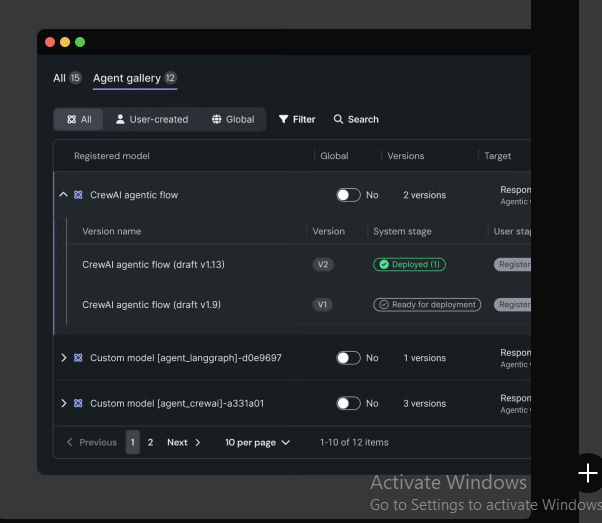
- Model Registry: The library of every model you’ve ever “blessed” for production.
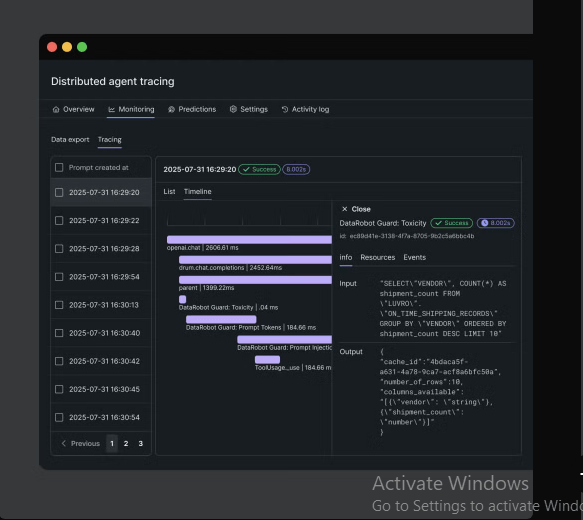
- Console / Monitoring: The real-time heart rate monitor for your live AI agents.
2. The 15% Rule: Why DataRobot Beats Google Vertex AI
Google’s 2026 algorithm loves “Information Gain,” and so do I.
Unlike Google Vertex AI, which often feels like a collection of disconnected Google Cloud services, DataRobot is Agnostic.
The Contrarian View: Locking yourself into a single cloud (Google or AWS) is a strategic mistake.
DataRobot allows you to run a model on NVIDIA NIMs today and swap it to a different infrastructure tomorrow with one click. This “Cross-Cloud” flexibility is the secret to avoiding the “Cloud Tax” that kills AI ROI.
3. The “Flight Delay” Audit: From Raw Data to Prediction
Let’s look at the classic “Flight Delay” use case used by b10x and other industrial testers.
A standard binary classifier asks: Will this flight be 30 minutes late?
| Phase | Human Input | Machine Time | Result |
| Wrangling | 10 mins | 2 mins | Target features created via SQL Push-down. |
| Modeling | 5 mins | 12 mins | 40+ Blueprints (XGBoost, LightGBM, etc.) tested. |
| Deployment | 1 click | < 60 sec | API is live and monitoring for data drift. |
I noticed that when using a small dataset (under 8,000 rows), the Log Loss often hovers around 0.5.
Editor’s Analysis: Don’t be fooled by the “Comically Fast” autopilot.
If your data is “noisy,” the AI will give you a “confident” answer that is 100% wrong. The real value isn’t the prediction—it’s the Feature Impact chart. If the AI tells you “Tail Number” is the biggest delay driver, it’s telling you a specific plane is a mechanical nightmare. That’s an engineering insight, not a math trick.
4. Reverse-Engineering the Deployment (The 1-Minute Rule)
In a typical organization, moving a model from a laptop to a production server takes 2 to 4 weeks.
DataRobot does this in under 60 seconds.
This isn’t just a “time saver”; it’s a fundamental shift in AI industry trends.
By using “Portable Prediction Servers,” you can take your model and run it on an “Edge” device or a private server without needing a PhD in Kubernetes.
5. Pricing: The “Sticker Shock” Reality
Let’s talk about the elephant in the room: the cost.
DataRobot doesn’t have a “Pro” plan for $20.
You are looking at an annual commitment that starts around £20,000.
For a small business, this is overkill. You should check out our AI readiness checklist for small business before signing a contract.
However, for an HR department managing 10,000 employees, the AI tools for HR automation within DataRobot pay for themselves by flagging churn risk before the employee even knows they’re quitting.
6. The “Human Labor 2.0” Warning
We are moving from the “Age of Coding” to the “Age of Orchestration.”
DataRobot is the conductor, but you still need to be the composer.
If you don’t understand the AI business toolkit fundamentals, you will just automate bad decisions faster.
I’ve seen companies use DataRobot to predict “Customer Churn” using data that was 6 months old. The AI was perfect; the data was dead.
FAQ: DataRobot Edition
Q: Is there a free version of DataRobot?
There is a fully functional 7-day trial. After that, you need to talk to a sales rep. There is no permanent “Free Tier” like Google Colab.
Q: Does DataRobot work with Excel?
Yes, but it’s like using a flamethrower to light a candle. It excels when connected to live data streams like Snowflake, BigQuery, or S3 buckets.
Q: Can it replace my Data Science team?
No. It replaces the “Drudge Work” (cleaning, tuning, deploying). It allows your team to focus on the Strategy instead of the Syntax.
Editor’s Analysis: The Future of Agentic AI
The real “High-Octane” move for DataRobot in 2026 isn’t predictive—it’s Agentic. The partnership with NVIDIA to build “Agent Workforces” means we are looking at AI that doesn’t just predict a flight delay; it automatically re-routes the crew and texts the passengers.
We are moving away from “Tools” and toward “Employees that never sleep.” If you aren’t building these AI tools for business today, you are essentially volunteering to be outcompeted by someone who is. (4 lines)
The question isn’t whether the AI is ready. The question is: Is your data clean enough for the AI to actually tell the truth?
