


Sales Talent Recruiter for an AI company is not the same as hiring for any other tech company. The buyers are more technical. The sales cycles are longer. The products change faster than most sales playbooks can keep up. And the pool of sales professionals who actually understand what they are selling — and can explain it credibly to a CTO or a data science team — is genuinely small.
That is exactly why sales talent recruiter roles inside AI organizations have become high-stakes, well-compensated, and hard to fill themselves.
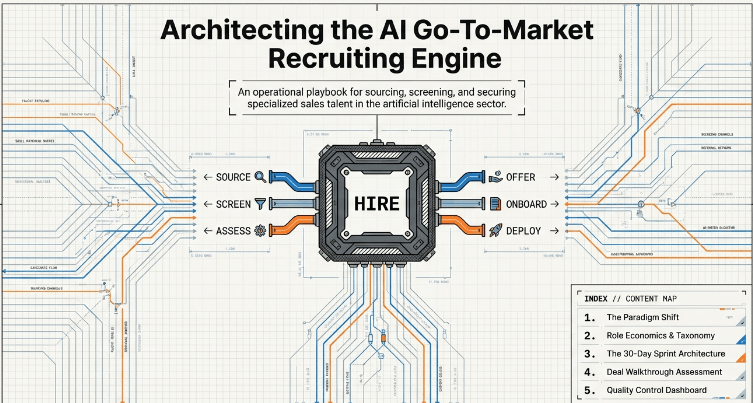
This guide covers every major sales recruiter position in AI companies — what each role actually does, what skills matter, what it pays, where it sits in the org, and what separates a strong hire from a weak one.
SECTION 1: WHY SALES RECRUITING IN AI IS A DIFFERENT JOB ENTIRELY
1.1 Why Does Hiring Sales Talent for an AI Company Require a Specialist Recruiter?
Because AI sales requires a very specific type of seller — someone who can handle technical objections, navigate multi-stakeholder buying groups, and explain machine learning outcomes in plain business language. A generalist recruiter screening for quota history and polished presentation skills misses this completely.
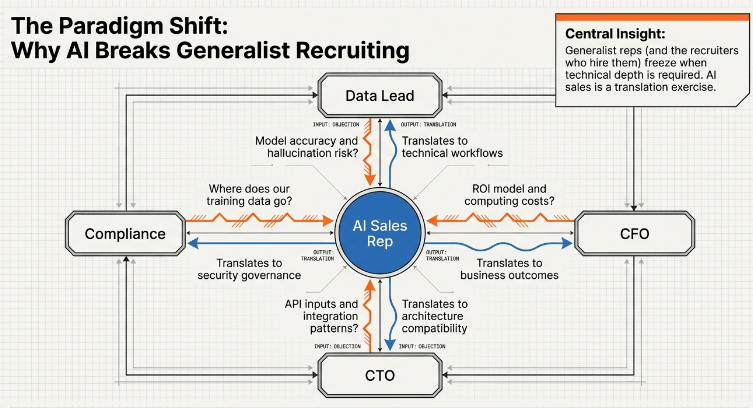
Think about what an AI sales rep actually faces on a call. The buyer is not just a VP of Sales or a marketing director. It is often a CTO, a data team lead, a compliance officer, and a CFO — all in the same meeting. Each person in that room has a completely different concern. The data lead wants to know about model accuracy and hallucination risk. The CFO wants to see an ROI model. The compliance officer wants to know where the data goes.
A sales rep who can navigate all of that is rare. Most good enterprise SaaS reps cannot do it. They freeze when the technical questions get deep.
So a recruiter inside an AI company needs to know how to spot the difference between a candidate who sounds technically fluent and one who actually is. That requires the recruiter to understand AI well enough to run a real screening conversation — not just check boxes on a resume.
Hiring top sales talent in AI is not like hiring for a typical SaaS company. AI companies need go-to-market teams who can translate complex technology into real customer outcomes. That translation skill is the thing most generalist recruiters cannot assess because they do not know what good looks like.
The result: AI companies that use general recruiting teams or post on LinkedIn and wait end up with sales reps who are good at selling but cannot hold the room when the technical questions start. Revenue slows. The company blames the product. The real problem was the hire.
1.2 What Are the Actual Sales Roles That AI Companies Need Recruiters to Fill?
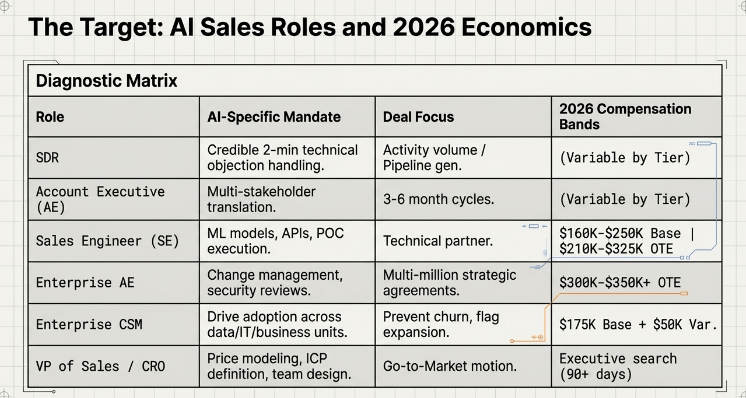
The six roles that AI companies hire most frequently are: Sales Development Representative (SDR), Account Executive (AE), Sales Engineer (SE), Enterprise Account Executive, Customer Success Manager (CSM), and VP of Sales or CRO. Each requires a different screening approach.
Let us go through each one with specifics.
Sales Development Representative (SDR) This is the prospecting role. SDRs run outbound sequences, qualify inbound leads, and book meetings for AEs. In an AI company, the SDR needs to know enough about the product to have a credible 2-minute cold call conversation and handle the first “but how does the AI actually work?” objection.
What to screen for: high activity tolerance, coachability, and a basic grasp of how the product solves a business problem. Do not screen SDRs the same way you screen AEs. SDRs are volume-based; AEs are judgment-based.
Account Executive (AE) Mid-market AEs run full sales cycles — discovery, demo, proposal, negotiation, close. In AI, the cycle is longer because procurement, security review, and legal sign-off all add stages. AEs need to manage multiple stakeholders and keep deals moving across a 3–6 month timeline without losing momentum.
What to screen for: multi-stakeholder management experience, deal size alignment (a rep who has only closed $30K deals will struggle on a $300K AI platform sale), and the ability to explain technical value in business terms.
Sales Engineer (SE) The SE is the technical partner to the AE. They run product demos, answer deep technical questions, run proof-of-concept projects, and translate customer workflows into product solutions. In AI, SEs need to understand model inputs, outputs, APIs, and integration patterns.
Sales Engineer salary in AI: $160,000 to $250,000 base, with on-target earnings (OTE) of $210,000 to $325,000. This is among the most technically demanding sales-adjacent roles in the market.
Enterprise Account Executive Enterprise AEs manage large, complex deals with major organizations. They work with multiple decision-makers across lengthy sales cycles, negotiating contracts that can reach into the millions. These sellers act as strategic partners to C-level executives, shaping multi-year agreements that directly impact company growth. AI solutions often require significant organizational change management, security reviews, and procurement complexity.
Enterprise AE salary in AI: $300,000 to $350,000 OTE, with top performers exceeding $400,000.
Enterprise Customer Success Manager (CSM) CSMs own the relationship after the deal closes. In AI, this is more complex than traditional SaaS because the customer is often running an AI deployment that involves a data science team, an IT team, and a business unit all with different expectations. CSMs need to drive adoption, flag expansion opportunities, and prevent churn by making the AI actually work inside the customer’s environment.
Enterprise CSM salary for $500K–$1M accounts: $175,000 base plus $50,000 variable.
VP of Sales / CRO The sales leadership hire. In an early-stage AI company, this person builds the entire go-to-market motion pricing, ICP definition, sales process design, hiring plan, and territory model. They have usually scaled a technical sales team before and understand how to hire for AI specifically.
Recruiting for this role is executive search work. It is confidential, reference-heavy, and takes 90+ days to do properly.
SECTION 2: THE CORE SALES RECRUITER POSITIONS IN AI ORGANIZATIONS
2.1 What Does a Sales Talent Acquisition Specialist Do Inside an AI Company?
Quick answer: A Sales Talent Acquisition Specialist sources, screens, and pipelines SDR and AE candidates. They own the full recruiting funnel for individual contributor sales roles sourcing through LinkedIn Recruiter and Gem, running first-round screens, coordinating with hiring managers, and managing offer logistics. This is a high-volume, process-driven role.
This is the entry point into sales recruiting in AI. The role exists because AI companies hire SDRs and AEs in waves — when a new product launches, when a new vertical opens, or when a sales team scales after a funding round. A Talent Acquisition Specialist handles that volume without dropping quality.
What the job actually looks like day to day:
In the morning, the specialist logs into Gem — a recruiting CRM and sourcing platform that combines candidate tracking, automated outreach sequences, and pipeline analytics. They review responses from outbound sequences they set up earlier in the week targeting SDRs with 1–3 years of SaaS experience and some exposure to technical products.
In the afternoon, they run phone screens with 4–6 candidates. These are 20–30 minute calls. The specialist is trying to answer two questions: Can this person explain what they sell in clear, compelling language? And do they have the activity metrics (dials, connects, meetings booked) that suggest they can hit a number?
What NOT to do in this role: Do not screen SDR candidates for deep AI knowledge. SDRs learn product through onboarding. What you are screening for is coachability, resilience, and communication clarity. A specialist who over-indexes on product knowledge misses candidates who would excel with proper training.
What TO do: Build a passive candidate pipeline using LinkedIn Recruiter Boolean strings like "SaaS" AND "SDR" AND ("machine learning" OR "AI" OR "data analytics") AND "quota". Do not wait for applicants. The best SDR candidates are already employed and performing well. You have to find them.
This role typically reports to a Senior Sales Recruiter or a TA Manager. Salary range: $65,000–$90,000 base.
2.2 What Does a Senior Sales Recruiter Do and Why Is This the Most Critical Hire in a Growing AI Company?
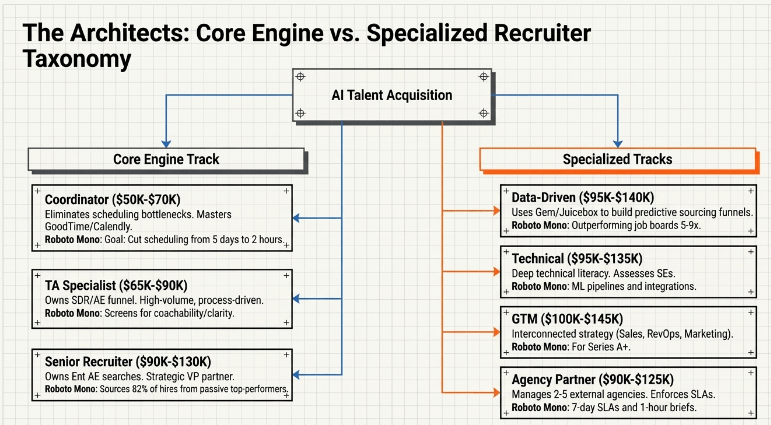
Quick answer: A Senior Sales Recruiter owns executive-level and strategic AE searches. They source passive candidates who are not applying anywhere, run competency-based interview processes for complex roles, and act as a genuine strategic partner to the VP of Sales. This is the person who determines whether the sales team scales well or collapses under bad hires.
The Senior Sales Recruiter is not doing volume work. They are doing precision work. One wrong hire at the Enterprise AE or Sales Manager level costs the company 6–12 months of salary, plus the lost pipeline from deals that were mishandled. That is a $500,000–$1,000,000 mistake on a single bad hire.
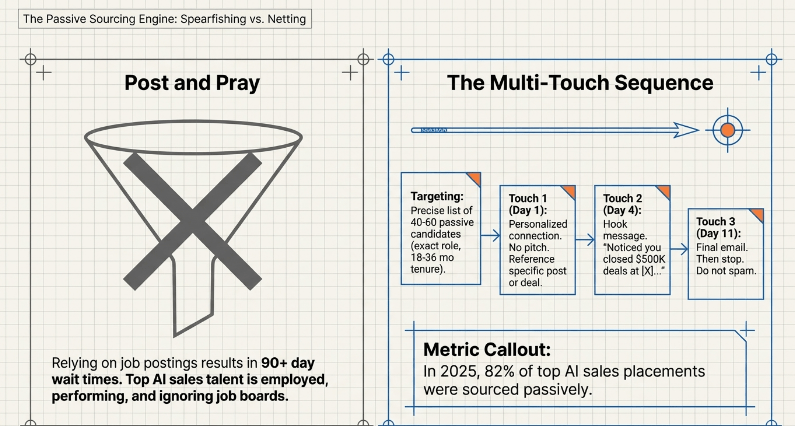
In 2025, 82% of candidates placed by top AI sales recruiting firms were sourced from passive top performers currently employed. That means the Senior Sales Recruiter’s most important skill is not writing job descriptions it is finding people who are not looking.
How passive sourcing actually works:
The Senior Sales Recruiter builds a target list of 40–60 people who currently hold the exact title and deal profile they are looking for Enterprise AEs closing $200K+ AI deals at companies like Salesforce AI, Microsoft Copilot, NVIDIA, or mid-stage AI startups. They then run a multi-touch outreach sequence:
- Touch 1: LinkedIn connection request with a brief, personal note (no pitch)
- Touch 2: Three days later, a follow-up message with a specific reason they reached out — “I noticed you closed three $500K deals last year at [Company]. We are building something similar and would value your perspective”
- Touch 3: Email to their work address if available, or a direct message on another platform
This is not mass outreach. Each message should reference something specific about the candidate’s background. Generic outreach gets ignored. Personalized outreach gets responses.
The Senior Sales Recruiter also runs the competency interview for AE candidates. This is not a casual conversation. It is a structured interview that asks the candidate to walk through a specific deal from their pipeline — how they found it, how they ran discovery, what objections they hit, and how they closed it. The recruiter listens for specifics. Vague answers (“we handled objections by building trust”) signal a weak candidate. Specific answers (“the technical buyer pushed back on our integration timeline, so I brought in our SE to co-host a 2-hour technical deep-dive and we resolved it with a phased implementation plan”) signal a strong one.
What NOT to do: Do not let the hiring manager run the search without a structured process. Hiring managers default to pattern-matching on logos they hire from companies they know, for roles they understand. The Senior Sales Recruiter’s job is to expand that aperture and enforce rigor.
Salary range: $90,000–$130,000 base. Some AI companies offer equity.
2.3 What Does a Sales Recruitment Coordinator Do and Where Does This Role Add Real Value?
Quick answer: A Sales Recruitment Coordinator manages the operational side of recruiting — scheduling interviews, tracking candidate status in the ATS, preparing offer letters, and ensuring candidates have a smooth experience. In AI companies where top candidates receive 3–5 competing offers simultaneously, a fast and organized process is a competitive advantage.
The coordinator is the person who makes the recruiter look good. Or makes them look slow.
Here is the reality: the best Enterprise AE candidates have a shelf life of about two weeks before another company closes them. If your interview process takes six weeks because scheduling is disorganized, you lose them. The coordinator’s job is to collapse that timeline.
In a well-run recruiting operation at an AI company, the coordinator uses Calendly or GoodTime (a scheduling automation tool that syncs interviewer calendars and offers candidates self-scheduling links) to eliminate the 15-email scheduling chain. A candidate gets a link, picks a time, and the interview is confirmed automatically. This alone cuts scheduling time from 3–5 days to under 2 hours.
The coordinator also owns the ATS the Applicant Tracking System. Most AI companies use Greenhouse or Lever. The coordinator keeps every candidate’s status current, adds interview feedback notes from hiring managers, and flags any candidates who have gone more than 3 days without a touchpoint (because silence kills candidates’ enthusiasm faster than anything).
What NOT to do: Do not treat this as a purely administrative role. The best coordinators also run a light candidate experience check after each interview a short message asking if the candidate has any questions or needs any clarity. This gives the company a warm, responsive feel that candidates notice and mention when they are deciding between offers.
Salary range: $50,000–$70,000. Often the entry point into a recruiting career for someone transitioning from sales operations or HR coordination.
2.4 What Does a Sales Talent Acquisition Manager Do and How Is It Different From a Senior Recruiter?
Quick answer: A Sales Talent Acquisition Manager owns the entire sales recruiting function strategy, team management, process design, and reporting to leadership. They do not typically source and screen themselves. They set the system, manage the recruiters, and ensure the pipeline of sales talent matches the company’s growth plan. This is a people manager role, not an individual contributor role.
The distinction matters. Many companies confuse these two roles and promote a strong Senior Recruiter into a Manager position without realizing the job is completely different. Senior Recruiters are great at finding and closing individual candidates. Managers are great at building systems and developing recruiting teams.
A Sales TA Manager at an AI company spends their time:
Setting hiring targets: Working with the VP of Sales and CFO to determine how many AEs, SDRs, and SEs the company needs per quarter, and in what territories. This is a capacity planning conversation, not a recruiting conversation.
Designing the intake process: When a new role opens, the Manager runs an intake meeting with the hiring manager before any sourcing begins. This meeting defines: the ideal candidate profile (not just a job description, but the specific background, deal size, and company stage that produces success in this role), the interview process steps, the timeline, and the decision criteria. Without a good intake, recruiters source the wrong people for weeks.
Analyzing recruiting metrics: The Manager tracks time-to-fill (how many days from job opening to accepted offer), source-of-hire (are top performers coming from LinkedIn, referrals, or agencies?), offer acceptance rate, and 90-day retention of new hires. If time-to-fill for Enterprise AE roles is running at 90 days, that is a flag. The Manager investigates whether the problem is sourcing (not enough good candidates entering the funnel), screening (too many candidates being filtered out too early), or closing (offers that are losing to competitors).
Building agency relationships: For senior and executive roles, AI companies often use recruiting agencies. The Manager decides which agencies to partner with, negotiates terms (typically 15–25% of first-year base salary as a contingency fee), and manages the agency relationship to ensure they are not wasting time on poor-fit candidates.
What NOT to do: Do not let the Manager stay in the weeds of individual searches. A TA Manager who is sourcing candidates themselves is a sign that the team is understaffed or that the Manager has not made the transition from individual contributor to leader.
Salary range: $110,000–$160,000 base. Typically includes equity at growth-stage AI companies.
2.5 What Is a Data-Driven Sales Recruiter and Why Are AI Companies Creating This Role Now?
Quick answer: A Data-Driven Sales Recruiter uses AI recruiting tools and performance analytics to predict which candidates will succeed — not just who looks good on paper. They analyze patterns from previous hires, use predictive scoring to rank candidates, and build sourcing funnels that outperform traditional job posting by 5–9x.
This role is relatively new. It emerged because AI companies started noticing that traditional recruiting correlated poorly with actual sales performance. Candidates who interviewed brilliantly sometimes failed. Candidates who were nervous in interviews sometimes became top performers. The intuition-based approach was failing at scale.
The Data-Driven Sales Recruiter uses three specific tools:
Gem (gem.com): A recruiting CRM and analytics platform that combines candidate sourcing, outreach automation, and pipeline tracking. In Gem, the recruiter builds sourcing campaigns targeting specific candidate profiles. Gem’s LLM-powered search covers 20+ databases and delivers AI-personalized outreach. Open rates for AI-personalized recruiter outreach average 40–50%, compared to 20–25% for generic templates.
Here is how to use Gem for AI sales hiring:
- Create a new project for the role (example: “Enterprise AE — Healthcare AI”)
- Build a Boolean search:
"Enterprise Account Executive" AND ("AI" OR "machine learning" OR "healthcare tech") AND ("quota" OR "ARR") - Set up a 3-touch automated outreach sequence with personalized first-line variables that pull from the candidate’s LinkedIn profile
- Review responses daily. Move interested candidates to a “phone screen” stage. Archive unresponsive candidates after 14 days.
- Track campaign-level open rates and response rates. If a campaign gets below 20% open rate, rewrite the subject line.
Juicebox (juicebox.ai / PeopleGPT): A conversational AI search tool that lets you search across 600 million+ profiles using natural language instead of Boolean strings. Instead of writing "SDR" AND "SaaS" AND "AI" NOT "manager", you type: “Sales development reps with 1–3 years experience at AI or ML startups who have hit quota consistently.” The tool interprets the intent and returns a ranked list of candidates.
Juicebox is faster for niche searches where Boolean logic gets complicated. Use Juicebox for initial discovery, then move to Gem for outreach sequencing.
Predictive performance analytics: Some AI companies now score candidates using tools like Eightfold AI or Phenom, which analyze historical hire data and flag candidates whose backgrounds statistically resemble top performers at the company. Eightfold’s talent intelligence platform uses deep learning to match candidates to roles based on skills and potential, not just keyword matches.
One important warning: do not over-rely on algorithmic scoring. Amazon famously shut down an AI resume screener after discovering it systematically downgraded resumes containing the word “women’s.” Any AI scoring model needs regular audits against actual performance outcomes to verify it is surfacing genuinely better candidates — not just replicating whatever biases existed in historical hiring data.
Salary range: $95,000–$140,000. This role is increasingly common at Series B and later AI companies.
SECTION 3: SPECIALIZED ROLES IN AI SALES TALENT ACQUISITION
3.1 What Is a GTM Recruiter and Why Does Every AI Company Past Series A Need One?
Quick answer: A GTM (Go-To-Market) Recruiter specifically hires for the entire revenue-generating function — sales, marketing, revenue operations, customer success, and sales engineering. In an AI company, these functions are deeply interconnected, and a recruiter who understands all of them builds a stronger, more coordinated team than one who only handles sales.
GTM recruiting is different from general sales recruiting because the GTM Recruiter thinks in terms of the whole revenue motion, not individual job titles.
When an AI company is building its first GTM team at Series A, the GTM Recruiter helps answer questions like: Do we hire an SDR team or go outbound-only with senior AEs? Do we need a Sales Engineer on day one, or can the founding team demo the product? Should the first marketing hire be demand generation or product marketing?
These are not just hiring questions. They are business strategy questions. The GTM Recruiter who can participate in that conversation at a strategic level is worth significantly more than one who just fills job requisitions.
The GTM Recruiter also manages role transitions. If the company plans to hire a founding AE and then pivot to a Director of Sales six months later, the GTM Recruiter adapts the search without losing momentum. A high-touch process means pivoting quickly without losing a step when roles change mid-search.
A bad GTM hire costs 6–12 months of salary plus lost deals and damaged customer relationships. Generic recruiters who do not understand GTM nuances make these expensive mistakes regularly. Specialized GTM recruiters reduce hiring errors through better assessment and market knowledge.
What the GTM Recruiter assesses differently than a general recruiter:
- For AEs: Can they articulate how they run discovery? Not just “I ask about their problems” — but specifically what questions they ask and in what order.
- For SDRs: Can they personalize outreach in real-time? Give them a LinkedIn profile in the interview and ask them to write a cold email opening on the spot.
- For CSMs: Can they hold a difficult renewal conversation? Role-play a customer who is threatening to churn because the AI model is giving inaccurate outputs.
- For RevOps: Can they build a compensation plan? Ask them to walk through how they would design OTE for a new SDR team.
Salary range: $100,000–$145,000 base. Some GTM Recruiters at growth-stage AI companies earn equity that makes total compensation significantly higher.
3.2 What Is a Recruiting Agency Partner Role and When Does an AI Company Actually Need One?
Quick answer: A Recruiting Agency Partner manages the relationship between an AI company and external recruiting agencies. This role exists at companies that rely on 2–5 agencies simultaneously for hard-to-fill roles. The partner evaluates agency quality, negotiates terms, briefs agencies on the ideal candidate profile, and holds them accountable for results.
This is an internal role — not the agency recruiter. It is the person inside the AI company who manages the agency ecosystem.
AI companies use agencies when:
- They need to hire faster than internal recruiting capacity allows
- The role is senior or executive (VP of Sales, CRO) and requires confidentiality
- They are entering a new geographic market and need a local recruiting partner
- A role has been open for 90+ days and internal search has failed
The problem with using agencies without an internal partner managing them: every agency sends their “best” candidates, but agencies get paid when you hire someone — not when you hire the right person. Without a strong internal partner running rigorous briefs and strict feedback cycles, agencies default to sending whoever is available and enthusiastic, not whoever is genuinely right for the role.
The Recruiting Agency Partner fixes this by:
- Running a structured agency briefing before search begins. This is not a 10-minute call. It is a 1-hour working session where the Partner walks the agency through the specific type of deal the AE will close, the technical objections they will face, the culture of the sales team, and what failure looks like at the 90-day mark.
- Setting a 7-day response SLA. Within 7 days of briefing, the agency submits 3–5 candidates. If the candidates are off-profile, the Partner gives specific written feedback — not “these aren’t right” but “these candidates have only closed $50K deals; we need someone with $300K average deal size.”
- Requiring agency exclusivity windows strategically. For executive roles, negotiate a 2-week exclusivity window with one agency before opening to a second. This motivates the first agency to move fast and focus resources.
Agency fees for sales recruiting typically run 15–20% of first-year base salary as a contingency fee (paid only if you hire), or a retained search structure for senior roles (partial payment upfront, partial on completion). Know the difference before signing.
Salary range: $90,000–$125,000. Often a stepping stone to a TA Manager or VP of Talent role.
3.3 What Is a Technical Sales Recruiter and How Do They Screen Sales Engineers for AI Companies?
Quick answer: A Technical Sales Recruiter hires for roles that require both sales skill and deep technical knowledge — primarily Sales Engineers and Solutions Architects. They need enough technical literacy to evaluate whether a candidate’s claimed knowledge of ML pipelines, APIs, and enterprise integrations is real or rehearsed.
Sales Engineers are the hardest sales-adjacent hire to get right. They need to be able to explain a machine learning model’s output to a CTO, demo a complex AI platform to a data science team, run a proof-of-concept deployment, and still be commercially minded enough to help close the deal.
Getting a wrong SE hire is expensive. Sales Engineer salary in AI runs $160,000–$250,000 base. Plus the indirect cost of AEs who cannot close deals without strong SE support during the 3–6 month POC phase.
How the Technical Sales Recruiter screens SEs:
The screen has three parts that no general recruiter would think to include:
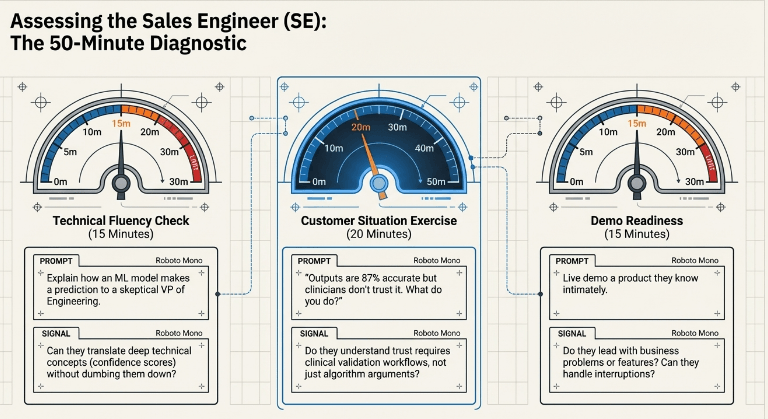
Part 1: Technical fluency check (15 minutes) Ask the candidate to explain how a machine learning model makes a prediction — in language they would use with a skeptical VP of Engineering who has never bought AI software before. This tests whether they can make technical content accessible without dumbing it down or losing accuracy.
Weak answer: “The model processes data and outputs a result based on its training.” Strong answer: “The model has learned patterns from millions of historical examples. When it sees new input, it compares it to those patterns and assigns a probability to each possible outcome. The one with the highest probability becomes the output. The interesting part is explaining why the model is confident, which is where I’d walk them through a few specific examples with the actual confidence scores.”
Part 2: Customer situation exercise (20 minutes) Give the candidate a scenario: “You are two months into a proof-of-concept with a 500-person healthcare company. The medical director says the AI outputs are correct 87% of the time, but the clinical team does not trust them. They are considering canceling. What do you do?”
What you are looking for: Does the candidate understand that trust in AI is not just about accuracy? Do they know to involve the clinical team in retraining or validation? Do they have a plan that keeps the deal alive without overpromising?
Part 3: Demo readiness check (15 minutes) Ask the candidate to demo a product they know well — could be a previous employer’s product, could be a tool they use personally. Watch how they structure it. Do they lead with the customer’s business problem or with features? Do they handle questions mid-demo without losing the thread?
Salary range for Technical Sales Recruiters: $95,000–$135,000 base.
SECTION 4: THE SKILLS THAT SEPARATE AVERAGE FROM EXCEPTIONAL IN AI SALES RECRUITING
4.1 What Technical Knowledge Does a Sales Recruiter Actually Need to Hire Well in an AI Organization?
Quick answer: You do not need to be a data scientist. You need to understand three things: what the AI product does for the customer (the business outcome), what the technical buying process looks like (who is in the room and what they care about), and what questions a technical buyer asks that would expose a weak sales rep.
There is a common mistake here. Companies either hire sales recruiters with no technical background who struggle to evaluate real technical fluency in candidates — or they hire highly technical people who have never recruited and do not know how to assess whether someone can actually sell.
The right profile is a sales recruiter who has spent enough time with the product team, sales engineers, and customers to understand the problem the AI solves and the typical objections it faces. This does not require a computer science degree. It requires curiosity, a willingness to sit in on sales calls and demos, and the intellectual honesty to say “I need to learn this before I can screen for it.”
Practically, a good AI sales recruiter should be able to:
- Explain the product in one sentence in business language
- List the top 3 technical objections buyers raise
- Describe the typical buying committee (who signs, who blocks, who champions)
- Explain what a proof-of-concept looks like and how long it takes
- Know what “quota” actually means in context (monthly, quarterly? What is a good number for this role and market?)
If you cannot answer those questions about the role you are recruiting for, you will evaluate candidates wrong.
4.2 Why Does Passive Candidate Sourcing Matter More in AI Sales Recruiting Than Anywhere Else?
Quick answer: Because the best AI sales talent is already employed, performing well, and not applying anywhere. The only way to reach them is through proactive, personalized outreach. Companies that rely on job postings for senior AI sales roles wait an average of 90+ days and often compromise on the hire.
The numbers tell the story clearly. In 2025, 82% of candidates placed by top AI sales recruiting firms were sourced from passive top performers who were currently employed. These people will never see your LinkedIn job post because they are not looking.
Passive sourcing in AI sales works differently than in general recruiting. Here is the specific approach:
Step 1: Build your target list Before writing a single message, identify 40–60 people who currently hold the exact role you are hiring for, at companies whose deal profiles match yours. If you are hiring an Enterprise AE to sell a $200K AI analytics platform to Fortune 500 CFOs, your target list includes Enterprise AEs at Databricks, Snowflake, Palantir, and comparable AI companies who have been in their current role 18–36 months (long enough to have real results, but possibly ready for a new challenge).
Step 2: Personalize the first message Do not send a template. Go to each candidate’s LinkedIn profile and find one specific thing — a post they wrote, a deal they referenced, a company they work at, a mutual connection who vouched for them. Your first message references that thing. It is 3–4 sentences maximum. It does not pitch the role. It creates a reason to talk.
Good example: “Saw your post about the 9-month enterprise sales cycle at [Company]. We’re navigating something similar here and I’d value your perspective — would you be open to a 20-minute call?”
Bad example: “Hi, I’m a recruiter and I have an exciting opportunity that might be a great fit for your background. We’re a fast-growing AI company…”
Step 3: Follow up twice, then stop If there is no response after the first message, follow up once 5–7 days later with a specific new hook. If still no response, send one final note 10 days after that. Then stop. Repeated messages beyond three touches are not persistence — they are spam and they damage the company’s reputation with people you may want to approach again in the future.
4.3 How Do You Assess Whether an AI Sales Candidate Will Actually Close Enterprise Deals?
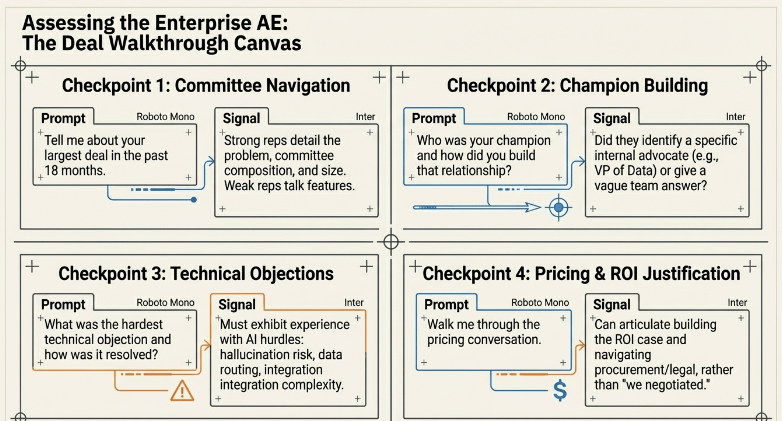
Quick answer: Use a structured deal walkthrough interview. Ask the candidate to walk through a specific deal from start to close in real time. Listen for how they describe the buying committee, what objections they faced, and how they managed the technical evaluation. Generic answers expose weak candidates faster than any resume screen.
This is the single most predictive interview format for enterprise AI sales roles, and most companies do not use it properly.
Here is the specific structure:
Question 1: “Tell me about the largest deal you have closed in the past 18 months.”
Wait. Do not prompt further. See what they tell you. Strong candidates immediately describe the customer’s problem, the buying committee composition, and the deal size. Weak candidates describe features of the product they sold.
Question 2: “Who was the champion inside the account, and how did you develop that relationship?”
This tests whether they know how to navigate political complexity inside an enterprise buyer. Good AI sales reps identify a specific internal advocate — usually a VP of Data or a Director of Operations who wants the AI to succeed — and invest heavily in that relationship. Weak reps say things like “we worked closely with the whole team.”
Question 3: “What was the hardest technical objection you faced and how did you resolve it?”
For AI sales, common objections include: model accuracy concerns (“what happens when the AI is wrong?”), data privacy worries (“where does our data go?”), integration complexity (“how does this connect to our existing stack?”), and governance concerns (“how do we explain this to regulators?”). A candidate who has sold AI before has dealt with all of these. A candidate who has sold simpler software has not.
Question 4: “Walk me through your pricing conversation. How did you justify the price?”
AI products are often expensive and the value is not always immediate. Strong AEs can explain how they built the ROI case, how they handled procurement pushback, and how they got legal and compliance through the process. Weak AEs say “we negotiated a bit and they signed.”
The recruiter should take detailed notes during this interview and compare them to the hiring manager’s assessment. Any significant gap in evaluation between recruiter and hiring manager is worth discussing before moving the candidate forward.
SECTION 5: THE TOOLS AND PROCESS THAT AI SALES RECRUITING RUNS ON
5.1 Which Recruiting Tools Do AI Companies Actually Use for Sales Talent Acquisition?
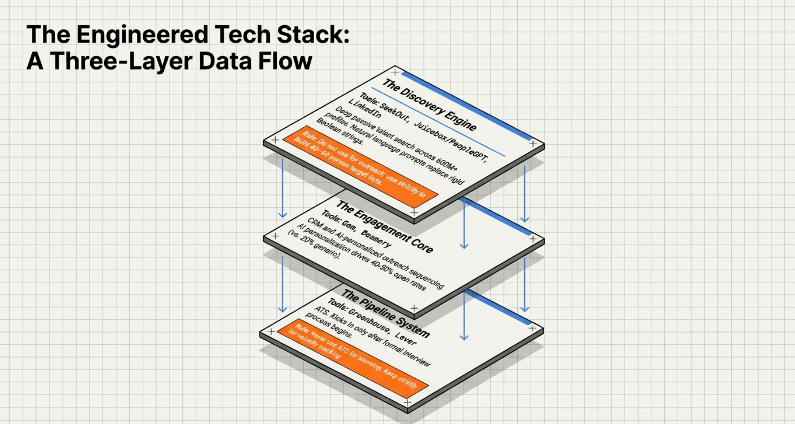
Quick answer: The core stack for most AI sales recruiting operations is: LinkedIn Recruiter (sourcing), Gem or Beamery (CRM and outreach sequencing), Greenhouse or Lever (ATS), and SeekOut or Juicebox (deep passive talent search). Each tool has a specific job. Using all of them without a clear workflow creates duplicate work.
Let us break down each tool and exactly where it fits:
LinkedIn Recruiter ($10,000–$15,000/year per seat) The baseline sourcing tool. Its main value is the InMail system, which lets you reach anyone on LinkedIn regardless of connection level. For AI sales recruiting, use LinkedIn Recruiter to build a first-pass list of candidates, then export to Gem for sequenced outreach.
Boolean search on LinkedIn for Enterprise AEs: "Enterprise Account Executive" OR "Senior Account Executive" AND ("AI" OR "machine learning" OR "artificial intelligence") AND ("$500K" OR "$300K" OR "quota" OR "ARR")
Limitation: LinkedIn has too much noise. Its algorithm also suppresses recruiters who send high-volume generic InMails. Keep InMail acceptance rates above 30% by personalizing every message.
Gem (gem.com) — pricing varies by team size Gem is an AI-first recruiting platform that combines sourcing, outreach sequencing, CRM, and analytics. It layers on top of LinkedIn Recruiter and your ATS. Use Gem to:
- Set up a 3-touch outreach sequence with personalized first lines
- Track which campaigns are generating responses and which are not
- Build talent pools of warm candidates who responded but were not right for the current role (they may be right in 6 months)
- Report to leadership on source-of-hire and pipeline health
Greenhouse (greenhouse.io) or Lever (lever.co) — ATS The Applicant Tracking System manages candidates once they are in the formal interview process. Greenhouse is more structured and better for companies with formal hiring processes. Lever is more flexible and better for fast-moving startups. Both integrate with Gem and LinkedIn.
Do not use the ATS for sourcing. Use it only for pipeline management from first interview onward.
Juicebox / PeopleGPT (juicebox.ai) Juicebox is a conversational AI search tool across 600 million+ profiles. Use it for niche searches where LinkedIn Boolean logic becomes unwieldy. Type a plain-language description and get a curated shortlist.
Best use case: “Find Sales Engineers with experience selling machine learning platforms to enterprise healthcare buyers.” Juicebox interprets that intent and returns relevant profiles from a wider dataset than LinkedIn alone.
SeekOut (seekout.com) SeekOut is an AI-powered talent search engine that lets recruiters find passive candidates using natural language prompts across a database that includes LinkedIn, GitHub, academic publications, and other public sources. Particularly useful for finding Sales Engineers with genuine technical depth — you can filter by actual GitHub contributions or published work, not just job titles.
A recruiter using Juicebox and SeekOut together for passive sourcing outperforms a job board-only approach by nearly 9x.
5.2 How Do You Build a Repeatable Sales Recruiting Process That Fills Roles in Under 30 Days?
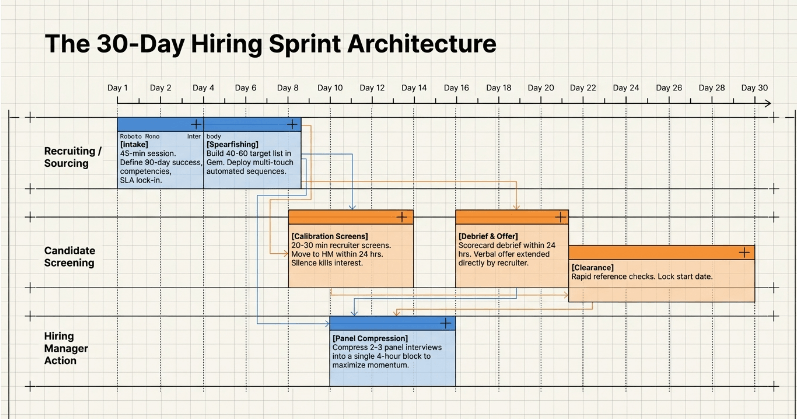
Quick answer: The 30-day fill timeline is achievable for SDR and mid-market AE roles when you run five steps in parallel: intake meeting on day 1, sourcing begins on day 2, first screens by day 7, panel interviews by day 14, offers by day 21, start date day 30. Every day of delay past day 10 increases the risk of losing the candidate to a faster competitor.
Let us map this out specifically.
Day 1 — Intake meeting The recruiter meets the hiring manager. Not a 10-minute call. A structured 45-minute session with a written output that documents: the ideal candidate profile (3–5 specific background requirements, not a generic job description), the interview process (who is involved, in what order, and what each interviewer is assessing), the timeline expectation, and what “done” looks like for the first 90 days of the hire.
If the hiring manager cannot describe what success looks like in 90 days, the recruiter pushes back before sourcing begins. Sourcing without a clear success definition generates the wrong candidates every time.
Day 2–6 — Sourcing and outreach Recruiter builds target list in Gem. Sets up outreach sequences. Sends first-touch messages to 40–60 passive candidates. Reviews inbound applications if the role is posted.
Day 7–10 — First screens Phone screens run 20–30 minutes. Recruiter assesses communication quality, career narrative, motivation for the move, and basic product/customer fit. Strong candidates are moved to the hiring manager screen within 24 hours.
Do not let candidates wait 5+ days to hear back after a phone screen. Every day of silence is a day they are interviewing somewhere else.
Day 11–15 — Hiring manager screen and panel interviews Hiring manager interviews run 45–60 minutes. Panel interviews (2–3 interviewers) are scheduled in a single day where possible — not spread across a week. Candidates who fly through a full interview day in 4 hours feel more wanted than candidates who come back four separate times.
Day 16–21 — Debrief, decision, offer Recruiting runs a structured debrief with all interviewers within 24 hours of the final interview while feedback is fresh. Decision is made. Offer is extended verbally first — never email-first. The recruiter calls the candidate, walks through the offer, pre-closes on any concerns, and confirms verbal acceptance before sending the written offer.
Day 22–30 — References and start date Reference checks run immediately after verbal acceptance. Two references from managers who saw the candidate sell. One from a peer or customer if possible. Start date is set for day 30 or as close to it as the candidate’s notice period allows.
What kills this timeline: slow hiring manager availability, multi-week gaps between interview stages, or delayed decisions after the final interview. The recruiter’s job is to actively compress every gap.
SECTION 6: COMPENSATION, CAREER PATH, AND WHAT THESE ROLES PAY IN 2026
6.1 What Do Sales Talent Recruiter Roles Pay in AI Organizations in 2026?
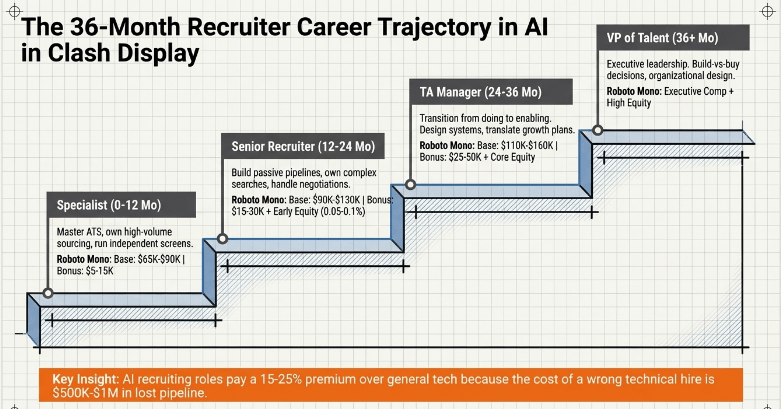
Quick answer: Sales recruiting roles in AI organizations pay 15–25% more than equivalent roles in general tech companies because the search complexity is higher and the cost of wrong hires is significantly greater. Here are the specific salary ranges by role.
| Role | Base Salary | Additional Compensation |
|---|---|---|
| Sales Recruitment Coordinator | $50,000–$70,000 | Minimal bonus |
| Sales Talent Acquisition Specialist | $65,000–$90,000 | $5,000–$15,000 bonus |
| Senior Sales Recruiter | $90,000–$130,000 | $15,000–$30,000 bonus + equity |
| Data-Driven Sales Recruiter | $95,000–$140,000 | $15,000–$30,000 bonus + equity |
| Technical Sales Recruiter | $95,000–$135,000 | $15,000–$25,000 bonus |
| GTM Recruiter | $100,000–$145,000 | $20,000–$40,000 bonus + equity |
| Recruiting Agency Partner | $90,000–$125,000 | $15,000–$25,000 bonus |
| Sales Talent Acquisition Manager | $110,000–$160,000 | $25,000–$50,000 bonus + equity |
Equity is increasingly common at Series A through C AI companies for all recruiting roles. A Senior Recruiter at a Series B AI company may receive 0.05–0.1% equity — which at a successful exit is meaningful. At a $1B exit, that is $500,000–$1,000,000.
The highest-paid sales recruiting roles in AI are at the manager level or above, at companies post-Series B, or in locations with high cost of living (San Francisco, New York, Seattle). Remote roles at AI companies headquartered in major tech hubs often pay at the SF/NY level regardless of where the recruiter is located.
6.2 What Career Path Does a Sales Talent Recruiter Follow Inside an AI Organization?
Quick answer: The typical path is: Coordinator → Specialist → Senior Recruiter → TA Manager → VP of Talent Acquisition. Each step adds scope and strategic responsibility. The fastest progression happens at fast-growing AI companies where the function expands quickly and early hires move up as the team scales.
Here is what each step actually requires to advance:
Coordinator to Specialist (12–18 months): Demonstrate mastery of the scheduling and ATS workflow. Start owning sourcing campaigns for high-volume roles. Build relationships with hiring managers. Show you can run a phone screen without significant supervision.
Specialist to Senior Recruiter (18–24 months): Own a full search from intake to offer on a complex role. Build a passive candidate pipeline from scratch. Handle an offer negotiation without manager involvement. Demonstrate understanding of the GTM structure well enough to advise hiring managers on role definition.
Senior Recruiter to TA Manager (24–36 months): This transition requires moving from doing to enabling. Can you design a process that your team follows? Can you develop a junior recruiter? Can you translate a business growth plan into a hiring plan with timelines and headcount targets? The technical recruiting skill is table stakes here — leadership is the differentiator.
TA Manager to VP of Talent Acquisition: The VP role is a business leadership role. You sit in on exec team meetings, own the people strategy alongside the CPO, and make decisions about build-vs-buy (when to hire internally, when to use agencies, when to outsource to RPO). This requires enough credibility with the CEO, CFO, and VPs that they genuinely seek your input on organizational design.
Here you can check data maturity and infrastructure prerequisites before adoption. Check our latest enterprise CoE models for scaling guidance.
SECTION 7: COMMON MISTAKES THAT BREAK AI SALES RECRUITING
7.1 Why Do Most AI Companies Hire the Wrong Sales Talent and How Does the Recruiter Fix It?
Quick answer: Three mistakes cause most bad AI sales hires: screening for logo prestige instead of deal fit, using unstructured interviews that let candidates charm their way through, and moving too slowly so the best candidates get hired by competitors. The recruiter fixes all three with a defined process, not with individual judgment.
Mistake 1: Logo screening
Hiring managers at AI companies often default to candidates from Google, Salesforce, Microsoft, or other well-known companies. The reasoning is intuitive: if they succeeded there, they will succeed here. But early-stage AI startups need sellers who are comfortable with ambiguity — a missing pricing page, a product that changes every sprint, a demo environment that breaks. Large-company reps are often the worst fit for this. They expect air cover, brand recognition, and a mature process.
The recruiter’s job is to challenge this instinct. Not by ignoring logos entirely, but by explicitly testing for startup readiness in the interview: “Tell me about a time you sold a product that was still being built. How did you handle customer expectations?” Someone from a large company who can answer this well is worth considering. Someone from a large company who goes blank is a risk.
Mistake 2: Unstructured interviews
AI company founders and VPs often run interviews as conversations. They like the candidate, the energy is good, and they make an offer. Three months later the rep cannot close a deal because they never had the right background for the deal complexity.
The recruiter’s fix: implement a scorecard before any candidate enters the interview process. The scorecard lists 5–7 specific competencies that matter for the role — things like multi-stakeholder management, technical objection handling, deal size experience, territory building. Every interviewer scores the candidate on each competency with specific evidence. Offer decisions require evidence against the scorecard, not just a gut feeling.
Mistake 3: Slow process
A qualified Enterprise AE who interviews at your company on a Tuesday is receiving offers from 2–3 other companies by the following Monday. If your process takes 6 weeks because scheduling is fragmented and decisions take forever, you do not get the best people. You get the people who were willing to wait.
The recruiter’s fix: set an explicit SLA with the hiring manager at intake. “We will complete all interviews within 10 business days of the first screen. We will make a decision within 48 hours of the final interview. We will extend an offer within 24 hours of the decision.” Get this in writing. Hold the hiring team accountable to it.
Here you can check resume screening and onboarding workflow automation. Check our latest people analytics platforms for strategic workforce insights.
7.2 Why Is the Candidate Experience in AI Sales Recruiting a Competitive Advantage?
Quick answer: Top AI sales talent evaluates the company’s recruiting process as a signal of how the company operates overall. A disorganized, slow, or impersonal process tells a senior candidate that the company has execution problems — and they choose the other offer. A fast, respectful, and thoughtful process signals a well-run organization worth joining.
This is a point most recruiting articles mention briefly and then move on from. But it deserves real attention.
Think about what a top Enterprise AE sees in your recruiting process. If scheduling takes a week, interviewers show up unprepared, feedback takes two weeks to come back, and the offer letter has errors — this candidate, who has closed million-dollar deals and managed complex enterprise relationships, notices everything. They tell themselves: “If they can’t run a clean hiring process, how do they run a customer onboarding? Or a QBR? Or an executive sponsor call?”
The recruiter is the company’s first impression for every candidate. Every interaction — the first InMail, the scheduling, the pre-interview briefing, the post-interview follow-up — is part of that impression.
Specific things that create a strong candidate experience in AI sales recruiting:
- The recruiter sends a briefing document before every interview with details on who the candidate is meeting, the format of the conversation, and logistics. This takes 5 minutes and candidates consistently mention it as a sign of respect.
- After each interview, the recruiter calls the candidate with a status update within 24 hours — even if the update is “we are still in the process.” Silence after an interview is the single most-cited complaint from candidates who withdraw from processes.
- The offer call is done by the recruiter personally, not emailed. The recruiter walks through every component, asks if there are any concerns, and listens before the candidate has to decide.
A GTM recruiter in 2026 must source candidates across time zones, assess ability to operate autonomously, and evaluate culture fit without in-person interactions. The companies winning in distributed environments treat remote hiring as a distinct competency.
Here you can check predictive retention and workforce planning solutions. Check our latest HR automation tools for administrative efficiency.
SECTION 8: HOW TO BREAK INTO SALES TALENT RECRUITING IN AI ORGANIZATIONS
8.1 What Background Do You Need to Get a Sales Recruiter Job at an AI Company?
Quick answer: The fastest path is 1–2 years in a sales role at a tech or SaaS company, then transitioning to recruiting. Former sellers make strong sales recruiters because they understand the job from the inside and can credibly evaluate candidates. A pure HR or HRIS background without sales exposure is a harder starting point.
This is counterintuitive to people who think recruiting is an HR function. In AI companies, it is more of a sales and business function. The best sales recruiters have sold something, understand what a sales cycle feels like from the inside, and can talk to candidates as peers rather than as administrators.
If you have a sales background and want to move into recruiting at an AI company, start here:
Step 1: Get experience on the sourcing side first. Many AI companies use contract sourcers or research associates who build candidate lists and run outreach sequences. This is a lower-stakes entry point that builds the technical recruiting skill without requiring you to own a full search.
Step 2: Learn the tools. LinkedIn Recruiter, Gem, and Greenhouse are the core stack. Gem has free educational resources. Greenhouse offers certification. Get comfortable in all three before applying for recruiter roles.
Step 3: Apply to Coordinator or Specialist roles at Series A or Series B AI companies. These companies move fast, promote from within, and give you real ownership quickly. A large enterprise company might have you scheduling interviews for two years before you run a search. A Series B AI startup will have you owning searches within six months.
Step 4: Study the AI space specifically. Understand what the major product categories are — AI infrastructure (chips, cloud, MLOps), AI applications (vertical SaaS powered by AI), and AI platforms (tools that developers use to build AI products). Know 10–15 companies in each category, what they sell, who they sell to, and what their sales motion looks like. This knowledge makes you dramatically more credible in interviews for recruiting roles at AI companies.
Here you can check governance models and cross-functional alignment strategies. Check our latest team structure templates for talent allocation.
Final Checklist: What Strong Sales Talent Recruiting Looks Like in an AI Organization
Before any search begins, a strong AI sales recruiting operation can answer yes to all of these:
Process:
- [ ] Intake meeting completed with written ideal candidate profile
- [ ] Scorecard defined with 5–7 competencies and evidence criteria
- [ ] Interview process mapped with each interviewer’s specific assessment area
- [ ] Timeline set with SLAs for each stage
Sourcing:
- [ ] Passive sourcing campaign active in Gem or Juicebox targeting 40–60 named candidates
- [ ] First-touch messages personalized, not templated
- [ ] Job posting live only as a secondary channel (not the primary sourcing method)
Screening:
- [ ] Deal walkthrough interview format used for AE and SE roles
- [ ] Technical fluency check included for Sales Engineer screens
- [ ] Scorecard completed by every interviewer before debrief
Closing:
- [ ] Offer extended verbally by recruiter before written offer sent
- [ ] Compensation benchmarked against current market rates
- [ ] Start date confirmed with candidate notice period accounted for
Candidate experience:
- [ ] 24-hour follow-up after every interview stage
- [ ] Pre-interview briefing document sent to every candidate
- [ ] References completed within 48 hours of verbal offer acceptance
Here you can check org charts for data scientists, ML engineers, and product managers. Check our latest Center of Excellence guide for governance frameworks.
