


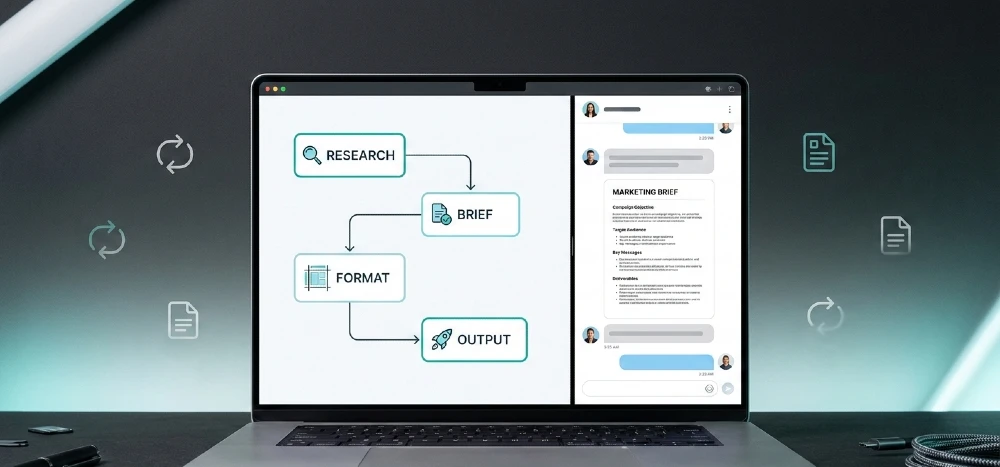
Marketing teams spend enormous time re-explaining the same tasks to AI tools every single day. Same format requests. Same workflow instructions. Same brand voice reminders — repeated from scratch in every new session. Perplexity just shipped a fix for that.
On March 6, 2026, Perplexity released “Skills” inside its Computer agent platform — a feature that lets users teach an AI workflow once, save it permanently, and have it execute automatically every time that task comes up again. No re-prompting. No re-explaining. The AI remembers the exact steps, format preferences, and workflow logic, and applies them on its own.
This is a meaningful shift in how AI tools handle repetitive professional tasks — and marketing teams are already the clearest beneficiaries.
What Perplexity Skills Actually Are (Not What the Name Implies)
The word “Skills” sounds like a library of pre-built features. That’s not what this is.
Skills are reusable capabilities — step-by-step instructions, preferred formats, and specific workflows — that Perplexity’s Computer agent applies automatically whenever they’re relevant. You create a custom skill for any task you perform repeatedly, and Computer follows it every time without you re-explaining it.
The simplest way to understand it: think of a Skill as a saved operating procedure that runs inside an AI agent. Instead of typing a 300-word prompt every time you need a competitive brief, you create a Skill once that says — “Create a skill that takes a company name and produces a one-page competitive brief with funding history, product overview, and recent news.” From that point forward, typing a company name triggers the full output automatically.
That shift from one-off prompts to persistent, reusable instructions is what separates Skills from standard AI chat.
The Marketing Automation Problem Skills Is Designed to Solve
Here’s the honest situation most marketing teams are in right now.
They use AI tools daily — for content drafts, research briefs, social post variations, email subject lines, competitor analysis. But every session starts from zero. The AI doesn’t know that your brand always uses a conversational tone, that competitor briefs need to follow a specific structure, or that blog intros should avoid generic openers. You explain it each time. Or you keep a document of prompts you paste in manually.
That’s not automation. That’s assisted copying and pasting.
Perplexity Skills addresses this at the root. Once a workflow is saved as a Skill, the Computer agent:
- Recognizes when a task matches that workflow
- Applies your exact formatting and structural preferences automatically
- Follows your preferred output length, tone, and section order
- Executes without waiting for re-instruction
For a content team producing 20+ pieces of research per week, this compounds fast. A skill built for “generate a weekly content brief from a keyword” runs identically every time — consistent structure, consistent depth, no variation based on who prompted it or how.
How Perplexity Skills Compares to Jasper AI’s Content Workflows
The comparison to Jasper AI is worth examining directly because they’re solving adjacent problems, not identical ones.
Jasper is a dedicated AI content platform. Its workflow features — called “Campaigns” — let teams build templated content production pipelines for blogs, ads, and email. The AI generates copy inside those templates, staying within brand voice guidelines you set up during onboarding. It’s purpose-built for marketing content output.
Perplexity Skills lives inside a general-purpose AI agent (Computer) that handles research, analysis, writing, web browsing, and task execution — not just content. A Skill in Perplexity is not limited to writing. You can build a Skill that:
- Researches a company, summarizes recent news, pulls funding history, and formats it as a briefing document
- Monitors a competitor’s pricing page and summarizes changes weekly
- Takes a blog URL and produces a repurposed social post in a specific format
Jasper generates content well. Perplexity Skills automates workflows that include research, synthesis, formatting, and output — with content generation as one step in a broader process.
The practical difference: if your team needs polished long-form marketing copy at scale, Jasper is still the cleaner tool for that specific output. If your team needs to automate research-heavy tasks that end in a content deliverable, Perplexity Skills covers the full loop.
Perplexity Computer: The Platform Skills Lives Inside
Skills don’t work as a standalone feature — they run through Perplexity Computer, the company’s cloud-based autonomous agent platform launched for $200/month Max subscribers.
Perplexity Computer is a “computer user agent” that can carry out complex workflows on its own, including creating sub-agents for parts of a task. It’s cloud-based, meaning it doesn’t require installing anything on your machine or giving the AI access to your local files and system.
Perplexity CEO Aravind Srinivas explained that the company wants to make agent-style work feel more like using a Macintosh or an iPhone than configuring a server. Internally, the company already uses Computer to debug code, analyze metrics, and generate marketing assets — often directly from Slack or a phone.
The “team of agents” framing is not marketing language here. Computer routes subtasks to whichever AI model handles them best. It currently orchestrates 19 models on the backend, including Claude Opus 4.6 for orchestration and coding tasks, Google Gemini for deep research, and ChatGPT 5.2 for long-context recall and wide search.
Skills layer on top of this multi-model architecture. When you trigger a Skill, Computer decides which model or combination of models to use for each step — you don’t need to specify. The workflow logic is yours. The execution routing is automatic.
Model Council: The Feature That Changes How Marketing Teams Make Decisions
Skills launched alongside another significant addition that most coverage has underreported.
Model Council automatically runs GPT-5.4, Claude Opus 4.6, and Gemini 3.1 Pro in parallel, then synthesizes where they agree, disagree, and what each uniquely contributes. You can choose your orchestrator model for full control over how results are combined. Available for Max subscribers.
For marketing strategy decisions — campaign positioning, pricing messaging, audience targeting angles — getting three frontier models to independently analyze the same brief and surface where they diverge is genuinely useful. It’s not about picking the “best” answer. It’s about seeing which assumptions different models challenge and which conclusions they converge on.
Practical example: a marketing team stress-testing a product launch message can run it through Model Council and see whether GPT-5.4, Claude, and Gemini agree on the core value proposition — or flag different weak points. That disagreement is the insight. You can use it to stress-test a business plan: “Here’s my pitch deck for an AI startup. Use Model Council to identify the three weakest assumptions, and how each model would challenge them.”
This is the kind of feature that sounds abstract until you use it once on a real decision and realize it does in five minutes what previously took multiple rounds of stakeholder review.
Perplexity’s Broader Strategic Shift in 2026
Skills and Model Council don’t arrive in isolation. They’re part of a deliberate push by Perplexity to move from being an AI search engine to becoming a business workflow platform.
The signals have been clear for months. Perplexity processes approximately 780 million queries monthly as of mid-2025 — more than 20% month-over-month growth — and has reached approximately $200 million in annualized revenue. The company serves over 100 million users and was most recently valued at $20 billion following a $200 million funding round in September 2025.
That scale gives Perplexity the data and revenue base to build agent infrastructure that genuinely competes with productivity platforms, not just with other search tools.
Perplexity has also phased out advertising entirely as of early 2026, with company executives stating they have no plans to revisit the ad model. One executive told the Financial Times the company might “never ever need to do ads,” signaling confidence in the subscription-based model.
That’s a stark contrast to OpenAI, which introduced advertising to ChatGPT’s free and lower-cost tiers in February 2026. Perplexity’s ad-free, subscription-only model shapes the product differently — when the business doesn’t depend on attention metrics, the agent can be built to complete tasks efficiently rather than extend session time.
Trending: Three More AI Tool Updates From the Same Week
Claude Code Voice Mode — Hands-Free Coding Is Now Real
On March 3, 2026, Anthropic announced voice mode for Claude Code — initially available to 5% of users before a full rollout. Developers activate it with /voice, then speak commands like “refactor the authentication middleware” using a push-to-talk interface (hold spacebar, release to send).
This isn’t a novelty feature. Developers think out loud, explain logic verbally while reviewing code, and describe problems before typing solutions. Voice mode aligns the tool with how developers already work. It’s included at no extra cost for Pro, Max, Team, and Enterprise subscribers.
Claude Code is currently generating over $2.5 billion in annualized revenue. According to SemiAnalysis data, 4% of all global public GitHub commits were authored by Claude Code — double its share from a month earlier. Voice mode arriving at this growth stage suggests Anthropic sees it as a retention and adoption driver, not just an experiment.
OpenAI Codex + Figma: Bidirectional Code-to-Design Loop
Also on March 4, OpenAI and Figma launched a two-way integration between Codex and Figma through the Figma MCP Server. Teams can bring design details from Figma into Codex to implement in code — and then convert running UI back into editable Figma designs for iteration.
The bidirectional flow is what matters. Previous design-to-code tools were one-way exports. This creates a continuous loop where design informs code and code informs design, both in sync. For product teams where the lines between designer and developer blur regularly, this removes a significant friction point.
One practical caveat: Codex reads visual layer data — frames, positions, colors — but it doesn’t understand your team’s component architecture or naming conventions. Clean design systems produce cleaner code output. Teams without a structured design system will need to do cleanup on generated code.
Hermes Agent: Open-Source Persistent Memory for Developers Who Don’t Trust Cloud AI
Nous Research released Hermes Agent on February 26 — an open-source autonomous agent built on the Hermes-3 model family that solves the problem every AI user faces: it forgets everything when the session ends.
Hermes Agent stores completed workflows as permanent “Skill Documents” — searchable, reusable records of how it handled past tasks. The next time a similar task appears, it queries its own library rather than starting from scratch. That’s persistent procedural memory, not just a longer context window.
It supports cross-platform access through a single gateway: Telegram, Discord, Slack, WhatsApp, and CLI — all carrying full context across channels. Five execution backends (local machine, Docker, SSH, Singularity, Modal) mean it can manage real remote environments, not just simulate conversations. Released under MIT license with full commercial use rights.
For developers and teams uncomfortable routing sensitive workflows through commercial AI platforms, Hermes Agent is currently the most capable self-hosted alternative available.
What This Week Signals About AI’s Direction
Set these four launches side by side — Perplexity Skills, Claude Code voice mode, Figma-Codex integration, Hermes Agent — and a single pattern emerges.
The AI tool market is moving from “here’s a powerful model, figure out how to use it” toward “here’s a system that learns how you work and operates accordingly.” Skills that persist. Memory that carries across sessions. Voice interfaces that match natural working patterns. Bidirectional design-code loops that eliminate translation friction.
The underlying shift: AI is being rebuilt around workflow continuity, not just capability. The tools that win the next phase of enterprise adoption will be the ones that reduce the overhead of using AI — not just the ones with the highest benchmark scores.
Perplexity Skills, for all its apparent simplicity, sits at the center of that shift. Teaching an AI your workflow once and having it remember forever is not a small productivity gain. For teams running repetitive research and content tasks at scale, it’s the difference between AI as a daily tool and AI as actual automation infrastructure.
What’s Coming Next
Perplexity has confirmed Skills will expand beyond the current Max tier as the feature matures. The immediate question for enterprise teams is whether custom Skill libraries can be shared across team members — a critical capability for consistent output at scale that the current documentation doesn’t fully address.
Claude Code’s voice mode completes its full rollout over the coming weeks. Enterprise security reviews of audio data handling and third-party voice provider involvement will follow quickly.
The Figma-Codex integration is likely to evolve toward design system awareness — meaning the AI learns not just what a design looks like, but which specific components your team uses to build it.
And Hermes Agent’s growing GitHub community will accelerate its skills library, with community-contributed workflows expanding its out-of-the-box capabilities rapidly.
The week of March 3–6, 2026 delivered infrastructure changes, not feature updates. The marketing teams, developers, and product builders who recognize that distinction early will have a meaningful operational advantage over those treating these as incremental improvements.
Check the latest news about : Claude Marketplace Launches: Enterprise AI Procurement
