


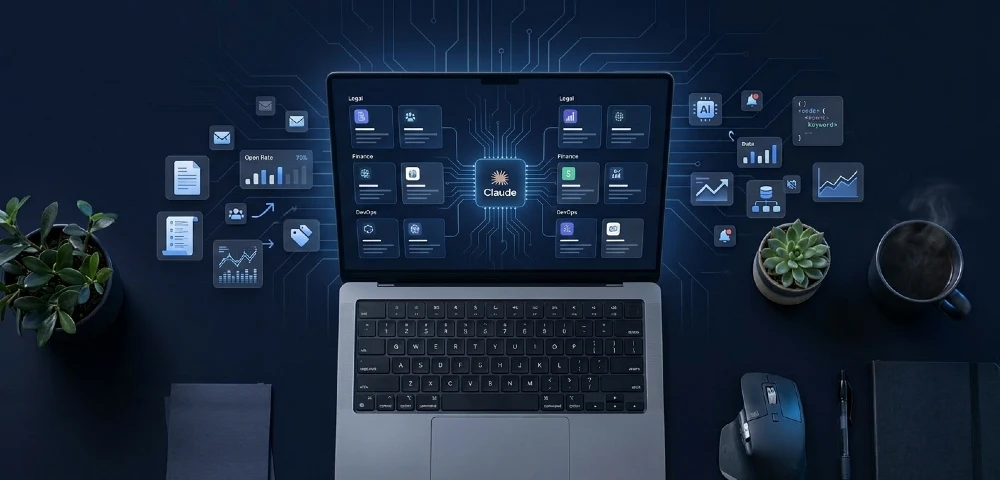
Enterprise AI procurement just changed. Anthropic launched the Claude Marketplace on March 6, 2026, giving companies a single place to buy Claude-powered software from verified partners — and unlike AWS or Azure marketplaces, Anthropic takes zero commission on purchases. The six launch partners — Snowflake, GitLab, Harvey AI, Rogo, Replit, and Lovable — cover enterprise data, legal automation, software development, financial research, and app building. The bigger story is not the marketplace itself. It’s what it signals about where enterprise AI is heading in 2026.
Why Enterprises Actually Need This (The Procurement Problem Nobody Talks About)
If you’ve ever worked inside a large company trying to adopt new software, you know the pain. Separate vendor contracts. Multiple invoices. Individual security reviews for each tool. Compliance approvals that take weeks. By the time IT approves the tool, the team has moved on or found a workaround.
This is called vendor sprawl, and it’s one of the biggest hidden costs in enterprise AI adoption today.
Anthropic designed the Claude Marketplace specifically to simplify procurement and consolidate AI spend. Enterprises with existing Anthropic spending commitments can now apply a portion of that commitment toward Claude-powered partner solutions — and Anthropic manages the invoicing for all partner purchases, meaning companies deal with a single billing relationship instead of separate contracts per tool.
In practical terms: a company already paying Anthropic six or seven figures annually can now fold legal AI tools from Harvey, data tools from Snowflake, and developer environments from Replit into that same budget line. No separate procurement cycle for each. No extra security review — these tools are already vetted by Anthropic.
Cox Automotive Chief Product Officer Marianne Johnson described the real-world benefit directly: the marketplace lets their teams move faster by extending their existing Anthropic investment into the partner tools they need, with simplified procurement and the confidence that everything works together.
What Makes Claude Marketplace Different From Other AI Tool Stores
Other marketplaces exist. AWS has one. Azure has one. Salesforce has one. So why does this matter?
The no-commission structure is what stands out. AWS and Azure both charge marketplace sellers a percentage of revenue — typically between three and fifteen percent depending on the category and deal structure. Anthropic waiving that entirely signals that deepening enterprise lock-in is currently worth more to them than transaction revenue.
That’s a deliberate strategic choice. Anthropic is betting that if enterprises consolidate their AI tooling inside the Claude ecosystem, those relationships become stickier over time. A company that buys Harvey for legal work, GitLab for development, Snowflake for data, and Replit for app building — all through Anthropic — is far less likely to switch AI providers than a company using Claude only for direct API access.
The store is exclusive to Claude-powered applications, which creates an additional incentive for software startups to integrate Anthropic’s models. For launch partners like Harvey, Replit, and Snowflake, distribution through the marketplace provides access to enterprise customers who have already committed AI budgets, completed security reviews, and signed contracts.
That last point matters enormously. The hardest part of selling to enterprises is not building the product — it’s getting through procurement. The Claude Marketplace essentially hands partners a warm introduction to customers who are already bought in.
The Six Launch Partners: What Each One Actually Does
Snowflake — Enterprise data cloud platform. Snowflake and Anthropic announced a $200 million multi-year partnership in early 2026, giving Snowflake’s 12,600 global customers access to Claude. Through the marketplace, enterprises can use Claude-powered data analysis inside their existing Snowflake environment without moving data to a separate tool.
GitLab — DevOps platform covering the entire software lifecycle. GitLab confirmed that organizations can now use their existing Anthropic commitment to purchase GitLab and orchestrate agentic AI across the entire software development lifecycle.
Harvey AI — Legal AI built specifically for law firms and in-house legal teams. Not a generic AI with a legal prompt — Harvey integrates compliance workflows, contract drafting, and institutional knowledge that legal teams have spent years building.
Rogo — Financial research AI for investment professionals. Analyzes financial data, earnings reports, and market intelligence at a depth that generic AI tools don’t deliver for finance-specific workflows.
Replit — Developer platform with AI-powered application building. Both technical developers and non-technical builders can create apps directly. The natural language interface makes it accessible without sacrificing depth.
Lovable — Enables non-technical users to build websites and simple applications using plain language prompts. Bridges the gap between business needs and technical implementation without requiring a developer.
This Is Not Anthropic’s First Enterprise Move — Context Matters
The Claude Marketplace launch didn’t happen in isolation. It comes during one of the most turbulent periods in Anthropic’s history, which makes the timing deliberate and the signal even louder.
Anthropic’s run-rate revenue recently topped $19 billion — more than double the $9 billion it achieved just three months prior. That growth has been driven primarily by Claude Code and enterprise API adoption.
At the same time, the U.S. Department of Defense designated Anthropic a supply-chain risk after the company declined to strip certain safety guardrails from its models for military use. The designation restricts companies doing Pentagon-related work from using Anthropic’s models — a significant headwind for government contracts.
Anthropic CEO Dario Amodei stated the restrictions are narrowly tailored and limited to work directly tied to Pentagon contracts, and Microsoft confirmed it can continue working with Anthropic on non-defense projects.
Launching a major enterprise product in this context is Anthropic doubling down on commercial enterprise as its primary growth path. The message is clear: the company is not pivoting toward government or defense — it’s going deeper into the commercial enterprise market where it already has strong momentum.
Trending: Claude Code Gets Voice Mode — Developers Can Now Code Hands-Free
While the Claude Marketplace captures the headline, a quieter but arguably more impactful update arrived three days earlier.
On March 3, 2026, Anthropic engineer Thariq Shihipar announced that voice mode is now live in Claude Code. Initially available to approximately 5% of users, it is rolling out in stages over the coming weeks. Once enabled, developers type /voice to activate it, then speak their commands — for example, “refactor the authentication middleware” — and Claude Code executes the request.
This is not a gimmick feature. Think about what developers actually do during a coding session — they think out loud, they explain logic verbally while reviewing code, they describe problems to colleagues. Voice mode aligns the tool with how developers naturally work, rather than forcing them to translate every thought into typed commands.
Voice mode is included at no extra cost for Pro, Max, Team, and Enterprise subscribers. It uses a push-to-talk design — hold the spacebar to speak, release to send — which gives developers control over when voice input is active. This design positions it as a precision tool rather than an always-listening assistant, which matters for developers who cannot afford misheard commands mid-session.
The competitive context is worth noting. OpenAI’s Codex shipped its own voice mode on February 26 — one week before Claude Code’s rollout — signaling that voice has moved from a differentiating feature to a baseline expectation across developer tooling. Both companies are racing toward the same conclusion: the terminal interface will be voice-first within two years.
Claude Code’s run-rate revenue has surpassed $2.5 billion, with enterprise customers now accounting for more than half of total revenue. According to SemiAnalysis, 4% of all global public GitHub commits were authored by Claude Code — double the share from a month earlier.
Trending: OpenAI Codex and Figma Launch Bidirectional Code-to-Design Integration
The design-to-development handoff has been a painful problem for product teams for years. Designers create in Figma. Developers rebuild in code. The translation between the two wastes time, creates inconsistencies, and forces constant back-and-forth.
On March 4, 2026, OpenAI and Figma addressed this directly.
The new Codex to Figma integration connects Figma’s canvas directly to Codex through the Figma MCP (Model Context Protocol) Server. Teams can now bring design details from Figma Design, Figma Make, or FigJam into Codex to implement them in code. Critically, it also works in reverse — running UI from code can be converted back into editable Figma designs, enabling teams to explore iterations before bringing changes back to code.
That bidirectionality is what separates this from previous design-to-code tools. It’s not a one-way export. It’s a continuous loop — design informs code, code informs design, both updating in real time.
Codex product lead Alexander Embiricos explained that the integration makes Codex powerful for a much broader range of builders because it doesn’t assume you identify as a designer or an engineer first. That framing reflects a real shift in how modern product teams work — roles blur, and tools need to accommodate that.
One honest caveat: Figma’s MCP server exposes visual layer data — frames, layers, colors, positions — but it doesn’t tell Codex what things architecturally are. When Codex generates code from that visual data, it’s interpreting pixels and making educated guesses about which component to use, what props to set, and what your team actually calls things in your existing codebase. For teams with strong design systems, this works well. For teams without one, expect some manual cleanup.
This Codex integration comes one week after Figma struck a similar partnership with Anthropic to integrate Claude Code — signaling that Figma is pursuing an AI-agnostic strategy, positioning itself as the design layer that works with whichever AI coding tool a team prefers.
Trending: Hermes Agent Solves the AI Memory Problem That Commercial Tools Ignore
Every AI assistant you’ve used forgets everything the moment the session ends. Start a new chat, and it has no idea who you are, what projects you’re working on, or what you figured out together last week. This is the fundamental limitation of session-based AI.
Nous Research shipped a direct solution on February 26, 2026.
Hermes Agent is an open-source autonomous system built specifically to solve two bottlenecks in agentic workflows: memory decay and environmental isolation. Built on the Hermes-3 model family, it is designed to be the assistant that genuinely grows with you over time.
The memory system works differently from standard context windows. When Hermes Agent completes a complex task — such as debugging a microservice or optimizing a data pipeline — it synthesizes that experience into permanent, searchable artifacts called Skill Documents. The next time a similar task comes up, the agent queries its own library of past solutions rather than starting from scratch. This is persistent procedural memory, not just longer context.
Hermes Agent ships with 40+ bundled skills and supports cross-platform access through a single gateway process — Telegram, Discord, Slack, WhatsApp, and CLI. A conversation started on Telegram during a commute can be continued in the terminal at work, with full context carried across. Voice memo transcription works on all channels.
The agent supports five execution backends — local machine, Docker, SSH, Singularity, and Modal — meaning it can manage real remote environments, not just simulate conversations. A developer can initialize a long-running data analysis on a remote server via SSH, log off, and return later with the agent having maintained terminal state and tracked file system changes independently.
It’s released under an MIT license, which means full commercial use with no restrictions. For teams uncomfortable with sending all their data to commercial AI providers, Hermes Agent is the most capable self-hosted alternative available right now.
What These Three Launches Mean Together
These three developments — the Claude Marketplace, Claude Code voice mode, and Hermes Agent — point to the same underlying shift, just from different angles.
Enterprise AI is becoming infrastructure. The Claude Marketplace is not a feature. It’s Anthropic building the procurement layer that makes Claude a platform, not just a model. AWS and Azure built dominance by becoming the infrastructure layer that everything else runs on. Anthropic is trying to do the same thing for AI tooling.
The interface layer is being rebuilt. Voice mode in Claude Code, bidirectional design-code workflows via Figma, and cross-platform messaging in Hermes Agent all reflect the same insight — the text prompt box is not the right default interface for professional work. Every major AI tool is quietly building toward more natural, context-aware interaction modes.
Open source is closing the gap with commercial AI. Hermes Agent delivers persistent memory and real-world execution that commercial tools still don’t offer in fully self-hosted form. The gap between what open source and closed commercial AI can do is shrinking fast.
The enterprise AI market is not settling into a stable equilibrium. It’s accelerating. The tools, procurement models, and interfaces that seem new today will look standard by the end of 2026.
What’s Coming Next
Anthropic has confirmed the Claude Marketplace will expand its partner catalog as more companies build on Claude. The current six partners are a starting point, not a ceiling.
Claude Code voice mode will complete its full rollout over the coming weeks. Enterprise security teams will scrutinize audio processing policies, data retention, and whether third-party voice providers are involved — Anthropic has not yet published detailed documentation on these questions.
For the Figma-Codex integration, the next logical step is tighter design system support — meaning Codex doesn’t just interpret visual layers but understands the specific component libraries and naming conventions a team actually uses.
And Hermes Agent, with its MIT license and growing GitHub community, is likely to see rapid expansion of its skills library as more developers contribute to the open-source ecosystem.
The week of March 3–6, 2026 was a dense one for AI infrastructure. The moves made this week will shape enterprise AI workflows for the next several years.
Check Latest news about : OpenAI Robotics Head Resigns — And the Reason Should Concern Everyone in AI
