


For any team running AI agents at scale, token costs are not an abstract number — they show up directly in the monthly cloud bill. OpenAI just changed that equation.
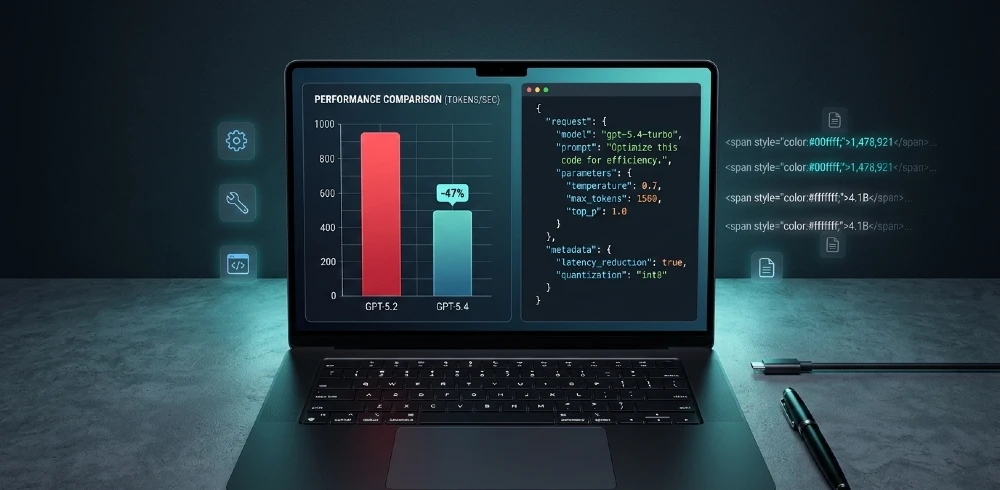
On March 5, 2026, OpenAI released GPT-5.4 across ChatGPT, the API, and Codex simultaneously. The headline benchmark numbers are impressive, but the update that actually changes the economics of building AI-powered applications is quieter and more technical: a new API feature called Tool Search that cuts total token usage by 47% on complex, tool-heavy agent workflows — with no drop in accuracy.
For developers building anything that calls multiple external tools, APIs, or services, this is an immediate and direct cost reduction starting today.
| What Changed | What It Means |
|---|---|
| Tool Search reduces token usage by 47% | Agent pipelines with many tools cost significantly less per run |
| 1M token context window | Process entire codebases, legal documents, or datasets in one request |
| Native computer use built in | Agents can operate software directly, not just generate text |
| GPT-5.4 merges GPT-5.3-Codex capabilities | One model for reasoning AND coding — fewer model-switching decisions |
| 33% fewer factual errors vs GPT-5.2 | More reliable for professional work (legal, finance, research) |
| GPT-5.2 Thinking retires June 5, 2026 | Teams still using 5.2 need a migration plan |
The Tool Search Problem It Solves — And Why It Matters More Than the Model Upgrade
Before GPT-5.4, every API request that involved tools worked the same way: all tool definitions were loaded into the system prompt upfront, every single time, regardless of which tools the model would actually need.
Previously, when a model was given tools, all tool definitions were included in the prompt upfront. For systems with many tools, this could add thousands — or even tens of thousands — of tokens to every request, increasing cost, slowing responses, and crowding the context with information the model might never use.
VentureBeat described this old approach accurately as a tax paid on every request: cost, latency, and context pollution. You were paying for tool definitions whether the model used them or not. With 36 tools loaded, every single request carried the full weight of all 36 definitions — most of which were irrelevant to that specific task.
Tool Search eliminates this entirely.
With Tool Search, GPT-5.4 instead receives a lightweight list of available tools along with a tool search capability. When the model needs to use a tool, it can look up that tool’s definition and append it to the conversation at that moment. This approach dramatically reduces the number of tokens required for tool-heavy workflows and preserves the cache, making requests faster and cheaper. It also enables agents to reliably work with much larger tool ecosystems.
The real-world result: tested across 250 tasks from Scale’s MCP Atlas benchmark with 36 MCP servers enabled, Tool Search reduced total token usage by 47% while maintaining the same accuracy.
That 47% is not a theoretical improvement. It was measured on a real benchmark with a real agent ecosystem. For any team running production agent pipelines with multiple MCP servers, external APIs, or large tool libraries, this translates directly to nearly half the token spend on those workflows.
What GPT-5.4 Actually Is — The Architecture Change Most Reports Missed
GPT-5.4 is not a minor version update. It’s a structural consolidation that changes how OpenAI’s model lineup works.
GPT-5.4 launched on March 5, 2026, as OpenAI’s new mainline reasoning model for professional work. OpenAI says it is the first mainline reasoning model to absorb the frontier coding capabilities of GPT-5.3-Codex.
That merger matters. Previously, developers building applications that needed both strong reasoning and strong coding had to make a choice — or build routing logic to switch between models. GPT-5.4 eliminates that decision. One model handles reasoning, coding, computer use, and professional knowledge work.
GPT-5.4 makes those boundaries much blurrier. It supports the full modern agent stack: web search, file search, image generation, code interpreter, hosted shell, apply patch, skills, computer use, MCP, and Tool Search.
For developers, that consolidation reduces complexity in production architectures. Fewer models means fewer routing decisions, fewer integration points to maintain, and a simpler billing structure.
The Benchmark Numbers — With Honest Caveats
GPT-5.4’s performance improvements over GPT-5.2 are significant and verified across multiple independent benchmarks.
On GDPval, GPT-5.4 reaches 83.0%, up from 70.9% for GPT-5.2. On OpenAI’s internal investment banking modeling tasks, GPT-5.4 scores 87.3% versus 68.4% for GPT-5.2. On SWE-Bench Pro, GPT-5.4 posts 57.7%, slightly ahead of GPT-5.3-Codex at 56.8%. On OSWorld-Verified, GPT-5.4 hits 75.0%, above GPT-5.2 at 47.3% and even above the human baseline OpenAI cites at 72.4%.
That last number — surpassing the human baseline on computer use for the first time — is the most significant capability leap in the release. An AI agent that operates computers more reliably than the average human on standard software tasks is no longer a future milestone. It’s a current product feature.
GPT-5.4 was 33% less likely to produce errors in individual claims compared with GPT-5.2. Overall, responses were 18% less likely to contain factual mistakes.
The honest caveat: these are aggregate benchmarks across general tasks. Domain-specific accuracy in medicine, law, or financial modelling can diverge significantly from headline numbers. Run your own domain evaluations before promoting to production.
Benchmark scores set expectations. Your production task determines what actually matters. Always test on your specific use case before making deployment decisions.
GPT-5.4 Pricing — The Full Picture
The 47% token reduction via Tool Search matters more when you see the actual pricing.
GPT-5.4 costs $2.50 input, $0.25 cached input, and $15.00 output per 1M tokens.
For comparison, Claude Opus 4.6 is priced at $5.00 input / $25.00 output per million tokens, and Gemini 3.1 Pro at $2.00 / $12.00.
GPT-5.4 sits between the two on input pricing and slightly above Gemini on output. But the effective cost for tool-heavy pipelines drops substantially once Tool Search activates — which means in real agent workflows, the actual per-task cost is lower than the headline rate suggests.
GPT-5.4 Pro costs much more at $30 input and $180 output per 1M tokens, and is for the hardest tasks only.
The Pro tier is not for routine use — it’s for tasks that genuinely require maximum capability: complex legal analysis, high-stakes financial modelling, research synthesis across massive document sets. Using GPT-5.4 Pro for tasks that standard GPT-5.4 handles perfectly is how teams burn budget unnecessarily.
One critical pricing detail that enterprise teams must know: prompts above 272K input tokens on GPT-5.4 and GPT-5.4 Pro are billed at 2x input and 1.5x output for the full session. Regional processing endpoints add a 10% uplift.
If your workflows regularly approach or exceed 272K input tokens — large document processing, full codebase analysis — plan for this pricing threshold. It can double your effective input cost without warning if you’re not monitoring token counts.
Computer Use: The Capability That Changes What Agents Can Do
In the API, GPT-5.4 is the first general-purpose model OpenAI has released with native, state-of-the-art computer-use capabilities, enabling agents to operate computers and carry out complex workflows across applications. It supports up to 1M tokens of context, allowing agents to plan, execute, and verify tasks across long horizons.
What this means practically: instead of building an agent that generates instructions for a human to follow, you can now build an agent that executes those instructions directly in software. It can open applications, navigate interfaces, fill forms, extract data, and complete multi-step processes without human hand-holding at each step.
GPT-5.4 excels at complex frontend tasks, with noticeably more aesthetic and more functional results than any models OpenAI has launched previously.
For enterprise automation teams, this is the capability that finally makes browser-based workflow automation viable at scale without custom scripting for every edge case.
The Trust Issue Surrounding This Launch
No honest account of this release ignores the context it arrived in.
GPT-5.4 arrives two days after GPT-5.3 Instant, an acceleration in release cadence that nobody predicted, in the middle of the most significant user backlash in OpenAI’s history.
In late February 2026, OpenAI signed a contract with the US Department of Defense — a decision that triggered substantial criticism from researchers, ethicists, and a portion of its own user base who view AI-military integration as a line that should not be crossed. The release cadence — GPT-5.3 Instant on March 3, GPT-5.4 on March 5 — reads partly as a deliberate news cycle strategy.
On safety specifically, OpenAI published notable findings alongside the release. OpenAI said deception is less likely in GPT-5.4 Thinking, “suggesting that the model lacks the ability to hide its reasoning and that CoT monitoring remains an effective safety tool.”
Chain-of-Thought (CoT) monitoring means safety researchers can read the model’s reasoning steps before it acts — making it easier to detect potentially harmful intent before it executes. This is a meaningful safety mechanism, and OpenAI’s transparency in publishing these findings is worth noting. But it applies to the Thinking variant specifically. Standard GPT-5.4 without explicit CoT output does not carry the same monitoring guarantees.
How to Migrate From GPT-5.2 — Timeline and What to Do
GPT-5.2 Thinking will remain available for paid users in the Legacy Models section until June 5, 2026, after which it will be retired. In the API, gpt-5.2 continues to be available with no announced retirement date at this time.
If you’re currently using GPT-5.2 Thinking in ChatGPT, you have until June 5 to move your workflows to GPT-5.4 Thinking. That’s roughly 90 days — enough time if you start now, not enough if you wait until May.
Migration checklist for API teams:
- Update model string from
gpt-5.2togpt-5.4in API calls - Enable Tool Search if your pipeline uses more than 5 tools — the token savings are immediate
- Audit any workflows where prompt length regularly approaches 272K tokens — the 2x pricing threshold is a real cost risk
- Run parallel testing on GPT-5.4 and GPT-5.2 for your specific domain before full cutover
- For Codex users: GPT-5.4 replaces GPT-5.3-Codex as the default — no separate action needed
The one thing to avoid: switching every workflow to GPT-5.4 Pro without evaluating whether standard GPT-5.4 achieves the same result. The Pro tier is priced at 12x the input rate of standard GPT-5.4. Use it selectively.
What GPT-5.4 Means for Teams Building ChatGPT-Like Applications
For startups and product teams building consumer or enterprise applications on top of OpenAI’s API, GPT-5.4 changes three things concretely:
1. Agent pipelines finally scale economically. The 47% token reduction on tool-heavy workflows is the difference between agent-based features being marginally profitable and clearly profitable at scale. This unlocks use cases that were technically possible but economically impractical on GPT-5.2.
2. Computer use enables a new product category. Applications that previously required custom browser automation, Selenium scripts, or RPA (Robotic Process Automation) tools can now route those tasks through GPT-5.4’s native computer use. The integration surface shrinks. The reliability improves.
3. One model simplifies architecture. Teams that maintained separate pipelines for reasoning tasks and coding tasks can consolidate. Fewer models, fewer routing decisions, simpler billing, fewer failure points in production.
The trade-off: GPT-5.4 matches but does not clearly beat GPT-5.3-Codex on pure coding benchmarks. If raw coding performance is the sole criterion, GPT-5.3-Codex remains available in the API. For applications that need both strong coding and strong reasoning in the same workflow, GPT-5.4 is the clear choice.
What’s Coming Next
GPT-5.4 in Codex includes experimental support for the full 1M context window. Developers can try this by configuring model_context_window and model_auto_compact_token_limit. The word “experimental” matters — long-context quality degrades at the far end of the window, and this feature is not yet production-stable for all use cases.
GPT-5.4 Thinking in ChatGPT can present an initial reasoning plan before generating its full answer, allowing users to adjust the direction of the response mid-process and reach better results without additional prompts. This mid-generation steering capability — adjusting the reasoning path before the final output — is a UX feature that consumer-facing applications have not yet fully exploited.
OpenAI has not announced a GPT-5.5 timeline. Given the compressed release cadence of the past two weeks — GPT-5.3 Instant on March 3, GPT-5.4 on March 5 — the next update could arrive faster than the usual multi-month cycle suggests.
Enterprise teams watching the competitive landscape: Anthropic and Google are not standing still. Claude Opus 4.6 and Gemini 3.1 Pro both compete directly in the same capability tier. GPT-5.4’s 47% token efficiency gain and unified architecture are meaningful advantages today. How long they remain exclusive to OpenAI’s API is the question worth watching.
Check Our latest news about : Perplexity Skills for business marketing automation
