


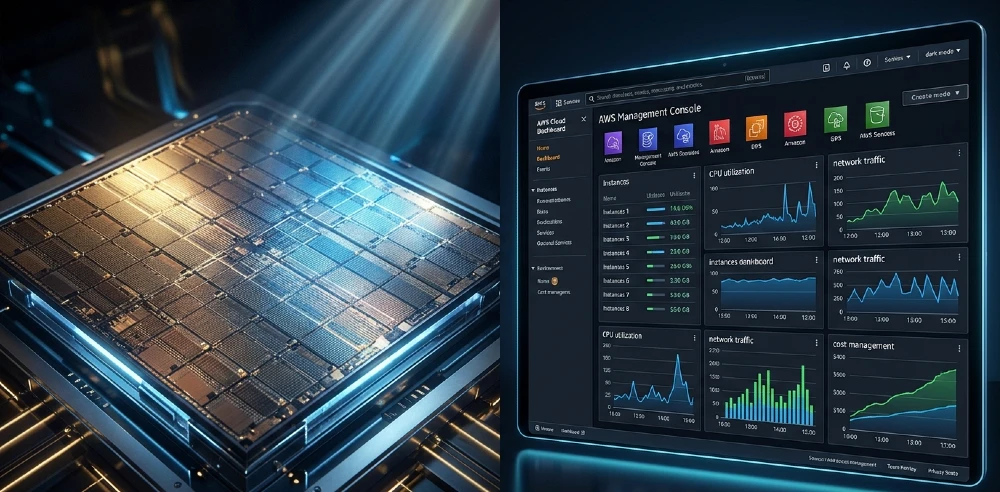
The biggest frustration with enterprise AI isn’t cost — it’s waiting. Every second of latency in a live campaign tool or customer-facing assistant costs real money. AWS just took direct aim at that problem by deploying Cerebras CS-3 systems inside Amazon Bedrock, making near-instant AI inference accessible to any developer with an AWS account.
This isn’t a minor update. It’s a fundamental shift in how large language models run at scale.
What Actually Happened — And Why It Matters Now
Amazon Web Services has integrated Cerebras’ CS-3 hardware — powered by the third-generation Wafer-Scale Engine (WSE-3) — directly into its Bedrock managed AI platform. Bedrock is where enterprises already run their production AI workloads. Adding Cerebras to that ecosystem means companies don’t need to rebuild anything. They just get faster.
The number that matters: 5x higher token throughput compared to standard GPU-based cloud inference. That’s not a benchmark trick. That’s what the WSE-3 physically does — it processes tokens across a single chip the size of an entire silicon wafer rather than coordinating across hundreds of smaller GPU units.
The Architecture Behind the Speed
Here’s the technical piece that most coverage glosses over.
Traditional cloud AI inference runs on clusters of A100 or H100 GPUs. When you send a long prompt to an LLM, the system has to first “read” your entire input (called the prefill stage), then generate each token one by one (the decode stage). Running both on the same GPU cluster creates bottlenecks.
Cerebras and AWS solve this with disaggregated prefill and decode — a split architecture where:
- Prefill runs on AWS Trainium chips, which are designed for parallel computation
- Decode runs on the Cerebras WSE-3, which excels at sequential token generation
This is a genuinely clever pairing. Neither chip is doing someone else’s job. They each do what they’re architecturally built for, in parallel, handing off cleanly between stages. The result is sustained high throughput without the latency spikes that plague GPU clusters during peak load.
What Models Can You Actually Run?
Bedrock’s Cerebras integration covers two categories:
- Open LLMs — including Llama-class and similar community-popular models
- Amazon Nova models — AWS’s own proprietary foundation model family
This dual coverage matters. Enterprises running open-source models for cost control get the same speed benefits as teams using Nova for compliance-sensitive workloads. You’re not locked into one model family to access the hardware advantage.
Real Business Impact: What This Changes for Agencies and Enterprises
Let’s be direct about who benefits most here.
Marketing and creative agencies running AI tools for copy generation, campaign drafting, or real-time personalization have always hit a wall at scale. When dozens of users simultaneously generate content, latency compounds. A 3-second wait per generation becomes a 30-second workflow slowdown when chained across a campaign tool.
With Cerebras-backed inference on Bedrock:
- Real-time AI writing assistants become genuinely real-time
- Batch content generation for email campaigns runs dramatically faster
- Multi-turn AI conversations feel more natural — less “waiting for the AI” moments
Enterprise software teams building internal tools on ChatGPT-style interfaces (now commonly deployed via Bedrock’s API layer) gain the ability to scale without throwing more GPU instances at the problem.
The Cost Question: Is This Actually Cheaper?
This is where it gets nuanced — and most coverage gets it wrong.
Cerebras hardware isn’t cheaper per API call than commodity GPU cloud. The WSE-3 is specialized silicon. It costs more to manufacture and operate than an H100.
But here’s the real cost math:
Speed = fewer idle compute hours. If your inference is 5x faster, your per-request infrastructure spend doesn’t scale linearly with traffic. You serve more requests on the same provisioned infrastructure window.
For agencies with spiky, campaign-driven traffic patterns — a product launch, a seasonal push — this is significant. You burst hard for 2 hours instead of paying for 10 hours of GPU cluster time trying to keep up.
That said, for teams with steady, moderate-volume inference needs, standard GPU-backed Bedrock models may still be the more economical choice. The right answer depends entirely on your throughput requirements and traffic shape.
How This Stacks Up Against Competing Cloud GPU Options
| Factor | Standard GPU (Bedrock) | Cerebras CS-3 (Bedrock) |
|---|---|---|
| Token throughput | Baseline | ~5x higher |
| Latency at scale | Degrades under load | Maintains consistency |
| Model selection | Broad | Open LLMs + Nova |
| Best for | Steady workloads | Burst, real-time, high-volume |
| Cost efficiency | Predictable | Better at high throughput |
The sweet spot for Cerebras on Bedrock is latency-sensitive, high-throughput production workloads. Research notebooks and dev-tier usage don’t need it. Live customer-facing AI does.
What Industry Analysts Are Saying
The broader signal here is strategic. AWS is making a clear statement: Bedrock isn’t just a model marketplace. It’s an inference infrastructure layer that will match model capability to hardware capability automatically.
Cerebras has been positioning the WSE-3 as the answer to the “memory wall” problem in LLM inference — the architectural bottleneck where GPUs stall waiting to load model weights from DRAM. The WSE-3 places 44GB of on-chip SRAM directly on the wafer, eliminating that bottleneck entirely. AWS clearly saw that as a genuine differentiator worth embedding into Bedrock’s routing layer.
This partnership also signals growing pressure on Nvidia’s inference dominance in cloud deployments. Cerebras, Trainium, and even Groq’s LPU architecture are all chipping away at the assumption that H100s are the only serious option for production inference.
What to Watch Next
Several developments worth tracking closely:
- Pricing transparency — AWS hasn’t published detailed per-token pricing for Cerebras-backed inference tiers yet. That number will determine real-world adoption speed among cost-conscious teams.
- Model expansion — whether Anthropic’s Claude models or Mistral variants get Cerebras-backed inference options inside Bedrock will be a major signal about how broadly AWS is rolling this out.
- Groq vs. Cerebras — Groq’s LPU architecture is the other major challenger in ultra-fast inference. Both are now accessible via managed cloud APIs. Direct head-to-head benchmarks on real enterprise workloads are coming, and they’ll matter.
- Regulatory angles — as inference speeds up, the time window for human review of AI-generated outputs shrinks. Compliance teams at regulated enterprises will need to adapt their AI governance frameworks accordingly.
Bottom Line
The Cerebras CS-3 integration into AWS Bedrock is one of the more practically significant infrastructure moves in enterprise AI this year. It doesn’t change what LLMs can do — it changes how fast they do it, at scale, without asking developers to learn new tooling.
For agencies, product teams, and enterprise AI builders already on AWS: this is worth testing on your highest-volume, most latency-sensitive workloads. The 5x throughput number is real, the architecture is sound, and the integration path is already there.
Faster inference isn’t just a technical win. It’s a product win for anything your users interact with directly
check out our latest news
Mistral Small 4 Multimodal Is Here — And It Could Change How Businesses Use AI Forever
