


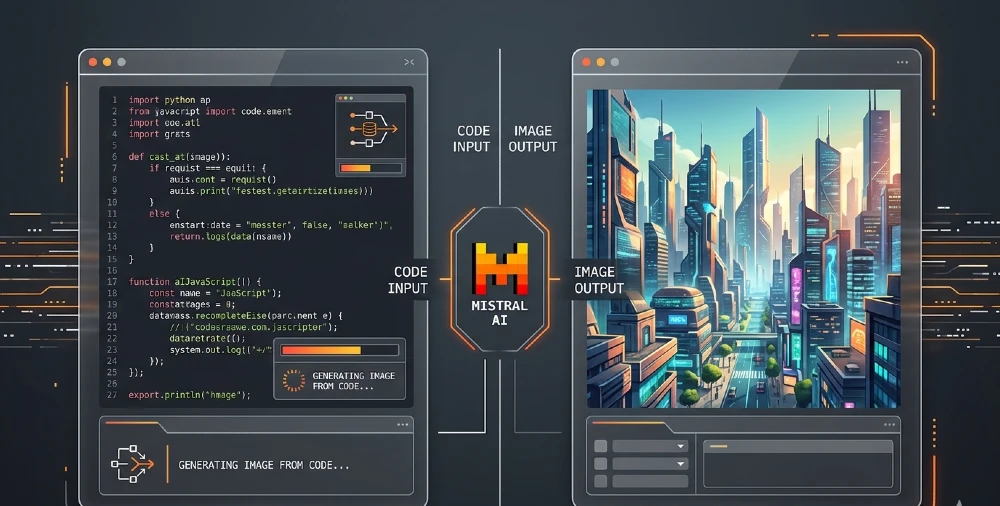
Mistral just dropped something worth paying attention to. Their new Mistral Small 4 Multimodal model doesn’t just process text — it sees, reasons, and generates, all inside one unified open-source package. For businesses exhausted by expensive API bills from Gemini or Claude, this one hits different.
This isn’t a minor update. It’s a full architectural shift. Mistral built Small 4 on a Mixture of Experts (MoE) framework, which means the model activates only the parts it needs for each task — making it significantly more efficient without sacrificing capability. Think of it like hiring a specialist who knows when to bring in the right expert, instead of paying a full team to sit on standby.
What Exactly Is Mistral Small 4 Multimodal?
At its core, Small 4 is a single model that handles three things simultaneously: text understanding, image interpretation, and structured reasoning. You feed it a product photo plus a content brief, and it outputs marketing copy. You give it a screenshot plus a question, and it answers with context. That’s the pitch — and it’s a practical one.
What makes it stand out technically:
- MoE (Mixture of Experts) architecture — activates only relevant model parameters per task, slashing compute waste
- Configurable reasoning modes — you control how “deep” the model thinks; lighter for speed, heavier for accuracy
- Open-source under a permissive license — you can actually run this yourself, modify it, and deploy it commercially
- Compatible with vLLM and llama.cpp — two of the most popular inference frameworks, meaning fast deployment on your own hardware or cloud
That last point matters more than most coverage has acknowledged. Compatibility with llama.cpp means Small 4 can run on consumer-grade hardware. A startup with a single GPU server can deploy this today — no enterprise contract required.
Why MoE Architecture Is a Bigger Deal Than It Sounds
Most people skim past architecture details. Don’t, in this case.
Traditional dense models activate every parameter for every token processed. MoE models route each input to only the relevant “experts” — sub-networks trained for specific types of tasks. The result? Lower latency, lower memory consumption, and better cost efficiency at scale.
OpenAI’s GPT-4 uses MoE. Google’s Gemini uses MoE. The fact that Mistral is bringing this to an open-source, small-footprint model is genuinely notable. It’s not just about matching big players — it’s about democratizing the architecture that makes them powerful.
Who Should Actually Pay Attention to This?
Small 4 isn’t trying to beat GPT-4o on benchmarks. That’s not the point. The real audience here is specific:
Small and mid-size businesses (SMBs) running content pipelines, product description generators, or social media automation will find this extremely relevant. You get multimodal input — images plus text — without paying per-API-call pricing to third-party providers.
Developers and AI engineers who need a self-hosted option that doesn’t require negotiating enterprise deals will appreciate the vLLM support. Spin it up, configure your reasoning depth, and go.
Marketing teams can feed it product visuals and get structured, tone-consistent copy back. It’s not DALL-E — it doesn’t generate images — but it interprets them intelligently to produce text-based outputs. Important distinction.
Mistral Small 4 vs. The Competition — An Honest Look
Let’s be direct: Mistral Small 4 is not trying to out-generate DALL-E or out-reason GPT-4o on complex multi-step tasks. Here’s where it actually stands:
| Capability | Mistral Small 4 | Gemini Flash | Claude Haiku |
|---|---|---|---|
| Open-source | ✅ Yes | ❌ No | ❌ No |
| Image input | ✅ Yes | ✅ Yes | ✅ Yes |
| Self-hostable | ✅ Yes | ❌ No | ❌ No |
| Configurable reasoning | ✅ Yes | Limited | Limited |
| Cost at scale | Very low | Moderate | Moderate |
The gap in raw benchmark performance exists. But benchmark performance doesn’t pay your AWS bill. For high-volume, cost-sensitive use cases — product descriptions, automated content review, image-grounded Q&A — Small 4 competes in a way that matters to budget-conscious teams.
The Open-Source Angle Nobody Is Talking About Enough
Here’s something worth sitting with: every time a capable open-source model ships, the leverage shifts slightly away from proprietary API providers.
Businesses that once had to use Gemini or Claude for multimodal tasks now have an alternative they can host, fine-tune, and control. Data stays in-house. Latency drops because there’s no external API hop. And the cost curve looks completely different at 10 million tokens a month versus 100,000.
This is Mistral’s consistent strategy — release capable open models, build credibility, then offer enterprise hosting and fine-tuning as a premium layer. It’s working. Small 4 is the most polished execution of that strategy yet.
How to Deploy Mistral Small 4 — The Short Version
For teams ready to move fast:
- Pull the model weights from Mistral’s official Hugging Face repository
- Set up vLLM for GPU-accelerated inference (recommended for production loads)
- Use llama.cpp if you’re working with consumer hardware or need CPU fallback
- Configure reasoning depth via system prompt parameters — start lighter, dial up for complex tasks
- Test with mixed inputs — image URLs plus text prompts — to validate multimodal pipeline behavior
Don’t skip the reasoning configuration step. Running it at full reasoning depth on simple tasks wastes tokens and adds latency. Calibrate it per use case.
What This Means for the AI Industry Going Forward
Mistral is proving something the industry needed to see: you don’t need a 100-billion-parameter model to deliver serious multimodal capability. Efficient architecture plus smart design beats raw scale for most real-world applications.
If Small 4 performs as advertised in production environments — and early developer feedback suggests it does — expect it to put real pressure on the pricing of proprietary small models. Google and Anthropic have noticed. The question is whether they respond with pricing cuts, capability jumps, or both.
The open-source multimodal space just became significantly more competitive. And for the businesses, developers, and teams sitting on the outside of enterprise AI contracts, that competition is very good news.
Mistral Small 4 Multimodal is available now. If your team processes images and text together at any real volume, it deserves a serious look — not someday, but this week.
check our latest news
