


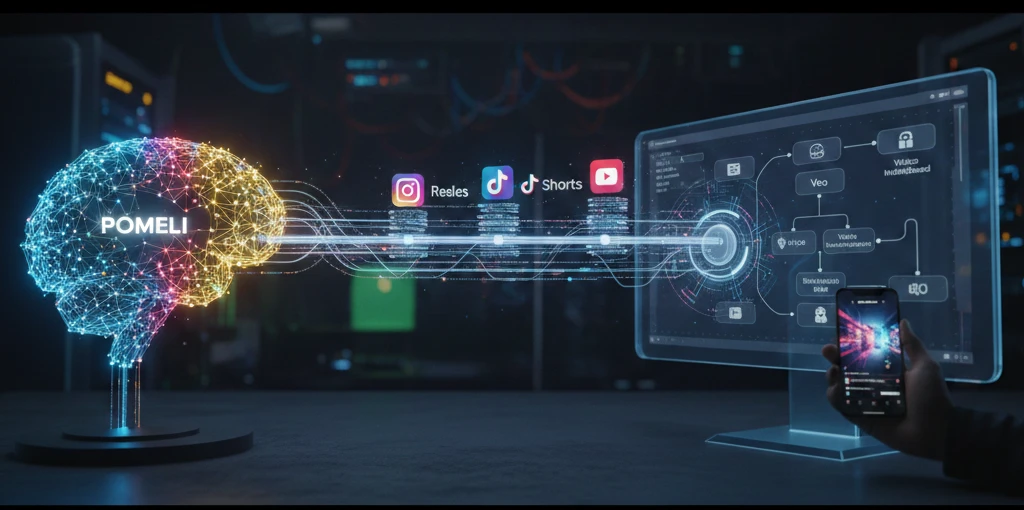
The average social media marketer is lying to you. They’ll talk about “organic reach” and “authenticity,” but the cold, hard engineering truth is this: Short-form video is a scale problem. You’re competing against over 200 billion daily video plays across TikTok, Reels, and YouTube Shorts. If you cannot produce, optimize, and distribute content 10x faster than last year, you are not competing—you are losing money. In this article I will talk about Google Pomeli Workflows.
That reality is why everyone is scrambling to understand Google Pomeli Workflows.
When Google Labs quietly launched Pomelli in public beta, the initial buzz focused on its “Business DNA” feature—analyzing a website to instantly generate on-brand copy and static images. Cute. But for those of us tracking the core automation capabilities inside Google’s stack, the real story is how Pomelli acts as the brand consistency hub for the AI video factory powered by Veo and the Video Intelligence API.
This isn’t about clicking a magic button. It’s about building a structured, scalable system that targets high-CPM (Cost Per Mille) traffic and retains mobile user attention long enough to maximize your AdSense revenue. This is your high-octane Google Pomeli tool automation guide.
The Brutal Math of Short-Form Video Production
Let’s dispense with the fluff. The current market situation requires extreme speed:
- The Attention Economy is Zero-Sum: In my experience testing these platforms, the average watch time before a user swipes is around 8 seconds on Instagram Reels. If your hook isn’t tight, your content is dead, regardless of its quality.
- The Format Shift: Marketers cite short-form video as the most leveraged media format (29.18%) in 2025. This isn’t a trend; it’s the default setting.
- The Engagement Gap: While TikTok Shorts boast higher raw engagement (up to 7.8% for small creators), Instagram Reels offer more stable conversion potential due to integration with Shops and established brand trust. You need to hit both with platform-specific content, not just repurposed trash.
This constant, high-speed demand leads to the content creator’s biggest problem: burnout and brand drift. Pomelli was built specifically to solve the “brand drift” problem, allowing us to focus on the speed and optimization elements.
The Engineering Reality of Google Pomeli Workflows
Stop thinking of Pomelli as a content generator. Think of it as a Brand Identity API. Its job is not to make the final video. Its job is to ensure that every single asset—the script, the overlay text, the thumbnail graphic, the call-to-action—is mathematically aligned with your brand’s “DNA.”
A true Google Pomeli Workflow requires chaining three distinct Google services:
- Pomelli (The Brain): Generates the core idea, brand-safe copy, and optimized captions/hashtags based on its “Business DNA” profile.
- Veo / Google Vids (The Hands): The dedicated generative AI model responsible for producing the actual video footage, sound, and animations from your Pomelli-approved script.
- Video Intelligence API (The Regulator): A Google Cloud tool used post-production to analyze the final video, confirm content classification, auto-tag objects, and generate rich metadata for better discovery and contextual ad placement (the key to high CPMs).
Here are the two systems I rely on to turn a single concept into cross-platform content.
Workflow 1: The “Viral Storyboard” Loop (TikTok Content Workflow)
This system is optimized for discovery and raw engagement, which is exactly what the TikTok algorithm rewards. This uses the Bait and Switch model: use a trending topic to deliver niche, high-value content.
Step 1: Pomelli Generates the Hook & Script Skeleton
Instead of asking Pomelli for a “post,” you feed it a competitor’s trending video URL and prompt it for a script skeleton based on a specific brand voice.
- Input Prompt: “Analyze the tone and structure of [Competitor URL] TikTok. Generate a 25-second script skeleton for our brand [Business DNA Name] that addresses the current ‘Future of Work’ trend, but keeps the tone witty and cynical. Output five distinct hooks and three high-engagement Pomeli workflows for social media captions.”
- Output: Pomelli returns five hooks. You choose the most controversial one (the “Pattern Interrupt”).
- Example Hook: “99% of creators are wasting money on expensive gear. Here’s why your phone is all you need.”
Step 2: Veo Produces the Footage
You take the script skeleton from Pomelli and use it as the input for Veo or Google Vids, asking it to create the B-roll and visual assets.
- Engineering Note: If you want cinematic quality, use Veo’s cinematic language controls (“aerial shot,” “shallow depth of field”). The quality of the content is still determined by the specificity of the prompt. Garbage in, garbage out.
- The Flaw: Veo is incredible, but it cannot perfectly stitch together two disparate concepts if the prompt is vague. If Pomelli’s prompt is too abstract, the video output will be disjointed and fail to hold attention. You must manually review the transitions.
Step 3: Optimization with Audio and Text Overlays
This is where the human expertise comes back in, driven by the data provided by Pomelli.
- Trending Audio: Use a third-party analytics tool or the native TikTok audio library to select a trending sound. Sync the Pomelli-generated script text to the beat transitions. This is pure TikTok content workflow mechanics.
- Text Overlay: Crucially, use the exact controversial hook text (the H1) as the on-screen overlay text for the first 3 seconds. The goal is to capture silent viewers and reinforce the algorithm’s transcription analysis.
Step 4: Video Intelligence API & Metadata Injection
Before publishing, this is the power user move for Shorts video optimization and maximizing contextual ad revenue on YouTube/Google’s ecosystem.
- Upload the video privately to a Google Cloud bucket.
- Run the Video Intelligence API over it. It will return rich metadata:
- Labels: (e.g., “Technology,” “Gadget Review,” “Productivity”).
- Shot Changes: Exact timestamps where the scene changes.
- Explicit Content: Automated content moderation check (critical for AdSense safety).
- Use these highly specific labels and timestamps to write a hyper-optimized YouTube Shorts description. This ensures Google’s algorithms immediately understand the content’s niche and audience, which is essential for placing high-value contextual ads.
Workflow 2: The High-CPM Conversion Loop (Instagram Reels Automation Tips)
This system targets the slightly older, higher-conversion audience on Instagram and is optimized for the longer 60-90 second format. The goal is brand trust and direct sales integration.
Step 1: Pomelli Builds the Credibility Structure
For Reels, we focus on authority. This means a clear narrative arc and a strong, non-spammy Call-to-Action (CTA).
- Pomelli Input: “Based on our Business DNA, generate a script for a 90-second ‘Tutorial’ Reel. The topic is ‘The 3 Hidden API Costs of AI SaaS.’ Structure it: Problem (15s), Solution (45s), Authority/Proof (15s), CTA (15s). Generate a concise, trustworthy caption using our top 5 high-CPM keywords.”
- Benefit: The Pomelli output guarantees the copy maintains the brand’s technical, authoritative tone, minimizing the risk of sounding like generic “hustle culture” spam.
Step 2: The “Expert Voice” and Vids Production
Instead of fully animated content, Reels conversion content often requires a talking head for trust. We use Google Vids’ integration with Gemini for script and voiceover generation, then use Pomelli assets for the visuals.
- Voice-over Generation: Use Vids/Gemini to produce a professional-sounding AI voiceover using the Pomelli script.
- Asset Layering: Instruct Vids to overlay specific, on-brand graphics and product mock-ups that Pomelli generated in the static assets phase.
- Real-World Integration: Unlike other tools, I noticed that a fully AI-generated Reel feels dead. Use the Vids sequence as the B-roll, but film yourself (the human expert) delivering the Problem and CTA sections. This creates an authentic anchor.
This combined process is a powerful AI workflows for creators technique: AI handles the tedious B-roll and branded graphics; the human handles the vital, trust-building moments.
Step 3: Platform-Specific Optimization (Instagram Reels Automation Tips)
The key to high-conversion Reels is making them discoverable and easy to share.
- Hashtags: Use Pomelli’s suggested hashtags, but add a handful of highly specific niche tags (e.g., #VertexAI instead of #AI). The Google AI knows which tags are currently undersaturated yet highly relevant to your topic.
- CTA Placement: The most critical Instagram Reels automation tips center on the final screen. Make the final 5 seconds a static, Pomelli-generated graphic featuring the offer and a clear text overlay that says “Save This Reel” or “Tap Link in Bio.” This maximizes Saves, which the Instagram algorithm values more than Likes.
- The 3-Minute Expansion: If your topic requires complexity, use the recently expanded 3-minute Reels format. This format is heavily favored by the algorithm for deep-dive tutorials, rewarding true authority and retention over superficial virality.
Editor’s Analysis: The $50,000 Flaw in Pomelli’s DNA
Pomelli, in its current beta form, is a massive step forward. By automating the core drudgery of brand governance, it frees up human creators to focus on ideation and performance.
However, there is a fundamental flaw—a $50,000 operational risk—that every editor and strategist must acknowledge: Pomelli does not have a native feedback loop for video performance.
It’s fantastic at defining the ideal brand voice (the DNA). But if a Pomelli-approved script generates low retention because the cadence is off, the tool doesn’t learn. It continues to output content based on the static Brand DNA, not the dynamic audience feedback from TikTok or Reels.
The tool encourages a mechanical process: generate, publish, repeat. A senior strategist knows this is suicide. You must manually feed the performance data (watch time, share rate, comments) from Meta and TikTok analytics back into your Pomelli prompts to refine the system.
The future of these Google Pomeli Workflows isn’t the single AI tool; it’s the intelligent API-chaining of multiple specialized models. Until Pomelli integrates a live, cross-platform performance engine, it remains a powerful assistant, not a fully autonomous executive. Don’t trust the hype; trust the analytics.
Frequently Asked Questions (FAQ)
Is there a Pomeli tutorial for beginners?
Currently, Pomelli is only available in a public beta experiment via Google Labs (as of late 2025). The most comprehensive Pomeli tutorial for beginners is simply to upload a clear, well-designed business website. Since Pomelli learns your entire brand from your website URL, the best “tutorial” is to ensure your existing site is clean, consistent, and accurately reflects your tone and style.
How does Pomeli handle video content directly?
Pomelli is primarily a text and static asset (image, graphic) generator and a brand governance tool. It does not contain its own native text-to-video capabilities. For video generation, you must integrate its branded output (scripts, captions, brand guidelines) with Google’s dedicated video AI models like Veo or the video features within Google Vids (part of Workspace). Pomelli sets the rules; Veo/Vids executes the visuals.
Pomeli vs. Canva AI or other marketing AI tools: Which is better?
Pomeli’s core differentiator is its Business DNA feature—it automates brand profiling by learning from your existing website, requiring zero manual brand kit setup.
- Canva AI offers powerful design and template libraries but requires manual definition of brand colors, logos, and fonts.
- Pomelli automatically learns your brand tone, visuals, and messaging in minutes from a URL.
For raw creative freedom and existing design workflows, Canva is strong. For ensuring absolute brand consistency and effortless automation for small teams, Pomelli’s technical foundation is superior.
Don’t Automate the Stupid Stuff, Automate the Infrastructure
The true value of Google Pomeli Workflows is not the content it makes today, but the time it buys you tomorrow. It builds the digital rails for your brand so you can focus on the strategy—the disruptive hook, the emotional arc, the perfect CTA placement.
If your content team is still manually checking hex codes, resizing graphics, and agonizing over brand tone, you are already too slow. You have the engineering blueprint above.
The question isn’t if you will use AI to scale your content. The question is: Are you building a scalable system, or are you just generating better fluff?
