


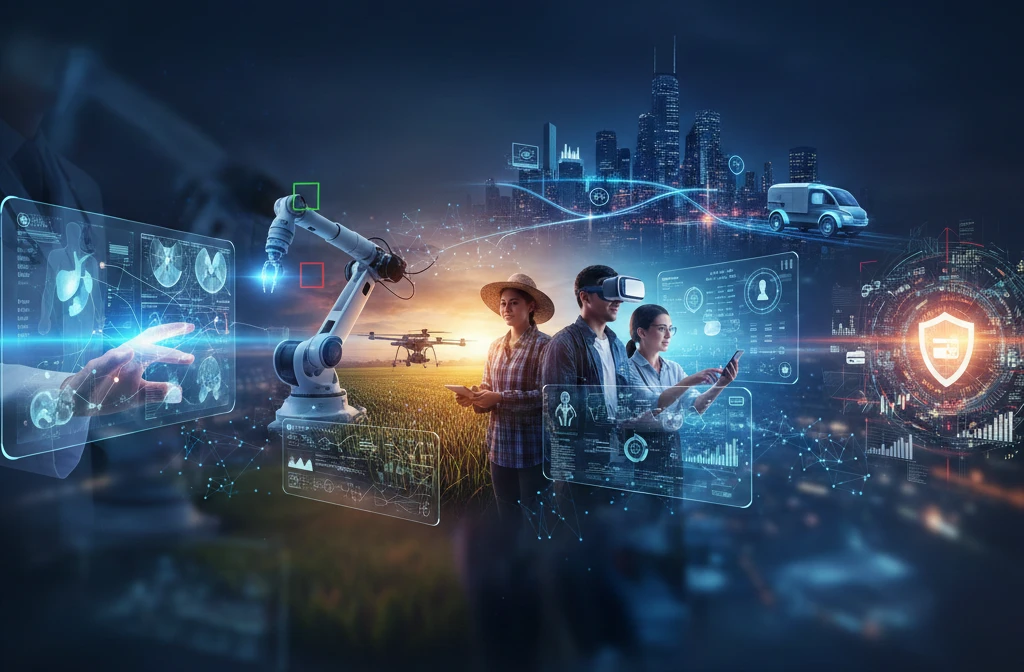
The term “Artificial Intelligence” used to conjure images of silver-clad robots and sci-fi tropes. Today, however, AI is less about Hollywood and more about the invisible engine powering our modern world. It’s the algorithm that caught a fraudulent charge on your credit card this morning, the system that helped your doctor spot a microscopic abnormality in a scan, and the logic behind your favorite playlist.
In this deep dive, we’re moving past the hype to look at artificial intelligence applications as they exist today—practical, powerful, and transformative across every major sector of society.
What Do We Mean by AI Applications?
Before we jump into the industries, let’s clarify what we’re talking about. When we discuss AI technology use cases, we are generally referring to systems that can perform tasks traditionally requiring human intelligence. This includes:
- Machine Learning (ML): Systems that improve their performance as they are exposed to more data.
- Natural Language Processing (NLP): The ability for computers to understand and generate human speech and text.
- Computer Vision: Giving machines the ability to “see” and interpret visual information from the world.
1. AI Applications in Healthcare: Saving Lives with Data
Healthcare is perhaps the most profound area for AI applications. Here, the stakes aren’t just ROI—they’re human lives.
Medical Imaging and Diagnostics
One of the most successful real-world AI use cases is in radiology. AI models can scan thousands of X-rays, MRIs, and CT scans in seconds, flagging potential tumors or fractures with a level of precision that rivals (and sometimes exceeds) human specialists.
Drug Discovery
Traditionally, bringing a new drug to market takes over a decade and billions of dollars. AI is slashing that timeline. By simulating how different chemical compounds interact with human cells, AI can identify “candidate” drugs for diseases like cancer or Alzheimer’s much faster than manual laboratory testing.
Personalized Treatment Plans
Every human body is different. AI helps doctors move away from “one-size-fits-all” medicine by analyzing a patient’s genetic makeup, lifestyle, and medical history to predict which treatments will be most effective.
2. AI Applications in Business: Efficiency Reimagined
For the modern entrepreneur, AI applications in business are no longer optional—they are the key to staying competitive.
Supply Chain Optimization
AI can predict when a product will run out or when a shipping route will be delayed by weather. By analyzing historical data and real-time trends, businesses can keep their inventory lean, saving millions in warehouse costs.
Robotic Process Automation (RPA)
Think of all the “drudge work”—data entry, invoice processing, and payroll. AI-powered bots now handle these repetitive tasks, freeing up human employees to focus on creative strategy and problem-solving.
Human Resources
From screening thousands of resumes to identify the best candidates to predicting employee burnout through sentiment analysis, AI is making the “human” part of HR more data-driven.
3. AI in Marketing: The End of “Guesswork”
Marketing has shifted from “spray and pray” advertising to surgical precision, thanks to AI in marketing.
Hyper-Personalization
Have you noticed how Amazon or Netflix seems to know what you want before you do? That’s AI analyzing your past behavior to serve up recommendations tailored specifically to you.
Content Creation and Optimization
Generative AI tools are now used to draft copy, generate social media images, and even optimize email subject lines for the highest open rates. It allows small teams to produce the volume of content that used to require a massive agency.
Sentiment Analysis
Brands use AI to “listen” to social media.By analyzing millions of tweets and posts, AI can tell a company if the public mood toward their new product is positive, negative, or neutral in real-time.
4. Machine Learning Applications in Finance
The financial sector lives and breathes data, making it the perfect playground for machine learning applications.
Fraud Detection
This is one of the most common artificial intelligence examples. While a human could never monitor millions of transactions simultaneously, AI can. It looks for patterns—like a sudden purchase in a foreign country—and freezes the account instantly to prevent loss.
Algorithmic Trading
In the stock market, milliseconds matter. AI-driven trading platforms can execute thousands of trades per second based on complex mathematical models, reacting to market news faster than any human trader could blink.
5. AI in Education: Personalized Learning
Education is undergoing a quiet revolution as AI technology use cases move into the classroom.
Adaptive Learning Platforms
No two students learn at the same pace. AI-powered software adjusts the difficulty of lessons in real-time. If a student struggles with a math concept, the AI provides extra practice; if they breeze through it, the AI moves them to the next level.
Administrative Support for Teachers
Grading multiple-choice tests and organizing schedules takes up hours of a teacher’s week. AI automates these tasks, allowing educators to spend more one-on-one time mentoring students.
6. AI in Daily Life: The Invisible Assistant
You likely use artificial intelligence applications dozens of times a day without even realizing it.
- Virtual Assistants: Siri, Alexa, and Google Assistant use NLP to understand your voice commands.
- Smart Home Devices: Thermostats that learn your schedule to save energy.
- Navigation: Google Maps uses AI to predict traffic jams and suggest the fastest route based on real-time data from other drivers.
7. AI in Cybersecurity: The Digital Shield
As our lives move further into the cloud, the threats we face have become more sophisticated. In this landscape, AI technology use cases in cybersecurity are no longer just a luxury—they are the frontline of defense.
Threat Detection and Prevention
Traditional antivirus software relies on “signatures”—essentially a database of known viruses. If a new virus comes along, the software misses it. AI, however, uses machine learning applications to recognize “anomalous behavior.” If a user suddenly downloads five gigabytes of data at 3 AM from an unusual IP address, the AI flags it as a potential breach, even if the “virus” itself hasn’t been seen before.
Automated Incident Response
When a hack occurs, every second counts. AI systems can automatically isolate infected servers or block suspicious traffic the moment an intrusion is detected. This speed prevents a small leak from becoming a catastrophic data breach.
Phishing Detection
AI models analyze the metadata, links, and even the writing style of incoming emails. By identifying subtle cues—like a slightly misspelled URL or an unusual request for administrative access—AI filters out phishing attempts before they ever reach an employee’s inbox.
8. AI in Agriculture: The Future of Farming
It might seem counterintuitive to link high-tech AI with the ancient practice of farming, but real-world AI use cases in agriculture are helping solve the global food crisis.
Precision Farming
Farmers are now using AI-powered drones to monitor crop health. These drones use computer vision to identify which specific plants are suffering from pests or lack of water. Instead of spraying an entire field with pesticides, farmers can target only the affected areas, reducing chemical use and saving money.
Yield Prediction
By analyzing weather patterns, soil quality, and historical crop data, AI algorithms can provide farmers with highly accurate harvest predictions. This helps in planning logistics and ensuring food security in regions prone to climate volatility.
Autonomous Tractors and Harvesters
Self-driving tractors can plow fields with centimeter-level precision. This isn’t just about saving labor; it’s about efficiency. These machines can operate 24/7, choosing the most fuel-efficient routes and ensuring that every inch of soil is utilized correctly.
9. AI in Manufacturing: Industry 4.0
The “Smart Factory” is the next evolution of production, driven largely by AI applications in business and heavy industry.
Predictive Maintenance
One of the costliest events in manufacturing is an unexpected machine breakdown. AI sensors monitor the vibration, temperature, and sound of factory equipment. By identifying the tiny signs of wear and tear that precede a failure, the system alerts technicians to perform maintenance before the machine breaks down.
Quality Control
Human inspectors can get tired or distracted. AI-powered cameras on assembly lines never blink. Using computer vision, these systems can spot microscopic defects in products—from circuit boards to car engines—with 100% consistency at high speeds.
Generative Design
Engineers are now using AI to design parts. You input the constraints (e.g., “I need a bracket that weighs less than 1 lb but can support 500 lbs”), and the AI generates thousands of potential designs. Often, it comes up with organic, complex shapes that a human engineer might never have considered, resulting in stronger and lighter products.
10. AI in Law and Legal Services
The legal profession is notoriously paper-heavy. Artificial intelligence examples in law focus on streamlining the “discovery” process and document review.
- Contract Analysis: AI can scan hundreds of pages of legal contracts to find specific clauses or identify “red flag” terms that might put a company at risk.
- Legal Research: Tools like “ROSS” allow lawyers to ask questions in plain English and receive citations from thousands of past cases, a task that used to take junior associates days of manual library work.
11. AI in Creative Arts and Media
The rise of “Generative AI” has sparked a massive conversation about creativity. We are seeing AI technology use cases change how we produce entertainment.
Music Composition
AI can now compose original scores for video games or background music for YouTube videos. It analyzes the mood of the visual content and generates audio that matches the tempo and emotional tone perfectly.
Film and Video Editing
AI is used to “de-age” actors (as seen in recent Hollywood blockbusters) or to automate the tedious process of color correction and noise reduction. It can even generate realistic CGI environments from simple text descriptions.
Deep Dive: How Machine Learning Actually Works
To truly understand machine learning applications, it helps to look under the hood. Machine learning isn’t “magic”; it’s a process of statistical pattern recognition.
The Training Phase
Think of an AI like a child. If you want to teach it to recognize a cat, you show it ten thousand pictures of cats. Each time it gets it right, the “neural network” strengthens the pathways that led to that correct answer.
The Inference Phase
Once trained, the AI can look at a brand-new photo it has never seen before. It breaks the image down into pixels, looks for patterns (ears, whiskers, tail), and calculates a probability. “I am 98% sure this is a cat.”
12. AI in Transportation and Logistics
Beyond self-driving cars, AI applications are optimizing the movement of goods and people worldwide.
Fleet Management
For companies like UPS or FedEx, AI calculates the most efficient routes for thousands of delivery vans. It considers traffic, delivery windows, and even the weight of the truck to minimize fuel consumption.
Urban Traffic Management
Cities are implementing AI-controlled traffic lights. By using sensors to monitor real-time traffic flow, the AI can adjust light timings to clear congestion during rush hour, significantly reducing carbon emissions from idling cars.
The Social Impact: Beyond the Technology
When we talk about real-world AI use cases, we must also address the “Human-in-the-Loop” concept. AI is most effective when it acts as a partner.
Bridging the Accessibility Gap
AI is a game-changer for people with disabilities. NLP powers real-time transcription for the deaf, while computer vision apps can describe the surrounding world to the visually impaired, identifying objects, reading signs, and even recognizing faces.
Language Barriers
Real-time AI translation is breaking down barriers in global business and travel. We are reaching a point where two people speaking different languages can have a fluid conversation through an AI-powered earpiece.
Challenges and Future Outlook
While the artificial intelligence examples above are inspiring, the road ahead has hurdles:
- Data Privacy: AI requires massive amounts of data to learn. Ensuring this data is collected ethically and stored securely is the primary challenge of the next decade.
- Energy Consumption: Training massive AI models requires significant electrical power. The industry is currently racing to develop “Green AI”—models that are more efficient and have a smaller carbon footprint.
+1 - The “Black Box” Problem: Sometimes, AI makes a decision, and even the programmers don’t know why. Creating “Explainable AI” (XAI) is a major focus for researchers, especially in high-stakes fields like law and medicine.
The Ethical Side
As we embrace these real-world AI use cases, we also have to talk about responsibility. Issues like data privacy, algorithmic bias (where an AI might unintentionally discriminate), and the impact on jobs are serious conversations that need to happen alongside technical advancement.
AI Applications at a Glance
| Industry | Key AI Application | Benefit |
| Healthcare | Diagnostic Imaging | Faster, more accurate disease detection |
| Business | Supply Chain Forecasting | Reduced waste and lower costs |
| Marketing | Predictive Analytics | Highly personalized customer experiences |
| Finance | Fraud Detection | Real-time security for transactions |
| Education | Adaptive Learning | Personalized curriculum for every student |
Conclusion
Artificial intelligence applications are not about replacing humans; they are about augmenting our capabilities.
By handling the massive data processing and repetitive tasks that overwhelm the human brain, AI allows us to focus on what we do best: creating, empathizing, and leading.
Whether you are a business owner looking to optimize your workflow or a student curious about the future, understanding these AI technology use cases is the first step toward navigating the world of tomorrow.
