



Testing the return on investment (ROI) of any AI tool is crucial for businesses and professionals. AI tools like ChatGPT, Jasper, Tidio, and UiPath can save time, reduce costs, and improve efficiency. However, before investing fully, it’s important to know whether these tools actually deliver value. Testing ROI allows you to measure both financial and qualitative benefits, ensuring that your AI investment is justified. This guide will show you how to Test ROI of Any AI Tool in a simple, practical way using a structured template.
By following this step-by-step approach, you can clearly see whether AI tools are worth integrating into your workflows. Whether it’s automating customer support, content creation, or internal operations, ROI testing provides clarity and confidence. With the right metrics, you can make data-driven decisions and avoid spending money on tools that do not provide tangible benefits.
What is ROI and Why Does It Matter for AI Tools?
ROI, or Return on Investment, measures the value generated compared to the cost of a tool or project. For AI tools like Zendesk AI, Intercom, and UiPath, ROI helps businesses determine whether automating tasks or using AI-driven solutions is financially worthwhile. It is not just about money—it also evaluates efficiency gains, improved accuracy, and time saved. Knowing ROI ensures that investments in AI tools align with business goals.
Understanding ROI helps prioritize which AI tools to adopt first. For example, if Tidio chatbot reduces 15 hours of manual customer support weekly, calculating the cost saved versus the subscription fee can show clear financial benefits. ROI also highlights non-monetary gains such as better customer satisfaction, fewer errors, and faster workflows.
Define Your Goals
Before testing, define exactly what you aim to achieve with the AI tool. Goals can include increasing productivity, reducing operational costs, generating leads or sales, or improving customer satisfaction. Be as specific as possible, for instance: “Reduce content creation time by 30% in 2 months using Jasper AI.” Clear goals make it easier to track whether the AI tool delivers measurable results.
Setting goals also helps in choosing the right tool. If your goal is automating repetitive office tasks, UiPath or Zapier with AI may be ideal. For content generation or marketing tasks, ChatGPT or Jasper might be better suited. Aligning goals with tools ensures the ROI test is meaningful and actionable.
Step-by-Step Process to Test ROI of Any AI Tool
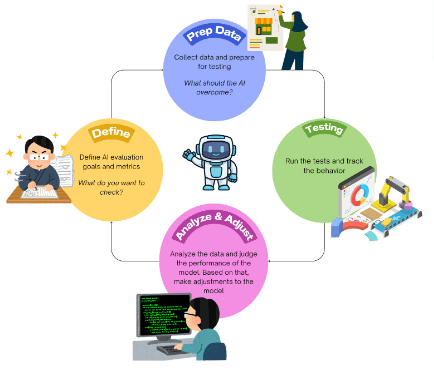
The first step is planning a pilot test. Select a small team or subset of tasks to try the AI tool, such as using ChatGPT for email drafts or Tidio for live chat automation. Set a clear timeframe, ideally 2–4 weeks, to observe results without disrupting operations.
Next, track all relevant metrics: hours saved, errors reduced, and revenue impact. Keep a record of costs associated with the AI tool, including subscription fees, training, and setup. Comparing these metrics against the baseline will show the effectiveness of the tool. This method ensures a practical, step-by-step approach to Test ROI of Any AI Tool efficiently.
The ROI Template (Downloadable/Printable)
A template simplifies tracking and calculating ROI for any AI tool. Include fields for tool name, purpose, baseline metrics, AI implementation period, and results. Templates can be printed or used digitally for easy updates. Tools like Excel, Google Sheets, or Canva can help you design this template quickly.
Having a structured template ensures consistency and clarity. You can record metrics such as hours saved, cost reductions, or revenue growth, making it easier to calculate ROI at the end of the test phase. Templates are particularly useful for teams managing multiple AI tools simultaneously.
Calculate Current Baseline
Before using an AI tool, measure the current performance. For example, customer support may take 10 hours per week, or manual content creation may cost $500 monthly. This baseline provides a reference point to evaluate improvements after AI implementation.
Documenting baseline metrics ensures that any gains can be clearly attributed to the AI tool. Tools like Zendesk AI or UiPath can then be compared against these baseline numbers, showing the actual impact on time, cost, or quality. Accurate baseline measurement is key for a meaningful ROI calculation.
Implement the AI Tool in a Test Phase
Run a pilot program for a limited period, usually 2–4 weeks. Assign the AI tool to a small team or a specific task set, such as Tidio handling customer queries or Jasper AI creating social media posts.
During the pilot, track all metrics carefully, including time saved, errors reduced, and additional revenue generated. Document costs such as subscriptions, training, and implementation efforts. This trial phase ensures real-world insights into the tool’s effectiveness before full deployment
Measure the Results
Compare performance before and after AI implementation. For example, hours saved multiplied by the hourly cost equals labor cost saved. Additional revenue generated also contributes to the ROI calculation.
Example: ChatGPT saves 10 hours per week at $20/hour = $200 saved. Tool cost = $100/week. Net gain = $100/week → ROI = 100%. Measuring results this way shows clear, quantifiable value from using AI tools.
Evaluate Qualitative Benefits
Some AI benefits are non-monetary but still important. Tools like Intercom AI can improve customer satisfaction by providing faster responses, while UiPath reduces repetitive errors.
Other benefits include higher employee satisfaction and better workflow efficiency. Factor these qualitative improvements into your ROI assessment to get a complete picture of the tool’s value beyond just money saved.
Decide on Full Implementation
If ROI is positive, consider rolling out the AI tool fully across teams or departments. Ensure training and integration are handled to maximize benefits.
If ROI is lower than expected, investigate possible reasons. It could be an incorrect use case, insufficient training, or tool limitations. Adjusting your approach before full deployment can improve outcomes and ROI.
Calculate ROI
The basic formula for ROI is:
ROI=Benefit from AI Tool−Cost of AI Tool/Cost of AI Tool×100
Where the benefit is the quantified improvement, such as time saved or revenue generated.
Example: AI tool saves 100 hours/month at $50/hour → $5,000 benefit. Tool costs $3,000/month.
ROI=5,000−3,0003,000×100=66.67%ROI = \frac{5,000 – 3,000}{3,000} \times 100 = 66.67\%ROI=3,0005,000−3,000×100=66.67%
This formula helps businesses clearly understand the financial value of testing the ROI of any AI tool.
