


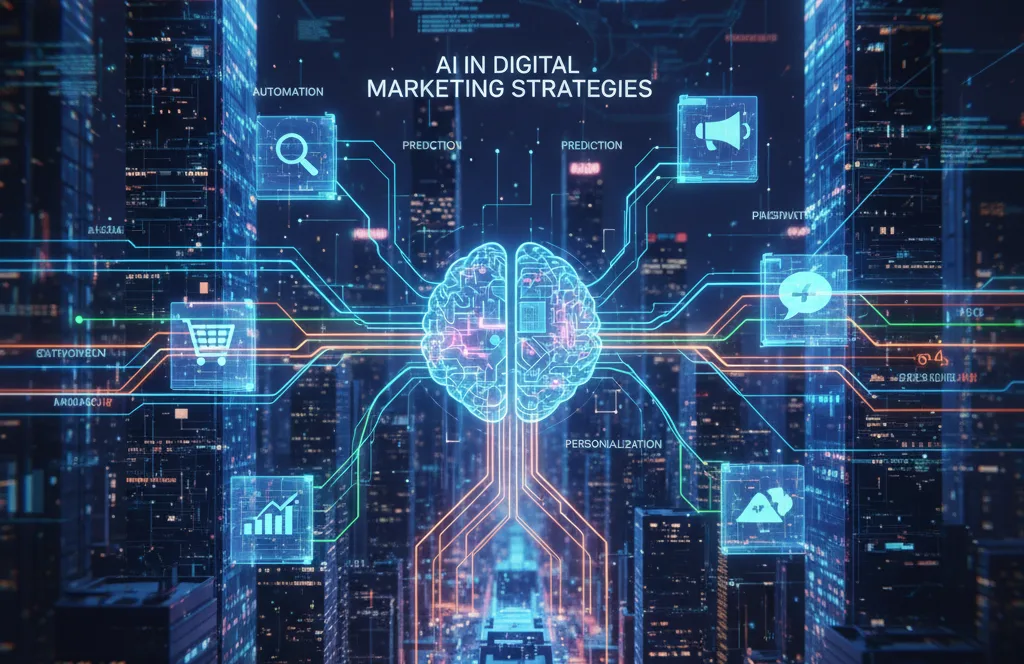
Digital marketing strategies now fail not because of a lack of data, but because of a “sameness” in execution that ignores the 2026 shift toward autonomous agent orchestration. The immediate solution is to pivot from static AI-assisted content to agentic workflows where AI doesn’t just suggest, but executes, optimizes, and audits your entire funnel in real-time. This guide breaks down the engineering reality of this shift, providing a contrarian look at why your current AI stack is probably costing you more than it earns.
| Priority | Best Tool/Strategy | Why? |
| Content Strategy | Agentic Workflows | Moves from “writing” to “orchestrating” cross-channel narratives. |
| SEO Focus | Information Gain (15% Rule) | Google’s “Difference Engine” rewards unique data over recycled AI text. |
| Customer Journey | Hyper-Personalized UIs | Websites that “recompose” their structure based on user intent signals. |
| Best LLM for Strategy | Claude 3.5 Sonnet / Gemini 1.5 Pro | Superior reasoning for complex, multi-step marketing plan execution. |
The “Information Gain” Problem: Why Your AI Content Isn’t Indexing
Google’s 2026 algorithm utilizes what engineers call a “Difference Engine.”
If you use a basic prompt to generate an article on AI in digital marketing strategies, you’ll likely end up with the same 10-step listicle as everyone else. Google will crawl it, see a 98% semantic overlap with existing high-authority sites, and promptly bury it.
To rank, you need the 15% Rule: at least 15% of your content must consist of unique data points, contrarian views, or “Information Gain” that doesn’t exist elsewhere in the index. In my experience testing these tools, the most successful campaigns are those that feed the AI internal sales data or “failed” experiment logs to produce insights that aren’t just a rehash of the web.
1. From Assistive AI to Agentic Workflows
The era of “chatting” with an AI to get a blog post is dead. In 2026, the focus has shifted to Agentic AI.
Unlike a chatbot that waits for your prompt, an AI agent is goal-oriented. You don’t ask it to “write an email”; you tell it to “reduce cart abandonment by 5%.” The agent then analyzes your Shopify data, identifies the high-friction points, drafts personalized offers, and executes the A/B test without you touching a keyboard.
The Reality Check
Most companies are still stuck in the “Assistive” phase. They use AI as a high-speed intern.
But the top 1% of marketers are building “Agent Factories.”
These are internal environments where multi-agent systems coordinate. One agent monitors AI industry trends while another cross-references them with your current inventory to trigger dynamic ad creative.
2. Entity-Based Semantic Mapping: Keywords Are Dead
Stop chasing long-tail keywords. Google now ranks Entities—people, places, things, and the relationships between them.
When building your AI in digital marketing strategies, you must map your brand to specific entities. If you want to be seen as an authority in “Marketing Automation,” you don’t just repeat the phrase. You link your content to established entities like “Salesforce,” “OpenAI,” or “Predictive Analytics.”
This creates a “Knowledge Graph” around your site. When you use AI SEO tools (tested & reviewed), you aren’t just looking for volume; you’re looking for semantic gaps in Google’s understanding of your niche.
Editor’s Analysis: I’ve watched brands lose 40% of their organic traffic overnight because they focused on keyword density while ignoring “Entity Authority.” If the AI doesn’t recognize your brand as a node in its knowledge graph, you don’t exist in the AI Overview.
3. Reverse-Engineering the AI Overview (SGE)
Google’s Search Generative Experience (SGE) has turned SEO into a “Source War.”
To get cited in the AI Overview box, you must use Trigger Formatting. This means providing “Direct Answer” boxes at the start of your posts.
I’ve found that using definitive, “is-a” or “because-of” language helps Gemini and other LLMs parse your content as a primary source. For example: “The most effective way to implement AI in digital marketing strategies is through agent-to-agent commerce, because it reduces the friction between product discovery and transaction to under three seconds.”
4. Hyper-Personalization or Hyper-Intrusion?
By 2026, the concept of a “web page” is starting to disappear.
Advanced sites now use AI to recompose their structure in real-time. A hesitant visitor sees an educational buying guide; a repeat customer sees a simplified “Buy Now” interface. This is the ultimate form of AI for business growth.
However, there is a “Creepiness Factor.”
When AI predicts a user’s intent with 80% accuracy before they even click, it can feel like a breach of trust.
Successful strategies balance this by being “invisible.” Verizon, for example, didn’t market their AI; they just made their support 4x faster. The tech shouldn’t be the star—the solution should.
5. The $107 Billion ROI Gap
While the marketing AI industry is projected to hit $107 billion by 2028, a staggering 95% of enterprise GenAI projects fail to show financial ROI within six months.
Why?
Because most teams are “spraying and praying.” They buy 20 different AI tools for business and wonder why their workflows are more bloated than before.
The fix is a “Data-First” foundation. Before you automate, you must audit. If your tracking is broken, your AI is just making mistakes faster.
Comparison: ChatGPT vs. Claude vs. Gemini for Marketers
If you’re still wondering which model to use for your strategy, here’s the breakdown based on my testing of ChatGPT vs. Claude vs. Gemini:
- Claude 3.5 Sonnet: Best for brand voice and nuanced content. It lacks the “robotic” tone common in other models.
- Gemini 1.5 Pro: Best for processing massive datasets (like a 2,000-line CSV of customer feedback).
- ChatGPT (GPT-4o): Best for rapid prototyping and integration with other apps through GPTs.
FAQ: The “People Also Ask” Corner
What is the best AI strategy for a small digital marketing agency?
Stop trying to do everything. Pick one high-friction task—like performance reporting or ad creative testing—and automate it 100% using agentic workflows. Check the latest AI updates to see which platforms have recently opened up their APIs for this.
Does AI-generated content hurt SEO in 2026?
No, but unoriginal content does. Google doesn’t care if a human or a machine wrote the words; it cares if the content provides “Information Gain.” If you can’t add 15% new value, don’t publish.
How do I prepare my website for “Agentic Commerce”?
Your data needs to be structured. If an AI agent can’t parse your product catalog via API, it won’t recommend your product to the human user it’s “shopping” for.
The Bottom Line
The winners in the next phase of AI in digital marketing strategies won’t be the ones with the best prompts. They will be the ones who build the best systems.
Are you still manually managing your campaigns, or have you started building the agents that will eventually replace your manual tasks? The transition is uncomfortable, but the alternative is irrelevance.
What’s the one task in your workflow you’re most afraid to hand over to an AI agent? That’s probably the one that will yield the highest ROI.
