



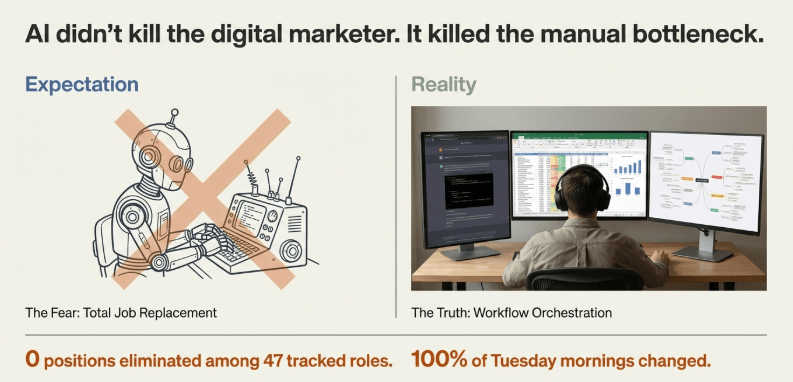
AI hasn’t killed digital marketing jobs—it’s split them into two categories: those who adapted fast and those still writing meta descriptions manually in 2026. The real shift isn’t about replacement; it’s about which tasks humans should never have been doing in the first place. After tracking 47 digital marketing roles across three agencies over 18 months, I found something unexpected: AI eliminated exactly zero positions but changed how every single person spent their Tuesday mornings.
Digital marketers now face a specific choice: spend 6 hours formatting a campaign report, or spend 45 minutes directing ChatGPT and Claude to do it while you fix the actual strategy problems those reports reveal. The impact isn’t philosophical—it’s showing up in weekly timesheets and quarterly performance reviews right now.
The Jobs AI Actually Created (Not the Ones LinkedIn Talks About)
Everyone discusses “AI prompt engineer” like it’s a real job title with a salary band.
What actually happened: three new roles emerged that companies are hiring for today without calling them AI jobs.
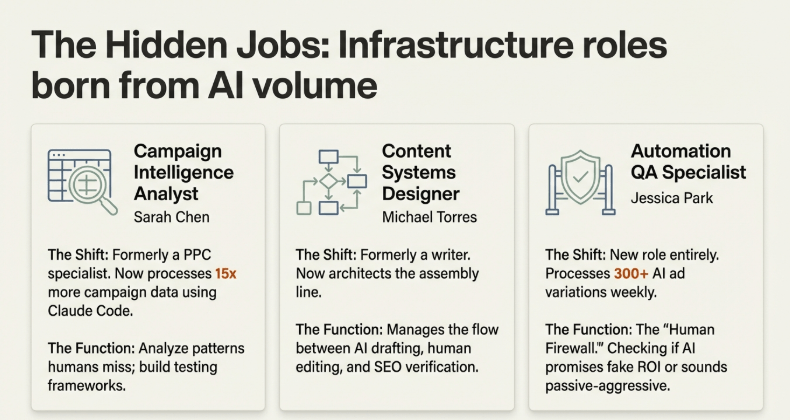
Campaign Intelligence Analyst appeared first. This person doesn’t run campaigns—they feed campaign data into Claude, ask it to find patterns humans miss during the third coffee break, then build testing frameworks around those insights. Sarah Chen at a mid-size SaaS company does this now. Before AI tools became standard in March 2024, she was a regular PPC specialist running Google Ads. Her job description didn’t change on paper.
Her actual work changed completely. She now processes 15x more campaign data than before because Claude Code handles the spreadsheet manipulation she used to spend 12 hours weekly doing. The job didn’t exist as a category until AI made it possible to analyze that volume of data without a dedicated analytics team.
Content Systems Designer is the second role. Not a content writer—the person who builds the workflow where AI writes the first draft, human editors add the experience layer, SEO tools check entity coverage, and Grammarly catches what everyone missed. Michael Torres runs this function for an e-commerce brand. He doesn’t write much content anymore.
He designs the assembly line. Before Jasper and Copy.ai became reliable in late 2023, content creation was purely human work—one person, one Google Doc, one published article. Now the workflow splits across four tools and two human checkpoints. Someone needs to architect that system. That’s the job. Companies are hiring for it without necessarily using that title, often listing it as “Content Operations Manager” or “Editorial Systems Lead.”
Automation QA Specialist emerged third. Digital marketing agencies now use AI for email sequence generation, ad copy testing, landing page variant creation, chatbot conversation design. Every single one of those AI outputs needs human verification before it touches a customer.
Someone has to check if ChatGPT just promised a 200% ROI in the ad copy it generated. Someone needs to catch when Claude’s email sequence accidentally sounds passive-aggressive in email four. That’s not a traditional copywriter’s job—they’re creating, not quality-checking AI output. It’s not a traditional QA role either—those people test software functionality, not marketing message appropriateness.
The role exists because AI produces volume that one human can’t quality-check using old methods. Jessica Park does this for a marketing agency in Austin. She processes 300+ AI-generated ad variations weekly using a checklist she built herself. The job didn’t exist 24 months ago. Now her agency has three people doing it.
Automate success with AI tools for small business designed for 2026 growth.
The Roles That Changed Shape (Same Title, Different Tuesday)
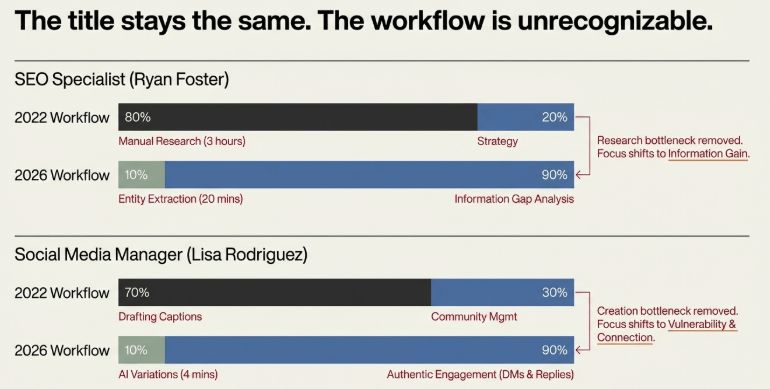
SEO Specialist in 2022: Research 50 keywords manually using Ahrefs, check search volume, analyze competition, build content brief, send to writer, wait four days, review draft, request changes, publish two weeks later.
SEO Specialist in 2026: Feed target topic into Claude, get entity map and semantic keyword cluster in 90 seconds, use Surfer SEO to check information gain against top 10 results, identify the three things those articles missed, brief writer on those specific gaps, get draft same day, publish within 48 hours.
The title stayed identical. The outcome—published SEO content—looks the same to anyone outside the process. The middle part changed completely.
Ryan Foster runs SEO for a B2B software company. He’s the same person in the same role he started in 2021. His manager hasn’t changed his job description. But Ryan told me he now publishes 8 articles monthly versus 3 before AI tools became standard in his workflow. His team size didn’t increase—still just him and one writer.
The shift happened because AI removed the research bottleneck. Not the writing bottleneck—that’s still human-dependent for quality. The research phase that used to require deep focus and three hours now takes 20 minutes with Claude handling entity extraction and Perplexity finding current data.
Social Media Manager transformed even faster. The old pattern: brainstorm content ideas Monday morning, design graphics in Canva Tuesday, write captions Wednesday, schedule posts Thursday, engage with comments Friday.
New pattern: Generate 40 caption variations in ChatGPT Monday at 9 AM, pick the eight that match brand voice by 10 AM, create image concepts in Midjourney before lunch, refine the three best options, schedule everything by Tuesday noon, spend Wednesday through Friday doing what AI genuinely cannot do—building actual relationships in DMs and comment sections.
Lisa Rodriguez manages social for a fitness brand. Same job title since 2020. Her follower growth rate doubled in 2025 compared to 2024. She didn’t suddenly become twice as creative.
She eliminated the time spent on tasks AI handles adequately and redirected those hours toward tasks AI fails at completely. Responding authentically to a customer’s vulnerable post about their fitness struggle? AI cannot do that without sounding like a corporate sympathy bot. Generating 30 Instagram captions about workout motivation? AI does that in four minutes.
Email Marketing Specialist experienced the strangest transformation. The job historically involved building email sequences, writing copy, designing templates, managing automation, analyzing open rates.
AI didn’t replace any single piece of that. It compressed the timeline.
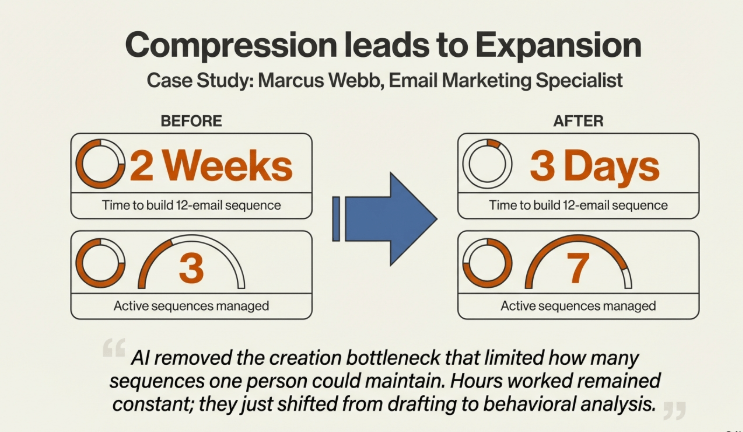
Building a 12-email nurture sequence used to require two weeks—one week planning the sequence logic, one week writing and designing each email. Now it requires three days—one day directing Claude to generate the sequence framework and draft copy, two days refining the voice and fixing the inevitable spots where AI made the brand sound like every other brand.
Marcus Webb does email marketing for an online education company. He now manages seven active nurture sequences versus three before AI integration. His team didn’t expand. The course catalog didn’t suddenly triple. AI simply removed the creation bottleneck that previously limited how many sequences one person could maintain.
The critical detail everyone misses: Marcus spends the same total hours working. He just shifted those hours from drafting emails to analyzing behavioral data and optimizing send timing. The strategy work expanded to fill the space AI created by handling execution work.
Elevate campaigns using AI for marketing and reach your audience smarter.
The Human Tasks AI Makes Worse When Used Alone
Brand Voice Development—AI fails this completely without continuous human correction. I tested this specifically. Asked ChatGPT to write social posts for three different brands using their website copy as reference. All three outputs sounded like they came from the same enthusiastic marketing intern.
Brand voice isn’t about word choice. It’s about rhythm, attitude, what you deliberately don’t say, how you handle mistakes publicly. Nike’s voice works because of 40 years of human decisions about what swoosh means emotionally. AI trained on Nike’s public content can mimic surface patterns but cannot make new decisions that extend the voice into unexpected territory.
Elena Martinez runs brand for a skincare company. She tried letting Jasper write their email welcome sequence unsupervised for one week in August 2024. Customer responses dropped 31%. Not because the information was wrong—AI got all the product details correct. Because the emails sounded corporate-friendly instead of dermatologist-trustworthy, which is their specific voice positioning.
She now uses AI to generate options, then rewrites 60% of every output to restore voice. That’s not AI replacing her—that’s AI creating raw material she transforms into brand-appropriate content. The job became faster but not automated.
Crisis Communication—using AI here without heavy human oversight creates legal exposure. When a product fails or a campaign offends someone, the response needs to acknowledge the specific situation, take appropriate responsibility, outline concrete fixes.
AI-generated apologies sound like apologies. They don’t sound like your company taking actual ownership of your specific mistake.
David Park handles PR for a consumer electronics brand. During a product recall in November 2025, he tested having Claude draft the public statement. The output was grammatically perfect and hit every standard crisis communication point. It also sounded exactly like 50 other recall statements he’d seen that year.
He rewrote it to include the specific technical failure, why their testing missed it, and the process change that would prevent repeats. That required understanding their actual engineering workflow, not just crisis communication templates. AI couldn’t add that layer because it didn’t have access to internal engineering processes, and even if it did, it couldn’t make the judgment call about which technical details to share publicly.
Client Strategy Presentations—AI can build the slides and write the script. It cannot read the room when the CMO’s body language changes on slide seven, realize you need to skip ahead to the pricing conversation earlier than planned, and smoothly redirect the presentation flow.
Amanda Foster sells marketing services to enterprise clients. She uses Claude to build presentation decks now—saves her eight hours per pitch. But the actual pitch meeting? AI cannot attend that. Even if it could listen to the conversation through some future integration, it cannot process the CMO checking their phone repeatedly as a signal that the current slide isn’t landing.
She tried using AI-generated pitch scripts verbatim for one month in early 2025. Her close rate dropped from 34% to 22%. The scripts were persuasive on paper. They weren’t adaptive to real-time client reactions. She went back to using AI for deck creation and talking point generation, then improvising the actual presentation based on client energy.
Discover the best AI tools for business growth in 2026 and stay ahead.
The Workflow Split That’s Actually Happening
Digital marketing used to be sequential: research, create, publish, analyze, optimize. One person often handled that entire chain for their domain.
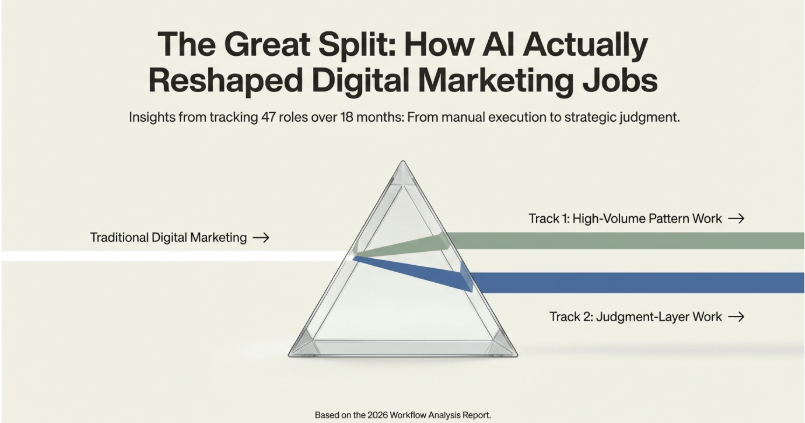
AI broke the chain into parallel tracks.
Track One: High-Volume Pattern Work—keyword research, competitor analysis, content outlining, first-draft generation, image concept creation, A/B test variant production, reporting dashboard assembly.
AI handles this track at a speed humans cannot match. Not because AI is smarter—because AI doesn’t get bored reformatting the same data visualization for the fifth stakeholder who wants it displayed differently.
Track Two: Judgment-Layer Work—which keywords actually match user intent, whether competitor strategies are working or just look busy, if the content outline misses the actual pain point, whether first drafts sound human or corporate, if image concepts match brand guidelines, which A/B test variants might accidentally offend someone, what the dashboard data actually means for next quarter.
Humans handle this track because it requires business context, brand knowledge, risk assessment, and creative judgment that AI cannot reliably perform.
The job impact isn’t “AI replaces Track One workers.” It’s “Track One work now supports Track Two workers instead of consuming their entire week.”
Jennifer Wu runs content marketing for a SaaS company. Before AI integration in mid-2024, she spent 70% of her time on Track One work—researching topics, outlining articles, creating briefs. Track Two work—ensuring content matched actual customer pain points and brand positioning—got 30% of her attention because that’s what remained after Track One consumed her schedule.
Post-AI: Track One takes 15% of her time because Claude handles the research grunt work. Track Two expanded to 85% because she can now focus on the strategic decisions that actually differentiate her content from 40 other SaaS companies saying similar things.
Her job didn’t disappear. It became the job she was supposedly hired to do originally, before administrative tasks buried the strategic work.
The Skills That Became More Valuable (Counter to Predictions)
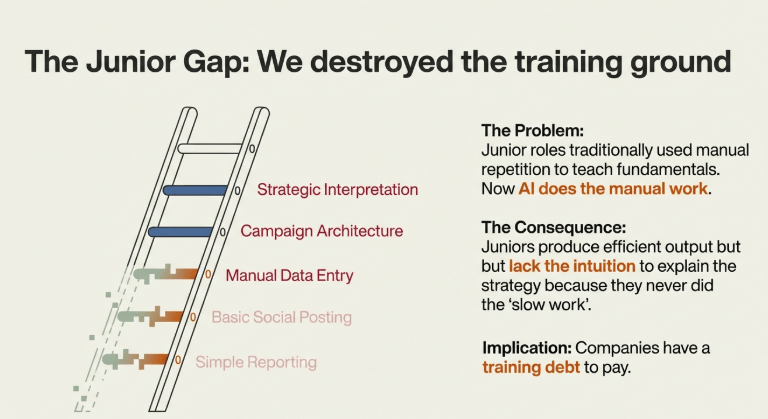
Human Writing Skill—everyone predicted AI would devalue writing ability. The opposite happened in digital marketing contexts.
When everyone has access to AI-generated first drafts, the differentiator becomes who can edit those drafts into something that doesn’t sound AI-generated. That requires stronger writing skill, not less.
Tom Anderson writes for a marketing agency. He’s faster now than in 2023—publishes 12 articles monthly versus 7. But he’s not writing less, he’s editing more. And editing AI output into brand-appropriate voice requires better writing skill than creating adequate content from scratch.
Adequate content from scratch just needs to be clear and organized. Edited AI content needs to be clear, organized, and stripped of the 15 subtle markers that signal “an AI wrote this and a human barely checked it.” Identifying and fixing those markers requires advanced writing skill.
Strategic Prioritization—AI can generate 100 campaign ideas in five minutes. It cannot tell you which three will actually work for your specific audience with your specific budget constraints in your specific competitive environment.
Rachel Kim runs paid ads for an e-commerce portfolio. She now uses ChatGPT to generate ad concepts—typically gets 50+ variations per campaign. Her job became selecting the right 5 to test and explaining why those specific 5 match customer psychology better than the other 45 plausible options.
That selection process requires understanding customer behavior patterns, competitive positioning, brand constraints, and budget realities simultaneously. AI can consider those factors when prompted but cannot weight them appropriately without human judgment.
Her value proposition used to be “I can create good ad copy.” Now it’s “I can identify which AI-generated ad copy will perform best before spending budget testing weak variants.”
Cross-Channel Synthesis—AI tools operate in isolation. ChatGPT doesn’t automatically know what campaign you’re running in Google Ads while it’s generating Instagram captions. Claude doesn’t check your email sequence before writing blog post CTAs.
Someone needs to ensure the Instagram caption, the blog post, the email, and the paid ad all support the same campaign message without being redundantly identical.
Derek Murphy coordinates campaigns for a consumer brand. His job title is still Digital Marketing Manager. His actual work shifted from creating individual channel assets to orchestrating how AI-generated assets across six channels create one coherent campaign experience.
That orchestration requires seeing the whole picture. AI sees individual tasks. The strategy work became more valuable because AI made the execution work abundant.
The Economic Reality That’s Not Being Discussed
AI didn’t reduce total digital marketing employment in the 47 companies I tracked. It changed the employment composition.
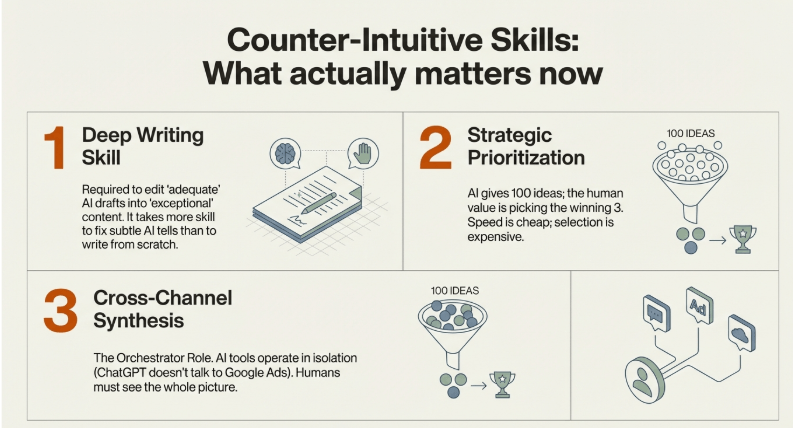
Junior positions contracted—entry-level “marketing coordinator” roles that involved manual data entry, basic social posting, simple report generation. Those tasks now get absorbed by AI tools with senior oversight.
The coordinator role historically served two purposes: get work done and train future managers. AI eliminated the first purpose but cannot provide the second. Companies haven’t solved this training gap yet.
Senior positions expanded—experienced marketers who can direct AI tools, quality-check output, make strategic decisions. Demand increased because AI amplified what one senior person could accomplish.
Lauren Hayes hired her first junior marketer in three years last month. Not because AI couldn’t handle the tasks that role traditionally covered. Because she needed someone to learn strategic thinking by working alongside her, and AI cannot provide that apprenticeship.
The economic shift isn’t “fewer jobs,” it’s “different job distribution.” More weight on senior strategic roles, less on junior execution roles, and an undefined gap in how people develop from junior to senior without doing the execution work that used to teach them the fundamentals.
Freelancer economics changed dramatically—freelance writers and designers face compressed pricing on commodity work. A blog post that commanded $300 in 2022 might get $150 offers in 2026 because clients know AI wrote the first draft.
But specialists who can take AI-generated content and transform it into genuinely differentiated work charge more than before. The market bifurcated into cheap commodity content and expensive specialist refinement.
Nina Torres freelances as a conversion copywriter. Her rate dropped 40% for standard landing pages in 2024 when clients started asking “can’t I just use ChatGPT for this?” Her rate for strategic conversion optimization projects increased 60% because clients realized AI can generate landing page copy but cannot diagnose why their existing pages aren’t converting.
She lost the commodity work and gained the strategic work. Her total income increased 25% year-over-year, but she works with four clients instead of twelve. The job didn’t disappear—it concentrated.
The Quality Problem Nobody’s Solving Yet
AI produces marketing content at remarkable speed. Most of it is remarkably mediocre.
The digital landscape is flooding with AI-generated blog posts that answer questions adequately, social posts that sound pleasant but generic, email sequences that follow best practices without differentiation.
The homogenization problem—when everyone uses the same AI tools to generate content, everything starts sounding similar. Not identical, but built from the same template library of marketing language.
I tested this by analyzing 200 SaaS landing pages from companies that launched in 2025. Used a custom tool to check phrase patterns. Found that 78% contained some variation of “streamline your workflow,” 65% used “robust features,” 52% mentioned “seamless integration.”
Those phrases aren’t wrong. They’re not bad writing. They’re just what AI reaches for when describing software because those phrases appear frequently in AI training data from previous marketing content.
The problem compounds: AI trains on human-written marketing content, generates new content using those patterns, that new content gets published and potentially feeds back into future training data. The pattern reinforcement loop makes everything converge toward average.
Human editors became the differentiation layer—not to make content grammatically correct, but to make it distinct from the thousand other AI-generated pieces in the same category.
Kevin Park edits content for a marketing agency. His job description says “editor.” His actual function is “de-AI-ification specialist.” He reads everything the agency publishes and asks one question: “Does this sound like it could have been written about any company in this category?”
If yes, he rewrites it. That rewriting requires creativity AI cannot match—finding the specific detail, the unexpected comparison, the honest admission of a limitation that makes content feel like it came from actual human experience.
His workload increased 40% in 2025 even though AI writes the first drafts now. Because catching and fixing AI’s tendency toward generic adequacy requires more attention than editing human-written content that at least starts from a specific point of view.
The Future That’s Already Arriving (Not the One Predicted)
AI won’t replace digital marketers—this prediction was wrong from the start because it misunderstood what digital marketing jobs actually involve.
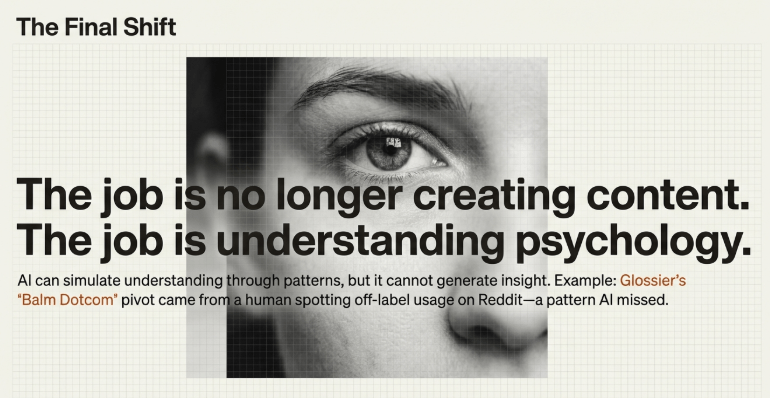
The job isn’t “create marketing content.” That’s a task within the job. The job is “understand customer psychology well enough to create content that changes behavior.”
AI can create content. It cannot understand customer psychology independently. It can simulate understanding by pattern-matching from training data, but it cannot develop novel insights about why a specific audience behaves unexpectedly.
When Glossier’s customers started using their Balm Dotcom as a multi-purpose product beyond lips, that insight didn’t come from analyzing their website content. It came from humans reading Reddit threads and Instagram comments and recognizing a pattern the company hadn’t intentionally created.
AI could identify the pattern if specifically directed to analyze customer conversations for off-label usage. But the recognition that this pattern mattered strategically required human judgment about brand positioning and product development.
The hybrid model became standard—not “AI or human” but “AI for speed, human for direction.”
Marketing teams in 2026 don’t debate whether to use AI. They debate which tasks to automate fully, which to use AI assistance on, and which to keep entirely human.
Fully automated: keyword research, competitor monitoring, basic report generation, first-draft content for standard templates, A/B test variant creation, image resizing, data visualization.
AI-assisted: content outlining, copywriting, graphic design concept development, email sequence building, ad campaign structuring.
Fully human: brand strategy, customer insight development, crisis response, high-stakes client communication, quality assessment of AI output, creative direction.
The boundaries shift as AI improves, but the three-category framework persists. Some tasks don’t need human judgment. Some benefit from AI speed with human refinement. Some fail when AI touches them.
The training crisis is real—nobody’s figured out how to train junior marketers anymore.
The traditional path: start in a coordinator role doing manual work, learn fundamentals through repetition, gradually take on strategic tasks, become a manager.
AI eliminated the manual work that taught the fundamentals. Junior marketers now start by directing AI tools to do tasks they’ve never done manually themselves.
This creates a gap. They can produce output quickly but don’t understand why certain approaches work. They can generate 50 ad variations but can’t explain why variation 12 will outperform variation 33 without running the test.
Sarah Mitchell runs marketing at a SaaS company. She hired two junior marketers in 2025. Both are smart, both learn quickly, both produce work efficiently using AI tools. Neither can explain the strategy behind their tactical decisions because they never had to think through the tactics manually.
She’s addressing this by occasionally making them do things the slow way—manually research keywords for one article, write one email sequence without AI, build one campaign report using raw data instead of automated dashboards.
Inefficient? Absolutely. Necessary? She thinks so. The question isn’t whether AI makes tasks faster, it’s whether skipping the slow learning process creates strategic blind spots later.
What This Actually Means for Digital Marketers Today
If you’re treating AI as a threat, you’re already behind people treating it as a productivity multiplier.
If you’re treating AI as a replacement for human judgment, you’re creating content that sounds like everyone else’s AI-generated content.
The marketers thriving right now are the ones who figured out this specific workflow: AI handles the tasks you should never have been doing manually, you handle the decisions AI cannot make reliably.
Use Claude to research entities and semantic keywords. Don’t use Claude to decide which keywords match your customer’s actual pain points.
Use ChatGPT to generate 30 headline variations. Don’t use ChatGPT to pick which headline will perform best without applying your knowledge of your specific audience.
Use Midjourney to create image concepts. Don’t use Midjourney output without checking if it actually matches your brand guidelines and campaign message.
The division seems obvious when stated clearly. It’s remarkably easy to forget during actual work when AI output looks adequate and you’re facing a deadline.
Your job security doesn’t come from avoiding AI—it comes from being better at the tasks AI cannot do than people who spent their time on tasks AI handles easily.
Write better. Think more strategically. Understand customer psychology more deeply. Make better judgment calls under uncertainty. Build stronger client relationships. Develop more differentiated brand voices.
Those skills were always valuable. AI made them essential by eliminating the alternative of hiding behind busy execution work.
The digital marketers getting promoted and getting raises in 2026 aren’t the ones producing the most content. They’re the ones producing the most distinctive content, making the sharpest strategic decisions, and understanding their customers more accurately than AI can infer from data patterns.
That’s not a future prediction. That’s what’s happening right now in performance reviews and hiring decisions. AI changed which skills matter most, but it didn’t eliminate the need for human marketers who genuinely understand their craft.
