


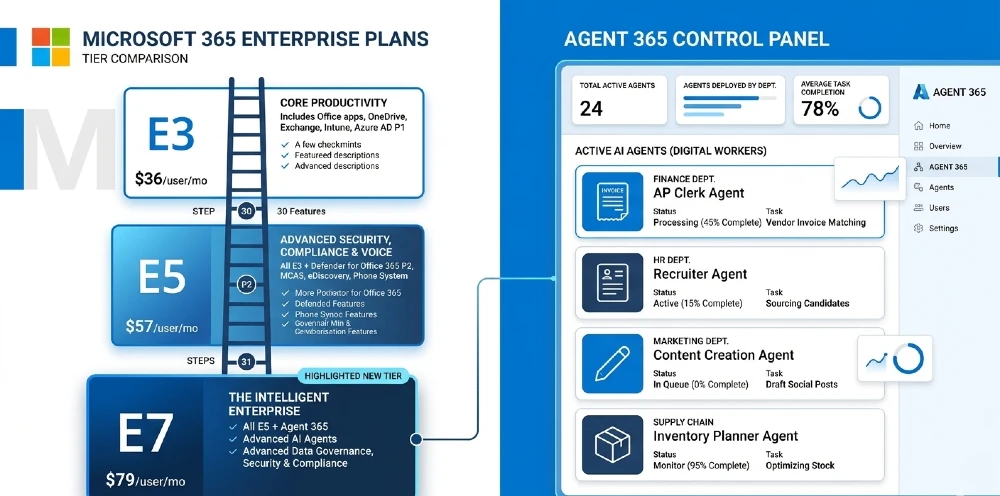
| Microsoft 365 E7Announced March 9, 2026. Generally available May 1, 2026. Price: $99 per user per month. Includes: Microsoft 365 E5 + Copilot + Agent 365 + Microsoft Entra Suite. Saves ~$18/user/month vs buying components separately at scale. Biggest change: Agent 365 — a dedicated control plane to govern, secure, and manage AI agents across the entire organization. Not for everyone — best fit is organizations already on E5 where Copilot is in active daily use. |
Microsoft 365 E7 Just Changed the Enterprise AI Licensing Conversation
Microsoft 365 E7 is the most significant restructuring of Microsoft’s enterprise licensing since the E5 tier launched in 2015. Announced on March 9, 2026, and going live on May 1, the new plan bundles four products that enterprises have been paying for separately into a single subscription — and adds a brand-new layer, Agent 365, that has no equivalent anywhere else in the market right now.
The timing is not coincidental. Microsoft reported that 65,000 AI agent responses are generated every day just within its own internal workforce using these tools. Copilot paid seats grew 160% year-over-year. Over 90% of Fortune 500 companies already use Copilot in some capacity. The market for enterprise agentic AI is not theoretical anymore — Microsoft is pricing for an infrastructure layer that enterprises are actively demanding.
The number that stops most IT and procurement teams: $99 per user per month. That sounds high until you run the comparison.
What Microsoft 365 E7 Actually Includes — and What Each Part Does
E7 is a bundle of four products. Here is what each one is and why it matters:
1. Microsoft 365 E5 — The Foundation
E5 is the current top-tier Microsoft 365 enterprise plan. It includes all Office apps, Teams, Exchange, SharePoint, OneDrive, Power BI Pro, advanced security through Microsoft Defender, Intune device management, and Purview compliance tools. E5 currently costs $57 per user per month, rising to $60 in July 2026. This is the base layer of E7 — everything in E5 is fully included.
2. Microsoft 365 Copilot with Work IQ — The AI Layer
Copilot has been available as a $30 per user per month add-on since late 2023. In E7, it is included by default. But this is not the same Copilot from 2023. Wave 3 of Microsoft 365 Copilot, launching alongside E7, introduces Work IQ — an intelligence layer that builds context from how each employee works, who they work with, and what content they collaborate on. The model becomes more useful the longer it is used because it learns the specific work patterns of the organization, not just generic language patterns.
Wave 3 also brings Copilot into Word, Excel, PowerPoint, and Outlook in a deeper way — users can now build their own agents directly inside the canvas they already work in, without needing to use a separate tool or developer workflow.
One more detail: Microsoft 365 Copilot is now model diverse. Claude from Anthropic is available in the mainline Copilot chat interface through the Frontier program, alongside OpenAI’s latest models. Microsoft is not betting on one model — it is running multiple models and letting the system route to the best one for each task.
3. Agent 365 — The New Control Plane for AI Agents
This is the genuinely new piece of E7. Agent 365 is a governance and management layer specifically designed for AI agents. As organizations start running autonomous AI agents across their workflows — agents that book meetings, handle ticket routing, process invoices, manage customer follow-ups — the question of who is watching these agents becomes critical.
Agent 365 answers that question. It automatically creates a full inventory of every AI agent in use across the organization, tracks adoption rates, flags potential security risks, and monitors infrastructure usage — all in one dashboard. As Jared Spataro, Microsoft’s CMO for AI at Work, described it: Agent 365 gives IT and security leaders one place to observe, secure, and govern every agent across the organization.
On its own, Agent 365 is priced at $15 per user per month. In E7, it is included. For enterprises running even a handful of agents across different teams, the governance value alone justifies having this in the bundle.
4. Microsoft Entra Suite — Identity and Access for Agents and Humans
Entra is Microsoft’s identity and access management platform. In the agentic AI era, this matters more than it did before. AI agents need identities, access permissions, and audit trails — just like human employees. Entra Suite provides that infrastructure. Without it, agents operating across an organization’s data and systems create untracked access vectors. With it, every agent action is authorized, logged, and auditable.
The Pricing Math: Does $99 Per User Actually Make Sense?
Here is the honest comparison most IT procurement teams will run:
| Plan / Component | Current Price/User/Month | From July 2026 |
| Microsoft 365 E3 | $36 | $39 |
| Microsoft 365 E5 | $57 | $60 |
| Copilot add-on (E5) | $30 | $30 |
| Agent 365 (standalone) | $15 | $15 |
| Entra Suite (add-on) | $12 (est.) | $12 (est.) |
| Total à la carte (E5 + all adds) | ~$114–117 | ~$117 |
| Microsoft 365 E7 (bundle) | $99 | $99 (confirmed) |
The savings are real: roughly $15 to $18 per user per month compared to assembling the same stack from components. At 1,000 users, that is $180,000 to $216,000 per year. For a 5,000-seat enterprise, the saving approaches $1 million annually.
But the more important question — the one LazyAdmin’s analysis put clearly — is how many of your users actually need all of this. For heavy Copilot users: legal, marketing, executive assistants, sales ops, HR, and finance, E7 is the right choice. For a warehouse worker or a field technician who uses Teams once a week, paying $99 per seat for the full agentic AI stack makes no sense.
The practical deployment recommendation: run E7 for your AI-intensive roles. Keep E3 or E5 for standard seats. This tiered approach gives enterprises the full agentic infrastructure for the teams that need it without paying for it across every seat in the organization.
Agent 365 Is the Feature Nobody Is Talking About Enough
Most coverage of E7 focuses on the price and the bundle structure. The more significant story is what Agent 365 signals about where Microsoft sees enterprise AI going.
AI agents — autonomous software that takes actions, not just generates text — are already running inside organizations at scale. Microsoft’s own data puts this clearly: IDC projects 1.3 billion AI agents in enterprise use by 2028. The question is not whether enterprises will run AI agents. It is whether they will have any visibility into what those agents are doing, what data they are accessing, and whether they are doing what they were designed to do.
Agent 365 is built specifically for this. It treats AI agents as digital workers — entities that need identities, permissions, activity monitoring, and security governance, just like human employees. Without something like Agent 365, organizations are effectively running workers with no HR records, no access controls, and no audit trail.
That framing — AI agents as managed digital workers — is new. And it is commercially smart. It gives Microsoft a durable justification for per-seat pricing in an era where AI is increasingly replacing tasks that humans used to do. As AI agents reduce the number of human seats needed, Agent 365 ensures Microsoft still collects a seat fee for every agent deployed. The commercial model evolves with the technology.
Who Should Upgrade to E7 and Who Should Wait
Switch Now — Best Fit
- Organizations already on E5 where Copilot is in active daily use by a significant portion of the workforce
- Enterprises deploying multiple AI agents across departments who currently have no centralized governance for those agents
- Companies running tools like Grammarly Business, Copy.ai, or Jasper AI as separate subscriptions — the Copilot layer in E7 covers most of what those tools do for writing, summarization, and content generation, at no additional cost
- Legal, financial services, and healthcare organizations where agent governance and compliance logging is a regulatory requirement, not just a nice-to-have
Wait or Evaluate Carefully
- Organizations where Copilot adoption is still low — paying $99 per seat for a tool most employees are not using is expensive
- Companies not yet on E5 who are considering jumping to E7 directly — the step up from E3 to E7 is a $60 per user per month increase. That requires a clear business case for every seat
- Teams that only need specific AI capabilities — if you only need meeting transcription, a standalone tool like Otter.ai covers that at a fraction of the cost
What This Means for the Broader Enterprise AI Market
E7 is not just a licensing change. It is Microsoft’s answer to tool sprawl — the problem of enterprises running eight different AI subscriptions that do not talk to each other. Notion AI, Jasper, Grammarly Business, Otter.ai, Salesforce Einstein, HubSpot AI — each one solves a specific problem but creates another: fragmented data, fragmented governance, fragmented costs.
Microsoft’s proposition with E7 is consolidation. One subscription, one governance layer, one identity system, one security stack — all built on top of the Microsoft 365 infrastructure most large enterprises already use. The switching cost from those standalone tools drops when you already pay for Copilot anyway.
The risk, and TechRadar flagged this directly, is vendor lock-in. When an organization’s AI infrastructure, security, identity, and productivity layer all live inside one vendor’s ecosystem, the negotiating position at renewal time weakens. Microsoft’s pricing has already increased — E5 goes to $60 in July 2026, E3 goes to $39, and volume discount structures from Enterprise Agreements were removed in November 2025. By the time E7 hits at $99, the relative cost feels more manageable partly because everything else got more expensive first.
That context matters for procurement teams building multi-year technology budgets.
Also This Week: Three Developer Tools Reshaping AI Workflows
Claude Code Adds Voice Mode for Hands-Free Coding
Anthropic rolled out voice mode for Claude Code on March 3, 2026, currently live for 5% of users. Type /voice to enable it. Hold the spacebar, speak your instruction, release to send. Claude Code acts on it — refactoring a function, running a test suite, explaining an error — all without touching the keyboard.
The push-to-talk approach is deliberate. It avoids accidental activation and keeps the interaction precise. Claude Code’s run-rate revenue crossed $2.5 billion in February 2026, more than double January’s figure. OpenAI’s Codex shipped voice mode one week earlier. This is now a baseline expectation in developer tooling, not a differentiator.
OpenAI Codex Launches Two-Way Figma Integration
Codex now syncs with Figma in both directions. Designers push a component to Codex and receive working code. Developers push code back to Figma and see a rendered design. The result is a single source of truth for both design and implementation — which means fewer QA cycles, fewer design-implementation mismatches, and faster product iteration.
For product teams, this closes a gap that has existed since design tools and code repositories became separate parts of the workflow. The practical impact is most visible in review cycles — reviewers now look at the actual rendered component, not a static mockup that differs from what gets shipped.
Hermes Agent: Open-Source AI With Persistent Memory
Hermes Agent launched this week as an open-source personal AI agent that remembers context across sessions. Most AI assistants reset between conversations — Hermes does not. It stores what it learns about your projects, writing patterns, and preferences and applies that context automatically in future sessions.
For privacy-focused organizations, the open-source, self-hostable architecture is the main appeal. Data stays inside the organization’s infrastructure rather than flowing through a third-party API. Early developer interest is high, and the persistent memory architecture is being watched closely by teams building internal AI agent infrastructure.
The Decision Every Enterprise IT Team Needs to Make Before May 1
Microsoft 365 E7 is a real product with real value — but only for the right organizations at the right deployment scale. The bundle saves money versus buying components separately. Agent 365 solves a governance problem that is about to become acute as AI agents proliferate. Work IQ makes Copilot genuinely smarter over time.
What E7 is not is a universal upgrade. The $99 per seat price only makes sense when the full stack — Copilot, agents, Entra identity, E5 security — is actively needed by that user. For organizations with mixed workforces, a tiered approach is the smarter play.
The window before May 1 is the time to audit Copilot usage, map which teams are actually running AI agents, and identify which seats in the organization justify the full E7 stack. That audit will determine whether E7 is a strategic investment or an expensive way to pay for capabilities half the organization will never use.
Microsoft has built the infrastructure for the agentic era. Whether E7 is the right commercial vehicle for your organization depends entirely on how far into that era you are ready to go.
Check Latest news about: GPT-5.3 Instant Is Live
