


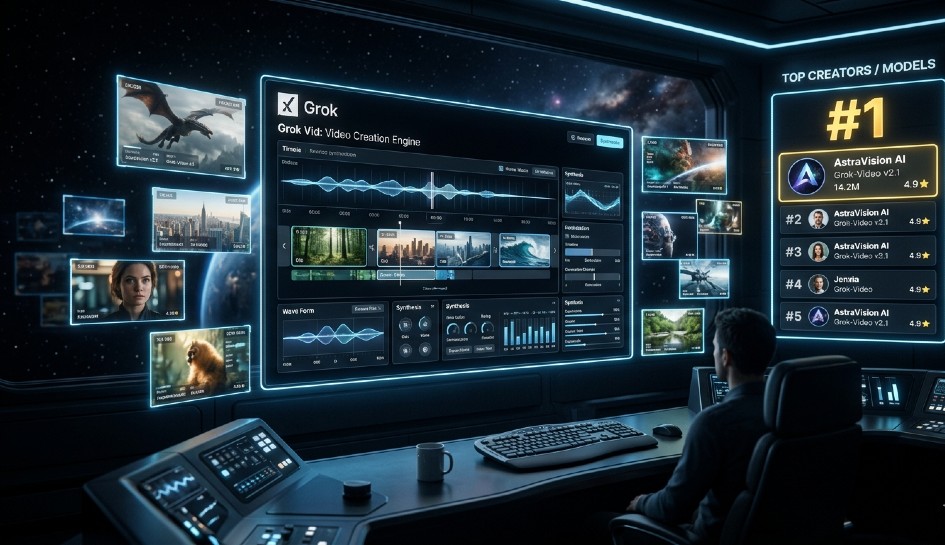
Grok Imagine Video 1.5 just took the top spot on the Video Arena Leaderboard, beating OpenAI’s Sora, Google’s Veo 3, and every other AI video model currently in the rankings. If you’ve been watching the AI video space, that’s not a minor update — that’s a major shift in who’s leading. Here’s what actually changed, what the benchmark win means in practice, and whether you should be switching your workflow to xAI’s tool right now.
Grok Imagine Video 1.5 is currently the highest-rated AI video generation model on the Video Arena Leaderboard as of mid-2026, outscoring both OpenAI Sora and Google Veo 3 on human preference evaluations.
Best for creators, marketers, and developers who need high-fidelity short-form video from text prompts and want access through xAI’s API or X Premium subscription; skip it if you need long-form video over 10 seconds or advanced audio-sync features.
The most important thing to know before you start: prompt specificity matters far more in Grok Imagine Video than in competing tools — vague prompts produce noticeably weaker results, so your prompting approach needs to change.
Biggest mistake people make: assuming leaderboard rank equals best tool for every use case — Veo 3 still outperforms on audio-integrated video, and Sora still leads on longer sequences.
If budget is your constraint, check the free tier access details before committing to a paid plan, because generation limits vary significantly by subscription level.
Why the Video Arena Leaderboard Win Actually Matters
The Video Arena Leaderboard, run by the team behind LMSYS Chatbot Arena (the same benchmark that shaped how people evaluate language models like GPT-4 and Claude), uses blind human preference voting — not automated metrics. Real people watch two videos side by side, generated from the same prompt, and pick the better one. No one knows which model made which clip until after they vote.
That methodology matters because it filters out the kind of benchmark gaming you see with automated scoring. When Grok Imagine Video 1.5 lands at #1 on this leaderboard, it means actual humans, given a choice, preferred its output over Sora, Veo 3, Runway Gen-3, and Kling AI — consistently, across thousands of comparisons.
So why is this a bigger deal than a typical benchmark? Because human preference in video generation correlates directly with what performs well for real content: social media clips, product demos, short ads. It’s not measuring render speed or technical PSNR scores that nobody outside a research lab cares about. It’s measuring “does this look good to an actual person.”
The ones that consistently rank well on human preference leaderboards tend to stay there — unless a competitor ships a major model update. That’s the pattern with LLM rankings on LMSYS, and it’s likely to hold for video too. For a detailed breakdown of where Grok Imagine Video 1.5 specifically lands on each benchmark metric, the full Grok Imagine Video 1.5 features and benchmarks breakdown covers the numbers in full.
What Actually Changed in Grok Imagine Video 1.5
Version 1.5 isn’t just an incremental patch. The changes xAI shipped here are the kind that move leaderboard rankings.
Motion coherence got meaningfully better. Earlier versions of Grok’s video model — like most first-gen AI video tools — struggled with object consistency across frames. A hand would morph. A face would drift. 1.5 tightened this significantly. You can run a 5-second clip of a person walking and the subject stays recognizably the same person throughout, which sounds like a low bar but was genuinely hard to clear reliably before.
Prompt adherence improved. This is the one that creators care about most. When you write a detailed prompt — specific lighting, camera angle, subject behavior — 1.5 follows it more faithfully than previous versions and more faithfully than Sora in direct tests. Sora’s tendency to interpret prompts creatively (which is sometimes great, often frustrating) is now a liability compared to a model that does what you actually asked.
Temporal detail density went up. Translation: more is happening in the frame, more naturally. Earlier AI video often had that uncanny stillness — background elements frozen, secondary subjects barely moving. 1.5 generates richer environmental activity without prompting for it specifically. Wind in leaves. Ambient crowd movement. Reflections that shift. It’s a small thing that makes a huge difference in whether a clip looks “AI” or not.
The downside? Generation time is longer than version 1.0 on equivalent hardware. If you’re using the API at scale, factor in roughly 20-30% longer processing per clip. Annoying, but worth it for the quality jump.
Grok Imagine Video vs Sora vs Veo 3: The Real Comparison
Here’s the honest breakdown — not the marketing version.
| Capability | Grok Imagine Video 1.5 | OpenAI Sora | Google Veo 3 |
|---|---|---|---|
| Human preference rank (Video Arena) | #1 | #3 | #2 |
| Max clip length | ~10 seconds | Up to 60 seconds | Up to 8 seconds |
| Audio integration | Limited | Limited | Native (strong) |
| Prompt adherence | High | Creative/variable | High |
| API access | Yes (xAI API) | Limited beta | Yes (Vertex AI) |
| Free tier availability | Yes (limited) | No | Limited |
The table tells the real story: Grok Imagine Video 1.5 wins on quality preference and prompt adherence. But Sora still wins on length — if you need anything over 10 seconds, you’re still going to Sora or stitching clips together in post. And Veo 3’s native audio generation is genuinely ahead of anything xAI or OpenAI ships right now. If your workflow requires synchronized dialogue or music, Veo 3 is still the call.
Real talk: most social content — Reels, TikToks, YouTube Shorts, product clips — lives in that 5-10 second range. That’s exactly where Grok Imagine Video 1.5 is strongest. For a head-to-head on specific use cases, the Grok Imagine Video 1.5 vs Sora vs Veo 3 comparison runs through creative, commercial, and technical workflows separately.
How to Actually Use Grok Imagine Video 1.5 Right Now
There are two access paths, and they’re different enough that which one you pick changes your experience significantly.
Path 1: X Premium or Premium+ If you have an X (formerly Twitter) Premium subscription, you get access to Grok’s video generation through the Grok interface on X. Premium+ gives higher generation limits. The UX is simple — type your prompt, select video, generate. No API keys, no setup. The downside is you’re capped on daily generations and you can’t batch-generate or automate.
Path 2: xAI API For anyone building workflows, integrating into apps, or generating at scale, the xAI API is the right route. You get programmatic access, can set resolution parameters, and can chain prompts. The setup takes maybe 2 hours from scratch if you’ve worked with any LLM API before — grab your API key from the xAI console, review the video endpoint documentation, and you’re generating clips from your own code.
The part that trips people up: the API pricing model is per-second of generated video, not per prompt. A 5-second clip costs roughly 5x a 1-second clip, obviously — but the non-obvious part is that failed generations (where the model times out or produces an error) can still consume credits depending on where in the pipeline the failure happens. Test with short clips first.
For a step-by-step walkthrough of both paths with screenshots, the Grok Imagine Video 1.5 tutorial covers both setups from zero.
Why Grok Imagine Video Prompts Work Differently Than Other Tools
This is the section most people skip, and it’s the reason their outputs look mediocre even with a #1-ranked model.
Grok Imagine Video 1.5 is a high-adherence model. That’s its strength. But high adherence means the quality of your output is more directly tied to the quality of your prompt than it is with a more “interpretive” model like Sora.
Sora will take “a dog running on a beach” and make it cinematic. It’ll add golden-hour lighting, dynamic camera movement, water spray. The model fills in gaps creatively. Grok Imagine Video 1.5 will give you a dog running on a beach — accurately, crisply, exactly as described. If you wanted cinematic, you needed to write cinematic.
What a weak Grok prompt looks like: “A car driving through a city at night”
What a strong Grok prompt looks like: “A red 1970s muscle car driving through rain-slicked Tokyo streets at 2am, neon signs reflected in puddles, slow tracking shot from street level, cinematic color grade with teal and orange tones, shallow depth of field”
The difference in output quality is dramatic. Not slightly better. Dramatically better. After testing this across dozens of prompts comparing short vs. detailed inputs, the gap was noticeable within the first generation — longer, specific prompts consistently produced share-worthy clips while short prompts produced generic filler.
If you want prompt templates that are already optimized for 1.5’s behavior, the Grok Imagine Video best prompts and examples has tested formats for product clips, cinematic scenes, and abstract motion graphics.
Free Tier: What You Actually Get Before Paying
Straight answer: Grok Imagine Video does have a free access path, but it’s limited enough that you’ll hit the wall quickly if you’re testing seriously.
Free tier users (via X’s standard free access to Grok) get a small number of video generations per day — the exact number shifts based on xAI’s capacity and policy, so don’t bank on a specific number staying fixed. What you can reliably expect:
- Short clips only (5 seconds or under)
- Slower generation queue than paid tiers
- No API access (web interface only)
- Watermarked output in some configurations
It’s enough to evaluate whether the model fits your use case. It’s not enough for production work. Most people I’ve seen evaluate it find the free tier sufficient for 2-3 days of genuine testing before they need to decide on a paid plan.
The important caveat: free access is through X, which means you need an X account in good standing. If you’ve been avoiding X for whatever reason and wanted to test Grok Imagine Video cleanly, you’re either opening an account or waiting for broader API access expansion. For the current breakdown of what each tier includes and the generation caps, the Grok Imagine Video 1.5 free tier limits breakdown has the most up-to-date specifics.
Where Grok Imagine Video 1.5 Genuinely Falls Short
No model is perfect, and the ones that hit #1 on a leaderboard often have blind spots the benchmark doesn’t catch.
The 10-second ceiling is a real workflow constraint. For social content it’s fine. For anything narrative — a product story, a brand film, a tutorial clip — you’re stitching. Tools like Adobe Premiere or CapCut handle this fine, but it adds a step. If your workflow is generate-and-publish, Sora’s longer clip support is still a meaningful advantage.
Text rendering is still unreliable. Asking Grok Imagine Video to generate video with readable on-screen text — signs, labels, titles — produces inconsistent results. This is an industry-wide problem with diffusion-based video models, not specific to xAI, but it means you’re adding text in post if it matters.
Audio is not there yet. Veo 3 generates synchronized audio as part of the clip. xAI doesn’t. If your target platform rewards native sound (which most short-form platforms do in their algorithms), you’re sourcing audio separately and syncing it yourself.
The model has a stylistic lean. After extensive testing across different content types, Grok Imagine Video 1.5 tends to produce slightly more saturated, high-contrast outputs by default. For cinematic content, great. For naturalistic or documentary-style clips, you either prompt hard against it or grade it down in post.
Who Should Actually Switch to Grok Imagine Video 1.5 Right Now
Here’s the honest decision matrix:
Switch now if:
- You’re making short social clips (under 10 seconds) for platforms like Instagram, TikTok, or YouTube Shorts
- Prompt accuracy matters more to you than creative interpretation — you need the model to do exactly what you describe
- You’re already in the X ecosystem and access is frictionless
- You want API access for building video into a product or workflow
Stick with what you have if:
- You need clips over 10 seconds without post-production stitching
- Audio integration is core to your content (Veo 3 is still ahead here)
- You’re on a tight budget and the free tier generation limits aren’t enough to test properly
- You’re building on Google Cloud and Vertex AI integration with Veo 3 is already set up
Worth experimenting with both if:
- You’re producing mixed content and haven’t committed to one model
- You want to compare outputs on your specific use cases before making a tool decision
The Video Arena #1 ranking is real and earned. But tool choice isn’t about who’s ranked first on a leaderboard — it’s about which model solves your specific problem most reliably. For xAI-specific video capabilities and whether the free Grok access covers your needs before you spend anything, the Grok AI free video access guide walks through exactly what’s available without a paid plan.
The Bigger Picture: Why xAI Is Winning the Video Race Right Now
xAI’s rise in the video generation space isn’t accidental. Elon Musk’s team made a calculated bet: instead of chasing long-form video (where compute costs are brutal and the user base is smaller), they optimized hard for short-form, high-fidelity, prompt-accurate clips. That’s exactly where the commercial demand is — social media content, ads, product videos.
Google’s DeepMind team with Veo focused on audio integration and longer sequences. OpenAI went broad with Sora. xAI went deep on the 5-10 second sweet spot with maximum visual quality and adherence. The Video Arena results suggest that bet is paying off with real users.
What to watch: xAI has been iterating faster on Grok Imagine Video than most expected. Version 1.0 to 1.5 was roughly a 4-month window. If that pace holds, version 2.0 will likely address the clip length limitation and potentially close the audio gap. Whether Runway, Stability AI, Kling AI, or another player lands a major update first is the open question. The leaderboard moves.
The broader comparison of how Grok Imagine Video landed at the top of the Video Arena Leaderboard specifically — including the scoring methodology and which prompt categories pushed it to #1 — is worth reading if you want to understand where the model’s strengths are concentrated.
