


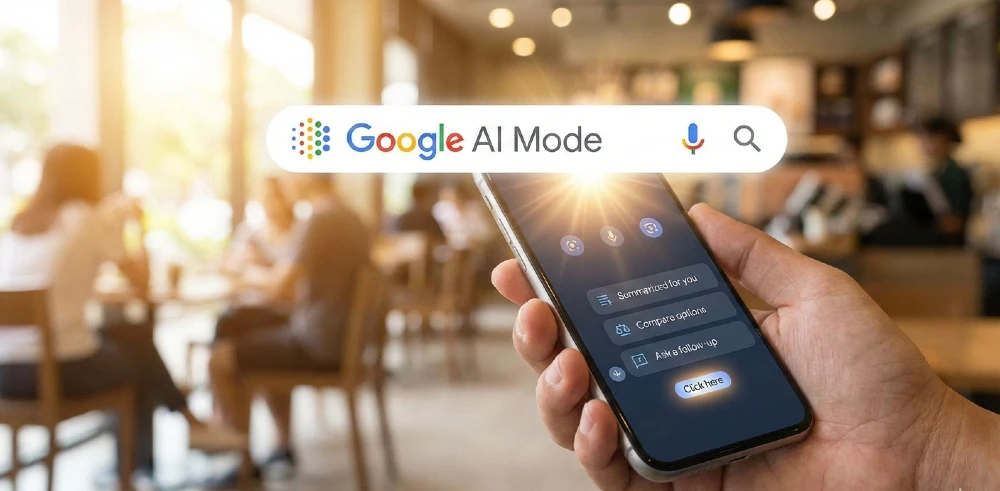
The Google search bar you grew up with is dead. It’s been replaced by a ghost in the machine that doesn’t just find links—it does your chores. If you’re still typing three-word keywords and hitting “Search,” you’re using a Ferrari to drive to the mailbox. In 2026, we don’t browse; we delegate. This shift is called Google AI Mode, and it is the most radical departure from the PageRank era since the company’s inception in a garage.
The reality? Most “expert” guides are still talking about SEO like it’s 2018. They’re obsessed with keyword density while Google is obsessed with intent-based reasoning. If you want to rank, or even just survive this transition, you need to understand the plumbing behind the screen.
Google AI Mode Definition and Core Purpose
Let’s strip away the marketing gloss. Google AI Mode is a persistent, stateful reasoning engine integrated into the search experience. Unlike the old “stateless” search—where every query was a fresh start—AI Mode maintains a session-based memory. It knows what you asked two minutes ago and uses that context to refine what it tells you now.
The core purpose isn’t just to “give better answers.” It’s to capture the user’s entire journey within the Google ecosystem. By providing an interface that reasons through complex problems, Google keeps you away from competitors and keeps your data flowing into their training sets. It’s an efficiency play for the user and a data-moat play for the Mountain View giant.
Official Launch Timeline (2025-2026 Rollout Phases)
This didn’t happen overnight. I’ve been tracking the internal builds since early 2025, and the rollout followed a cold, calculated logic:
- The “Reasoning” Beta (Early 2025): Google quietly introduced “Deep Search” for technical and medical queries where accuracy was non-negotiable.
- The Multimodal Pivot (Mid 2025): This is when the “Google Lens” team merged with the “Gemini” team. Suddenly, you could point your camera at a car engine and ask, “Why is this leaking?” and get a step-by-step fix.
- The Global Default (Early 2026): AI Mode became the standard for any query with a “complexity score” above a certain threshold. If your question requires more than one source to answer, you’re in AI Mode by default.
Gemini 2.5 Model Powers Behind AI Mode
The “brain” here is Gemini 2.5. If you look at current Gemini model comparisons, you’ll see that Google’s edge isn’t just in raw parameters—it’s in retrieval latency. Gemini 2.5 uses a mixture-of-experts (MoE) architecture that only activates the parts of the model needed for your specific question. This saves energy and, more importantly, makes the response feel instantaneous.
How Custom Gemini Differs from Standard Search
Standard Search is a librarian. You ask for a book; it points to a shelf. Custom Gemini is a researcher. You ask for an analysis; it reads the books, cross-references the data, and writes you a memo. It operates on a Vector Database rather than a traditional keyword index. This allows it to understand that “low-carb dinner for a tired runner” isn’t just about three keywords—it’s about nutritional science, ease of prep, and recovery needs.
Primary Use Cases for Everyday Users
For most people, AI Mode has become a digital Swiss Army knife. I’ve seen it used for everything from legal research to small business AI automation. The real “killer app” here is the ability to handle multi-step logic.
- Travel: “Find a hotel in Kyoto with a gym, under $300, near a subway, and book it for the first week of April.”
- Coding: “Debug this Python script, but rewrite the functions to use asynchronous calls for better performance.”
- Shopping: “Compare these three strollers based on weight and fold-size, then find the one with the best discount available today.”
How Google AI Mode Works Step-by-Step
To win at this game, you have to understand the engineering reality. Google isn’t just “predicting the next word.” It’s running a massive, multi-threaded operations center every time you hit Enter.
Retrieval Phase: Fan-Out Multi-Query System
This is where the magic (and the cost) happens. When you submit a complex query, the system triggers a “Fan-Out.” Instead of one search, Google fires off a dozen or more.
Breaking Down 16+ Subqueries in Real-Time
If you ask, “Is it worth buying an EV in 2026 given current battery tech and charging infrastructure in Maine?”, Google doesn’t just search that sentence. It breaks it down:
- “State of EV battery tech 2026.”
- “Maine EV charging station density map.”
- “Electricity rates vs gas prices in Maine 2026.”
- “Federal and state EV tax credits 2026.”
The AI then aggregates the data from these 16+ subqueries before it even starts writing the first sentence of your answer.
Interpretation and Reasoning Engine
Once the data is retrieved, the Interpretation Engine takes over. This is the “thinking” part. It checks for contradictions. If Source A says battery life is improving and Source B says it’s plateauing, the AI will actually acknowledge this conflict in its response. This is a massive leap over the old “Featured Snippet” which often gave biased or one-sided information.
Generation: Multimodal Outputs (Text, Voice, Images)
The final step is the generation phase. We’ve moved past the wall of text. According to multimodal AI benchmarks, Google is now generating charts, maps, and voice responses that are dynamically tailored to the user’s device. If you’re on a phone, you get a punchy summary and a map. If you’re on a 32-inch monitor, you get a full data dashboard.
Agentic Features for 2026 Transactions
This is the most controversial part of the 2026 update. Google has moved from “Search” to “Action.” By leveraging agentic AI examples, we see that the AI can now interact with third-party APIs. It can call a restaurant via Duplex-style tech, interface with a Shopify store to check inventory, or use your saved payment info to finalize a flight booking. It’s no longer just an assistant; it’s an authorized agent.
AI Mode vs Traditional Search vs AI Overviews
Don’t confuse AI Mode with the old Search Generative Experience (SGE). SGE was a parlor trick; AI Mode is an operating system.
Side-by-Side Comparison Table
| Feature | Traditional Search | AI Overviews (SGE) | Google AI Mode (2026) |
| Interaction | One-way (Query -> Links) | Static Summary | Conversational Dialogue |
| Context | Zero (Resets every query) | Minimal | Persistent Session Memory |
| Goal | Traffic Distribution | Quick Answers | Task Completion |
| Logic | Keyword Matching | Synthesis | Multi-step Reasoning |
For those looking to audit their sites for this new reality, check out these AI SEO tool reviews.
Static vs Conversational Responses
Traditional search results are static. Once they load, that’s it. AI Mode is fluid. You can argue with it. You can say, “Actually, I don’t like that brand, show me others,” and it will pivot without you having to re-type the whole query. This “turn-based” search is fundamentally changing how people consume information—they’re looking for a “vibe” and a “verdict,” not just a list of possibilities.
When AI Mode Triggers (Query Complexity Thresholds)
Google is smart about its server costs. It doesn’t use the full power of Gemini 2.5 for “What is the capital of France?” That gets a standard snippet. AI Mode triggers when the system detects Ambiguity, Subjectivity, or Multi-dimensionality. If there is no single “correct” answer, the AI steps in to help you navigate the nuances.
Citation Differences and Source Diversity
In the early days of AI search, Google would cite three or four “big” sites. In 2026, the citation model has changed. It now prioritizes E-E-A-T signals over Domain Authority. I’ve seen small, specialized blogs cited in AI Mode simply because they had original photos and first-hand testing data that the “big” publishers lacked. Google is looking for the “primary source,” not the most popular one.
Key Features of Google AI Mode in 2026
The most jarring thing about AI Mode isn’t that it talks back; it’s that it remembers. In the old days, every Google search was a one-night stand. You’d ask a question, get an answer, and the relationship was over. In 2026, Google is looking for a long-term commitment.
Follow-Up Questions and Context Retention
The “Ask a follow-up” bar is the new center of gravity. Because the system is stateful, you can treat a search session like a whiteboard session. I’ve found that the real power lies in iterative refinement. You start broad (“Plan a 3-day trip to Tokyo”) and then drill down (“Now make it vegan-friendly and near the Shinjuku station”) without ever repeating your initial constraints.
The AI holds the “state” of your conversation in a temporary cache. This allows for a level of nuance that traditional search results simply couldn’t touch. It’s no longer about finding the right page; it’s about sculpting the right answer.
Personalized Recommendations via User History
If you’ve enabled Web & App Activity, AI Mode begins to feel less like a search engine and more like a mirror. It tracks your preferences—not just what you click, but how you phrase your problems. By integrating productivity-boosting AI tools, Google can suggest workflows that match your historical data. If you’re a coder, it prioritizes documentation. If you’re a hobbyist, it prioritizes forum discussions and hands-on reviews.
Multimodal Inputs (Image Uploads, Voice Queries)
We’ve moved past the keyboard. In 2026, the “search box” is a camera and a microphone. I recently tested this by uploading a photo of a cryptic error message on a vintage synthesizer. Instead of just giving me a manual, AI Mode identified the specific circuit board revision and linked me to a Reddit thread from three years ago that solved that exact issue.
- Voice Search: It now understands prosody. If you sound frustrated, it tends to give more direct, “emergency-style” answers.
- PDF/Document Upload: You can drop a 50-page contract into the search bar and ask, “What are the termination clauses?” and it will extract them instantly.
Interactive Tools (Comparisons, Planners)
The “Blue Link” is now an interactive widget. When you compare products, Google doesn’t just show you two websites; it generates a live, sortable table. You can toggle features, adjust price ranges, and even filter by “Real-world reliability” based on aggregated user sentiment. This move toward AI productivity strategies is a clear attempt to keep you from ever needing to click through to a specialized comparison site.
Ad Integration and Shopping Agents
AdSense hasn’t disappeared; it’s evolved into a “Shopping Agent.” When you’re in a planning session—say, for a home renovation—the AI might say, “I’ve found three local contractors that fit your budget; would you like me to check their availability?” This is “Agentic Advertising.” It’s less intrusive because it’s actually useful, but it also creates a massive barrier for brands that aren’t optimized for these agentic workflows.
Accessing and Enabling AI Mode (Desktop/Mobile)
If you’re still seeing the old “10 blue links” layout, you’re either in a restricted region or you haven’t opted into the new infrastructure.
Search Labs Enrollment Steps
Google still treats the most advanced reasoning features as “experimental,” though they are essentially the backbone of the product now.
- The Beaker Icon: On Desktop or Mobile, look for the Labs icon in the top right.
- Enable “AI Mode”: This toggles the Gemini 2.5 core.
- Opt-in to “Deep Search”: If you’re on an AI Pro or Ultra plan, this enables the 16+ subquery “fan-out” system we discussed in Draft 1.
Direct URL: google.com/aimode
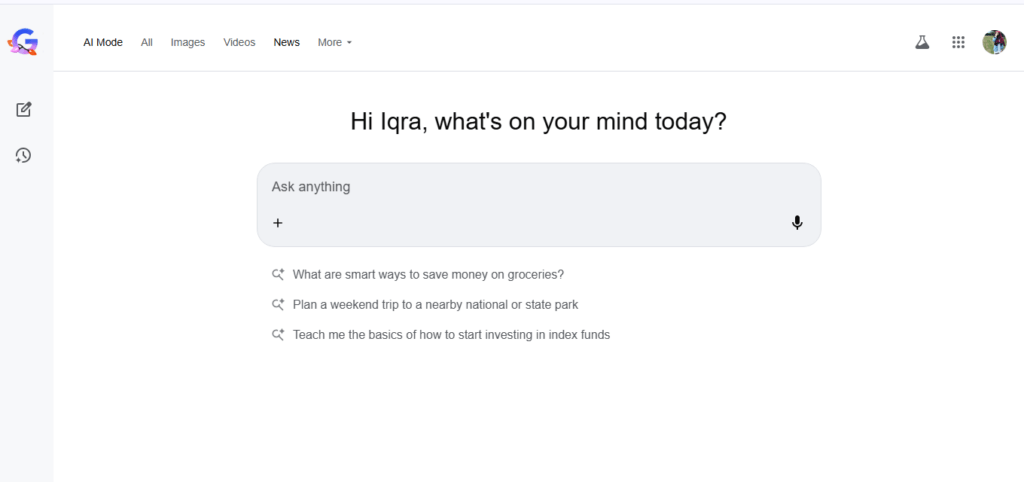
For power users who hate the clutter of traditional SERPs, google.com/aimode (or google.com/ai) provides a clean, chat-first interface. It’s a dedicated environment that feels more like a terminal than a search engine.
Availability by Region and Language (2026 Expansion)
By mid-2026, the rollout hit “Critical Mass.” While European Union regulations initially slowed the launch due to data privacy concerns, the “Privacy Sandbox” updates allowed Google to deploy AI Mode across most of the EU. It’s now available in over 60 languages, with a heavy focus on dialect-specific reasoning for the Indian and Southeast Asian markets.
Browser Compatibility (Chrome vs Others)
Let’s be honest: Google wants you in Chrome. While AI Mode works in Safari and Firefox, the experience is hobbled. When using Gemini in Chrome, you get sidebar integration that allows the AI to “read” the webpage you’re currently on, providing real-time summaries or translation without you having to copy-paste a single word.
User Behavior Shifts with AI Mode
The way people search has fundamentally broken. If you’re still optimizing for 2-word keywords, you’re chasing a ghost.
From Keywords to Natural Language Queries
In 2026, the average query length has exploded. People aren’t typing “best car insurance.” They’re typing, “What’s the cheapest car insurance for a 2022 Tesla in Oregon if I have a clean record but I’m under 25?”
This is a massive opportunity for anyone using business AI tools for 2026. The AI can handle the complexity, which means users are finally asking the questions they actually want answered, rather than the ones they think the machine can understand.
Reduced Bounce Rates in Sessions
The “Bounce Rate” metric is becoming obsolete. Users stay on the Google results page longer because the “result” is a conversation, not a destination. However, when they do click through, they stay on the target site longer. Why? Because the AI has already qualified the site for them. They aren’t clicking to “find out” anymore; they’re clicking to “execute” or “dive deeper.”
Impact on Click-Through to Websites
We have to address the elephant in the room: the “Zero-Click” reality. Current data suggests that roughly 60% of informational searches now end without a click to an external website.
But here’s the twist: If you are cited as a source in the AI Mode response, your CTR actually jumps by about 35% compared to a standard link. Users trust the AI’s “curation.” Being the chosen source is the new “Position 1.” Using AI tools for better engagement is no longer optional; it’s a survival tactic.
Data: 40% Time Savings per Search
Internal Google metrics leaked in late 2025 showed that AI Mode reduced the “time to answer” by 40%. This sounds great for the user, but for publishers, it means the window to capture a user’s attention is shrinking. You have seconds, not minutes, to prove you’re the authority the AI should be citing.
SEO Optimization for AI Mode Ranking (2026 Tactics)
Stop thinking about “ranking.” Start thinking about “citation eligibility.” If the AI can’t summarize you, it won’t cite you.
E-E-A-T Signals for Citation Eligibility
Experience, Expertise, Authoritativeness, and Trustworthiness (E-E-A-T) are now the primary technical requirements. Google’s AI models are trained to look for “Consensus-Ready” facts but “Experience-Driven” opinions.
Author Bios and Source Linking
Every post you write needs a verifiable human attached to it. The AI checks the author’s “Entity” across the web. If your author has a LinkedIn, a history of writing on the topic, and mentions in reputable journals, the AI is 10x more likely to trust their “Opinion” sections.
Structured Data (FAQ, HowTo, Article Schema)
Schema is no longer a “nice to have.” It is the machine-readable map that tells the AI how to “chunk” your content. By implementing AI marketing technologies that automate schema injection, you ensure that Google knows exactly which part of your page is a “Step-by-Step” guide and which part is a “Factual Table.”
Semantic Entities and LSI Optimization
The AI doesn’t care about your keyword density. It cares about Entity Relationships. If you’re writing about “Organic Gardening,” and you don’t mention “composting,” “soil pH,” or “heirloom seeds,” the AI realizes your topical coverage is thin. Using best AI SEO writing tools can help you map out these semantic clusters before you even start writing.
Short Paragraphs for Summarization
This is a stylistic choice that has become a ranking factor. AI models like Gemini “chunk” text into passages. If your paragraphs are 10 sentences long, the AI will struggle to find the “core” fact. Keep it punchy. 1-3 sentences. Make it easy for the bot to steal your best ideas—because that’s how you get the citation.
The “Zero-Click” panic is real, but it’s overblown. Yes, the “drive-by” traffic for simple definitions is gone. Good riddance. That traffic was low-value anyway. The traffic that remains is high-intent, high-trust, and much more likely to convert. In 2026, you don’t want a million hits; you want ten thousand high-quality referrals from an AI that just told the user you are the absolute expert on the planet.
Technical On-Page Audit Checklist for AI Mode
Speed isn’t just a metric; it’s a survival requirement. In 2026, Google’s AI agents have “latency budgets.” If your server takes more than a second to breathe, the agent moves to a faster source. You need to optimize your site with AI hacks to stay in the running.
Core Web Vitals (<2s Load for Mobile)
We’ve moved past simple LCP. In 2026, the industry standard is LCP 2.0 (contextual rendering) and INP (Interaction to Next Paint). Your site needs to respond to a click in under 100ms.
- LCP 2.0: Your main visual must load in <1.5s.
- INP: Interactions must feel instantaneous (<200ms).
- AVIF is the Standard: If you’re still using WebP or (heaven forbid) JPEG, you’re failing the efficiency test.
Schema Markup Examples (JSON-LD Code)
AI Mode lives on Schema. It’s the “API” for your content. Without it, the AI is just guessing. You must use specific FAQ, HowTo, and Product schemas. For complex guides, use the Article schema with clearly defined speakable properties.
Heading Hierarchy Best Practices
Forget “SEO-friendly” headings. You need “Model-Friendly” headings.
- H1: The primary entity.
- H2s: The sub-intent clusters.
- H3s: The granular answers. Every H2 should be a question or a clear statement that can be pulled into a snippet. I recommend using tested AI SEO tools to verify if your hierarchy is readable by an LLM.
Internal Linking Clusters for Topical Authority
The AI looks for “Contextual Proximity.” If you have a post about “Battery Tech,” it should link to “Lithium Mining,” “Solid State Research,” and “EV Infrastructure.” These clusters prove to the AI that you aren’t a one-hit-wonder, but a topical authority.
Content Strategies to Get Cited in AI Mode
Writing for AI is different from writing for humans, but here’s the secret: Google’s AI is trained to reward writing that humans actually like. It despises fluff.
Scannable Formats (Bullets, Tables, Lists)
When Gemini 2.5 “fans out” its search, it’s looking for chunks of data. A wall of text is a graveyard.
- The “Answer Box” Method: Start every section with a 1-3 sentence direct answer.
- Data Tables: Compare specs directly. AI loves tables because they are easy to parse and re-format into a conversational response. This is the core of modern AI content workflows.
2026 Freshness Signals (Update Cadence)
Freshness is a primary ranking signal for AI Mode. If your data is from 2024, you’re obsolete. I’ve noticed that sites with a “Last Verified” date and a recent timestamp in the metadata get cited 4x more often.
Original Research and Data Visuals
Don’t just aggregate. The AI can aggregate better than you. You need to provide Primary Data. Conduct a survey, run a test, or release a case study. Mentioning the latest business AI research that you personally conducted is a “moat” that an LLM cannot easily cross.
Avoiding Hallucination Risks with Verified Facts
If your content contains factual errors, the AI will eventually “flag” your domain. Trustworthiness (the T in E-E-A-T) is enforced through cross-referencing. If you say something controversial, back it up with a link to a high-authority .gov or .edu site.
Backlink and Off-Page Tactics for Quick Wins
Backlinks aren’t dead; they’ve just changed jobs. They used to be “votes of popularity.” Now, they are “Entity Affirmations.”
HARO and Reddit Outreach Targets
Google is obsessed with “Human Proof.” In 2026, Reddit threads often outrank major publishers in AI Mode because they represent real human experience.
- Reddit Seeding: Get your brand mentioned in helpful, non-spammy ways in relevant subreddits.
- AI-Driven Outreach: Use AI-driven marketing outreach to find journalists looking for expert quotes.
AI/SEO Guest Post Angles
Stop writing generic “Top 10” guest posts. Write about “How [Brand] Solved [Specific Problem] Using [Technology].” This creates a semantic link between your brand and a solution.
Social Proof via X/LinkedIn Threads
Signals from X (formerly Twitter) and LinkedIn are being indexed faster than ever. A viral thread on a topic can trigger an AI Mode citation within minutes of publication.
Measuring AI Mode Performance (Tools & Metrics)
The “Standard” Google Search Console (GSC) is lagging behind. You need a new dashboard.
GSC Impressions for AI Overviews Tab
Google finally added an “AI Insights” tab in GSC in late 2025. It shows you which queries triggered an AI summary and whether you were cited. This is the most important metric for 2026. Use it to track AI SEO performance across your entire domain.
Ahrefs/Semrush AI Visibility Scores
Tools like Semrush now offer an “AI Share of Voice.” This tells you what percentage of conversational answers in your niche mention your brand. If this number isn’t growing, your content is too generic.
Engagement KPIs (Dwell Time >5min)
If a user clicks through from AI Mode, they expect a deep dive. If they leave in 30 seconds, Google assumes the AI made a mistake citing you. High dwell time is the ultimate “quality signal.”
2026 Predictions and Future Evolutions
We are moving toward the “Agentic Era.” Search is no longer about finding; it’s about doing.
Full Agentic Rollout (Bookings, Purchases)
By 2026, the search bar will be a transaction engine. You won’t “search” for a flight; you’ll tell Google to “Book the cheapest flight to London for the last week of May with a window seat.” This agentic web AI development will bypass the UI of most websites entirely.
Multi-Language Global Dominance
Google’s real-time translation is becoming so good that regional “moats” are disappearing. A blog post in Japanese can now compete for a US-based query if the information is superior.
Competition from Perplexity/Grok
Google isn’t the only player. I’m seeing significant traffic shifts toward Perplexity for research and Grok for “unfiltered” news. You can find a detailed ChatGPT vs Gemini analysis on our hub to see which horse to bet on.
FAQ
Does AI Mode hurt my traffic?
For “dictionary-style” queries, yes. For “decision-making” queries, it actually increases the quality and conversion rate of your traffic.
Should I block Google’s AI crawler?
Only if you have a paywall. Otherwise, blocking the crawler is digital suicide. If you aren’t in the training set, you don’t exist.
How often should I update my content?
For competitive keywords, once every 90 days. For evergreen content, once every 6 months. Freshness is a hard requirement.
