


Will AI in admissions essays tank your Harvard application? That is the question students and parents are frantically asking themselves. The short answer is yes, AI will likely tank your application if you use it to write your essay. The longer, more cynical answer is that the tools designed to catch you are flawed, often triggering false positives that punish honest writers. This is the engineering reality of Do Colleges Check for AI in Application Essays, the systems are deployed, but they are not perfect.
The panic is justified. A recent survey confirmed that roughly 40 percent of colleges use AI detectors in some capacity. This is not a future problem; it is a present threat. If you are a high school student, an applicant, or a concerned parent, you need to stop listening to the hype and start understanding the specific policies and the technical weaknesses of the tools being used against you.
This is the definitive guide to navigating the college application AI rules in 2025, focusing on verifiable facts and actionable strategy, not fear.
Do Colleges Check for AI? The 2025 Reality
Yes, colleges check for AI. They are actively screening for ChatGPT in college essays and other forms of generative text. This practice is not uniform across the board, but institutional risk management has made it standard for many large and highly selective universities.
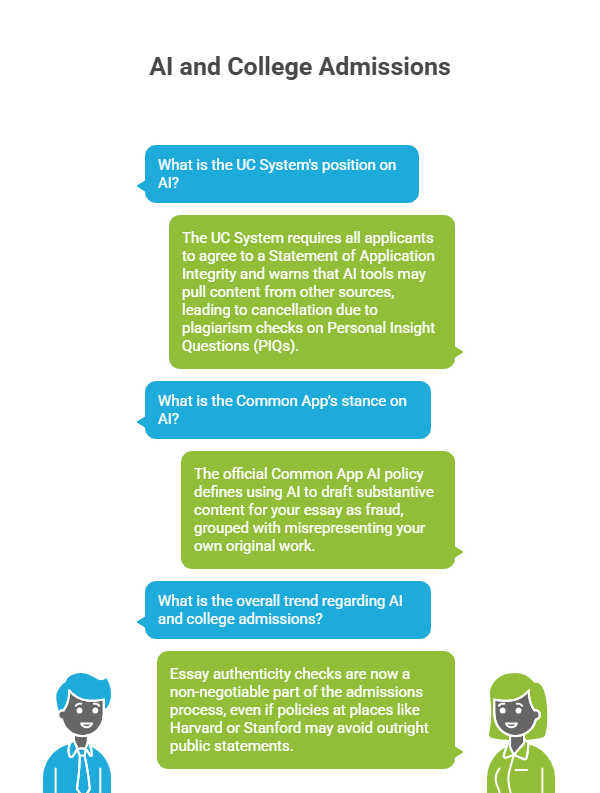
Colleges are not worried about basic plagiarism. They are worried about the wholesale fabrication of a student’s voice and experience. They require applicants to electronically sign a Statement of Integrity, and violating it by submitting AI-generated work is treated as fraud.
- The UC System’s Position: The University of California system requires all applicants to agree to a Statement of Application Integrity. They explicitly warn that AI tools may pull content from other sources, which can lead to cancellation due to plagiarism checks on Personal Insight Questions (PIQs). UC system plagiarism check procedures are in place.
- The Common App Stance: The official Common App AI policy defines using AI to draft substantive content for your essay as fraud. It is grouped with misrepresenting your own original work.
- The Trend: While policies at places like Harvard or Stanford may avoid outright public statements, the trend is clear: essay authenticity checks are now a non-negotiable part of the admissions process.
Top AI Detection Tools in Admissions
Colleges rarely build their own detection systems. They license expensive, off-the-shelf tools that plug directly into their learning management and application systems. Knowing which tools are in use—and more importantly, their failure rates—is essential.
Tool Comparison: Detection Technology Breakdown
This list simulates the critical comparison data needed to understand the risk.
- Turnitin AI Detection
- Accuracy: Advertised 98-100 percent for pure AI text (GPT-4, GPT-5).
- False Positive Rate: Historically low (around 1-4 percent for non-academic writing), but still a risk. They continually update their model to improve recall while maintaining a low false positive rate.
- College Users: Used widely by large university systems for coursework, and its AI detection in college essays feature can be enabled for admissions.
- GPTZero College Use
- Accuracy: High overall accuracy, often above 99 percent in controlled tests, especially on new models.
- False Positive Rate: Significantly lower than many competitors, reported as low as 0.24 percent in some benchmarks. The developers explicitly prioritize minimizing wrongful accusations.
- College Users: Gaining traction in educational settings due to its low false positive AI detectors profile.
- Originality.ai Accuracy
- Accuracy: Varies, but newer models boast 99 percent accuracy for some LLMs.
- False Positive Rate: Reported false positive rates around 0.5 percent to 1.5 percent, depending on the model. It is very cautious when flagging human-written text.
- Focus: Often used by publishers, but its conservative approach makes it appealing for high-stakes essay authenticity checks.
- Copyleaks Admissions
- Accuracy: Strong, but can struggle with heavily paraphrased or human-edited AI text.
- False Positive Rate: Higher in some independent tests compared to GPTZero. It might misclassify 1 in 20 human documents.
- Focus: Offers both plagiarism and AI detection, providing a unified risk score.
- Winston AI Tool
- Focus: A powerful tool specifically designed to check for generative text, often used by smaller institutions or individual departments.
Schools Actively Scanning Essays: 2025 Policy List
While most schools do not release a public list of the software they use, their academic honesty policies and general actions reveal their commitment to AI in admissions essays.
- Publicly Known Scanners/Policies:
- University of California System (UC): Explicitly checks for plagiarism on PIQs and requires the Integrity Statement. Admissions uses verification measures.
- Brigham Young University (BYU): The Academic Honesty Policy is clear: do not submit work another person or program created. This includes AI. BYU AI essay consequences can lead to suspension or expulsion.
- University of North Carolina (UNC) Chapel Hill: While many policies are evolving, top public universities have been proactive in using detection for coursework, making an admissions check highly likely.
- Caltech: Advises students that AI may NOT be used to outline, draft text, or translate the essay. You can use it only for spelling or clarity, similar to asking an adult for help.
- Implicit Scanners (Ivy League and Top Tier):
- Institutions like Harvard and Stanford rely on the Common App AI policy and their own, extremely strict honor codes. While they may not use a blanket scan on every essay, any application flagged by a human reader for generic, robotic language will undergo a secondary review using an AI detection tool.
The bottom line: assume that if the school has an acceptance rate below 20 percent, your essay will be screened, either by an algorithm or by a highly experienced human reader.
How Detectors Work & Their Weaknesses
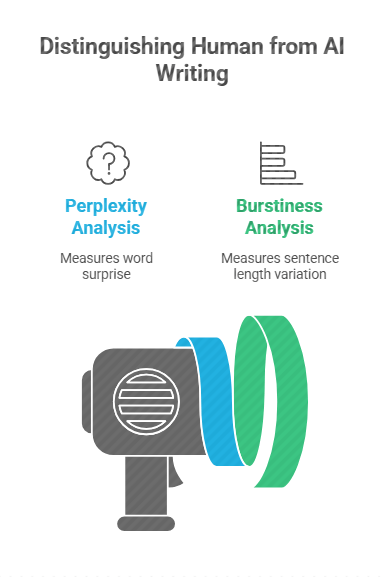
The technology is built on identifying predictable patterns, a concept known as perplexity and burstiness.
- Perplexity: This measures how surprising the next word is. Human writing has high perplexity because we frequently choose unexpected, descriptive, or emotional words. AI writing has low perplexity because it selects the most statistically probable next word, resulting in smooth, predictable, and ultimately boring text.
- Burstiness: This measures the variation in sentence length. Human writing is “bursty”—we use a mix of short, punchy sentences and long, complex ones. AI output is typically standardized, making it flat and easily identifiable.
The Problem of False Positives
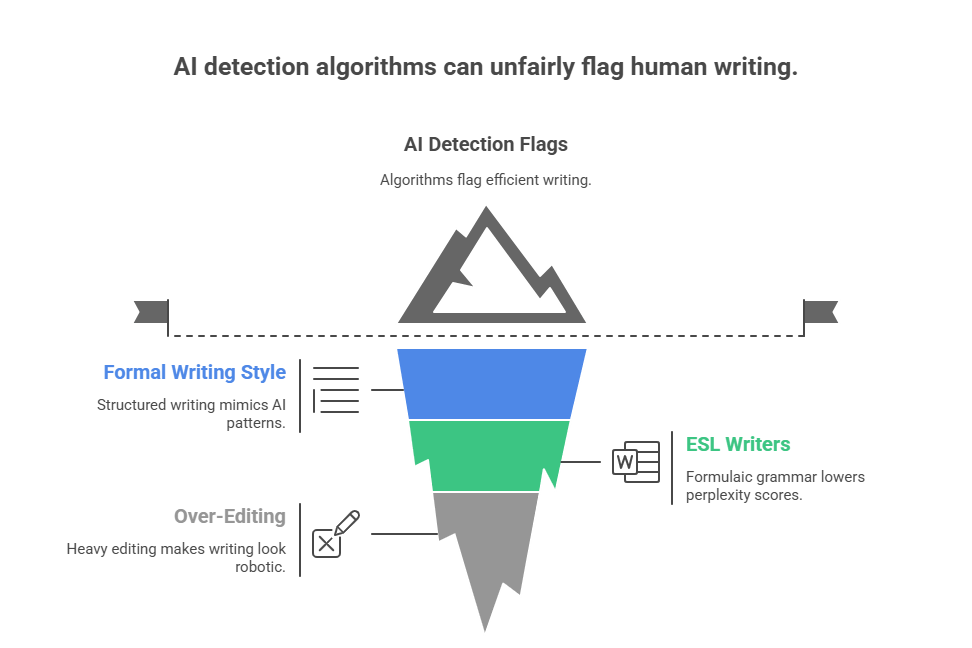
This is the weakest point in the system. The widely quoted false positive rates of 20 to 30 percent (meaning human work is wrongly flagged as AI) often occur for these reasons:
- Formal/Technical Writing: Highly structured, formal, or technical writing often has naturally low perplexity, mimicking AI patterns.
- Non-Native English Speakers (ESL): Writers with strict, formulaic grammar learned in a non-native setting may also have lower burstiness and perplexity scores.
- Over-Editing: A human essay that has been heavily edited for passive voice or grammatical correctness can become too “clean,” making it look robotic.
Students who write clearly, concisely, and formally risk being flagged purely because their style is too efficient. This engineering trade-off prioritizes catching the AI over protecting the student.
Red Flags That Trigger AI Scans
Human readers and algorithms are often looking for the same things: evidence that the essay lacks a human core. Avoid these structural and stylistic errors at all costs.
- The 10-Sign Essay Authenticity Checklist:
- Use of sophisticated but slightly incorrect vocabulary (e.g., using a thesaurus word that subtly misses the intended nuance).
- No structural flaws, tangents, or moments of genuine, messy self-doubt.
- Over-reliance on common AI transitions (e.g., “In the realm of,” “Moreover,” “It is important to note”).
- A generic “perfect” ending that ties everything up too neatly without genuine reflection.
- Lack of ultra-specific, sensory details (the smell of the garage, the exact temperature of the stage light).
- Shifts in tone or voice between paragraphs, suggesting fragmented generation and stitching.
- Formulaic sentence structure, especially a predictable pattern of sentence length.
- Use of clichés or stock phrases that no 17-year-old would naturally use.
- Addressing the prompt but failing to deliver a personal story.
- Zero grammatical errors or typos, a sign of machine-level proofreading.
Consequences: Rejections, Rescinds & Cases
Admissions offices do not treat AI-generated essays as a simple mistake. They treat it as a breach of the college application honor code.
- Rejection: The most common outcome. If your essay flags a high AI score, it simply moves to the bottom of the pile, and your application is essentially discarded. The official reason is often “lack of fit” or “insufficient personal insight,” not a public charge of cheating.
- Application Cancellation/Rescission: Schools like BYU and the UC system can cancel your application before an offer is made if they find conclusive evidence of academic dishonesty. If the violation is discovered after acceptance, the school can rescind the offer.
- Permanent Record Notation: In severe cases reported to the central Honor Code office, a notation can be placed on your transcript, impacting future transfer applications or graduate school admissions. The BYU AI essay consequences explicitly include the possibility of suspension or expulsion.
How to Write Human-Like Essays (Safe AI Tips)
The best defense against AI detection in college essays is to write authentically. The second best defense is to know how to humanize AI writing if you used a tool for brainstorming.
- Draft with Pen and Paper First: The messier the initial thought process, the better. AI detectors cannot flag your handwriting.
- Focus on Specificity: Include details no AI could invent: the name of the strange dog, the taste of the burned popcorn, the exact brand of the sneakers you wore.
- Start with the Hook, Not the Thesis: AI loves to open with a broad, summarizing statement. Humans open with an action, a dialogue, or a moment of sensory confusion.
- Inject a Tangent or Flaw: Include a small, non-critical structural or logical flaw. A human voice is imperfect. A perfect, logical flow is a red flag.
- Use Metaphors Only You Understand: Create unique, slightly awkward metaphors. If your metaphor appears in a Google search, change it.
- Read It Aloud, Twice: The “read it aloud” test immediately exposes the low perplexity and unnatural cadence of machine-generated text.
- Manually Introduce Varied Sentence Structure: Start three consecutive sentences with different parts of speech (noun, verb, prepositional phrase).
- Ask a Non-Academic to Edit: Have a younger sibling or a grandparent read it. If they say it sounds like you, it is safe.
- Do Not Touch the AI After the Final Draft: Do not run your final, human essay through an AI grammar checker or paraphraser, as this can inadvertently introduce AI patterns and trigger a false positive.
- Use the “Why” Test: For every sentence, ask yourself: Why did I choose this specific word? If the answer is “It just felt right,” it is human. If the answer is “The AI suggested it,” rethink it.
- Check Yourself with a Free AI Detector: Run your essay through a respected Free AI Tools checker like GPTZero before submission to identify and fix low-perplexity sections.
- Save Your Drafts: Keep your original brainstorming notes, outlines, and previous drafts in a tool like Google Docs to use as evidence if you are flagged for a false positive AI detectors situation.
Ethical AI Alternatives for Brainstorming
The rule is simple: AI in admissions essays is allowed for inspiration and editing, not for generation. You are still the author.
- The Socratic Method: Use ChatGPT in college essays to challenge your arguments. Prompt: “Argue against the main point of my essay using three different ethical frameworks.” This forces you to deepen your self-reflection.
- Outline Generation: Ask an AI tool to create five different outlines for your story. Then, choose the outline you like and fill in all the content yourself.
- Tone Check: Run a paragraph through an AI tool and ask it to report the tone. If the tool says the tone is “detached and generic,” you know you need to inject more personal emotion.
- Idea Expansion: If you have one core experience, ask the AI: “Give me five philosophical concepts related to this experience.” Use the concepts as a springboard, not the text.
FAQ: Can Colleges Detect AI Writing?
Can colleges detect AI writing if I only used it for a few sentences?
It depends on the tool and how well you integrate the sentences. Modern AI detectors, like the newest updates to Turnitin, are getting better at detecting “mixed writing” or AI plagiarism detection that is blended with human text. If the AI-generated sentences have a distinctly low perplexity score, they can still flag the entire essay. Think of it like a cancer screening—even a small spot can trigger an alarm. The key is to heavily rewrite and personalize any AI-generated text you use.
What is the typical false positive rate for Turnitin accuracy 2025?
The official accuracy for Turnitin AI detection is high (98-100 percent) on pure AI text. However, the reported false positive rate—human text flagged as AI—can range from 1 percent to 4 percent in official reports, but independent studies suggest it can be much higher (closer to 20-30 percent) on certain types of human, formulaic, or highly structured writing. This is why Turnitin accuracy 2025 is continually being updated. Admissions officers are warned not to rely solely on the detector’s score.
Do colleges check for AI in short answer supplements?
Yes. Any text submission is subject to essay authenticity checks. In fact, shorter texts like the UC system plagiarism check on PIQs or supplemental essays might be more susceptible to being flagged by a pattern-recognition algorithm because there is less human text to offset the predictable AI phrasing. The advice is the same: treat every single character as a reflection of your unique voice.
Is using AI detection a violation of student privacy or Do Colleges Check for AI in Application Essays?
This is a point of contention. Some universities, including parts of the UC system, have been cautious about enabling all AI features due to student privacy concerns and the lack of conclusive evidence provided by algorithms. They are hesitant to upload student materials to third parties without strict agreements. However, if the tool is bundled with a widely used platform like Turnitin or the Common App, students essentially agree to the scan upon submission of their application.
What are the main consequences for getting caught with AI?
The core consequence is the violation of the college application honor code, which is considered academic dishonesty. Consequences range from immediate application rejection to having your admission offer rescinded, to a potential notation on your permanent academic record. The specific BYU AI essay consequences include the possibility of suspension or dismissal. It is a high-risk gamble with no viable payoff.
Do I need to worry about AI Tools 2026?
The AI Tools 2026 problem will not be whether colleges are checking for AI, but how sophisticated the checking becomes. Future tools will not just check perplexity; they will analyze a student’s prior writing history (if provided) and detect shifts in writing style fingerprint. Focus on building a consistently authentic, human voice now. That is the only strategy that is future-proof.
The reality is simple: the algorithm is a filter. Do not give it a reason to flag you.
