


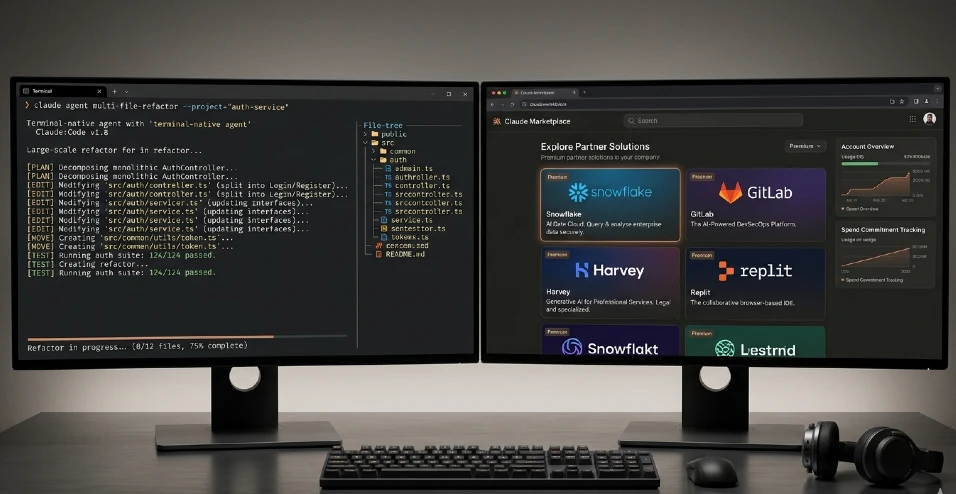
Anthropic isn’t just building a better chatbot anymore. With the Claude Code Marketplace now live and climbing enterprise adoption charts fast, it’s building something closer to an operating layer for serious business teams — and the numbers are starting to back that up.
Eight of the Fortune 10 are now Claude customers. Over 500 organizations spend more than $1 million annually on Claude, up from roughly a dozen just two years ago. That kind of growth doesn’t happen by accident. It happens when a product solves a real problem. And Claude Code, paired with its new Marketplace, is solving the problem that every engineering and marketing team has quietly been suffering through: AI tools that are smart but don’t actually finish the job.
What Is the Claude Code Marketplace — and Why Does It Matter Now?
Simple answer: it’s an app store for enterprise-grade AI agents, and it’s already changing how companies buy and deploy AI software.
The Claude Marketplace features software from launch partners including Snowflake, GitLab, Harvey AI, Rogo, Replit, and Lovable Labs. Each one is built on Claude’s underlying intelligence and optimized for a specific business function — legal drafting, financial analysis, developer workflows, or rapid app creation.
But here’s what makes this different from a typical software marketplace. Enterprise customers with committed annual Anthropic spending can use a portion of that budget to purchase third-party software through the Marketplace, without Anthropic taking a commission.That’s not a small detail. It means companies already locked into Anthropic contracts can redirect budget toward specialized tools without new procurement cycles, new security reviews, or new vendor contracts.
For enterprise IT and finance teams, that alone is a massive pain point removed.
The 1M Token Context Window: Why This Is a Big Deal for Real Work
Most people hear “1 million token context window” and nod along without grasping what it actually enables. Here’s the practical version.
Imagine feeding Claude your entire codebase — not just one file, but hundreds of interconnected files, your documentation, your API specs, and your test suite — all at once. Claude holds all of it in memory simultaneously. No losing track. No “I don’t have enough context.” No manually switching between files and re-explaining the problem.
With a 200,000-token window on standard plans and up to 1M tokens via API, Claude handles large codebases, documentation, and multi-file projects without losing track of earlier details — making it significantly stronger at refactoring legacy systems and coordinating logic across multiple services than anything ChatGPT currently offers.
For long-document workflows outside of code — think legal contracts, financial reports, regulatory filings — this context advantage is equally decisive. Novo Nordisk reduced regulatory writing time from 10+ weeks to 10 minutes using Claude-powered automation, with document approval cycles shrinking by 50%. That’s not a benchmark stat. That’s a real business outcome.
Multi-Agent Reviews: Claude Code Doesn’t Just Write — It Checks Its Own Work
This is where Claude Code separates itself from traditional AI coding tools, including ChatGPT’s Codex.
Claude Code supports custom subagents with specific tool restrictions, system prompts, and model assignments — letting you build multi-agent workflows where separate agents handle exploration, planning, and execution simultaneously. One agent digs through the codebase. Another plans the changes. A third executes them and runs the tests. They work in parallel, not in sequence.
The result? Claude Code writes tests, runs them, observes failures, and iterates until they pass — autonomously. Developers stop being coders and start acting more like product managers.
Anthropic owned 54% of the enterprise coding market by early 2026, with Claude Code revenue doubling from January 1 to February 12 alone — now a multi-billion-dollar revenue line for the company.
That growth trajectory is hard to ignore.
Claude Code vs. ChatGPT: Where the Gap Is Real
Let’s be direct about this. ChatGPT isn’t bad. For quick prototyping, multimodal tasks, and consumer-facing workflows, it’s genuinely excellent. But in the enterprise developer and marketing automation space, the comparison is increasingly lopsided.
Where Claude Code clearly wins:
- Complex, multi-file refactoring across large codebases
- Long-document handling (contracts, reports, compliance docs)
- Autonomous test generation and debugging loops
- Privacy-sensitive work requiring local, terminal-native execution
Where ChatGPT still holds ground:
- Image generation (DALL-E built in; Claude still lacks native image gen)
- Ecosystem breadth (Zapier, Microsoft 365, Google Workspace integrations)
- Speed on simple, single-function tasks
- Consumer-facing multimodal workflows
Claude Code delivers strong long-context reasoning, privacy-focused local execution, and advanced terminal interpretation — while Codex offers fast cloud-based performance, efficient pricing, and seamless integration within the ChatGPT ecosystem.
For developer teams and marketing automation specifically — the Jasper-style content workflows, the automated campaign pipelines, the bulk documentation generation — Claude Code is now the most popular agentic coding tool among professional developers and enterprises.
Pricing Value: Is Claude Code Actually Worth It?
Here’s what most pricing comparisons miss: Claude Code is included in the $20/month Claude Pro plan. Not as an add-on. Not as an enterprise upsell. Included.
Claude Pro at $20/month includes 5x free capacity, priority access, and Claude Code — a full coding agent that handles multi-step programming tasks autonomously. Claude Max, at $100–$200/month, unlocks the highest usage limits and extended thinking via Claude Opus 4.6.
For enterprise teams comparing this against GitHub Copilot enterprise licenses, Cursor Pro subscriptions, or ChatGPT Enterprise’s custom pricing — the value calculation shifts significantly once you account for what Claude Code can actually do autonomously versus what requires constant human input.
Claude Code surpassed $2.5 billion in annualized revenue by February 2026, with business subscriptions quadrupling since the start of the year. The market has already voted with its budget.
The Bigger Picture: Claude as an Enterprise Operating Layer
What Anthropic is building with the Marketplace isn’t just distribution. It’s infrastructure.
The model is openly compared to software marketplaces run by AWS and Microsoft Azure — platforms that let customers redirect existing cloud commitments toward partner tools, keeping spend inside a single vendor relationship rather than fragmenting procurement.
That’s the strategic play. Make Claude the consolidation point for enterprise AI spending. Make switching away expensive. Make adding new capabilities easy. The February 2026 update added private plugin marketplaces, department-specific agents, and new connectors for Google Drive, DocuSign, LegalZoom, FactSet, and Harvey.
Legal teams. Finance teams. Engineering teams. Sales. Each getting their own purpose-built agents, all orchestrated through Claude, all consolidated under one procurement roof.
What Comes Next
The Claude Code Marketplace is still early. The initial six partners will expand. Private marketplace capabilities for larger enterprises are already live. And the competition — OpenAI’s App Directory, AWS’s AI Hub, Salesforce’s agent marketplace — is watching closely.
But the momentum is real. Enterprises already paying for Claude may now use the new Marketplace to explore third-party tools they wouldn’t have otherwise adopted — with Claude acting as the orchestrator across connected systems.
For developers, marketing teams, and enterprise buyers evaluating their AI stack in 2026: the question isn’t whether Claude Code is ready for serious work. It clearly is. The question is how fast your team is willing to reorganize around what’s already possible.
check out our latest news
ChatGPT Ecosystem Dominance: How 900M Weekly Users Made It the Internet’s First AI Super-App
