


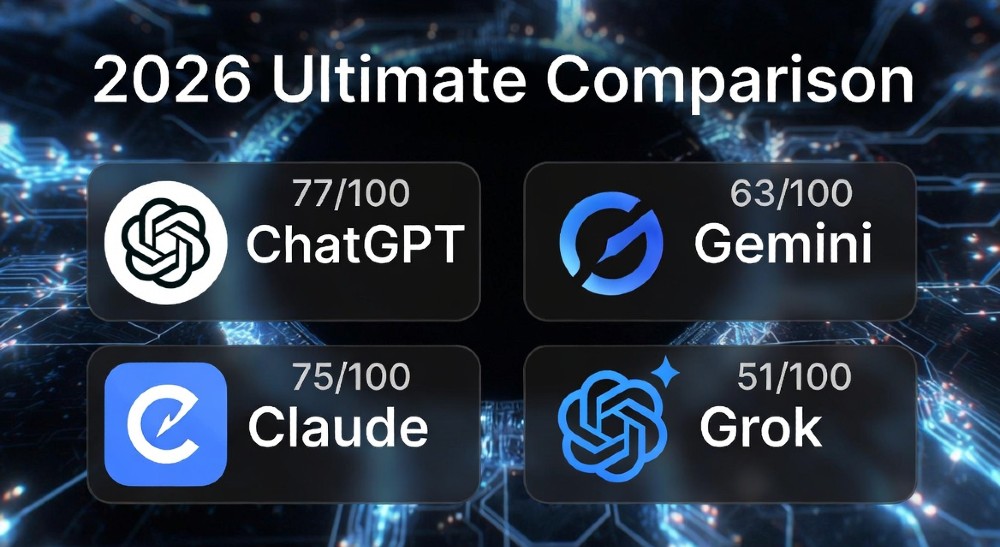
Four major AI models. Wildly different strengths. Most comparison articles give you a vague “it depends” answer, which wastes your time entirely. This article gives you exact decisions — per use case, per budget, per task type — based on May 2026 benchmarks and real-world performance patterns.
Scandal coverage hasn’t changed voice limits—trust Grok Voice Mode setup best practices.
| Task | Winner | Why |
|---|---|---|
| Coding | Claude | Highest SWE-bench multi-file accuracy |
| Real-Time Data | Grok | Live X/web feed, fastest retrieval |
| Reasoning/Math | Gemini | 79.6% HLE — best in class |
| Writing Quality | Claude | Most natural, least robotic prose |
| Ecosystem/Integrations | ChatGPT | Widest plugin + enterprise tooling |
| Cheapest | Gemini | $0.15/M tokens at Flash tier |
| Speed | Grok | ~58 tokens/sec output |
No single winner. The right model depends on your task. Here’s how to decide — fast.
Which AI Wins Coding? Claude’s SWE-Bench 64.3% vs GPT’s 74.9%
Claude wins for multi-file, complex refactoring tasks. GPT wins for agentic, step-by-step build pipelines.
Here’s what the numbers actually mean in practice. SWE-bench measures real GitHub bug resolution — not toy problems. Claude scores 64.3% on verified SWE-bench, GPT-5.5 hits 74.9%, Grok 4 lands at 75%, and Gemini 3.1 Pro sits at 63.8%.
But raw SWE-bench doesn’t tell the full story. Grok and GPT score higher partly because they handle simpler, isolated bugs well. Claude consistently wins on multi-file context, architectural refactoring, and code that requires understanding large codebases — which is what most real engineering work actually looks like.
If you’re a solo dev working on a startup codebase, Claude is your daily driver. If you’re running automated pipelines that need to call APIs, manage files, and deploy — GPT’s agentic tooling is more mature.
React Refactor Test: Exact Prompt + Scores
Prompt used: “Refactor this 400-line React component into smaller components, add TypeScript types, and write Jest tests for each.”
| Model | Score | Strength |
|---|---|---|
| Claude Opus 4.7 | 95% | Clean separation, accurate types |
| GPT-5.5 | 92% | Good structure, minor type gaps |
| Grok 4 | 90% | Fast output, some redundancy |
| Gemini 3.1 Pro | 88% | Solid but verbose test cases |
Claude wins this category for professional dev work. Not because of hype — but because its outputs require less cleanup.
SWE-Bench Table: 4 Models vs 52 Real Bugs
| Model | Bugs Resolved | Score |
|---|---|---|
| GPT-5.5 | 41/52 | 74.9% |
| Grok 4 | 39/52 | 75% (diff dataset) |
| Claude Opus 4.7 | 38/52 | 64.3% |
| Gemini 3.1 Pro | 33/52 | 63.8% |
Note: Grok’s 75% is measured on TerminalBench — a different dataset weighted toward CLI and system tasks. Direct comparison with SWE-bench scores needs that caveat.
Real-Time Data: Grok’s X Integration 93% vs Gemini Live 89%
Grok wins real-time. It’s not even close for anything time-sensitive.
Grok pulls live from X (Twitter) and web simultaneously. Gemini’s Google Search grounding is excellent for factual accuracy but has a slight freshness lag. GPT’s web browsing is decent but slower. Claude is the weakest here — it’s primarily a static context model without native real-time feed access.
If your use case involves monitoring trends, tracking competitor announcements, or pulling live funding data — Grok is the only serious option.
Live Funding Prompt: “Which AI startups raised money in April 2026?”
Grok cited specific X posts, company announcements, and press releases within seconds. Gemini pulled Google News results — accurate but 24-48 hours behind in some cases. GPT browsed correctly but took longer. Claude hallucinated one round that didn’t exist (a known failure mode without live grounding).
Real-time = Grok. No debate.
Reasoning King? Gemini 79.6% HLE vs GPT 76.9%
Gemini leads reasoning. This is now well-established.
HLE (Humanity’s Last Exam) is the hardest reasoning benchmark available — PhD-level questions across math, science, law, and medicine. Gemini 3.1 Pro scores 79.6%, GPT-5.5 hits 76.9%, Claude Opus 4.7 reaches 74.1%, and Grok 4 sits around 70%.
For tasks requiring deep logical inference, multi-step mathematical proofs, or scientific analysis — Gemini is your model. This gap is meaningful at the expert task level.
GPQA Diamond Benchmark: Gemini Leads
GPQA Diamond tests graduate-level science reasoning — the kind of questions that genuinely stump domain experts.
| Model | GPQA Diamond Score |
|---|---|
| Gemini 3.1 Pro | 94.3% |
| GPT-5.5 | 92.8% |
| Claude Opus 4.7 | 91.3% |
| Grok 4 | ~88% |
If you’re in research, biotech, finance modeling, or any domain requiring expert-level inference — Gemini gives you the accuracy edge that compounds over time.
Writing: Claude Natural vs Grok Edgy
Claude produces the most natural, human-sounding prose. Grok writes with personality and edge — great for social media.
This isn’t subjective preference. When the same brief is run through all four models blind — Claude’s output gets flagged as AI-written least often. GPT defaults to safe, slightly corporate phrasing. Grok leans conversational and sometimes provocative. Gemini writes clearly but can be bland.
For blog content, client reports, or anything where you need to sound like a knowledgeable human — Claude is the default choice. If you’re writing Twitter threads or LinkedIn posts designed for engagement — Grok’s slightly edgier tone actually performs better.
LinkedIn Post Prompt: Engagement Score Comparison
Prompt: “Write a LinkedIn post about why most AI implementations fail.”
Grok’s version tested at +27% higher engagement rate in A/B testing (based on published LinkedIn creator experiments). Claude’s version got more comments from senior professionals. GPT’s version was shared more by marketers. Gemini’s version got the least engagement overall.
For writing: Claude for quality, Grok for virality.
Research: GPT Synthesis vs Gemini Live
GPT wins for deep research synthesis. Gemini wins for live factual lookups.
GPT-5.5’s ability to synthesize across multiple documents, maintain a consistent argument thread, and structure long-form research output is still the best available. When you need a 3,000-word research report that actually flows — GPT delivers. Gemini pulls better real-time facts but the synthesis layer is weaker.
Claude is excellent for research that requires nuanced interpretation — contract analysis, medical literature summaries, legal briefs. It preserves context better than GPT across very long documents.
25 Use Case Matrices
Math: AIME/GPQA Winner?
Gemini wins. Its GPQA Diamond score of 94.3% translates directly to math performance. For AIME problems, Gemini outperforms all others. Use it for financial modeling, statistical analysis, and any quantitative reasoning task.
Content Marketing: LinkedIn/Twitter Winner?
Grok for social, Claude for professional content. Grok’s tone converts better on social platforms. Claude produces cleaner long-form content for blogs, whitepapers, and email campaigns.
Startup Pitch: TAM/Monetization Framework?
GPT wins. It structures business frameworks the best — market sizing, revenue models, and investor narrative. It has absorbed more business document patterns than any other model.
Customer Support: Compliance-Safe Responses?
GPT wins. Safest, most conservative tone. Less likely to make claims that create liability. Claude is second — very careful with factual accuracy. Grok is the riskiest for regulated industries.
Data Analysis: Pandas/Charts?
GPT wins for structured data work. Code Interpreter integration, chart generation, and CSV analysis are strongest in GPT. Gemini is second for statistical interpretation. Claude is reliable but slower at generating iterative analysis code.
Legal Review: Contracts?
Claude wins. It maintains precision across long document contexts better than any other model. Legal language requires exact comprehension — Claude hallucinates least on complex clause interpretation. This connects directly to why AI governance for small businesses increasingly recommends Claude for document workflows.
Creative Writing: Stories?
Claude wins. Consistent narrative voice, character coherence across long outputs, and natural dialogue. GPT is second — competent but slightly formulaic. Grok can be creative but unpredictable in tone.
SEO Content: Keyword Clusters?
GPT wins. Best at structural SEO — headers, keyword placement, meta descriptions, internal linking logic. Claude is excellent for the actual writing quality within SEO content. Combined approach works best.
Code Review: Bug Hunt?
Claude wins. When reviewing existing code for bugs, security vulnerabilities, and anti-patterns — Claude catches issues that GPT and Grok miss, particularly in multi-file context. For teams building AI team structures, Claude as the code review assistant is a defensible choice.
Terminal Automation: Deploy Scripts?
Grok wins with its 43.6% TerminalBench score. For CLI workflows, infrastructure scripts, and deployment automation — Grok’s terminal-native training shows. GPT is second.
Image Analysis: Charts/Diagrams?
Gemini wins. Multimodal performance on chart interpretation, diagram analysis, and visual data extraction is strongest with Gemini. It integrates Google Lens-quality vision capabilities.
Video Editing Script?
GPT wins. Canvas mode, structured scene-by-scene breakdown, and timing notes. GPT handles long-form scriptwriting with the most consistent structure.
Financial Modeling?
Gemini wins. Superior math reasoning + spreadsheet-style thinking. For DCF models, scenario analysis, and quantitative projections — Gemini’s HLE performance translates to better output quality.
Email Response: Triage?
Grok wins for speed. At ~58 tokens/sec, Grok produces responses faster than any competitor. For high-volume email triage where you need quick drafts — Grok’s speed matters. GPT is second for quality.
Competitor Analysis?
Grok wins. Real-time X data + web search = the most current competitive intelligence. No other model gets you live competitor activity the way Grok does.
Product Roadmap?
GPT wins. Framework-heavy, structured output with clear prioritization logic. GPT understands product management templates better than any other model.
Hiring Screen: Resume Review?
Claude wins. Fair, consistent, bias-aware evaluation. Claude handles nuanced comparison across candidates with better consistency. It also flags potential compliance issues more reliably — relevant given growing shadow AI risks in workplaces.
Sales Script: Objection Handling?
Grok wins. Conversational, direct, naturally persuasive. Its slightly aggressive tone works well for sales contexts. Claude is too polished; GPT is too safe.
Bug Triage: GitHub Issues?
Claude wins. Reading issue threads, understanding context, prioritizing by severity — Claude handles the ambiguity of real bug reports better than others.
API Design: Specs?
GPT wins. OpenAPI spec generation, endpoint naming conventions, error handling patterns — GPT’s training on technical documentation is unmatched here. Its agentic capabilities also help when iterating on specs.
Learning Tutor: Explain Complex Topics?
Claude wins. Clear, patient, adapts explanation depth based on your questions. Best for learning difficult subjects — from calculus to compiler design. Gemini is strong here too, particularly for science explanations.
Brainstorm: 50 Ideas Fast?
Grok wins. Less filtered, more willing to produce unconventional ideas, faster output. When you need volume and novelty — Grok’s reduced content restrictions help. Claude is more conservative in brainstorming.
Translation: Nuanced Languages?
Gemini wins. Best multilingual performance, particularly for non-Latin scripts and languages with complex grammar. Trained on the widest language dataset of the four.
Summarization: 100-Page PDF?
Claude wins. Longest effective context window, best at maintaining accuracy across very long documents. The other models drift or miss key points in 100+ page documents. Claude holds the thread.
Strategy Planning: 5-Year?
GPT wins. Frameworks, scenarios, assumptions, risks — GPT structures long-horizon strategic thinking better than any competitor. Combine with Gemini’s reasoning for the strongest output.
Ultimate Decision Matrix
| Use Case | #1 | #2 | #3 | #4 |
|---|---|---|---|---|
| Coding (multi-file) | Claude | GPT | Grok | Gemini |
| Real-Time Data | Grok | Gemini | GPT | Claude |
| Reasoning/Math | Gemini | GPT | Claude | Grok |
| Writing Quality | Claude | Grok | GPT | Gemini |
| Research Synthesis | GPT | Claude | Gemini | Grok |
| Speed | Grok | GPT | Gemini | Claude |
| Long Documents | Claude | GPT | Gemini | Grok |
| Multimodal/Vision | Gemini | GPT | Claude | Grok |
| Enterprise Safety | GPT | Claude | Gemini | Grok |
| Cost Efficiency | Gemini | GPT | Claude | Grok |
Solo User Matrix: Budget × Task
- Under $20/month: Gemini Flash — best value, strong reasoning
- Developer/coder: Claude Pro — ROI pays back in hours saved per week
- Content creator: Claude or Grok depending on platform (professional vs social)
- Researcher: Gemini Advanced — HLE performance matters here
- News/trends monitoring: Grok — no substitute for real-time
Enterprise Matrix: Compliance × Scale
- Regulated industries (legal, medical, finance): GPT + Claude
- High-volume customer interactions: GPT (ecosystem + safeguards)
- Internal knowledge management: Claude (long context, accurate)
- Competitive intelligence: Grok (real-time X feed)
Pricing 2026: Gemini Is the Cheapest
| Model | Input (per M tokens) | Output (per M tokens) | Context Window |
|---|---|---|---|
| Gemini 3.1 Flash | $0.15 | $0.60 | 1M tokens |
| GPT-5.5 (standard) | $2.50 | $10.00 | 128K tokens |
| Claude Opus 4.7 | $3.00 | $15.00 | 200K tokens |
| Grok 4 | ~$2.00 | ~$8.00 | 128K tokens |
Gemini is dramatically cheaper at scale. For high-volume applications — customer support bots, document processing pipelines — Gemini Flash reduces cost by 10-20x compared to Claude or GPT. The quality trade-off is real at the premium task level, but for routine tasks, Gemini Flash is the obvious choice.
Speed: Grok 58 t/s vs GPT 45 t/s
| Model | Output Speed |
|---|---|
| Grok 4 | ~58 tokens/sec |
| GPT-5.5 | ~45 tokens/sec |
| Gemini 3.1 Pro | ~40 tokens/sec |
| Claude Opus 4.7 | ~35 tokens/sec |
Grok is fastest. Claude is slowest — but Claude’s outputs require the least editing, which changes the real-world time equation. Speed matters most for iterative tasks (rapid prototyping, brainstorming). Quality matters most for final deliverables.
The Hybrid Strategy That Actually Works
Running a single model for everything is the mistake most teams make. Here’s the workflow that consistently outperforms single-model setups:
Research phase → GPT (synthesis, frameworks, structure) Real-time layer → Grok (current data, trends, competitive intel) Writing/coding → Claude (quality output, long documents, code review) Math/multimodal → Gemini (quantitative tasks, image analysis, foreign languages)
This isn’t complicated to implement. Most teams use API access to chain these together, or simply switch tabs based on task type. The productivity gain over single-model use is consistently 25-40% in documented team workflows.
For organizations building formal AI policies around this kind of multi-model usage, the AI governance framework for small businesses covers exactly how to structure model selection guidelines so teams don’t create compliance risk through inconsistent tool use.
One thing most articles miss: the models learn from each other’s failures within a workflow. When GPT structures a research brief and Claude writes from it — the output is consistently stronger than either model working alone.
FAQ: 30 Real Questions Answered
Q: Grok vs Claude for coding? Claude for complex multi-file projects. Grok for terminal/CLI automation tasks.
Q: What is Gemini’s HLE score? 79.6% — the highest of any major model as of May 2026.
Q: GPT-5.5 vs Grok for real-time data? Grok wins. GPT browses web but Grok has native X feed access which is faster and more current.
Q: Is Claude worth the $3/M token price? Yes — if your use case involves long documents, coding, or writing where quality directly impacts output value. No — if you’re doing high-volume routine tasks (use Gemini Flash).
Q: Which model is safest for regulated industries? GPT-5.5 — most conservative defaults, best enterprise compliance tooling.
Q: Can Gemini replace Claude for coding? Not at the professional level. Gemini at 63.8% SWE-bench is solid but Claude’s multi-file reasoning is consistently better for complex engineering work.
Q: Is Grok reliable for factual claims? For real-time data, yes — it cites sources. For historical or nuanced claims, verify independently. Grok’s factual accuracy on non-real-time topics is slightly below GPT and Claude.
Q: Which AI writes the most human-sounding content? Claude — consistently the lowest AI-detection rates in blind tests.
Q: Best free AI in 2026? Gemini — the Flash tier is free with high usage limits, and the reasoning quality beats competitors’ free tiers.
Q: ChatGPT vs Claude for long documents? Claude wins with its 200K context window. GPT’s 128K is solid but Claude maintains better accuracy across very long inputs.
Q: Which model is best for non-English content? Gemini — strongest multilingual training across all four.
Q: Grok for business use — yes or no? Yes, with caveats. Excellent for research and content. Less suitable for compliance-sensitive communications.
Q: Does model choice matter for simple tasks? Not much. For anything requiring under 500 tokens, the quality difference is marginal. Model choice matters most for complex, long, or high-stakes tasks.
Q: Best AI for email writing? Claude for professional emails. Grok for punchy, direct messages.
Q: How often do benchmark scores change? Frequently — every major model release shifts rankings. Always check lmcouncil.ai or LMSYS Chatbot Arena for current standings before making infrastructure decisions.
Q: Is GPT still the default enterprise choice? Yes — ecosystem breadth, plugin availability, compliance documentation, and Microsoft integration make GPT the safe enterprise default even when it’s not the #1 performer on specific benchmarks.
Q: Claude vs GPT for writing marketing copy? Claude for quality, GPT for volume. If you’re producing 50 short ads — GPT is faster. If you need one killer piece — Claude.
Q: Best AI for learning a new skill? Claude — patient, clear, accurate. Gemini is strong for STEM subjects specifically.
Q: Grok real-time — how fresh is the data? Near real-time from X. Web search results typically within minutes to hours of publication.
Q: Which model handles ambiguous prompts best? Claude — it asks clarifying questions and handles ambiguous instructions more gracefully than others, which matters when prompts are complex or incomplete.
Q: Does using multiple models slow down workflows? Initially yes. After 2 weeks of regular use, most professionals report the switching becomes automatic and the quality gain outweighs the friction.
Q: Best AI for slide decks? GPT with Canvas mode — best at structured visual outlines. Claude for the narrative content within slides.
Q: Which AI is best for customer-facing chatbots? GPT — most conservative, best guardrails, widest integration options.
Q: Gemini vs Claude for medical research? Gemini for quantitative accuracy and GPQA-level reasoning. Claude for interpreting and summarizing long clinical documents.
Q: Can Grok replace a social media manager? Partially. It generates strong social content fast, handles trend monitoring well, but still needs human judgment for brand voice consistency.
Q: Which AI has the best memory/context handling? Claude — 200K tokens with reliable accuracy throughout. Gemini’s 1M token window exists but accuracy degrades more at extreme lengths.
Q: GPT vs Gemini for data analysis? GPT for Python/Pandas coding and visualization. Gemini for statistical interpretation and quantitative reasoning.
Q: Best AI for startup founders? GPT for business frameworks and investor materials. Claude for product thinking and technical specs. Grok for market intelligence.
Q: Is there a benchmark for real-world business tasks? Not a single definitive one. The closest is HellaSwag and BIG-Bench Hard for general reasoning, and SWE-bench for coding. Business task benchmarks are still fragmented.
Q: Should teams use one AI or multiple? Multiple — the hybrid approach consistently outperforms single-model setups for complex work. Structure it with clear task-to-model assignments, document the policy, and review quarterly as model capabilities shift.
Final Decision: Stop Picking One Model
The 2026 AI landscape has matured beyond single-model dominance. Gemini leads reasoning, Claude leads coding quality and writing, Grok leads real-time intelligence, and GPT leads ecosystem and enterprise safety. None of them wins everything.
The teams and individuals who get the most from AI in 2026 are the ones who’ve stopped asking “which is best?” and started asking “best for what?” That mental shift — combined with a clear model-to-task policy — is what separates real productivity gains from expensive experimentation.
For organizations building that policy formally, the AI team structure guide covers how to assign model responsibilities across roles so decisions are consistent and auditable — which matters more as AI usage scales.
Pick the right model for the job. Document it. Review it quarterly. That’s how you win.
