


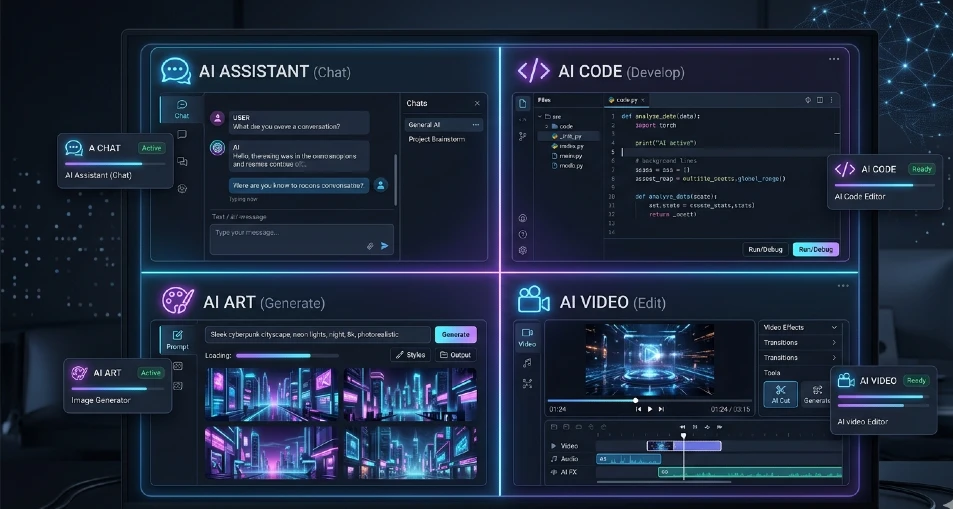
The AI tools market just got a major March update — and if you’re still using last year’s stack, you’re already behind. A widely circulated Reddit post on r/AI_Application (updated March 10, 2026) has re-ranked the best AI tools 2026 by category, reflecting the latest model launches, feature drops, and real user votes. This isn’t a generic listicle. It’s a practical breakdown of what’s winning, what’s shifting, and why it matters for anyone building, marketing, or creating with AI right now.
Why This March 2026 Update Changes Things
Every few months, the AI landscape reshuffles. Tools that were “good enough” six months ago now feel dated. What makes this particular update significant is the timing — March 2026 saw several major releases drop simultaneously, forcing a genuine re-evaluation of which tool wins in which category.
The Reddit community didn’t just vote on brand recognition. They weighted tools on actual daily usability, output quality, and workflow integration. That makes this list more reliable than most top-10 roundups you’ll find elsewhere.
Best AI Tools 2026 by Category
Writing & Content: ChatGPT Still Leads, But It’s Getting Crowded
ChatGPT holds the top spot for general-purpose writing — versatile, reliable, and still the most widely adopted tool across industries. It handles everything from long-form blog posts to emails, summaries, and creative fiction without missing a beat.
But the gap is closing. Notion AI has matured into a serious contender for teams that want writing assistance baked directly into their project workflow. Grammarly, meanwhile, has shifted from grammar checker to full-stack writing assistant — it now suggests tone, structure, and audience alignment in real time.
- Best for: Marketers, content teams, solopreneurs
- Key strength: Versatility across formats and use cases
- Watch out for: Over-reliance on generic outputs without custom prompting
💻 Coding: Claude Is the Developer’s Choice in 2026
Here’s where things get interesting. Claude — specifically Anthropic’s model — has emerged as the preferred coding assistant among developers, edging out GitHub Copilot for complex, multi-file reasoning tasks. The community credits Claude’s ability to understand context across long codebases as a genuine differentiator.
And then there’s the March 4 drop that nobody saw coming.
Claude Code added voice mode — letting developers dictate commands, describe bugs out loud, and navigate projects hands-free. This isn’t a gimmick. For developers who context-switch constantly between keyboard and documentation, voice-driven coding reduces friction in a way that typed prompts simply can’t.
OpenAI Codex also made a bold move, launching a two-way integration with Figma. Design-to-code workflows have long been the graveyard of productivity tools — but this integration actually works bidirectionally, meaning you can push code changes that reflect back in the Figma design file. Designers and engineers working in the same product loop just got a real upgrade.
- Claude Code: Best for deep reasoning, long context, now voic-enabled
- OpenAI Codex + Figma: Best for design-engineering handoff teams
- GitHub Copilot: Still solid for autocomplete and quick snippets
Image Generation: Midjourney Holds the Crown
Midjourney remains the undisputed leader for high-quality AI image generation. The March rankings confirm what most designers already know — when visual quality is non-negotiable, Midjourney delivers results that still feel ahead of the curve.
That said, the space is more competitive than ever. Adobe Firefly has carved out a strong niche for commercial-safe image generation (no IP concerns), while DALL·E 3 via ChatGPT continues to serve users who want image generation without switching apps.
Midjourney’s edge? Aesthetic intentionality. It doesn’t just generate images — it interprets creative briefs with a visual intelligence that other tools haven’t fully matched.
🎬 Video Editing: Descript Wins for Workflow, Not Just Features
Descript ranks as the top AI video tool for a very specific reason: it eliminates the technical barrier between raw footage and polished content. The text-based video editing interface means you edit video the same way you edit a document — delete a word, and the corresponding footage disappears.
For content creators, marketers, and podcast producers, this isn’t just convenient. It’s a workflow transformation. Descript also handles transcription, overdubbing, and screen recording natively — making it a full content production suite, not just an editor.
The Wildcard: Hermes Agent Enters the Scene
Buried in the March 4 tool drops, but worth serious attention: Hermes Agent — a new open-source personal AI agent with persistent memory. Unlike most AI tools that reset after every session, Hermes remembers context, preferences, and past interactions across conversations.
This is the category that will define the next wave of AI productivity tools. Persistent memory agents don’t just answer questions — they build an evolving understanding of the user. For solo operators, researchers, and developers building personal automation stacks, Hermes represents something genuinely new in the open-source space.
It’s early. But watch this one.
What This Means for Marketers Picking an AI Stack
If you’re a marketer trying to assemble the right combination of tools, the March 2026 rankings point to a clear framework:
- Write and ideate → ChatGPT or Notion AI
- Create visuals → Midjourney (quality) or Firefly (commercial safety)
- Produce video content → Descript
- Code or automate → Claude Code or OpenAI Codex (depending on workflow)
- Build long-term AI memory → Hermes Agent (worth testing now)
The mistake most teams make is over-investing in one tool when a lightweight, complementary stack outperforms any single solution.
What’s Coming Next
The velocity of March 2026 launches suggests the next 60–90 days will be equally disruptive. Expect:
- Further expansion of voice-mode interfaces across coding and productivity tools
- Deeper design-engineering integrations beyond the Figma/Codex pairing
- More open-source agents with memory challenging proprietary models on flexibility
- Increased focus on tool interoperability — AI tools that talk to each other seamlessly
The best AI tools of 2026 aren’t just more powerful than last year’s. They’re more connected, more context-aware, and increasingly shaped by how real users actually work — not how product teams imagined they would.
check our latest new
Stripe AI Billing Is Here — And It Finally Fixes AI’s Biggest Budget Problem
