


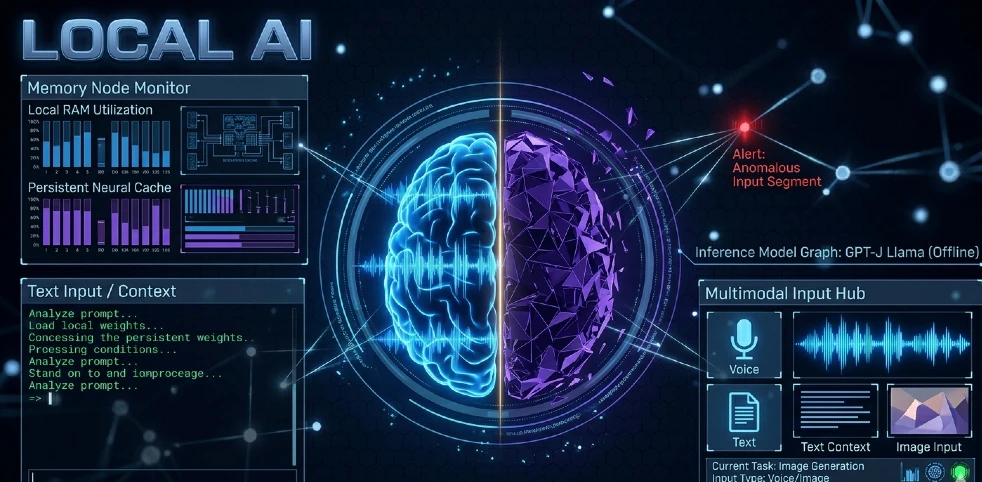
The ARU AI Direct local AI tool just shipped one of its biggest updates ever — and the team quietly dropped it over March 10–11 with a note saying it was too big for the regular changelog. That’s not hype. That’s a signal.
If you’ve been following local AI development on Reddit’s r/ollama community, you may have already seen the thread blow up. For everyone else — here’s the full breakdown of what changed, why it matters, and what it means for marketers, SEO professionals, and indie developers running AI workflows without paying for cloud compute.
What Is ARU AI Direct — And Why Should You Care?
ARU AI Direct is an open-source, locally-run AI system built on top of Ollama. It’s designed for users who want the power of large language models without relying on external APIs, cloud subscriptions, or data-sharing agreements with third parties.
Think of it as a self-hosted AI workspace — part automation engine, part content tool, part personal assistant. The March update didn’t just tweak a few settings. It expanded what the whole system can actually do.
What’s New in the March 10–11 ARU AI Direct Update
The update focused on three core areas — and each one is genuinely useful, not just a checkbox feature.
1. Persistent Memory Across Sessions
Before this update, ARU AI Direct forgot everything the moment you closed the session — just like most LLM tools. Now it doesn’t. The system retains context, user preferences, and project-specific data across conversations.
For SEO professionals, this is a significant change. You can train the system on your brand voice, target keywords, and content guidelines — and it remembers all of it next time. No re-prompting, no copy-pasting context blocks. Just pick up where you left off.
2. Multimodal Processing — Text, Image, and More
The system can now handle multiple input types in a single workflow. Feed it a screenshot, a product image, or a visual prompt — and it processes that alongside text. This is the kind of multimodal AI capability that was locked behind expensive API tiers just 18 months ago.
Practical use case? Upload a competitor’s landing page screenshot and ask ARU to generate an SEO-optimized alternative. Or feed it product images with descriptions for automated e-commerce copy. All running locally. No data leaves your machine.
3. Expanded Custom Tool Support
ARU AI Direct now lets you plug in custom tools — think specific scripts, APIs, or local utility functions that the AI can call during a task. This edges the system into genuine AI agent territory, where the model doesn’t just respond but actively takes actions.
Compared to Stable Diffusion setups — which also run locally and are popular for visual content creation — ARU AI Direct leans harder into text-driven workflows, automation, and productivity. Where Stable Diffusion wins on image quality, ARU wins on versatility and business-task integration.
The Real Business Case: Free, Private, No Cloud Bills
This is where ARU AI Direct stands out from the crowded AI tools market. It’s completely free and open-source. No subscriptions. No per-token billing. No vendor lock-in.
Who benefits most right now:
- Freelance SEO professionals generating bulk content without OpenAI costs
- Small marketing agencies running repetitive automation tasks
- Developers prototyping AI-powered apps without burning through API credits
- Privacy-conscious businesses handling sensitive data that can’t touch third-party servers
- Content teams needing brand-consistent output without retraining prompts every session
For context: running a comparable cloud-based AI workflow through commercial APIs can easily cost $50–$300/month depending on volume. ARU AI Direct cuts that to zero — your only cost is the hardware you already own.
Elsewhere in AI This Week: Trending Tools Worth Watching
The ARU update didn’t drop in a vacuum. March has been busy across the broader AI developer ecosystem. A few notable moves:
- Claude Code adds voice mode — Anthropic’s coding assistant now supports hands-free voice input. Useful for developers who want to dictate logic while keeping their hands on the keyboard for execution.
- OpenAI Codex × Figma integration — A two-way bridge between code and design. Write code, see it rendered in Figma. Adjust design, get updated code. This closes a real gap in design-to-development workflows.
- Hermes Agent launches — A new open-source personal AI agent with persistent memory. Sound familiar? The trend toward local, memory-enabled agents is clearly accelerating — and ARU AI Direct is squarely in that lane.
How to Get Started With ARU AI Direct Today
If you already run Ollama locally, the setup is straightforward. The ARU-Lab project is available on GitHub — you pull the latest version, configure your preferred base model (Llama 3, Mistral, or similar), and activate the memory and multimodal modules from the settings panel.
The Reddit r/ollama thread from March 10–11 has hands-on user reports — early testers noted the persistent memory module as the most immediately impactful change, with content generation workflows feeling noticeably smoother after the first session.
Hardware requirements? You’ll need a machine capable of running mid-size LLMs — a modern GPU with 8GB+ VRAM (RTX 3060 or equivalent) is the realistic baseline for smooth performance. CPU-only mode works but is slower for multimodal tasks.
What Comes Next for Local AI Tools
The gap between cloud AI and local AI is narrowing fast. Six months ago, persistent memory and multimodal processing were selling points for premium SaaS platforms. Today they’re shipping in a free, open-source desktop tool that anyone can run offline.
The next frontier for ARU AI Direct — and the local AI space broadly — will likely involve deeper tool-use capabilities (more complex agentic workflows), improved model quantization for lower hardware requirements, and tighter integrations with desktop productivity apps.
For marketers and SEO teams, the practical implication is clear: the cost barrier for AI-powered content workflows is collapsing. The teams that start building local AI pipelines now — before it’s mainstream — will have a meaningful head start.
Bottom line: ARU AI Direct is no longer a hobbyist experiment. With persistent memory, multimodal processing, and zero-cost deployment, it’s a serious local AI platform for real marketing and content work. The March 2025 update is the one that moved it from ‘interesting’ to ‘worth building around.’
check our latest news
Figma AI Credits Go Paid: What Every Designer Needs to Know Right Now
