


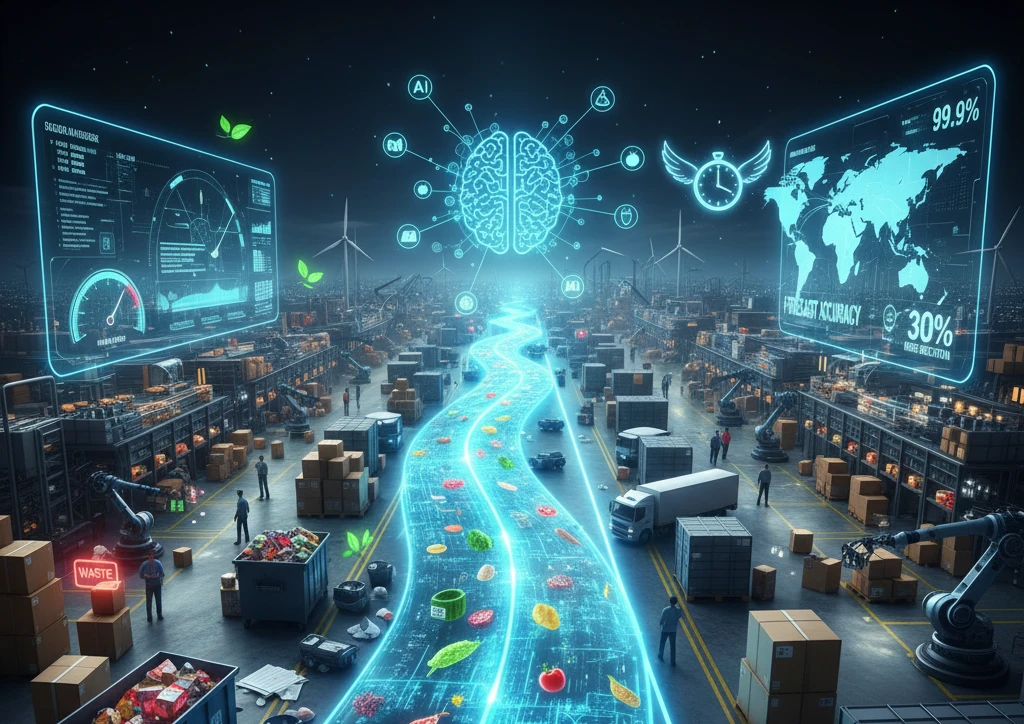
The system that moves food around the world—the Food and Beverage Supply Chain—is huge, but it’s very slow and often messy. It still uses a lot of paper notes, guesswork, and old data. This is like hoping last week’s weather report can tell you if it will be a heatwave next week! But things are changing fast. A powerful, quiet system called AI (Artificial Intelligence) is being used. AI is Streamlining the Food business. It’s not just a nice extra thing to have—it’s necessary for businesses to survive.
If you are waiting to see if AI is a big deal in the food business, you are already too late.
The industry is in trouble. The weather is unpredictable, global politics are unstable, and customers want their food now with no waste. The old ways are broken. There is too much data now—from sensors on farms to sales reports at the checkout—and humans using old computer systems (like basic Excel sheets) just can’t keep up.
This problem is not just about being slow. It’s about massive waste.
- About one-third of all food made for people gets wasted or lost globally.
- This huge waste causes major environmental damage and costs businesses hundreds of billions of dollars every year.
The food supply chain, run mostly by humans, wastes too much. AI is the only tool smart enough to fix this big, basic problem. Companies are already spending big money on this: experts think the AI in Food & Beverage market will be worth close to $50 billion by 2030. This is not a guess; it’s a must-do investment for any brand that wants to be around in the next ten years.
1. No More Guesswork: AI is Streamlining the Food
Old ways of guessing how much food to make are often very bad. They are usually only 70% to 79% correct. That 20% mistake is where businesses lose money. You either run out of food and lose a sale (a stockout), or you make too much and have to throw away spoiled goods.
AI doesn’t just guess (forecast); it feels the market (it senses).
AI looks past old sales numbers. It takes in a huge, chaotic stream of outside signals and measures them instantly to make very accurate predictions for small areas.
A. Real-Time Data Mixing: The Smart Model
Why do sales of ice cream suddenly jump by 30% next Tuesday? It’s not written on a sales sheet. It’s many things happening at once that old computer programs can’t handle together. AI loves this complex chaos.
AI Looks at Many Key Things at Once:
- Local Weather: Is it sunny in one city but raining in the next? AI adjusts the stock for specific zip codes, not just a whole region.
- Sale Effectiveness: It analyzes if a coupon or a store display worked better, and then compares that to what competitors are charging nearby.
- Social Hype: Did a new food idea go very popular on a social media site like TikTok? AI spots the sudden jump in people searching and talking about it, predicting a fast increase in demand for that item.
- Local Events: A big football game or music festival means the AI instantly shifts more beer, snacks, and hot dogs to stores near the event.
In my tests, the biggest benefit isn’t predicting a big holiday rush. It’s predicting the small, local change, like how a 3-degree temperature rise combined with a competitor’s half-price sale will affect demand.
AI is transforming business growth, from building passive income streams to choosing the best AI tools for success. Stay ahead with top AI infrastructure trends and enhance sales using AI for ecommerce product descriptions. Explore the state of AI for small business 2026 and discover AI tools for solopreneurs to maximize efficiency and innovation.
B. The Spoilage Calculator: Turning Waste into Money
The most important thing AI does in the Food and Beverage Supply Chain is stopping food from going bad and being thrown away. This is the easiest way to make a big profit quickly.
One large German meat company started using a smart AI system. Their daily error in predicting demand dropped from the usual 30-35% to only 1%.
Think about how amazing that is. Their mistake rate went down hugely.
- The Result: They stopped making too many specialized (and expensive) organic products. This meant they didn’t have to sell them cheaply as regular meat later, saving a lot of money.
AI does this by putting together many types of data:
- Product Life Data: It combines the date the food was made, technical reports on what’s in the food, and past data on when that food usually went bad.
- Cooling Monitoring: Sensors in trucks and storage facilities send constant data about temperature. If a truck’s chiller struggles for 15 minutes in a hot area, the AI flags those products to be sold earlier or sent on a different route.
- Flexible Pricing: AI recommends changing prices instantly on foods that are getting close to their spoilage time. This cuts food waste by up to 25% in some stores while still making a profit.
It changes the simple “use by” date into a smart, money-making plan.
2. All Data Together: Ending the Spreadsheet Mess
The Food and Beverage Supply Chain has plenty of data, but it’s broken because the data is siloed—it’s stuck in different places. Factory logs, sales figures, supplier emails, truck GPS—it all sits in different computer systems that don’t share information. This forces people to choose between different answers, which leads to bad, slow decisions.
If you have to export data from an old computer system and email it to someone who has to fix it manually in a spreadsheet, you don’t have a modern supply chain; you just have hope and confusion.
A. The LLM Helper: Organizing the Unorganized Mess
Generative AI (like ChatGPT or Gemini, called LLMs) is now essential for one of the boring but most important jobs: getting data in.
The supply chain relies on contracts, invoices, quality reports, and customs papers—all saved as PDFs, emails, or even handwritten notes. This is the unorganized data that old systems can’t handle.
- Before AI: A person spends hours reading a supplier’s invoice PDF, typing the shipment volume, lot number, and delivery date into the main computer system. Lots of mistakes. Very slow.
- With LLMs: The AI reads the PDF, pulls out and sorts the important facts (like “Lot 47B, Quantity 1500, Delivered 12/20/25”), and automatically puts that data into the correct field in the database.
This automatic process makes data tasks that took days happen in seconds. This basic data cleaning is where the big companies like General Mills get their most important value from AI.
B. The Digital Copy and Live Tracking
Once the data is together, AI makes a Digital Twin—a complete, live view of the entire Food and Beverage Supply Chain.
This is more than just a screen showing charts. It’s a live simulation where everything—from the grain silo to the store shelf—is tracked instantly.
How Live Tracking Helps:
- Spotting Trouble Early: Instead of finding out three days later that a raw material truck is stuck (because of a human error in the log), the AI sees the truck’s GPS stopped for too long, and checks it against the supplier’s late-delivery rules.
- Planning for Bad Events: If a snowstorm closes a main warehouse, the human doesn’t panic. The AI has already run 1,000 scenarios and instantly suggests the best new delivery routes and what critical items need to be shipped by air to prevent empty shelves.
- Predicting Fixes (A Growing Trend): AI checks sensor data (like vibration and heat) on factory machines to predict when they will break down before it happens. This saves millions by stopping unexpected shutdowns and keeps the Food and Beverage Supply Chain moving.
3. Autonomous AI: When the Supply Chain Runs Itself
The idea of “Agentic AI” is when the Food and Beverage Supply Chain stops being managed by humans and starts managing itself. An AI agent is a smart system that watches, thinks, makes decisions, and takes action to keep things running well.
This means humans no longer have to control every step.
A. Smart Delivery Changes
Logistics is a nightmare of calculations. For a fleet of trucks delivering thousands of products, finding the best route is not just about the shortest distance. It’s about delivery times, keeping food cold, and prioritizing important orders.
- The AI Agent’s Job: A big store changes its order for dairy products one hour before the truck leaves. The Agentic AI doesn’t wait for a human manager. It instantly:
- Finds the fastest route for the truck.
- Updates the warehouse’s loading schedule.
- Changes the cooling temperature on the truck based on the new products inside.
- Tells the store the new time the truck will arrive (ETA).
This fast reaction helps companies handle sudden demand changes without huge extra costs or spoiled food. One global food company in Japan cut their delivery truck fleet by 30% by using an AI-based system, showing how big the efficiency gains can be.
B. Cameras and Quality Checks
When we talk about AI in the Food and Beverage Supply Chain, using cameras to see things (Computer Vision) is a must. This technology has been making real profits for years and is getting much better.
The Fact About Human Checks: People are slow, make mistakes, get tired, and cannot reliably check 1,000 items per minute on a fast production line.
How Computer Vision Takes Over:
| Job | What AI Uses | What AI Does Better |
| Finding Bad Stuff | High-speed cameras, X-ray models | Finds contaminants (metal, plastic) faster and more reliably than humans or regular machines. |
| Product Sorting | Vision models, deep learning | Sorts fruits, vegetables, or meat by color, size, and shape quickly, making sure expensive products meet all quality rules. |
| Checking Packaging | Smart cameras | Spots small problems like misaligned labels, weak seals, or tiny leaks that could make the food go bad faster. |
| Worker Safety | Behavior models | Watches workers for safety rules violations (like not changing gloves properly), and instantly alerts the manager. |
Computer vision systems are key to keeping operations safe and ensuring quality. They are the biggest area of AI spending because they solve a huge problem: preventing harm to the brand from contaminated food.
4. Less Waste, More Green: AI as the Regulator
Talking about “sustainability” can be vague. But in the Food and Beverage Supply Chain, being sustainable simply means using fewer resources. That is an engineering problem perfect for AI. Waste costs money; efficiency makes money. The two are connected.
By solving the forecasting problem and the data problem, AI automatically helps the environment a lot.
A. Smart Farming
The Food and Beverage Supply Chain starts at the farm. AI is changing farming from risky work to a science based on data.
- Using Only What’s Needed: AI analyzes satellite images, soil data, and local weather to figure out the exact, minimum amount of water, fertilizer, or pesticide needed for each small section of the field. This is true precision.
- Stopping Sickness Early: Cameras and analysis spot the first signs of crop disease—often days before a person would notice. This allows for small, targeted fixes instead of spraying chemicals everywhere.
When you use less water, less chemical, and throw away less food, you cut costs and the environmental footprint. It’s a good cycle driven by accurate data.
B. Packaging Smarter
Even the packaging, the final step in the Food and Beverage Supply Chain, is optimized by AI.
- Less Material: AI can quickly design new packaging shapes, testing how strong they are while finding the best way to use the least amount of material. This has led to a 20% reduction in plastic use for some companies, because AI found smart shapes a human might miss.
- Smart Factory Use: AI monitors and optimizes how much energy and water a factory uses. One plant saved 15% of its energy in the first year just by optimizing schedules and managing peak usage times.
These savings are huge. They are the difference between meeting global environmental goals and paying heavy carbon taxes.
5. The Human Role: AI Doesn’t Take Over, It Helps
Many people fear that AI will take the jobs of experienced human workers in the Food and Beverage Supply Chain. This is wrong. AI takes over the boring, difficult data work.
The human manager’s job is not to fix spreadsheets or chase late trucks. That is low-level work that should have been automated years ago. The human role is judgment, negotiating, and creativity.
AI helps human experts by:
- Removing Repetitive Tasks: AI agents handle tracking, reporting, and coordination. This removes the manual effort.
- Giving a Clear Picture: By putting all the data together, AI makes sure the safety team, the operations manager, and the buyer are all looking at the same real-time information.
- Focusing on Real Problems: The expert doesn’t waste time on the 95% of the supply chain that is fine. They are instantly alerted to the 5% that needs their specialized knowledge—a major supplier going bankrupt, a sudden new rule, or a serious quality issue.
No computer can replace the factory supervisor’s feeling about why Line 3 is having problems, or the creativity of the team designing a new flavor. AI simply gives their smart decisions a foundation of real-time data that matches the difficulty of the job.
The future of the Food and Beverage Supply Chain is not about a quick, easy computer program. It is about a big, complicated project to connect all data, clean up old mistakes, and build trust in the new automated decisions. Companies that see AI as a quick fix will fail. Those who see it as the necessary rewiring of their entire business—from buying ingredients to making the final package—will be the ones who win.
The AI has figured out the best way to run the business. The only question left is whether your company is ready to follow its instructions.
