


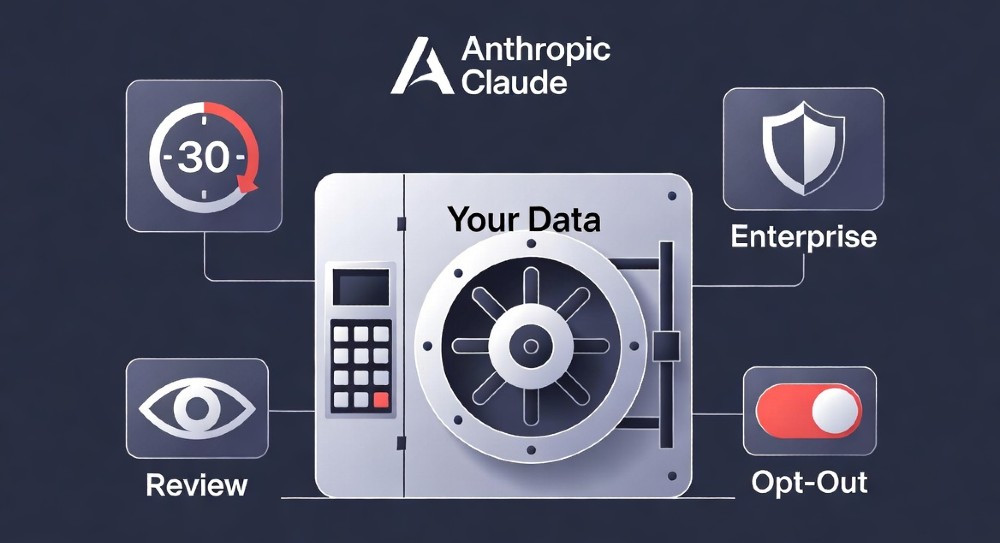
Most articles on Claude’s privacy stop at “Anthropic says your data is safe.” That’s not an answer — that’s a press release. Here’s what the policies actually say, what they mean for you in practice, and exactly what you need to do based on whether you’re a casual user, developer, or enterprise team.
- Consumer chats: Stored 30 days, can be human-reviewed, training opt-in only
- API default: 7-day retention, zero-retention available for enterprise
- Opted into training: Data held up to 5 years
- Projects feature: Data persists indefinitely until you manually delete
- PII training: Anthropic says no intentional PII training — but accidental PII stays in stored logs
- HIPAA: No BAA available — don’t put PHI in Claude prompts
- Bottom line: Claude is reasonably private by default. The real risks are opt-in training, Projects persistence, and assuming “30 days” covers everything.
Consumer Chats: 30-Day Retention + Human Review Reality
Here’s what actually happens when you type into Claude.ai: your conversation gets stored for 30 days on Anthropic’s infrastructure, then deleted — unless you’ve opted into model training, in which case that 5-year hold kicks in.
The 30-day window isn’t just storage — it’s an active review period. Anthropic can and does run safety scans on conversations. Human reviewers can access flagged chats. This isn’t buried fine print; it’s in their privacy policy explicitly. The purpose is abuse detection and safety — not advertising, not selling your data.
What this means practically: If you’re asking Claude general questions, drafting emails, or doing research, the 30-day default is fine for most users. The risk zone is if you’re pasting in anything sensitive — client data, internal financials, personal health info — because that content sits in Anthropic’s systems for a month.
30-Day Clock: Exact Delete Timeline
The timeline works like this:
Prompt sent → response generated → conversation stored → 30 days pass → automatic deletion
One exception: if a conversation gets flagged for abuse or safety investigation, that deletion can be paused. Anthropic doesn’t publish exactly how long flagged content is held, which is a real transparency gap.
Another exception most users miss — deleted conversations on your end don’t mean immediate deletion on Anthropic’s end. Clearing your chat history removes it from your interface; the backend retention timeline is separate.
Human Review Triggers: 7 Red Flags
Human review is possible — not guaranteed on every chat, but possible. The triggers that increase the likelihood:
- Content flagged by automated safety filters
- Apparent policy violations (harmful content requests)
- Abuse investigation
- Legal requests or regulatory inquiries
- Security incident investigation
- Model quality improvement sampling (opt-in users)
- Trust and safety audits
If your use case involves confidential business conversations, this matters. The API with zero-data retention (covered below) is the right path for sensitive workloads — not the consumer interface.
Opt-In Training = 5-Year Data Freeze? Deadline Details
This was the big shock of 2025. Anthropic changed from opt-out to opt-in for model training — meaning users had to actively choose whether to let their conversations be used for training. The deadline was September 28, 2025.
If you opted in before or after that deadline, your conversations used for training are retained for up to 5 years. That’s not a typo. Five years of chat history potentially accessible for model improvement purposes.
If you did nothing and were already opted out (the default pre-2025), you’re fine — no training use, standard 30-day retention.
The current 2026 status: the opt-in training option is live. If you’re on a consumer plan and haven’t checked your settings recently, check now.
Opt-Out Checklist: 5 Steps
If you want to confirm you’re not opted into training:
- Go to Claude.ai → click your profile icon
- Select Settings → navigate to Privacy
- Find “Improve Claude for everyone” toggle — make sure it’s OFF
- Confirm the change when prompted
- Screenshot the setting with timestamp for your records
Takes 90 seconds. Worth doing right now if you haven’t already.
5-Year Hold Math: What Gets Kept
When training opt-in applies, what’s actually retained? Per Anthropic’s policy: conversation content and associated metadata. They state data is anonymized before training use — but anonymization and deletion are different things. The data exists, processed and stored, for up to 5 years.
Metadata includes things like conversation timestamps, session length, feature usage — even if the content itself is anonymized for training runs, the raw data may be retained longer for audit and compliance purposes.
API Users: 7-Day Default + Zero-Retention Hack
If you’re building on the Claude API rather than using claude.ai directly, the default retention drops to 7 days instead of 30. Better — but not zero.
The real option for enterprises and compliance-sensitive applications is Zero Data Retention (ZDR). Under a ZDR agreement, prompts and responses are not stored by Anthropic at all after the API call completes. No logs, no retention period, no human review possibility.
This is the architecture that healthcare adjacent apps (not HIPAA-covered, but sensitive), legal tech, financial services, and any company handling regulated data should be using.
Zero Data Retention Agreement: Qualification Checklist
ZDR isn’t automatic — you need to qualify and contract for it. Requirements typically include:
- Enterprise-tier API access (not pay-as-you-go)
- Documented compliance need (regulated industry, internal security policy)
- Signed Data Processing Agreement (DPA)
- Review of use case by Anthropic’s enterprise team
- Acknowledgment of limitations (some features may not work under ZDR)
Contact Anthropic’s sales team directly — this isn’t self-serve. Worth doing if you’re processing anything you’d lose sleep over.
API Retention Table: 7 vs 30 vs 5 Years
| User Type | Default Retention | Training Use | Human Review |
|---|---|---|---|
| Consumer (claude.ai) | 30 days | Opt-in only | Safety/abuse |
| API (standard) | 7 days | No | Abuse only |
| API (ZDR agreement) | 0 days | No | No |
| Opted into training | Up to 5 years | Yes | Yes |
| Projects feature | Until deleted | Same as plan | Same as plan |
Print this. It’s what most articles don’t give you in one place.
Claude as Data Processor: Enterprise DPA Breakdown
For enterprise deployments, Anthropic operates as a data processor — your organization is the data controller. This is a critical legal distinction, especially under GDPR.
As controller, you’re responsible for what data goes into Claude. As processor, Anthropic is responsible for handling it per your instructions and the agreed terms. This is why a signed DPA isn’t optional for any EU-facing enterprise use — it’s a legal requirement under GDPR Article 28.
Anthropic does provide DPA capability. But you have to request and negotiate it — it doesn’t auto-apply when you sign up for an enterprise plan.
For teams thinking through their broader AI governance for small business or enterprise-level AI team structure, the DPA question needs to be resolved before Claude is deployed at scale, not after.
Model DPA Template: 12 Must-Have Clauses
A Claude DPA for enterprise use should cover:
- Subject matter and duration of processing
- Nature and purpose of processing activities
- Type of personal data being processed
- Categories of data subjects
- Processor obligations (Anthropic’s specific commitments)
- Sub-processor disclosure and approval process
- Data subject rights facilitation
- Security measures (technical and organizational)
- Breach notification timelines (72-hour GDPR requirement)
- Data transfer mechanisms (Standard Contractual Clauses if EU data)
- Retention and deletion schedules
- Audit rights for the controller
Don’t sign a DPA that’s missing any of these. Generic processor agreements often skip audit rights and sub-processor transparency — both are non-negotiable for real compliance.
Sub-Processor Disclosure: AWS + Who Else?
Anthropic’s infrastructure runs on AWS (Amazon Web Services). This means your data transits through Amazon’s cloud infrastructure. Anthropic publishes a sub-processor list — request it through their enterprise team or check their privacy documentation.
For EU deployments, confirm data residency. US-based AWS regions mean transatlantic data transfers, which require either SCCs or Binding Corporate Rules under GDPR.
PII in Prompts: Training Safe or Risky?
Anthropic’s stated policy: they don’t intentionally train on personally identifiable information. But “intentional” is doing a lot of work in that sentence.
If you paste a customer’s name, email, and account history into a Claude prompt, that PII is stored for the retention period regardless of training intent. The safety and abuse review systems can see it. It’s not used to train the model — but it exists in Anthropic’s infrastructure for 7–30 days.
The risk isn’t Anthropic selling your data. The risk is exposure in a breach, an overly broad legal request, or accidental inclusion in training datasets despite best efforts at anonymization.
Rule of thumb: Treat Claude like a smart contractor who’s under NDA — useful, trustworthy, but you still don’t hand them your customer database unredacted.
PII Redaction Checklist: 18 Fields
Before pasting anything into Claude that involves real people or customers, strip or anonymize:
- Full names
- Email addresses
- Phone numbers
- Physical addresses
- Social Security / National ID numbers
- Date of birth
- Account numbers
- IP addresses
- Device IDs
- Location data (precise)
- Passport / license numbers
- Credit card numbers
- Medical record numbers
- Biometric identifiers
- Employment records
- Financial account details
- Login credentials
- Session tokens or API keys
Use placeholders: [CUSTOMER_NAME], [EMAIL], [ACCOUNT_ID]. Takes 30 seconds and eliminates the risk entirely.
Projects Feature: Data Lives Forever?
This is the one most users get caught by. Claude’s Projects feature lets you create persistent workspaces where context carries across conversations. That’s powerful — but it also means that data doesn’t follow the 30-day deletion cycle.
Project data persists until you manually delete the project. If you uploaded a document to a Project six months ago, it’s still there. The 30-day clock doesn’t apply to Project content.
For teams using Projects for client work, strategy documents, or internal knowledge bases, this needs explicit data hygiene policies. You can’t assume automatic cleanup.
This connects directly to shadow AI governance concerns — if employees create Projects with sensitive company data and then leave, that data doesn’t auto-delete with their account unless there’s an admin-level offboarding process.
Project Delete Workflow: 4 Steps
- Open the Project → click the three-dot menu
- Export any content you need to retain (download docs, copy key outputs)
- Select Delete Project → confirm deletion
- Audit regularly — set a calendar reminder quarterly to review active Projects
For enterprise teams, assign someone ownership of Project audits. This isn’t a one-time task.
Claude Code: Separate Retention Nightmare
Claude Code (the agentic coding tool) uses the same underlying retention policies — 30 days for conversations, opt-in training, possible human review. The specific risk here is intellectual property.
When you paste proprietary code, internal APIs, database schemas, or architecture diagrams into Claude Code, that content is retained under the same terms. If you’re working on unreleased product features or trade-secret-level algorithms, this matters.
The training opt-in issue is amplified here: if an engineer opted into training and pastes code, that code could theoretically inform model training. Anthropic says it’s anonymized — but code is often identifiable even anonymized (unusual function names, specific architectural patterns).
Code Privacy Checklist: Before Paste
Before using Claude Code with any real codebase:
- Remove API keys, tokens, secrets — use environment variable placeholders
- Anonymize project names if working on unreleased products
- Strip proprietary library names if they’d identify your company’s tech stack
- Confirm opt-out status for the account doing the work
- Use API + ZDR for highly sensitive codebases rather than claude.ai
- Check your employment contract — many have AI tool restrictions for proprietary code
Claude Code is genuinely powerful. The risk isn’t theoretical — it’s manageable with 10 minutes of setup.
2026 Policy Diffs: What Changed Since 2025?
The major structural change was 2025’s shift to opt-in training with the September deadline. 2026 hasn’t brought a fundamental policy overhaul — but there are clarifications worth noting:
- Processor language is clearer in the updated privacy policy, making enterprise controller/processor relationships more explicit
- Training notice links are more prominently placed in the UI
- Sub-processor disclosure process is more formalized for enterprise requests
- ZDR eligibility has expanded slightly — more use cases qualify than in early 2025
No major new retention changes as of May 2026. The 30-day consumer, 7-day API framework remains intact.
Version Timeline: 2025→2026 Changes
| Period | Key Change |
|---|---|
| Pre-Aug 2025 | Default opt-out for training |
| Aug–Sep 2025 | Transition to opt-in model, 5-year hold announced |
| Sep 28, 2025 | Opt-in training deadline |
| Late 2025 | DPA process formalized for enterprise |
| 2026 | Processor language updated, ZDR expanded |
Enterprise Compliance Playbook
GDPR Article 28 DPA: Claude Processor Compliance
Article 28 requires a written contract between controller and processor covering security, breach notification, sub-processors, and data subject rights. Claude use without a signed DPA in EU contexts is a GDPR violation — full stop.
Required elements: documented instructions for processing, confidentiality obligations, security measures, sub-processor approval, audit rights, deletion or return of data at contract end, and assistance with data subject requests.
Anthropic does provide DPA capability. Request it through enterprise sales before deployment, not after a compliance audit flags it.
SOC 2 Type II: Anthropic Audits Passed
Anthropic holds SOC 2 Type II certification, covering security, availability, and confidentiality. This is real, third-party verified assurance — not a self-declaration.
For procurement teams requiring vendor security assessments, Anthropic’s SOC 2 report can be requested under NDA. It covers their infrastructure controls, access management, and incident response — the actual audit documentation, not a marketing summary.
CCPA/CPRA: Consumer Rights Mapping
California users have specific rights: access, deletion, correction, and opt-out of data selling (Anthropic doesn’t sell data, but the right still applies formally).
Exercise these rights via: [email protected]
Response time: 45 days under CCPA, extendable to 90 days with notice. Anthropic processes these requests — document your submission and track the response window.
HIPAA BAA? No — Stick to De-Identified
Anthropic does not offer a HIPAA Business Associate Agreement (BAA) for Claude. This means Claude is not a covered HIPAA-compliant tool for Protected Health Information (PHI).
If you’re in healthcare: don’t put patient data, medical records, or anything that qualifies as PHI into Claude prompts — even de-identified if you’re not confident in the de-identification. The liability exposure from a breach involving PHI in a non-HIPAA-covered system is significant.
Use Claude for non-PHI tasks: administrative drafting, general research, coding internal tools. Keep PHI in HIPAA-covered systems.
Zero-Retention ROI: $47K/Year Compliance Savings
The ZDR upgrade costs more than standard API pricing. Here’s why it pays:
- GDPR fines: Up to 4% of global annual revenue. One incident prevented pays for years of ZDR costs.
- Breach notification costs: Average $150–250 per affected record in incident response. ZDR means no records to breach.
- Annual compliance audit costs: Auditors charge less time when data minimization is provable. ZDR is the cleanest proof.
- Legal review: Fewer data-handling questions to legal = less billable time.
The $47K figure is a conservative estimate for a mid-size company — actual savings depend on your audit frequency and regulatory exposure. For heavily regulated industries, the ROI is higher.
SMB/Consumer Checklists
Free Tier: 30 Days = Safe Enough?
For casual use — drafting content, answering questions, general research — yes, 30-day retention is fine. The risk is low if you’re not pasting sensitive data.
Where it stops being safe: anything involving real customer data, proprietary business information, personal health details, or financial records. For those cases, either switch to the API with ZDR or keep that content off Claude entirely.
Pro/Max: Training Opt-Out Worth $20/Month?
The $20/month Pro plan isn’t primarily a privacy upgrade — it’s higher usage limits and access to more capable models. The privacy controls (opt-out of training) are available regardless of plan tier.
What Pro does affect: you get more conversations, longer context, access to extended thinking. From a pure privacy standpoint, the plan tier matters less than your opt-out status and what data you’re inputting.
Daily Delete Workflow: Zero Retention Hack
If you’re on the consumer tier and want to minimize exposure without upgrading to enterprise API:
- At end of each session: go to Settings → Data Controls → Delete All Conversations
- Confirm deletion — remember this removes from your view but backend retention still applies for the 30-day period
- Don’t use Projects for sensitive information
- Audit your Settings monthly — check opt-out status hasn’t changed after app updates
This isn’t true zero retention — only ZDR gets you that. But it limits the surface area.
PII Audit: Scan Your Last 100 Prompts
If you’ve been using Claude for a while without thinking about privacy, do a one-time audit:
- Export your conversation history (Settings → Data Controls → Export)
- Search the export for: email patterns (
@), phone patterns (\d{3}-\d{3}), SSN patterns, credit card patterns - Identify which conversations contained sensitive data
- Note those conversations are in the 30-day retention window (or longer if training opt-in)
- Adjust your input habits going forward
This takes an hour once. Most people find a few instances of accidental PII — rarely catastrophic, but good to know.
Comparison Matrix
| Aspect | Consumer | API Standard | API ZDR | Projects |
|---|---|---|---|---|
| Retention | 30 days | 7 days | 0 days | Until deleted |
| Training use | Opt-in | No | No | Same as base |
| Human review | Safety/abuse | Abuse only | No | Same as base |
| PII risk | Medium | Low | Minimal | Medium-High |
| Enterprise fit | Low | Medium | High | Medium |
| GDPR ready | With DPA | With DPA | Strongest | With DPA |
OpenAI vs xAI vs Anthropic: Retention Comparison
| Provider | Consumer Retention | API Retention | Training Default | ZDR Available |
|---|---|---|---|---|
| Anthropic (Claude) | 30 days | 7 days | Opt-in | Yes (enterprise) |
| OpenAI (ChatGPT) | 30 days | 0 days (API) | Opt-out available | Yes |
| xAI (Grok) | Per X/Twitter policy | Limited info public | Opt-out available | Not public |
Anthropic’s consumer retention is comparable to OpenAI’s. The API story is slightly less favorable (7-day default vs OpenAI’s 0-day API default), but ZDR availability puts enterprise options on par.
FAQ
Does Claude delete chats after 30 days? Yes — consumer chats are automatically deleted after 30 days from Anthropic’s systems. Note: deleting from your interface doesn’t trigger immediate backend deletion; the 30-day clock runs from conversation creation.
Does Anthropic train on my code? Only if you’ve opted into model training. Default is opt-out. If opted in, code conversations are retained up to 5 years and may inform training (anonymized per Anthropic’s policy).
Is zero retention available on the Claude API? Yes — through a Zero Data Retention agreement with Anthropic enterprise. Not self-serve; requires contract and qualification.
Are Projects data subject to the same 30-day rule? No. Project data persists until you manually delete the Project. This is a significant difference from standard conversation retention.
Is PII in prompts safe from training? Anthropic doesn’t intentionally train on PII, but the data is stored during the retention period regardless. Best practice: redact PII before inputting.
Can Anthropic employees read my Claude conversations? Possible — for safety review, abuse investigation, or quality purposes. Not routine for every conversation. API ZDR removes this possibility for enterprise users.
Does Claude comply with GDPR? With a signed DPA, yes — Anthropic operates as a compliant data processor. Without a DPA, GDPR compliance for EU deployments is not established.
What’s the safest way to use Claude for sensitive business data? Enterprise API with ZDR agreement + signed DPA + PII redaction practices + no Projects for sensitive content.
Does Anthropic sell my data? No — explicitly stated in their privacy policy. Revenue comes from subscriptions and API usage, not data monetization.
What happens to my data if I delete my Claude account? Anthropic processes deletion requests per their privacy policy. Residual copies may exist in backups for a limited period post-deletion. Request confirmation of deletion timeline when submitting.
Bottom line: Claude’s privacy is solid by AI industry standards — not perfect, but transparent and improvable with the right settings. The practical risks are specific: training opt-in, Projects persistence, PII in prompts, and assuming consumer-tier privacy is good enough for regulated data. Fix those four things and Claude is a reasonable tool for most professional use cases. For regulated industries — healthcare, finance, legal — enterprise API with ZDR is the only defensible path.
