


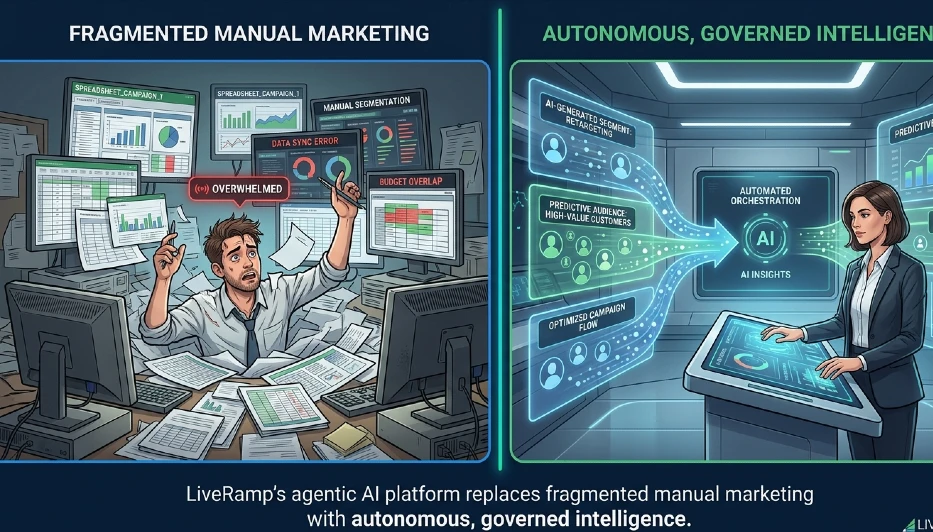
Manual marketing workflows are officially on notice. LiveRamp just handed autonomous AI agents the keys to its entire data collaboration network — and the ripple effects across the advertising industry are already visible.
LiveRamp (NYSE: RAMP), widely regarded as the leader in data collaboration, has officially launched a suite of new AI capabilities built to transform how marketers plan, execute, measure, and optimize campaigns using agentic systems. This isn’t a minor product tweak. It’s a fundamental shift in how enterprise marketing gets done.
What LiveRamp Actually Launched — And Why It Matters
Let’s skip the fluff. Here’s what’s new and why you should care.
LiveRamp is now the first platform to give autonomous AI agents the ability to collaborate with governed access to identity, segmentation, activation, and measurement solutions — enabling marketers to plan smarter campaigns, optimize investments, and prove impact across every channel that matters.
Translation? The system that used to require a team of analysts running queries, building audiences, and measuring cross-media results can now be handled — autonomously — by AI agents operating inside a secure, governed environment your organization already controls.
These updates allow specialized AI agents to collaborate autonomously across the marketing ecosystem within a governed environment, replacing manual, fragmented processes with intelligent execution designed to drive exponential performance gains for brands and their partners.
That’s not marketing copy. That’s a structural change to how modern ad campaigns are run.
The Agent Ecosystem: Who’s Already Plugged In
This isn’t theoretical. Real agents are live right now.
Newton Research and SemantIQ are already active on the platform — and they’re described as the first of many partners being onboarded. Both serve distinct marketing needs:
- Newton Research lets marketers ask natural language questions to instantly pull cross-media measurement insights from LiveRamp’s intelligence layer.
- SemantIQ enables health and life science marketers to build and activate healthcare provider audiences directly from within the LiveRamp Clean Room.
LiveRamp customers — including major ad agencies, big brands like Uber and Coca-Cola, publishers like Paramount, Netflix, and Spotify, and tech partners like The Trade Desk and Index Exchange — can now plug in specialized agents to interact with any partner on the platform.
That’s a serious client roster validating a serious capability.
From Identity Resolution Company to Agent Orchestration Layer
Here’s the bigger story most coverage is missing.
LiveRamp is increasingly positioning itself as an agent orchestration layer for marketing operations — a significant pivot from its earlier focus primarily on identity resolution and data collaboration. For a 15-year-old adtech company, that kind of strategic repositioning is either bold or necessary. Probably both.
The move makes sense when you look at the infrastructure they’ve built. LiveRamp’s agentic orchestration lets marketers connect their own agents, or partner agents, through APIs — with controlled access to LiveRamp’s identity, segmentation, activation, measurement, clean rooms, and insights from over 900 partners.
Nine hundred partners. That’s not just a data network. That’s a data moat.
What the New Capabilities Actually Do
Agentic audience building is now real. No more manually stitching together first-party CRM data with third-party segments across disconnected tools.
Marketers can now describe their audience using natural language and instantly generate accurate, multi-source segments pulling from first-, second-, and third-party data — then preview, refine, and activate them.
Lookalike modeling got a serious upgrade. The platform now features enhanced lookalike modeling across first-, second-, and third-party data — alongside the ability to apply a single identity-powered control group across multiple channels for consistent performance measurement.
That second part matters more than it sounds. Consistent control groups across surfaces means cleaner attribution. Cleaner attribution means better spend decisions.
AI-powered search for the Data Marketplace is also live. The LiveRamp Data Marketplace is now enhanced with AI-powered search, making discovery of third-party audiences faster and dramatically accelerating time-to-value for marketers.
The Privacy-Compliant Angle Nobody Talks Enough About
Agentic AI in advertising sounds powerful. It also sounds like a compliance nightmare. LiveRamp is betting it’s neither.
Thomas Atkins, Executive Director of Media at MGM Resorts International, confirmed that with data security and consumer privacy protected at every step, they can use AI and data collaboration to model, build, and recommend higher-quality audiences with confidence — driving stronger results while scaling more efficiently.
The governance framework isn’t an afterthought. Every agent, whether proprietary or third-party, operates within permissions that align with your organization’s AI policies. That’s a meaningful distinction in a regulatory environment where GDPR, CCPA, and evolving AI governance rules are constantly shifting.
LiveRamp donated its User Context Protocol — an open standard governing how agents exchange signals in digital ad environments — to the Interactive Advertising Bureau in November 2025, which is now building a framework for agentic ad auctions. LiveRamp isn’t just building for today’s compliance landscape. It’s helping write the rules for tomorrow’s.
Industry Analysts Are Paying Attention
Ananda Chakravarty, Research VP for Retail Insights at IDC, noted that marketers have historically struggled with lookalike audiences due to three friction points: data, workflow, and connectivity. This release from LiveRamp directly addresses all three by sourcing from multi-party data, adapting to existing workflows, and ensuring seamless connectivity and activation across the ecosystem.
That kind of IDC validation is worth noting. It’s one thing for a company to claim it solved a problem. It’s another when an independent research firm confirms the problem was real — and names the solution.
How It Stacks Up Against the Competition
LiveRamp isn’t moving in a vacuum. The broader adtech industry is racing toward agentic infrastructure.
The Trade Desk launched a competing approach in September 2025 with Audience Unlimited, introducing AI-powered scoring to evaluate data segments by relevance to specific campaigns. Adobe announced Experience Platform Agent Orchestrator in September 2025 for managing agents across Adobe and third-party ecosystems. Amazon introduced agentic AI capabilities the same month, transforming marketplace management through systems that monitor accounts, optimize inventory, and manage advertising campaigns autonomously.
The difference? LiveRamp’s play is data-first. Its competitive edge isn’t the agent itself — it’s the governed access to identity and audience infrastructure those agents can touch. LiveRamp can connect trillions of signals from its network to enhance AI with better data, enabling intelligent, secure data collaboration at scale for the agentic ecosystem.Competitors are building agents. LiveRamp is building the foundation agents need to actually work.
What This Means for Marketers Right Now
If you run campaigns at any meaningful scale, this deserves your attention:
- Audience planning that used to take days can now run continuously, autonomously, and across more data sources than a human team could realistically manage.
- Campaign measurement can happen in near-real time, with natural language queries replacing analyst bottlenecks.
- Budget optimization can shift from quarterly reviews to ongoing, agent-driven adjustments based on live performance signals.
- Privacy compliance is built into the workflow, not bolted on after the fact.
LiveRamp’s Chief Product Officer Matt Karasick summed it up clearly: the platform is making it possible for AI agents to do what marketers have been doing manually — build audiences, measure cross-media performance, and optimize spend — but faster and within the governed environment customers already trust.
What Comes Next
LiveRamp reported revenues of $212 million in Q4, up 9% year-over-year. The financial foundation is solid. The product roadmap is ambitious. And the ecosystem is growing fast — more than 25 new AI-first destinations and integrations have been added, with agentic buying and optimization partners like Chalice AI, Scope3, and others already onboarded or on the horizon.
The bigger question isn’t whether agentic AI will reshape marketing. That’s already happening. The question is which platforms will become the trusted infrastructure layer underneath it all.
LiveRamp is making a strong case that it intends to be exactly that.
check our latest news
Cerebras CS-3 on AWS Bedrock: The AI Inference Speed Breakthrough Enterprises Have Been Waiting For
