


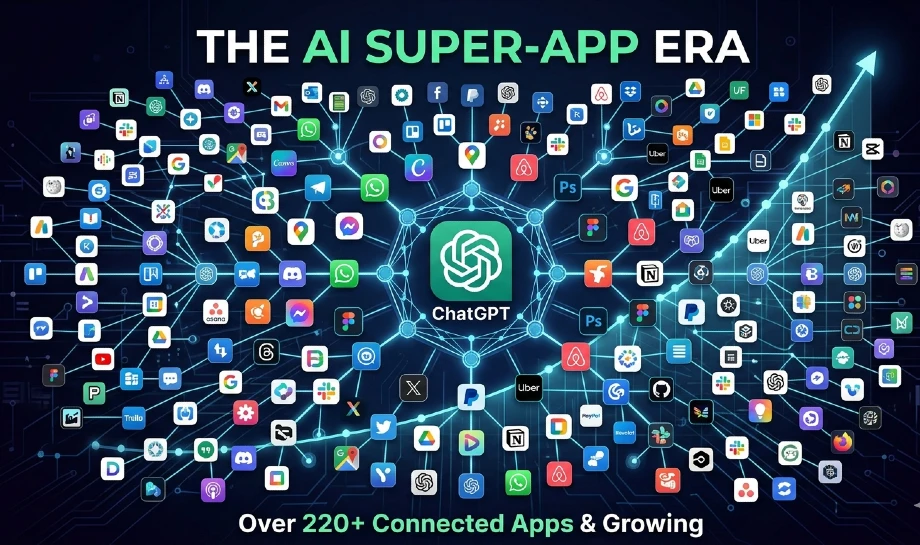
ChatGPT Ecosystem isn’t just winning the AI race — it’s lapping the field. With 900 million weekly active users, 220+ app integrations, and tools like Sora 2 video generation now baked in, OpenAI has quietly built something no competitor has matched: a self-contained AI ecosystem that handles everything from writing to video to business automation in a single interface.
This isn’t hype. This is a structural shift in how humans use the internet.
The Numbers Are Almost Impossible to Grasp
ChatGPT hit 400 million weekly active users in February 2025, climbed to 800 million by October 2025, and then added another 100 million in just four months to reach 900 million. For context — that weekly user count is now larger than the combined populations of the US, EU, and Canada.
The platform currently processes 2.5 billion requests every single day and holds 64.5% market share across generative AI platforms. It’s also the 4th most visited site on the internet globally — sitting alongside Google, YouTube, and Facebook.
That’s not a chatbot. That’s infrastructure.
What’s Actually Driving ChatGPT Ecosystem Dominance
Here’s the thing most coverage misses: raw user numbers don’t explain why people keep coming back. The real story is feature stacking.
What users get in one place today:
- File analysis — upload PDFs, spreadsheets, images, and get instant structured insights
- Sora 2 video generation — text-to-video inside the same chat window (no third-party tool needed)
- Custom GPTs — build your own AI workflows for SEO, HR, customer support, or research without writing code
- Deep Research mode — multi-step web research synthesized into a report in minutes
- Voice and vision — real-time conversation with image understanding built in
- 220+ app integrations — connecting directly with tools like Zapier, Notion, Slack, and more
No competitor offers this combination at this scale. Not yet.
Why This Beats Gemini and Claude — Honestly
According to market analytics, ChatGPT holds about 60.4% of the AI search and assistant market, while Google Gemini has captured between 15% and 18%, up from just 5.4% in early 2025. Anthropic’s Claude sits at around 4.5%.
Gemini is genuinely strong — especially inside Google Workspace. But it’s still reactive. It follows you into Google’s world. ChatGPT is the world.
Claude is arguably the most thoughtful writer of the three, and its reasoning on complex tasks is excellent. But it lacks ChatGPT’s ecosystem depth. No video gen. Fewer integrations. Smaller developer community building on top of it.
The gap isn’t just in model quality — it’s in surface area. ChatGPT touches more workflows, more devices, and more industries than any rival right now.
The Business Impact Is Already Here
OpenAI reported more than 9 million paying business users as of February 2026 — a fourfold increase from September 2025. That’s not people experimenting. That’s procurement decisions, IT approvals, and budget line items.
For marketing and SEO agencies specifically, ChatGPT has become a control center:
- Drafting, editing, and A/B testing ad copy — all in one thread
- Building custom GPTs trained on brand voice and SEO guidelines
- Running competitor analysis with Deep Research in under 10 minutes
- Generating video content with Sora 2 directly from briefs
One of the most significant shifts for businesses is the move from Search Engine Optimization (SEO) to Generative Engine Optimization (GEO) — as users increasingly get answers directly from AI assistants, companies must now optimize their content to be cited as an authoritative source in AI-generated summaries.
If your brand isn’t showing up in ChatGPT’s answers, you’re invisible to a growing slice of your audience.
Plugin Ideas SEO Agencies Should Build Right Now
Custom GPTs aren’t just productivity hacks — they’re client retention tools. Here’s what’s actually worth building:
- SEO Audit GPT — feed it a URL and get a structured technical + content audit in seconds
- GEO Optimizer GPT — trained on your client’s brand guidelines to optimize content for AI citation
- Keyword Clustering GPT — paste raw keyword lists, get semantic clusters with intent labels
- Content Brief GPT — pulls SERP data context and outputs a full brief with headings, FAQs, and word count targets
- Competitor Gap GPT — analyze three competitor URLs and surface content gaps instantly
These aren’t hypothetical. Agencies building these right now are billing them as premium deliverables.
The Competitive Pressure Is Real — But Not Fatal for OpenAI
ChatGPT’s market share dropped from a commanding 87.2% just one year ago to around 60.4% today, with Google Gemini driving most of that change through deep integration across Search, Workspace, and Android.
That’s a real erosion. But consider: users send about 2.5 billion messages daily — roughly 29,000 per second — while the API processes over 6 billion tokens per minute. That’s not a platform losing ground. That’s a platform with a retention problem that it’s solving through feature velocity.
OpenAI’s response has been to ship relentlessly — o3, GPT-4o updates, Deep Research, Sora 2, Canvas, and agentic computer use features all landed within months of each other.
What’s Coming Next
ChatGPT is planning to launch a “Super Assistant” mode that will help users manage calendars, email, trip planning, and external apps autonomously. If that lands well, it stops being a tool and becomes a daily operating system.
OpenAI’s stated goal is to build what they describe as an “AI coworker” infrastructure — a system through which enterprises, startups, and governments can build, deploy, and manage AI agents.
The billion-user milestone is likely in 2026. The real question is what OpenAI does with that scale — and whether regulators in the EU and beyond start treating it like the infrastructure it’s becoming.
Bottom Line
ChatGPT ecosystem dominance isn’t a marketing phrase anymore — it’s a market reality. The combination of 900M weekly users, a genuine super-app feature set, and a developer community building on top of it has created a flywheel that competitors will struggle to stop.
For businesses and agencies: the window to integrate and specialize is now. The brands that figure out how to show up inside ChatGPT’s answers — and build workflows on top of its tools — will have a structural advantage over those still treating AI as an experiment.
check out oue latest news
