


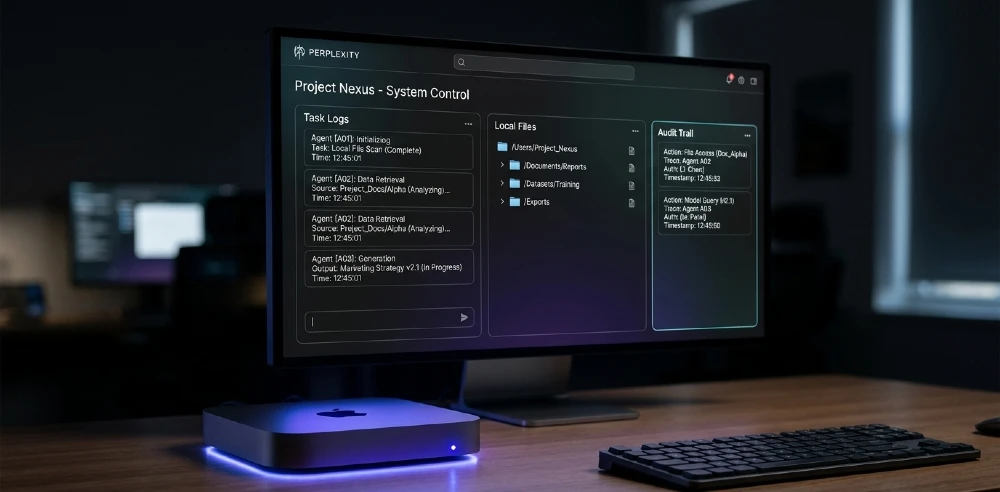
Perplexity just changed what “personal computer” means — and it has nothing to do with hardware. On March 11, 2026, the AI search company unveiled Perplexity Personal Computer, a software system that turns a Mac Mini into an always-on AI agent with full access to your local files, apps, and sessions. It runs 24 hours a day, works while you sleep, and connects to Perplexity’s cloud infrastructure — all while keeping every sensitive action behind a user-approval gate.
This is not a chatbot. This is an AI that lives on your machine.
What Perplexity Personal Computer Actually Is
The simplest way to understand it: Personal Computer is an extension of Perplexity Computer — the cloud-based AI agent the company launched in late February 2026. That earlier product operated entirely in the cloud and could orchestrate over 20 frontier AI models to handle multi-step tasks autonomously. Personal Computer takes that same engine and anchors it locally to a user-supplied Mac Mini.
The result is an AI that has persistent, always-on access to your Gmail, Slack, GitHub, Notion, Salesforce — whatever apps you have running locally. You don’t need to open it, prompt it, or manage it session by session. You describe a goal, and it figures out which files to open, which apps to use, and how to carry the work forward on its own.
CEO Aravind Srinivas framed the vision clearly at Perplexity’s Ask 2026 developer conference, held in a former church in San Francisco’s North Beach: “A traditional operating system takes instructions; an AI operating system takes objectives.”
That’s a meaningful distinction. Most AI tools wait for you to ask something. Personal Computer is designed to monitor, anticipate, and execute — continuously.
How It Works: The Technical Picture
Personal Computer is software, not a new device Perplexity is selling. You supply the Mac Mini. Perplexity’s platform connects to it remotely and can be controlled from any device, anywhere. The Mac Mini runs continuously, merging local app access with Perplexity’s cloud infrastructure.
Under the hood, the system works as a task orchestrator. You give it a broad objective — say, “prepare a morning brief using yesterday’s Slack messages, emails, and industry news” — and it breaks that down into subtasks. It pulls the right files, accesses the right apps, runs sub-agents to handle each piece, and combines the output into a deliverable. You don’t write the sub-instructions. It writes them.
For developers and privacy-minded users, Perplexity built in several safeguards from day one:
- User approval required for all sensitive actions before execution
- Full audit trail generated for every session — you can review exactly what the AI touched and when
- Kill switch that immediately halts all activity if anything goes wrong
- Secure environment with access controls that limit what the agent can do without explicit permission
These aren’t just nice-to-have features. Anyone following the AI agent space knows how badly things can go when agents have unrestricted local access. Perplexity built the guardrails first — which is notable.
Who Can Access It Right Now
Access is currently restricted. Here is the exact situation as of March 13, 2026:
- Personal Computer is Mac-only at launch — no Windows or Linux support confirmed yet
- Users must be on Perplexity Max, the company’s highest subscription tier at $200/month, which includes 10,000 monthly compute credits
- Even Max subscribers need to join a waitlist — the initial rollout is limited to a first cohort with hands-on support from Perplexity
- No public pricing for a standalone Personal Computer plan has been announced yet; the $200/month Max tier appears to be the entry point
This is a deliberate controlled rollout, not a broad public launch. Perplexity is clearly testing how real-world usage behaves before opening it wider.
The Privacy Angle: Why This Matters Against Cloud-Only AI Agents
This is where Personal Computer makes its most interesting argument.
Tools like ChatGPT’s Operator agents and similar cloud-based AI systems process everything through external servers. Your files, emails, and workflow data pass through a third-party cloud environment. For most consumer use cases, this is fine. For enterprises handling sensitive client data, healthcare information, financial records, or proprietary business logic — it’s a genuine compliance concern.
Perplexity Personal Computer flips this. The processing happens on your own machine. Your files don’t travel to an external server to be analyzed; the agent operates locally and only calls out to Perplexity’s infrastructure for the coordination layer. Combined with the audit trail and approval requirements, this positions the product as a more privacy-conscious alternative to cloud-first agents.
For marketing teams, this has practical implications. Running campaign automations, processing customer data, or pulling CRM insights through a locally anchored AI agent means that sensitive client information doesn’t leave your controlled environment. The audit trail adds a layer of accountability that cloud tools currently don’t offer at this level of granularity.
That said — it’s worth noting that Personal Computer still connects to Perplexity’s servers for orchestration. It is not entirely offline. The local component is the file and app access layer; the AI coordination still involves Perplexity’s infrastructure. Users with strict data residency requirements should verify exactly where data passes during task execution before treating it as a fully air-gapped solution.
Perplexity Computer for Enterprise: The Business Version
Alongside Personal Computer, Perplexity also launched Computer for Enterprise — the commercial-grade version built for organizations.
Enterprise gets everything in the consumer version plus:
- App connectors for Snowflake, Salesforce, HubSpot, and hundreds of other enterprise platforms
- Single sign-on (SSO) support
- Compliance controls meeting enterprise security standards
- Comet Enterprise Browser — an AI-first browser designed for business workflows where most work happens online
The performance claim Perplexity is making here is significant. The company states it saved $1.6 million in labor costs internally and completed the equivalent of 3.25 years of work in just four weeks using its own Computer system. Whether those numbers hold up at scale across diverse enterprise workflows is worth scrutinizing, but the internal benchmark signals how the company is positioning this product.
For enterprises running repeated research, compliance documentation, competitor monitoring, or data aggregation tasks, the pitch is clear: replace recurring human-in-the-loop workflows with an autonomous agent that runs continuously and logs everything.
The Developer Play: Four New APIs
Perplexity didn’t stop at end-user products. The Ask 2026 conference also introduced four new APIs — the same building blocks that power Personal Computer, now available externally:
- Search API — Grounded information retrieval with cited outputs, not just raw search results
- Agent API — Multi-step task delegation for complex autonomous workflows
- Embeddings API — Semantic relevance and retrieval for ranking systems
- Sandbox API — A controlled execution environment for testing agent behavior safely
This is Perplexity’s move to become infrastructure, not just a product. If developers start building applications on top of these APIs, Perplexity embeds itself into the broader AI ecosystem in a way that goes far beyond its current identity as a search engine alternative.
Why Perplexity Is Making This Bet Right Now
Context matters here. Perplexity is a company without its own frontier AI models. It runs on GPT-4, Claude, Gemini, Grok — depending on the task. That’s both a strength (model-agnostic flexibility) and a strategic vulnerability (why pay Perplexity when you can go directly to OpenAI or Anthropic?).
Personal Computer is partly the answer to that question.
Perplexity’s own internal data shows how dramatically the AI market has shifted toward multi-model use: in January 2025, 90% of enterprise queries routed to just two AI models. By December 2025, no single model accounted for more than 25% of usage. The market is moving toward orchestration, not single-model dependence. Perplexity is betting that being the best orchestrator — the layer that deploys all models intelligently — is worth more long-term than being another model provider.
Personal Computer is the physical manifestation of that bet. It’s not saying “use our model.” It’s saying “let us manage all your models, locally, continuously, with your data staying on your machine.”
The company’s annualized revenue was approximately $148 million as of mid-2025, against an internal target of $656 million by end-2026 — a roughly 230% growth requirement. Personal Computer and Computer for Enterprise are the products designed to close that gap.
What This Means for Marketers and Content Teams
For marketing professionals, Personal Computer opens up a category of automation that has been technically possible but practically inaccessible.
Consider what an always-on local AI agent could handle for a marketing team:
- Morning briefings pulled automatically from Slack, email, and industry news feeds, compiled and ready before you open your laptop
- Campaign performance monitoring that pulls from ad dashboards and CRM data, flags anomalies, and drafts a summary without you asking
- Content pipeline management where the agent tracks pending drafts, suggests which pieces need updates based on traffic data, and prepares briefs for upcoming topics
- Client reporting that aggregates data from multiple sources and formats it into a draft report, triggered on a schedule
The key difference from current automation tools is that Personal Computer doesn’t require you to pre-define every workflow step. You set objectives. The agent figures out the steps. This is where the practical value either proves itself or falls apart — and that proof will come from the first cohort of waitlisted users.
What’s Still Missing (And What to Watch)
A few things remain unclear and worth tracking:
Pricing transparency — The $200/month Max subscription is the current access point, but Perplexity hasn’t announced standalone pricing for Personal Computer. For teams, per-seat pricing at $200/month becomes expensive quickly.
Windows and Linux support — Currently Mac-only. Given that most enterprise environments run Windows, the Mac exclusivity is a real limitation for broader business adoption.
Data flow clarity — Perplexity describes the system as running in a “secure environment” but still connects to its servers for orchestration. Enterprises need a precise data flow diagram before trusting it with sensitive workflows.
Long-term model access — Personal Computer can run Claude, Gemini, or Grok as the underlying model. But model availability depends on Perplexity’s ongoing commercial agreements with those providers. If any of those relationships change, the product’s capabilities shift.
The Bigger Picture: AI Is Becoming Infrastructure
What Perplexity launched on March 11 isn’t just a new feature. It’s a signal about where AI is heading.
The first phase of AI was chatbots — you ask, it answers. The second phase was agents — you describe a goal, it executes steps. What Personal Computer represents is the third phase: AI as persistent infrastructure — always on, locally embedded, operating across your full digital environment without requiring your active presence.
Every major tech company is moving toward this model. OpenClaw already exists as an open-source version of the same idea. Nvidia is reportedly building its own competitor. Apple’s Siri is being rebuilt toward ambient intelligence. What Perplexity has done is ship something concrete, with real safeguards, attached to a platform that millions of people already use for search.
Whether it becomes a category-defining product or a first-mover that gets outcompeted by better-resourced rivals depends on execution over the next 12 months. The waitlist opens today. The real test starts now.
Check about: Best AI Tools 2026: The Complete Category Breakdown You Actually Need
