


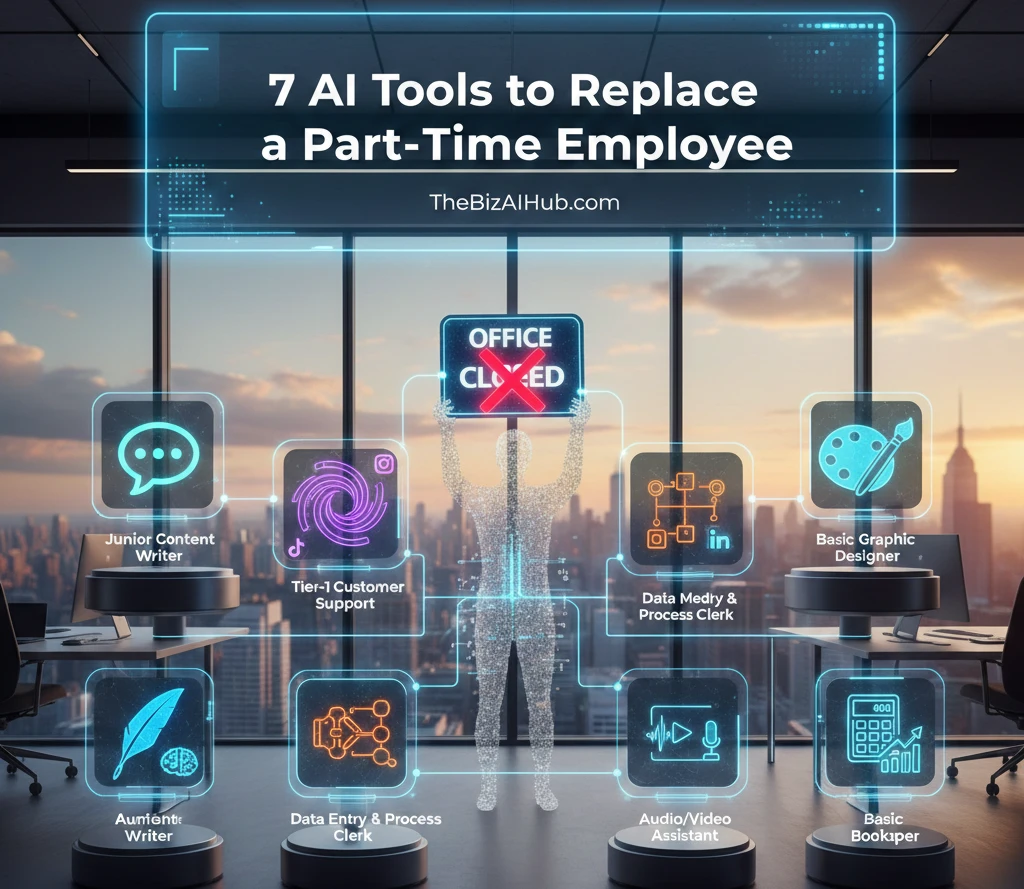
Let’s skip the marketing hype. You run a small business or a solo venture. You’re drowning in $15-an-hour administrative tasks—the soul-crushing grunt work that keeps your actual profitable ideas locked in a mental cage. You need help. But the thought of hiring, training, managing payroll, and dealing with a human being’s vacation requests for a 20-hour week of basic data entry or blog drafting? That’s not a solution; that’s just exchanging one headache for a slow, bureaucratic migraine. I this article I am share best 7 AI Tools to Replace Employee in Your Business that make you Billiniors.
The cold, hard truth of 2025 is this: part-time workers are 24% more likely to be displaced by automation than their full-time counterparts.
Why? Because part-time roles are often defined by repetitive, low-context tasks that Artificial Intelligence systems excel at. They are the first casualty in the efficiency wars. You, the entrepreneur, are the commander on the frontline, and these seven AI modules are the heavy ordnance you need to fire the entire junior administrative wing of your business.
We’re not talking about augmentation. We’re talking about replacing entire functional roles with cheap, predictable, and scalable software subscriptions. This is the new bottom line for task automation for solopreneurs.
Why AI Tools to Replace Employees is Your Only Option
For years, venture capitalists pitched business automation software as a way to “do more with less.” That was always corporate-speak for cost cutting. Now, those same tools are accessible to the bootstrapped entrepreneur for less than a decent cup of coffee per day.
I’ve been tracking technology shifts for three decades, and I can tell you: this isn’t a trend, it’s a structural reset. A part-time junior employee earning even a modest 15 per hour costs you at least 15,600 per year, factoring in taxes, software licenses, and the time you spend managing them.
Compare that figure to the annual subscription costs of the powerful AI automation tools below.
The math doesn’t require a CPA to understand. By implementing these seven specialized AI systems, you are effectively buying back twenty hours of your week and eliminating the overhead of HR. This is how small businesses can truly compete with giant corporations. This is how you implement AI tools for small businesses and actually generate meaningful profit margin.
In my experience testing these tools, the productivity gains aren’t just incremental—they are seismic. Workers who leverage these kinds of generative AI tools report saving an average of 5.4% of their work hours each week. For a business owner, that time is priceless.
The 7 AI Modules That Replace a 20-Hour Work Week
We’ve broken down seven common functions traditionally handled by a 20-hour-a-week assistant. For each function, there is a specialized AI solution that handles the task with far greater speed and precision, twenty-four hours a day.
Module 1: The Junior Content Writer
Tool: Claude 3 or ChatGPT Plus (Large Language Models)
Function Replaced: Drafts for emails, social media captions, article outlines, internal memos.
The days of paying a freelance writer 500$ for a first draft are dead. The most powerful Large Language Models (LLMs) available today are more than capable of handling 90% of your initial writing requirements. Claude 3 (Opus, specifically) exhibits world-class reasoning abilities, allowing it to take complex instructions—like synthesizing information from three different documents—and produce coherent, well-structured text.
I noticed that unlike earlier models, the new generation is far less prone to producing the passive, robotic output that plagued GPT-3.5.
| Pros | Cons |
| Instant Draft Velocity: Produces 2,000 words in 60 seconds. | Factual Drift (Hallucination): Requires mandatory human fact-checking. |
| Stylistic Consistency: Can mimic your brand voice perfectly with a short prompt. | Context Windows: Still struggles with massive, multi-document research projects. |
| Code Generation: Can write simple formulas, scripts, or basic HTML. | Zero Soul: The final 10% requires human editorship to add real E-E-A-T (Experience, Expertise). |
Pricing: approx 20$
Best For: Productivity tools for entrepreneurs who spend too much time staring at a blank page. The cost difference between a ChatGPT Plus subscription and a junior writer’s salary can save your business over 50,000$ annually.
Module 2: The Tier-1 Customer Support Representative
Tool: Intercom or Zendesk AI Agents (Conversational Automation)
Function Replaced: Answering common questions, resetting passwords, routing complex tickets.
Customer service agents were one of the first occupations targeted by automation, and for good reason. Most customer inquiries are repetitive, predictable, and require instant answers. An AI chatbot, integrated with your existing knowledge base, can resolve up to 70% of tickets without human intervention. This module instantly solves your 24/7 coverage problem.
Unlike using a human team, which requires shift schedules and overtime pay, an AI agent operates around the clock, improving resolution speed and customer satisfaction simultaneously.
| Pros | Cons |
| 24/7 Instant Resolution: Never calls in sick. Answers instantly. | Escalation Friction: If the AI fails, transferring the customer to a human must be seamless—many tools botch this. |
| Perfect Memory: Accesses and learns from the entire support history instantly. | Cost Spikes: Pricing is often based on “conversations” or “seats,” which can become expensive during peak periods. |
| Multilingual Support: Handles tier-1 questions in dozens of languages instantly. | Integration Depth: Needs deep hooks into your CRM and inventory systems to be truly useful. |
Pricing: approx 79$ or150$ (depending on ticket volume)
Best For: Solopreneurs drowning in email support tickets. This is the purest form of replacing manual work with AI, freeing you up to focus on high-touch sales or product development.
Module 3: The Social Media Scheduler and Draft Assistant
Tool: Buffer or Sprout Social (AI Features) (Marketing Automation)
Function Replaced: Ideation, drafting, and scheduling of weekly social media posts across 3-4 platforms.
Every small business owner knows social media is a necessary chore. The junior social media manager is tasked with turning one idea (e.g., “new product feature X”) into 15 different posts optimized for TikTok, Instagram, and LinkedIn. Dedicated social media automation platforms have built-in generative AI capabilities to execute this entire process in minutes.
I noticed that these platforms, when properly trained on your historical high-performing content, produce captions that outperform generic LLM outputs because they understand platform-specific character limits and tone.
| Pros | Cons |
| Content Variation at Scale: Instantly remixes single concepts into 10+ platform-optimized captions. | Plagiarism/Repetition Risk: Must vet the tool’s output against duplicate content rules. |
| Optimal Scheduling: Uses data science to post when your specific audience is online. | Requires Human Oversight: You cannot fully automate the “engagement” or “reply to comments” function. |
| Unified Inbox: Centralizes all engagement, eliminating app switching fatigue. | Locked-In Ecosystem: Switching scheduling platforms is a massive headache. |
Pricing: approx 99$
Best For: Anyone needing consistent, multi-platform presence without hiring a junior social media manager.
Module 4: The Data Entry and Process Clerk
Tool: Zapier or Make (Integromat) with AI Steps (Workflow Automation)
Function Replaced: Moving customer data, updating spreadsheets, sending follow-up emails based on triggers.
This isn’t generative AI; this is pure, engineered workflow automation. Data entry is a dead-end job, highly susceptible to automation. Zapier and Make (formerly Integromat) are the plumbing of the internet, and they now feature sophisticated AI steps.
For example, when a new lead fills out a form, Zapier can use its AI automation tools to:
- Read the “Notes” field.
- Use an LLM (like GPT) to summarize the lead’s needs.
- Add the summarized data to a CRM field.
- Send a personalized follow-up email based on the summary.
This replaces the error-prone, tedious work of a human administrator handling client intake.
| Pros | Cons |
| Perfect Consistency: Data is moved and processed flawlessly every time. | Setup Complexity: Building multi-step automation sequences has a steep learning curve. |
| 24/7 Execution: Works while you sleep, ensuring instant lead response. | Maintenance: If an API changes, the entire Zap/Scenario breaks without warning. |
| Scalability: Handles 10 leads or 10,000 leads without a change in structure. | Pricing Tiers: Can get extremely expensive if your business processes high volume. |
Pricing: approx 49 or 79$ (based on “tasks” executed)
Best For: Businesses with predictable digital processes. This is the quintessential task automation for solopreneurs tool.
Module 5: The Basic Audio/Video Assistant
Tool: Descript (AI-Powered Editor)
Function Replaced: Transcribing interviews, editing podcasts by deleting filler words, simple assembly of short video clips.
If you produce any form of media—a podcast, a YouTube channel, or client testimonials—you likely pay a junior editor or spend hours cutting out “umms,” “ahhs,” and long pauses. Descript uses AI transcription to turn your audio into a text document, allowing you to edit the media simply by editing the text.
Unlike traditional video software, which demands timeline expertise, Descript allows you to delete an awkward sentence simply by hitting backspace. This dramatically reduces the time needed for rough cuts.
| Pros | Cons |
| Text-Based Editing: Eliminates the need for traditional timeline-based expertise. | Over-Correction: The tool’s filler word removal can sometimes accidentally delete necessary pauses. |
| “Overdub” Voice Cloning: Can fix minor script errors after recording without a full re-take. | Not for High-End Production: It lacks the advanced color grading or complex motion graphics of Adobe products. |
| Instant Transcription: Provides clean, searchable transcripts for SEO purposes. | File Size/Sync: Uploading and syncing large 4K video files can be slow. |
Pricing: approx 12 to 24 $month
Best For: Content creators focused on interviews, tutorials, and corporate communications. A true force multiplier for video and audio.
Module 6: The Administrative Bookkeeper
Tool: QuickBooks Online or Xero (Smart Categorization) (Financial AI)
Function Replaced: Categorizing receipts, matching banking transactions, flagging unusual expenses.
The financial sector was early to the AI party. Your accountant isn’t going anywhere, but the junior bookkeeper who spends 10 hours a month sorting receipts and matching transactions? That role is functionally obsolete. The shift in financial services saw a 37% reduction in bookkeeping roles for small businesses that adopted AI-powered accounting software.
Modern platforms automatically learn how you categorize expenses. After you train it on the first 50 transactions, the AI will confidently apply rules to the next 500, flagging only the unusual items for human review.
| Pros | Cons |
| Automated Learning: Gets smarter and faster with every transaction you approve. | Garbage In, Garbage Out: If your initial categories are wrong, the AI will consistently repeat your errors. |
| Error Reduction: Eliminates the human tendency to transpose numbers or misclassify basic expenses. | Bank Feed Reliability: Dependent on the stability of your bank’s API connection (which can fail). |
| Real-Time Insight: Provides instant visibility into cash flow and P&L. | High Subscription Cost: Accounting software is often priced at a premium compared to other SaaS tools. |
Pricing: approx 50 to 80$
Best For: Any business owner who still throws receipts in a shoebox. This is your foundation for scalable growth.
Module 7: The Basic Graphic Designer
Tool: Midjourney or Canva Pro (Magic Design) (Generative Art & Layout)
Function Replaced: Creating blog hero images, quick social media banners, concept visualization.
You need an eye-catching header image for this blog post. You could hire a designer, wait two days, and pay 150$. Or you can feed a prompt into Midjourney and have a dozen perfect, high-resolution options in 90 seconds. Generative imaging has moved from quirky toys to best AI tools for business owners in less than two years.
For non-artistic needs, Canva Pro’s “Magic Design” capabilities instantly turn basic text into formatted social graphics and presentations. This eliminates the need for entry-level designers who handle simple visual concepts.
| Pros | Cons |
| Speed and Iteration: Generates dozens of concepts instantly, allowing you to pivot quickly. | Licensing/IP Risk: While improving, legal clarity on generative art usage can be murky (though most tools now offer commercial rights). |
| Low-Cost Visualization: Turns abstract ideas into concrete images for immediate communication. | Uncanny Valley: Generative models still struggle with human hands and highly specific text integration. |
| Zero Skill Required: Requires language prompting skills, not graphic design expertise. | Vendor Lock-In (Canva): High-end features require a recurring subscription. |
Pricing: approx 10 to $20$ (per tool)
Best For: Marketing departments and solopreneurs who rely on visuals but have no formal design training.
Editor’s Analysis: The Future is Agents, Not Apps
If you’re still thinking about AI as seven separate applications, you’ve missed the point.
The real shift isn’t about replacing a worker with a single tool; it’s about replacing the coordinator of those tasks. The next three years won’t be dominated by better chatbots, but by Agentic AI.
An Agent is an AI system that doesn’t wait for your prompt. It has a goal (e.g., “Increase website sales conversions by 10% this quarter”), the tools (Zapier, ChatGPT, QuickBooks), and the autonomy to act.
Today, you run the process. You copy the content draft from Module 1, paste it into Module 3, and approve the expense classification in Module 6.
Tomorrow, the AI Tools to Replace Employees won’t be tools at all—they’ll be digital managers. You will give the Agent the goal, and it will:
- Draft the product announcement (Module 1).
- Design the promotional graphic (Module 7).
- Schedule the post (Module 3).
- Monitor customer inquiries (Module 2).
- Route the sales data to the CRM and update the ledger (Modules 4 & 6).
This system, which is already functional but not yet user-friendly, completely atomizes the part-time administrative role. The human element will be pushed up the value chain, handling only true exceptions, strategic decisions, and high-stakes client relationships. The grunt work, from end-to-end, will be an autonomous software cost. If you aren’t laying the foundations for replace manual work with AI now, you are simply accepting a higher operating cost than your competitors.
Frequently Asked Questions (FAQ Section)
Q: Can AI legally fire an employee?
A: AI cannot directly terminate a worker. However, business leaders are increasingly using AI adoption as a documented reason for headcount reduction. If an AI tool can perform 80% of a part-time employee’s duties, the role’s necessity is immediately called into question. The decision to reduce staff remains a human, legal, and managerial one, but the driving economic pressure comes directly from the efficiency of the new business automation software.
Q: What is the highest-risk job for AI displacement in a small business?
A: Based on current trends, roles centered on structured data processing face the highest risk. This includes Data Entry, Administrative Assistants, and Basic Bookkeeping. The World Economic Forum notes that the largest predicted job loss category by 2027 is Data Entry Clerks. If a task involves copying, pasting, summarizing, or simple categorization of digital information, it’s already a target for AI replacement.
Q: Is using AI for core tasks bad for my brand’s E-E-A-T (Experience, Expertise, Authoritativeness, Trustworthiness)?
A: No, provided you maintain the human in the loop. AI should handle the mechanics (drafting, grammar, scheduling) while the entrepreneur or domain expert handles the context and final polish. When I use an LLM to draft a technical article, I ensure my decades of experience inform the prompt, and I personally verify every fact and inject my signature cynical tone. Using AI to speed up production is smart. Publishing thin, unverified AI-generated content is disastrous.
Q: Is it cost-effective to replace an employee with AI if I only save 10 hours a week?
A: Yes. A 10-hour-per-week employee still requires hiring, training, and fixed costs like payroll software and management time. Even the most expensive combination of the 7 modules listed here rarely exceeds 400$ per month, or about 4,800$ per year. This figure is significantly less than the fully loaded cost of a human worker, offering a predictable, non-expiring competitive advantage. The best AI tools for business owners offer ROI immediately.
Don’t wait for a recession to make the hard choice. Cut the administrative fat now, not out of malice, but out of necessity. The choice isn’t between hiring a part-time employee or buying AI; it’s between buying cheaper, faster software or operating a legacy business model destined for irrelevance.
If you don’t use these AI automation tools to free up your capital and focus on high-value strategy, what exactly are you going to do with the time and money you save?
