



The self-proclaimed “gurus” are lying to you. They want you to believe that the path to a million-dollar business is paved with cheap courses and shiny, worthless software. They preach about ‘hustle’ and ‘grind.’ But if you’re still grinding away, chasing five-figure months with 19th-century workflows, you’re missing the point entirely.
The actual secret to building a million-dollar business in 2025 isn’t working harder. It’s simple: leverage.
For years, leverage was reserved for Fortune 500s that could afford 50-person engineering teams. Not anymore. The best AI tools to build a million-dollar business have democratized that high-octane scaling power.
In my experience testing these tools, the difference between a side-project making $5,000 a month and an actual, scalable business hitting $100,000 a month is purely about the system you deploy. One relies on your time; the other relies on autonomous software systems.
If you are an entrepreneur, solopreneur, or founder aiming for serious business growth, this is the operational playbook.
The “Why It Matters” Now: The Productivity Chasm
The chatter around AI has shifted from theoretical doom to cold, hard ROI.
We are watching a clear, quantifiable separation happen in real-time. According to recent data, small and mid-sized businesses (SMBs) using AI report saving an average of 40 to 60 minutes per day. Industries most exposed to AI are seeing their productivity growth nearly quadruple.
The problem? Most small business owners are still stuck on the “low-value” AI usage: using ChatGPT for a polite email draft, or asking an image generator for stock photos. That won’t build you a million dollars.
A million-dollar business is built on three pillars:
- Strategic Insight: Knowing where to put your limited resources.
- Scaleable Output: Producing 100x the work of a competitor.
- Maximum Margin: Automating operations to keep profit high.
The 15 AI tools for business growth below are not toys. They are computational engines designed to tackle those three pillars, turning your solo operation into a genuine, highly-profitable enterprise.
I. The Foundational Brain: Strategy & Decision Systems
Before you can scale, you need a high-quality brain running the operation. These best AI tools for entrepreneurs are designed to replace the expensive analyst, the exhaustive internal document writer, and the competitive research team. They provide clarity and depth, not just content.
1. Perplexity Pro: Your Autonomous Research Analyst
Forget generic Google search results filled with dated listicles. A million-dollar business needs proprietary insight. Perplexity Pro isn’t a search engine; it’s a dynamic, cited research assistant that cross-references sources to give you a summarized, synthesized answer.
Why It Scales Revenue: It enables founders to instantly penetrate new markets or pivot strategy based on real-time, verified competitor data. When I need to understand a new regulatory hurdle or identify a niche market opportunity, this tool is the first stop. It gives you the full, cited brief an analyst would charge $5,000 for.
| Pros | Cons | Pricing | Best For |
| Citations: Every fact links to its source, eliminating verification time. | Depth Limit: Occasionally struggles with highly obscure B2B trade data. | $20/month for the Pro Tier (required). | Competitive Intelligence: Founders who need immediate, citable research to make six-figure decisions. |
| Visual Search: Handles chart/table interpretation directly. | Over-Reliance Risk: Don’t quote its summary without checking the raw source. | ||
| Focus: Excellent for synthesizing complex whitepapers into actionable steps. |
2. Claude 3/4 (Anthropic): The Long-Form Strategist
OpenAI dominates headlines, but Anthropic’s Claude models are the technical editor’s choice for long-context tasks. This is where you draft your business plan, your employee handbook, or that 50-page technical whitepaper you need to establish authority.
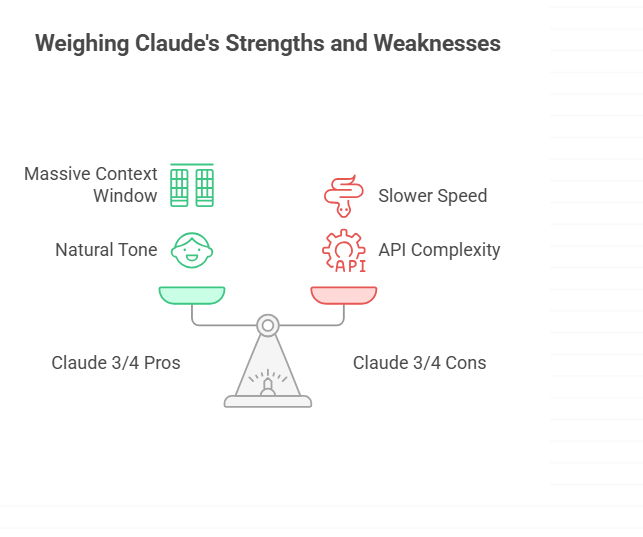
Why It Scales Revenue: The massive context window (up to 200,000+ tokens) means Claude can ingest all of your company documentation—past marketing campaigns, P&L statements, customer feedback reports—and draft cohesive, cross-referenced strategic documents. No junior consultant could hold that much data in their head.
| Pros | Cons | Pricing | Best For |
| Context Window: Handles entire books or complex legal drafts in a single prompt. | Speed: Can sometimes feel slower than GPT-4 when churning short replies. | Pro Tier: $20/month. | High-Value Documentation: Drafting detailed investment decks, internal policies, and authoritative technical guides. |
| Tone: Often produces more natural, less robotic text than competitors. | API Complexity: Integrating it into custom tools requires slightly more technical finesse. | ||
| Reasoning: Superior performance on complex, logical reasoning tasks and mathematical analysis. |
3. Notion AI: Internal Knowledge Management (The Scalable SOP Engine)
Every successful business operates on Standard Operating Procedures (SOPs). Most small businesses manage their knowledge like a digital junk drawer. Notion AI integrates deeply with your existing workspace—the very place your team documents everything.
Why It Scales Revenue: This is the ultimate tool for reducing training time and preventing knowledge silos. When a founder wants to delegate a complex task, Notion AI instantly turns bullet points into a formatted, step-by-step SOP. Need to summarize six months of client meeting notes? Done. This is the bedrock of AI automation for small businesses—the infrastructure that makes delegation possible.
| Pros | Cons | Pricing | Best For |
| Deep Integration: Works natively within your workspace, removing copy/paste friction. | Cost Per User: Can get expensive quickly if you have a large internal team. | Plus AI Add-on: $10/user/month. | Knowledge Transfer: Codifying and scaling internal processes (SOPs, company wikis, onboarding guides). |
| Template Generation: Instantly creates databases, project plans, and meeting agendas. | General Tasks: Its generative text is less sophisticated than dedicated LLMs. | ||
| Contextual Summarization: Summarizes long documentation relevant to the current page. |
II. Scaling Revenue: Automated Sales & Marketing Machines
A million-dollar business needs an engine that converts cold leads into cash while you sleep. These tools aren’t just for marketing; they are for revenue—automating the high-friction points in the sales funnel and scaling content production.
4. Attio: The Relationship-Centric CRM Reinvented
Traditional CRMs are clunky databases; Attio is a relationship operating system powered by AI. It moves beyond manually logging every detail. It automatically aggregates context from emails, calls, and internal notes to give you a true, dynamic relationship score.
Why It Scales Revenue: Attio allows a solopreneur to manage an enterprise-level pipeline. It alerts you when a key prospect hasn’t been contacted in 30 days or identifies dormant clients ready for an upsell. This level of automated relationship management used to require a dedicated Sales Development Rep (SDR). Attio allows the founder to maintain high-touch relationships at low-touch cost.
| Pros | Cons | Pricing | Best For |
| Data Aggregation: Automatically pulls key data from Gmail/Outlook/Slack interactions. | Steep Learning Curve: Takes a few weeks to fully customize the pipeline views. | Starts at $25/user/month (for scaling). | High-Value B2B Sales: Founders managing complex sales cycles and needing deep customer relationship intelligence. |
| Flexible Structure: Unlike rigid CRMs, you design the data structure that matters to your business. | Mobile App: Still catching up to desktop functionality. | ||
| Automated Insights: Proactive alerts on relationship health and next best actions. |
5. Fathom: The Meeting Intelligence Officer
If your business involves sales calls, client consultations, or deep technical interviews, Fathom is non-negotiable. It joins your calls (Zoom, Meet) and instantly provides full transcripts, highlights key moments (pricing mentions, pain points, next steps), and pushes summaries directly into your CRM.
Why It Scales Revenue: The time saved on writing follow-up notes is marginal; the real value is in the consistency and retrieval. You can search across thousands of calls to instantly identify every time a customer mentioned a specific competitor or feature request. This directly informs product roadmaps and closes sales faster because your follow-up is perfectly tailored.
| Pros | Cons | Pricing | Best For |
| Zero-Friction: Truly seamless integration; requires no extra clicks from the user. | Privacy Concern: Requires clear consent disclosure at the start of every call. | Free for individual users; Team plan for CRM integration starts at $32/user/month. | Sales and Coaching: Consulting firms, coaches, and B2B sellers who rely on high-volume discovery calls. |
| Action Items: Automatically tags and exports action items. | Accuracy: Foreign accents or poor audio quality can slightly affect transcription. | ||
| CRM Sync: Pushes the summary, video clips, and transcript right to Salesforce/HubSpot. |
6. Synthesia: Scalable Content Production (AI Video)
Video is the highest-engagement medium, but it’s expensive, time-consuming, and hard to update. Synthesia changes the calculus by letting you generate photorealistic presenter videos from plain text, complete with AI avatars that speak in dozens of languages.
Why It Scales Revenue: This is how you produce 50 instructional videos, 20 localized sales pitches, or an entire onboarding course in a single afternoon. AI tools to scale a business must decouple effort from output. Synthesia scales the face of your brand without requiring studio time, making it ideal for information products and international market penetration.
| Pros | Cons | Pricing | Best For |
| Speed & Consistency: Instant updates to scripts; uniform brand appearance. | The Uncanny Valley: While better than ever, the avatars still lack subtle human gestures. | Corporate plans start around $1,000/year for unlimited video creation. | E-learning & Training: Creating massive libraries of high-quality, easily updateable video content or localized marketing. |
| Localization: Translate videos into numerous languages instantly. | No Custom Avatars on Entry: Creating a clone of your face is pricey and locked behind enterprise tiers. | ||
| Cost Reduction: Eliminates hiring actors, studio fees, and editing time. |
7. Jasper/Rytr: High-Velocity Copywriting
If you’re still staring at a blank screen trying to write compelling ad copy or product descriptions, you’ve failed the first test of using AI tools for startups. Tools like Jasper or Rytr specialize not just in generating text, but in generating high volume of text optimized for specific conversion goals.
Why It Scales Revenue: The goal here is iteration speed. A junior copywriter might give you three variations of a headline; Jasper gives you thirty optimized for different emotional triggers in 60 seconds. This allows you to run A/B tests daily across your email, landing pages, and social media, constantly feeding the marketing machine with new ammunition.
| Pros | Cons | Pricing | Best For |
| Templates: Specific models tailored for Facebook Ads, AIDA framework, or product features. | SEO Quality: Requires a skilled editor to refine output for long-form content. | Jasper: Creator plan starts at $49/month. Rytr: Unlimited plan is $29/month. | Conversion Rate Optimization (CRO): Generating high-volume, short-form copy for digital advertising and landing page testing. |
| Brand Voice: Can be trained on your existing content to mimic your company’s tone. | Fluff Warning: Without very tight prompts, the output can be generic. | ||
| Integration: Works well with CMS and SEO tools (like SurferSEO). |
III. The Solopreneur Multiplier: Passive Income & Automation
The difference between a job and a business is whether revenue continues when you walk away. This section covers AI tools for solopreneurs and AI tools for passive income—the true automation backbone that allows the business to run itself.
8. Lindy.ai: Your Digital Chief of Staff
Lindy is not a chatbot; it’s an AI agent designed to execute multi-step tasks across different applications. You don’t prompt it for content; you prompt it for action. “Find the best flight to London, coordinate a meeting time with John using Calendly, and draft the preliminary agenda based on our last email thread.”
Why It Scales Revenue: This is the tool that replaces your expensive Executive Assistant. In my experience testing these tools, this category of agentic AI is the future. It operates by breaking down a complex request into sub-tasks and interfacing with your tools (Gmail, Slack, CRM) autonomously. This allows the founder to instantly delegate the messy, connective tissue of business operations.
| Pros | Cons | Pricing | Best For |
| Agentic: Executes complex tasks by itself across multiple platforms. | Setup: Requires significant time investment to correctly connect all third-party services. | Starts at $150/month for advanced executive tasks. | Delegation: High-earning solopreneurs who need an autonomous assistant handling scheduling, research, and communication logistics. |
| Customized Skills: You can train Lindy to handle your unique business workflows. | Error Rate: Still subject to occasional “hallucinations” in complex tasks; requires oversight. | ||
| Context Awareness: Retains context across hours or days of conversation and tasks. |
9. Zapier/n8n (The Automation Backbone)
While not strictly AI, these tools are the pipes that make AI truly powerful. Zapier (the mainstream, SaaS-based tool) and n8n (the open-source, powerful alternative) connect every piece of software you use. They are the essential foundation for AI automation for small businesses.
Why It Scales Revenue: A million-dollar business must process data without human intervention.
- Example 1: A new sale in Stripe triggers an action in Zapier, which sends the customer data to Claude for a personalized welcome email, and then adds the customer to a Fathom-monitored onboarding call series.
- Example 2: An incoming support ticket (Zendesk) is analyzed by an LLM via n8n, tagged for urgency, and automatically drafts a first response based on your Notion SOP.
| Pros | Cons | Pricing | Best For |
| Connectivity: Links virtually any two web services. | Over-reliance: Break one “Zap” or “Workflow,” and an entire system can collapse. | Zapier: Professional plans start at $69/month. n8n: Self-hosted is free; cloud starts at $50/month. | Systems Thinkers: Creating complex, multi-step, fully autonomous workflows that handle onboarding, sales routing, and reporting. |
| Low Code: Building complex logic requires minimal engineering background. | Maintenance: The more complex the flow, the harder it is to debug. | ||
| Triggers: The ability to initiate AI actions based on real-world events (e.g., a payment received). |
10. Lovable (No-Code App Builder)
The fastest way to $1M in recurring revenue is selling a product, not a service. Lovable and similar next-generation no-code platforms (like Vercel and Bubble) are integrating LLMs to help founders build actual, monetizable software.
Why It Scales Revenue: Instead of spending $50,000 and six months on a minimum viable product (MVP), you can describe the software you want (“a tool that lets coaches track client progress with a daily mood survey and generates a weekly PDF summary”) and the AI will scaffold the core application. This drastically cuts the time and cost to market for a truly scalable digital product.
| Pros | Cons | Pricing | Best For |
| Rapid Prototyping: Go from idea to functional app in days, not months. | Technical Debt: Scaling beyond a few hundred users still demands engineering cleanup. | Free tier available; paid scaling plans start around $29/month. | Product-Focused Entrepreneurs: Solopreneurs building SaaS products, membership sites, or mobile apps for their niche audience. |
| AI-Assisted Scaffolding: Models help write the initial database schemas and UI logic. | Integration Limits: You are locked into the platform’s ecosystem. | ||
| Focus on Outcome: Moves you away from code and toward feature delivery. |
11. DALL-E 4 / Midjourney (The Asset Factory)
If you are generating income through digital assets—e.g., e-books, print-on-demand designs, unique stock photo libraries, NFTs, or highly stylized marketing visuals—these tools are your industrial factory.
Why It Scales Revenue: The goal is high-volume, high-quality, unique assets on demand. No longer do you pay a designer $50 for a book cover or $15 for a stock image. You generate 50 unique, on-brand designs in minutes. This is critical for AI tools for passive income models where the input cost must be near zero to ensure maximum margin.
| Pros | Cons | Pricing | Best For |
| Quality & Speed: Generates production-ready, ultra-high-resolution imagery almost instantly. | Prompting is Key: Garbage in, garbage out. Mastering the prompt is a job unto itself. | Midjourney: Starts at $10/month. DALL-E 4 (via OpenAI API): Pay-per-use, generally low cost. | Asset Creators: Generating unique book covers, merchandise designs, social media art, and website visuals. |
| Consistency: Can maintain character and style across a campaign. | Intellectual Property (IP): The legal status of AI-generated work is still in flux. | ||
| Iterative Design: Test 100 design variations before settling on the winner. |
IV. Engineering the Edge: Finance & Custom Operations
The leap from $500,000 to $1,000,000 is not a revenue problem; it’s an efficiency problem. That last half-million in profit requires ruthless optimization of cost, compliance, and internal friction. These tools help AI tools for business growth by shoring up the back-office.
12. Causal: Financial Modeling and Forecasting
Stop using spreadsheets held together by sheer willpower and fragile formulas. Causal is a financial modeling platform that uses AI to ingest historical data and build dynamic forecasts, scenario plans, and investor reports.
Why It Scales Revenue: The difference between guessing and knowing your burn rate, cash flow, and key drivers is the difference between solvency and disaster. Causal lets you instantly model: “What if we hire two sales reps and raise prices by 10%?” or “How does a 3% customer churn reduction affect next year’s valuation?” This turns uncertainty into actionable foresight, which is the definition of best AI tools for entrepreneurs in the high six-figure bracket.
| Pros | Cons | Pricing | Best For |
| Scenario Planning: Instantly compare dozens of financial what-if scenarios. | Initial Setup: Requires correct mapping of historical financial data (API connections). | Starts at $200/month for serious SMB features. | Data-Driven Strategy: Founders and CFOs who need accurate, defensible financial forecasts for investors or internal planning. |
| API Integration: Connects directly to QuickBooks, Stripe, and other financial tools. | Complexity: The platform is powerful but assumes some fundamental finance knowledge. | ||
| Visualization: Produces clear, professional charts and reports instantly. |
13. GitHub Copilot / Cursor: Building Custom Internal Tools
You don’t need to be a programmer to write code anymore. Copilot and specialized AI coding assistants like Cursor act as a pair programmer, auto-completing code and writing entire functions based on plain English comments.
Why It Scales Revenue: There will always be a task just outside the capability of your SaaS stack—a custom data script, a small internal dashboard, or an integration between two niche tools. Instead of hiring an expensive developer for a few days of work, you can ask Copilot to “write a Python script that takes data from the exported CSV and checks the formatting.” This instantly reduces dependency on external development resources, saving thousands per month.
| Pros | Cons | Pricing | Best For |
| Speed: Drastically accelerates the development of simple utilities and scripts. | Security/Debugging: AI-written code still needs testing and security review. | $10/user/month (Copilot Business). | Founders with a Technical Lean: Building custom internal scripts, micro-apps, or connecting niche APIs that off-the-shelf tools can’t handle. |
| Lowers Barrier: Allows non-engineers to prototype real software. | Dependency: You still need to understand what the code is doing. | ||
| Context-Aware: Reads the surrounding code to suggest the next logical step. |
14. Pilot.com AI: Automated Bookkeeping and Compliance
Few things scale worse than bookkeeping. As transactions multiply, so does the risk of error and the cost of human accounting. Pilot is a modern bookkeeping firm powered by AI.
Why It Scales Revenue: Pilot uses machine learning to categorize transactions, reconcile accounts, and produce investor-ready financial statements with minimal human touch. By automating the compliance and reconciliation loop, you get real-time financial clarity, allowing you to focus on growth initiatives rather than chasing misplaced receipts. Time saved not dealing with compliance is time spent closing deals.
| Pros | Cons | Pricing | Best For |
| Accuracy: High automation reduces human error in expense categorization. | Cost: More expensive than cheap, self-service software, but cheaper than a dedicated full-time bookkeeper. | Custom pricing, often starting in the high hundreds per month. | High-Growth Startups: Businesses with complex revenue streams or inventory that need reliable, investor-grade financial reporting. |
| Tax Prep Ready: Seamlessly produces everything needed for tax filings. | Less Flexible: Not the best fit for highly non-standard, cash-only businesses. | ||
| Real-time Reporting: Financial dashboards are updated daily, not monthly. |
15. Gamma: Presentation Design Automation
You’re a founder, not a graphic designer. Yet, you waste hours fiddling with slide alignment when you should be perfecting your pitch. Gamma uses generative AI to design and format clean, professional presentations, decks, and documents instantly.
Why It Scales Revenue: A crisp, on-brand presentation is essential for landing investors, closing a high-value client, or training a new hire. You feed Gamma a document (or even a single prompt), and it designs the layout, selects the images, and organizes the flow. I noticed that this tool significantly cuts the time-to-pitch cycle. No more death-by-PowerPoint.
| Pros | Cons | Pricing | Best For |
| Instant Formatting: Automatically designs slides based on content structure. | Design Constraints: Doesn’t allow the same granular control as dedicated design tools. | Free tier available; Pro plan starts at $15/month. | Pitching & Authority: Founders who frequently need to create sales presentations, investor decks, or internal training materials rapidly. |
| Visual Appeal: Produces modern, clean designs that are highly engaging. | Long-Form Text: Works best when text is concise and structured (bullet points). | ||
| Interactive: Output is in a web format, perfect for sharing and tracking engagement. |
Editor’s Analysis: The Future of the $1M Solo Empire
The trend of building a million-dollar business with a skeletal team isn’t a fantasy; it’s a certainty. The next three years won’t be about new AI tools, but about the seamless convergence of the ones already available.
We are quickly moving past the single-task era—the chatbot that writes an email—and into the agentic workflow era where software manages itself.
The biggest mistake I see serious entrepreneurs making today is clinging to the false economy of free tools. They run their complex research on a limited-context free LLM and then outsource the crucial copywriting task to a $5 gig worker. That inefficiency is a tax on growth.
To succeed in 2025, you must treat your AI stack like your highest-paid, most mission-critical employee. You wouldn’t hire an assistant for a million-dollar role and then limit them to a free Hotmail account and a five-minute lunch break. Don’t do it to your tools. Pay the $20/month for the Pro subscription. It’s the single highest ROI investment you can make.
The human editor’s job in the next decade will be providing the inputs, the critical judgment, and the ethical guardrails, while the AI executes the labor. If you’re not prepared to manage a fleet of autonomous software agents, you will simply be out-scaled by those who are.
FAQ: People Also Ask About AI and Scaling
Q: Can a single person truly run a million-dollar business using only AI?
Yes, but the definition has shifted. A single person (the founder) remains the Chief Strategist, the brand voice, and the quality control. The “team” is now the AI automation for small businesses stack (e.g., Lindy, Zapier, Pilot). Your human effort is focused entirely on high-leverage activities: closing key deals, high-level product strategy, and creative direction. The goal is to reach $1M in revenue with 90% gross margin, which is highly achievable with this kind of technology stack.
Q: Which AI tool is the best for entrepreneurs focused on generating leads?
The best tool isn’t a single platform; it’s the pipeline. Fathom or another meeting intelligence tool is the crucial input, as it gives you perfect data on what leads actually care about. You then feed those insights into a copywriting tool like Jasper to generate high-converting ad copy, and finally, into a relationship CRM like Attio to automate outreach. You need the full loop.
Q: Are these AI tools for startups a security risk?
Any tool that handles proprietary data is a risk. For AI tools for startups dealing with sensitive customer information, compliance is paramount. Always use the Enterprise/Pro versions of tools like Claude or Notion AI. These tiers offer better security, often including encryption, data isolation, and compliance certifications (SOC 2, HIPAA). Never feed unsecured customer data into a free, consumer-grade large language model.
The software is here. The infrastructure is cheap. The only thing preventing you from building a million-dollar business this year is your willingness to shift from doing the work to deploying the system. Stop confusing motion with progress.
Start building your autonomous empire today. The market won’t wait.
