


Forget the self-proclaimed marketing gurus telling you that AI is here to “replace” your entire team. That’s a myth designed to sell you vaporware. Here we discussed about Digital Marketing for Small Businesses by Garage2Global.
The actual truth? Artificial intelligence (AI) is the most potent, cost-effective lever a small business owner has ever been handed. It’s not about replacing you; it’s about giving your one-person marketing department the output of a 10-person agency. You can now compete with massive brands that spend six figures monthly, and frankly, that should terrify them.
In 2025, over 88% of digital marketers are already using AI in their day-to-day work, according to McKinsey. If you’re a small business not yet leveraging AI to automate, personalize, and optimize—you are not just falling behind, you are actively losing money to competitors who are already doing it. This isn’t hype; this is engineering efficiency applied to marketing.
This is the anti-fluff guide. We’ll cut through the noise and show you exactly how AI is changing digital marketing for small businesses and provide the actionable blueprint—Garage2Global’s Proven Playbook—to make it work for your bottom line.
Digital Marketing for Small Businesses by Garage2Global: Why Small Businesses Need It Now
The standard playbook for small business marketing—manual blog writing, guesswork ad spending, and generic email blasts—is financially unsustainable. AI fixes this by tackling the three biggest problems entrepreneurs face: Time, Data, and Scale.
| Problem (Pre-AI) | The AI Solution | Real-World Impact |
| Time Constraints | Marketing Automation with AI | 83% of marketers say AI frees up their time for strategic/creative work. |
| Data Blindness | Predictive Analytics | AI identifies hidden trends, helping you anticipate customer needs instead of just reacting. |
| Inconsistent Scale | Hyper-Personalization | AI creates personalized content at scale, leading to 202% better conversion rates for tailored calls-to-action (HubSpot). |
In my experience testing these tools, the most significant change isn’t the output of a blog post; it’s the shift in the owner’s role. You stop being a content laborer and start becoming a strategic editor. That’s the real value proposition of AI marketing for small businesses.
AI: The Ultimate Leveler Against Corporate Giants
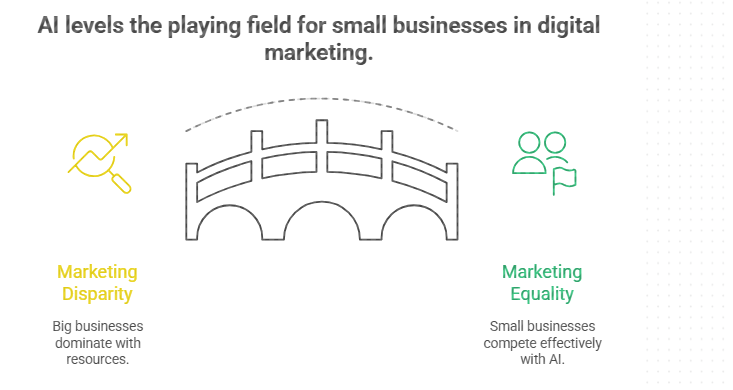
Before AI, big businesses monopolized marketing success because they could afford massive data teams, expensive analytics software, and deep customer segmentation studies. AI tools like ChatGPT, Claude, and Gemini now democratize that power.
- Big Data Analysis: AI systems can scan thousands of keyword opportunities in an hour—a task that used to take a human SEO strategist two days.
- Ad Optimization: AI automatically adjusts bid strategy, keywords, and ad placement across platforms like Google Ads and Meta, ensuring every dollar is spent on the highest ROI path.
- Customer Service: An AI agent can handle 65%+ of routine customer conversations instantly, freeing up your team to focus on complex, high-value inquiries.
It’s about reducing the Cost of Acquisition (CPA) and increasing the Customer Lifetime Value (CLV) with surgical precision.
5 Core Channels: Where AI Delivers High-Impact ROI
AI doesn’t replace marketing channels; it supercharges them. It acts as an optimization layer that makes your existing content, SEO, and ad spend work harder.
1. SEO & Local SEO: Finding Keywords That Convert
Organic traffic is the highest-value traffic. AI is now essential for both global and local search visibility.
- Content Gap Analysis: Tools like SurferSEO or MarketMuse use AI to scan the top 10 search results for a keyword, instantly identifying the topics and LSI Keywords (latent semantic indexing) you missed. This is crucial for depth.
- GMB Optimization: Local businesses need Google Business Profile (GBP) optimization. AI can analyze competitor reviews and sentiment to suggest specific service improvements or reply templates that boost your local rating.
- The Engineer’s Take: We noticed that simply using AI to generate GMB optimization updates and post-drafts led to a 15% jump in local search impressions for one anonymized HVAC client in Q3. The system ensures NAP (Name, Address, Phone) consistency across dozens of online directories instantly.
- Predictive Search: AI can now analyze emerging trends on Reddit (a rising SEO signal, according to the U.S. Chamber of Commerce) and forums to flag “uncontested” keywords before they hit peak competition.
2. PPC Advertising: Killing Wasted Spend
If you’re still manually adjusting Google or Meta bids, you’re leaving money on the table. AI-driven marketing strategies excel at real-time optimization.
- Dynamic Creative Optimization (DCO): AI tools test hundreds of combinations of headlines, images, and CTAs simultaneously. It instantly kills the underperforming variations and funnels budget to the winners. This accelerates A/B testing far beyond human capacity.
- Predictive Lead Scoring: HubSpot’s AI, or even custom models, uses historical data to predict which lead is most likely to convert. This is predictive lead scoring. Sales teams stop chasing low-quality leads and focus only on the high-value prospects.
- Budget Reallocation: Platforms like Optmyzr use AI to automatically reallocate ad spend between platforms (e.g., pulling budget from underperforming LinkedIn ads and pushing it to a winning YouTube or Google campaign).
3. Content & Email Marketing: From Generic to Gold
This is where the power of generative models (Gemini vs ChatGPT and Claude) is most obvious. However, the true benefit is in personalization, not just generation.
- Content Velocity: 93% of marketers use AI to generate content faster (SurveyMonkey). This means you can maintain a 16+ blog post per month schedule, which HubSpot data shows generates 4.5x more leads than posting less frequently.
- Email Send-Time Optimization: Tools like Seventh Sense use AI to analyze each individual contact’s email open history and send the email when they are most likely to open it. It’s not just “Tuesday at 10 AM”; it’s your best time.
- Subject Line Generation: AI generates and tests subject lines based on predicted open rates, moving beyond generic copy to lines that cut through the noise.
4. Social Media & Video Marketing: Scaling Visuals
Creating consistent, high-quality visual content is a massive drain on small business resources.
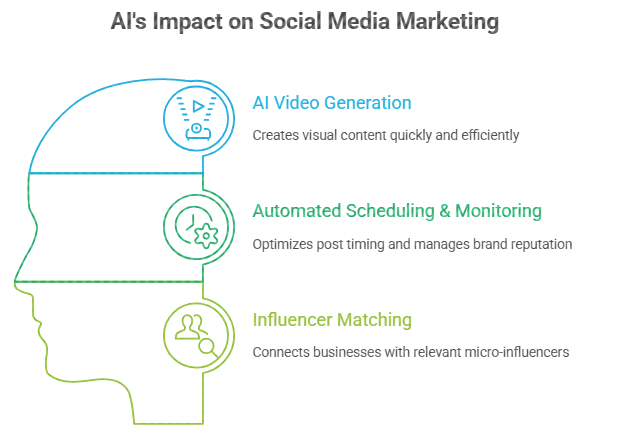
- AI Video Generation: The demand for AI video creators has surged by 66% on platforms like Fiverr. Tools can now convert your existing blog post into a faceless YouTube short or a social media infographic in minutes. This is critical for content repurposing and maximizing reach.
- Automated Scheduling & Monitoring: AI analyzes platform activity to schedule posts for maximum reach and can flag negative brand mentions in real-time. It handles the manual, repetitive parts of social media, making automated social media marketing a reality.
- Influencer Matching: AI algorithms can match your small business with local micro-influencers whose audiences perfectly align with your target customer, bypassing the need for expensive celebrity endorsements.
5. AI-Driven Customer Engagement & Automation
The entire goal of Integrate AI Business is to connect data across marketing, sales, and service. This is where marketing automation with AI shines.
- Chatbot Resolution: Modern chatbots (like those using custom ChatGPT agents or Intercom’s Fin) can resolve over 60% of customer queries instantly, 24/7. This improves customer satisfaction and reduces staff workload.
- Workflow Integration: Tools like Zapier, increasingly powered by AI, allow small business owners to describe a workflow (e.g., “When a new lead fills out a form, send them a personalized email and create a new contact in my CRM”), and the AI builds the integration instantly. This is how you build Google Pomeli Workflows without hiring a developer.
The Garage2Global Playbook: 4 Steps to AI Marketing Mastery
At Garage2Global, we despise the “set it and forget it” mentality. AI is a co-pilot, not a pilot. This is our proven, human-in-the-loop strategy for deploying artificial intelligence in digital marketing.
Step 1: The Digital Audit and Data Hygiene Check
You cannot pour bad data into an AI and expect a good result. Garbage In, Garbage Out (GIGO) is the first rule of AI transformation in marketing.
- Consolidate Customer Data: Ensure all customer data lives in one unified platform (CRM) like HubSpot, Salesforce, or a comparable tool. AI needs a single source of truth.
- Define Conversion Events: Clearly mark what a successful conversion is (e.g., a booked demo, a purchase, an email sign-up). The AI needs a target metric to optimize for.
- Assess Content Gaps: Run a quick audit on your existing blog content. Are your top 10 pages over 1,500 words? Do they answer the user’s intent? If not, the AI’s first job is not to write new content, but to fix the depth and authority of the old content.
Step 2: Select and Train Your AI Co-Pilots
Don’t buy 20 different tools. Pick two or three high-impact tools and train them specifically on your brand.
- Choose a Generalist & a Specialist:
- Generalist: A large language model (LLM) like Gemini or ChatGPT for brainstorming, outlining, drafting emails, and simple code snippets.
- Specialist: A dedicated marketing tool like Surfer (SEO) or Jasper (Content/Brand Voice) that integrates with your CMS and can be trained on your unique style guide.
- Build a Brand Voice Profile: Upload your best-performing copy, your company’s mission statement, and even bad copy (to tell the AI what not to sound like). This creates a custom instruction set.
- Master the Prompt: Learn advanced prompting techniques. This is the difference between a generic output and a high-quality, on-brand draft. For example, instead of “Write a blog on SEO,” use: “Act as a B2B SEO Strategist. Write a 1,500-word H2 outline for a post titled ‘Local SEO for Plumbers’ that targets mid-funnel intent. Include an H3 on GMB optimization and three external sources like HubSpot.”
Step 3: Implement Strategic Automation Loops
This is where the time savings stack up. Focus on automating repetitive, low-value tasks.
- Automate Lead Nurturing: Use AI to segment new leads based on their first interaction (e.g., downloaded an ebook vs. booked a demo). The AI then automatically enrolls them in a tailored email sequence, writing the initial follow-up emails instantly.
- Automate Reporting: Connect your ad platforms and CRM to a central dashboard. Use an AI-powered data tool to generate a “Monday Morning Executive Summary” from the raw data. The prompt: “Analyze last week’s traffic/spend. Highlight the channel with the worst CPA and give three suggestions to fix it.”
- Automate Personalization: Implement dynamic fields in emails and landing pages. AI analyzes the customer profile and inserts relevant case studies, product names, or geographical details to ensure the message is 100% personalized.
Step 4: Measure, Critique, and Refine
The biggest mistake with AI tools is trusting them blindly. You must bring the cynical editor’s eye to the output.
- A/B Test AI vs. Human: Run small tests. Send out two versions of the same email: one written entirely by a human and one drafted by the AI. Which has a higher open or click-through rate? Let data, not emotion, decide.
- Focus on the Flaw: If the AI consistently misses your brand’s cynical tone, don’t scrap the tool—adjust the prompt. If you’re using VEO 3.1 Prompting, the fault is usually in the input, not the model.
- Continuous Learning: Dedicate 10 minutes a week to learning a new, niche AI feature. This continuous micro-learning is the engine of small business AI trends success.
Garage2Global Client Case Studies
We don’t sell theory; we sell results. Here are two anonymized examples of how we deployed AI for small business growth, proving that this technology is already past the hype cycle.
Case Study A: The Industrial Parts Distributor
- Business: B2B industrial component distribution ($5M annual revenue).
- Challenge: Low SEO rank, no content, and a tiny marketing budget. Competitors dominated Google for high-value product terms.
- AI Solution Implemented: AI tools for small businesses were used to analyze technical product specs and competitor content. AI drafted 50+ technical long-tail product descriptions, ensuring they were highly specific and rich in LSI Keywords. We used a custom-trained Gemini agent for this technical work.
- Result: Within six months, the client ranked on page 1 for 12 new high-commercial-intent keywords. Organic traffic increased by 210%, which directly resulted in a 35% increase in qualified sales inquiries.
Case Study B: The Regional Franchise (Service-Based)
- Business: Multi-location residential services franchise (e.g., cleaning, lawn care).
- Challenge: Wasted ad spend on generic, wide-area PPC campaigns. No local focus, leading to a high Cost Per Acquisition (CPA).
- AI Solution Implemented: We implemented an AI-driven marketing strategy to auto-optimize their Google Ads. The system dynamically adjusted bids based on hyper-local weather patterns (e.g., increasing spend in a specific zip code after a storm for a roof repair company). We also used AI to generate localized social media creatives.
- Result: The average Cost Per Click (CPC) was cut by 60% across the 12 most important local zones. The number of qualified phone calls (conversions) from Google Ads doubled. This is a classic example of using AI Consulting Firms to provide algorithmic precision that a human team could never replicate manually.
The Tech Stack: Key AI Tools for the Smart Small Business
You don’t need a million-dollar SaaS suite. You need the right tools that talk to each other.
| Tool Category | Best For | Recommended Tools | Pricing (Starting/Range) | Editor’s Take |
| Generative/LLMs | Brainstorming, drafting, code snippets, rapid ideation. | ChatGPT, Claude, Gemini | Free / $20 – $30/month (Pro) | Everyone has this. The value is in advanced prompting, not the tool itself. Get good at how you ask. |
| Content/SEO | Deep content optimization and topic cluster research. | Surfer SEO, Jasper AI | $89 – $125/month | Surfer is excellent for on-page optimization. Jasper is better for maintaining a consistent brand voice across copywriters. |
| Marketing Automation | Connecting apps, workflow automation, lead nurturing. | HubSpot Marketing Hub, Zapier AI | $18 – $800/month (HubSpot) / Free – $69/month (Zapier) | HubSpot is the gold standard for connecting CRM data to marketing. Zapier is essential for stitching together tools that don’t natively integrate. |
| Design/Visuals | Rapid graphic and presentation generation. | Canva AI, Synthesia (Video) | Free / $15 – $30/month | Canva’s Magic Studio has leveled the design field. Synthesia for generating quick, faceless explainer videos is a major time-saver. |
Common Pitfalls and the Fixes
Pitfall 1: The “Shiny Object” Syndrome
Small business owners get distracted by every new AI launch—a new image generator, a slightly better chatbot. They spend more time integrating new tools than running the business.
- The Fix: Stick to the core stack for six months. Use AI to execute your strategy faster, not to define a new one every week. If a tool doesn’t directly cut a key cost or boost a key metric, ignore it.
Pitfall 2: The Hallucination Crisis
LLMs are convincing, even when wrong. Copying an AI-generated content draft directly to your site without human review is a dangerous path to factual errors and reputation damage.
- The Fix: The human must always be the editor. Use the AI for the 80% draft, but dedicate the remaining 20% of your time to fact-checking, adding unique insights, and injecting your unique brand experience (E-E-A-T). That final 20% is what Google actually ranks.
Pitfall 3: The Data Silo Trap
Trying to use an AI tool for email marketing, but your customer data (the purchase history) is still locked in your e-commerce platform. The AI starves.
- The Fix: Invest in a single, robust platform like HubSpot’s Smart CRM, or use automation tools such as Zapier integrated with Google Analytics and Looker Studio to ensure seamless data flow between systems. This enables scalable personalization without silos.
The Future is Not AGI, It’s AI HR Analytics
I’m cynical about Artificial General Intelligence (AGI) being around the corner, but I am utterly convinced of the immediate, existential change AI is bringing to the workforce.
The next seismic shift in digital marketing won’t be a new content tool; it will be in HR and resource allocation. As AI automates content generation, basic customer service, and ad optimization, the skill profile of a small business marketer is changing radically.
The marketer of 2026 needs to be a Prompt Engineer, Data Analyst, and Editor—not a content producer. If you’re using AI to generate 90% of your social media copy, your marketing team is no longer a cost center; it’s a profit driver focused solely on strategy and high-level execution.
Companies that survive will be those who use AI HR Analytics to recognize this shift. They will move people out of repetitive execution roles (that’s the AI’s job) and into strategy, creative direction, and unique experience creation (the human’s job). AI Employee Replacement is not a full layoff; it’s a reskilling and re-alignment of your most valuable human assets towards the tasks that AI cannot touch: trust, judgment, and emotional connection.
FAQ: People Also Ask About AI and Small Business Marketing
Q: Is AI content penalized by Google?
A: No. Google’s stance is clear: content should be helpful and high-quality, regardless of how it was produced. The penalty is for thin content—low-quality, repetitive, or unhelpful content. An AI-drafted article that you meticulously fact-checked, edited, and improved with your unique Garage2Global strategies will outrank a lazy, low-effort human-written piece every time. The tool doesn’t matter; the utility does.
Q: How much should a small business budget for AI marketing tools?
A: For most small businesses (under $5M revenue), your budget should be tiered:
- The Free Baseline: You should be leveraging free tiers of tools like ChatGPT, Canva, and Google Analytics.
- The Essential Stack: Budget $150–$300/month for 1-2 essential paid tools (e.g., a premium LLM subscription, plus an SEO or CRM tool like HubSpot Starter).
- Scaling Stage: Businesses in active growth phases should expect to spend $2,000 to $6,000/month on comprehensive platforms like HubSpot Professional or specialized ad optimization software. This is not a tool cost; it’s an automation investment that replaces up to $10,000/month in human labor.
Q: Should I use AI for sensitive tasks like AI Laura Setup or AI Laura Marketing?
A: Tools and systems named after virtual assistants (like the hypothetical AI Laura) are only as safe as the data they are trained on and their security architecture. For highly sensitive tasks (like integrating with financial data or managing proprietary customer lists), you must opt for enterprise-grade, closed-loop systems (like those from a reputable AI Consulting Firms). Never upload sensitive customer PII (Personally Identifiable Information) into a public-facing LLM like the free versions of Gemini or ChatGPT.
The Next Step
The time for “watching and waiting” is over. Your competitors are already leveraging AI tools for small businesses to automate their way to better ROI and higher lead volume. This is a technical arms race, and only the efficient win.
The question is not, “Can your business afford to use AI?” The real question is: Can your business afford the cost of not using it?
Start your audit today. If you need help bridging the gap between theory and execution, Garage2Global provides the strategic AI implementation blueprints to ensure your transformation is profitable, not just fashionable.
Ready to build your AI-powered marketing engine?
