


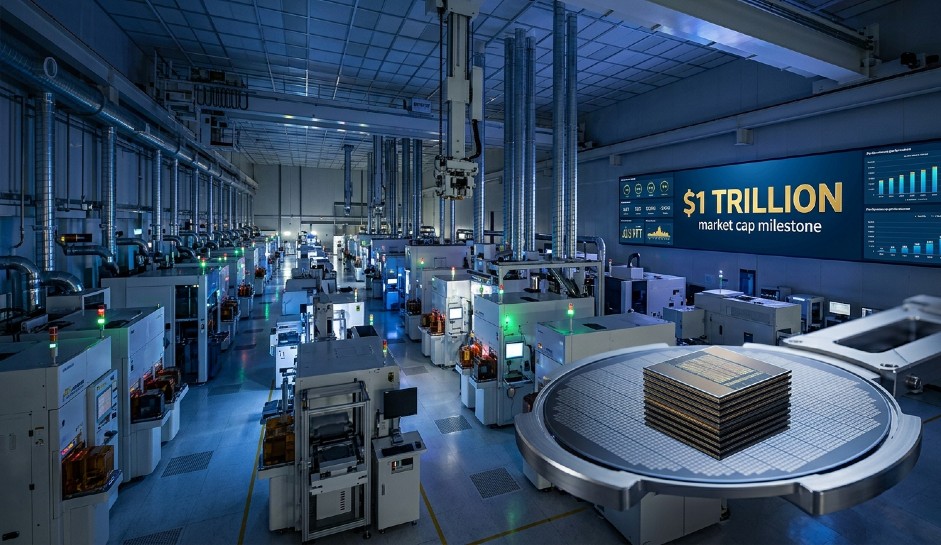
On May 27, 2026, SK Hynix did something that looked impossible just 16 months ago — its market cap crossed $1 trillion. The stock jumped 9.2% in a single session, capping a run that’s seen shares gain over 250% year-to-date and more than 470% over the past two years combined. This isn’t a bubble story or a sentiment trade. It’s a structural shift in what the global economy values most right now: memory chips that power AI. If you want to understand where this is going, what the real risks are, and what it means for investors and the broader AI infrastructure buildout, here’s the unfiltered picture.
If you’re tracking how AI infrastructure investment is reshaping the entire tech stack, the top AI infrastructure trends shaping 2026 give the essential wider context alongside this story.
| Question | Answer |
|---|---|
| What pushed SK Hynix to $1 trillion? | Insatiable demand for HBM chips from AI accelerator makers, especially Nvidia |
| Is the rally justified by fundamentals? | Yes — Q1 2026 revenue up 198% YoY, operating margin at 72%, beating even Nvidia’s 65% |
| Who are the main customers? | Nvidia (14.8% of revenue), plus a new unnamed hyperscaler at 12.4% — likely Microsoft or Google |
| What’s the primary risk? | Samsung qualifying HBM4 for Nvidia by Q4 2026, which could compress SK Hynix’s market share |
| Is there more upside? | Analysts say yes — earnings forecasts are rising faster than the share price |
| What’s next for the product line? | HBM4 ramp in late 2026, HBM4E mass production in 2027 |
Why This Milestone Is Different From Past Semiconductor Rallies
Most semiconductor cycles follow a familiar pattern: demand spikes, fabs expand, oversupply hits, prices crash, stocks fall. That’s the playbook from 2018, from 2022. This time the dynamics are genuinely different, and conflating the two is the most expensive mistake an analyst or investor can make right now.
The core difference is supply-side physics. Building a new wafer fab takes four to five years from groundbreaking to volume production. SK Hynix’s capacity is completely sold out — every DRAM, NAND, and HBM unit through 2026 is pre-committed. Goldman Sachs raised its DRAM supply-demand gap forecast in April to 4.9%, calling it the tightest imbalance in 15 years. There simply isn’t new capacity coming online fast enough to close that gap in the near term.
On top of that, HBM isn’t a commodity product that any fab can spin up. It requires advanced 3D stacking, through-silicon via technology, and thermal management expertise that only SK Hynix and, to a lesser degree, Micron have mastered at scale. Samsung is still trying to get its HBM4 validated by Nvidia. That qualification gap is where SK Hynix’s valuation premium lives.
Three memory chipmakers — SK Hynix, Samsung, and Micron — all crossed $1 trillion within weeks of each other in May 2026. That’s not coincidence. It’s the market collectively repricing memory from a cyclical commodity to strategic AI infrastructure.
The HBM Dominance Story: By the Numbers
SK Hynix controls roughly 62% of global HBM shipments as of Q2 2025, with a 57% revenue share by Q3. That lead didn’t happen by accident. The company bet heavily on HBM when others were hedging, and it’s now the sole volume supplier of HBM3E — the fifth-generation chip — to Nvidia’s AI accelerators.
Here’s what the Q1 2026 numbers actually look like:
Revenue: 52.58 trillion won (~$35 billion) — up 198% year-over-year Operating profit: 37.61 trillion won — up 405% year-over-year Operating margin: 72% — higher than Nvidia’s 65%, a jaw-dropping figure for a chip manufacturer HBM revenue from Nvidia alone: ~$5.2 billion in the quarter, up 62.6% year-over-year New unnamed hyperscaler customer: ~$4.4 billion, marking the first time any client other than Nvidia exceeded 10% of revenue
That unnamed client is significant. The market has been watching SK Hynix’s Nvidia dependency as a concentration risk. The emergence of a second $4+ billion customer — almost certainly a US hyperscaler building custom AI chips — changes that risk profile materially.
HBM3E chip prices have also been supported by demand, not just supply constraints. DRAM average selling prices rose by mid-60% sequentially in Q1 2026. When both volume and price move together, the earnings math gets exponential fast.
The broader semiconductor market is heading toward $975 billion in 2026, with memory growing at 30% year-over-year. Server and data center memory alone could exceed $440 billion. SK Hynix sits at the richest part of that market.
SK Hynix AI Chip Demand: What’s Actually Driving It
The fundamental driver is simple to state but complex in its implications: every AI accelerator needs memory that can feed data to the GPU fast enough to keep it busy. Standard DRAM can’t do it. HBM stacks multiple DRAM dies vertically with through-silicon vias, achieving bandwidth that’s roughly 10x what conventional memory delivers.
Nvidia’s H100 uses HBM3. The B200 Blackwell chips use HBM3E. The forthcoming Rubin platform, due late 2026, is expected to require HBM4E with bandwidth exceeding 1.2TB/s per module. Each generational step requires more layers, tighter tolerances, and more sophisticated packaging — the exact capabilities that give SK Hynix its moat.
Demand isn’t just from Nvidia either. Google and AWS are building custom ASICs — the TPUs, Trainium chips — that also require HBM3E. Microsoft’s Maia AI chip program is scaling up. Meta’s MTIA accelerators need memory. Every major hyperscaler is either buying Nvidia GPUs with HBM or building their own chips that also need HBM. SK Hynix sells to both camps.
The massive AI infrastructure investment wave hitting $650 billion in 2026 is the demand engine that explains why SK Hynix’s order book is full through the rest of the year and why customers are reportedly reserving slots three years out.
The New Fab Buildout: What SK Hynix Is Spending and Where
Understanding the capital expenditure plan is essential to evaluating whether the current valuation makes sense. This isn’t a company coasting on existing capacity — it’s investing aggressively to maintain its lead.
Cheongju M15X Fab: The first clean room came online in May 2026. Over 20 trillion won (~$13.4 billion) is committed to this facility, which will produce both HBM3E and HBM4. Mass production from the first clean room is expected around November 2026.
Yongin Cluster Fab: Phase 1 completion was accelerated to February 2027, pulled forward from May. The Yongin project represents $14.4 billion in investment and will be the company’s most advanced facility when complete.
Cheongju P&T7 Packaging Facility: A separate $13 billion packaging mega-fab broke ground in April 2026. This handles the assembly side — the advanced 2.5D packaging that integrates HBM stacks with logic dies. It directly addresses the bottleneck that’s constrained HBM supply even when die production is adequate.
Indiana, USA: SK Hynix is building its first US packaging facility, a $3.9 billion investment that serves the domestic AI market and reduces geopolitical supply chain risk for American hyperscalers. It also fits the CHIPS Act incentive structure and positions the company for long-term US government procurement.
US ADR Listing: The company filed confidentially with the SEC in March 2026, targeting a raise of $6.7 billion to $14 billion. The funds go directly toward the Yongin fab and other capacity expansion. The listing also signals intent to become a truly global company, accessible to a broader investor base beyond Korean markets.
This level of capital commitment is only rational if you believe HBM demand is structural and sustained. SK Group Chairman Chey Tae-won has publicly predicted a global chip shortage lasting through at least 2030. Microsoft, Google, and Amazon are reportedly offering multi-year investment commitments to lock in HBM capacity — that’s not behavior you see in a cyclical market.
The Samsung Threat: Honest Assessment
Here’s where most coverage gets sloppy — either dismissing the Samsung risk entirely or using it to argue the SK Hynix rally is unsustainable. Neither is accurate.
Samsung has reported passing final qualification tests for its HBM4 chips with both Nvidia and AMD, with full-volume shipments potentially beginning as early as June 2026. If Samsung ramps HBM4 production in the second half of 2026, analysts estimate SK Hynix’s HBM market share could compress to 50-60% from its current 62%+.
That sounds bad. But consider what it actually means for SK Hynix’s financials. Even at 50% market share, in a market where total HBM revenue is projected to be hundreds of billions annually, the company remains an extraordinary cash generator. The question isn’t whether Samsung competes — it’s whether Samsung’s entry meaningfully compresses pricing or just divides a growing pie.
Right now, demand so far exceeds supply that Samsung’s HBM4 output will likely be absorbed without meaningfully relieving the supply-demand imbalance. There simply isn’t excess supply to push prices down. Goldman’s 4.9% supply gap forecast accounts for competitors’ ramp.
There are also complicating factors for Samsung. An 18-day union strike was set to begin at Samsung around May 29, 2026, which could disrupt production and shift near-term orders toward SK Hynix. Samsung has also raised foundry prices for 4nm HBM4 logic dies by 40-50%, which compresses its own margin advantage.
The real decision point is Q4 2026. If Samsung achieves mass HBM4 production and gets into Nvidia’s Vera Rubin supply chain on schedule, the valuation conversation about SK Hynix changes. If Samsung slips — whether due to yield problems, labor issues, or qualification delays — SK Hynix’s premium expands further.
The data center expansion wave across the US is relevant here too, because US-based capacity directly shapes which suppliers get preferred status in government and enterprise procurement chains.
The HBM4 and HBM4E Roadmap: What It Means for Market Position
SK Hynix announced it completed HBM4 development with a claimed 40% improvement in power efficiency and data rates of 10 Gbps. Volume production ramps once customer qualification is complete, which is on track for late 2026.
HBM4E — the next step — has samples due in the second half of 2026, with mass production targeted for 2027. The base die uses technology optimized per customer requirements; the core die adopts 1c nm process technology, SK Hynix’s latest DRAM node. Customer demand for HBM4 and HBM4E over the next three years already exceeds supply capacity. Management said that on the record in the Q1 2026 earnings call. That’s a remarkable statement: they haven’t even started volume production of HBM4 yet, and they’re already capacity-constrained.
Nvidia’s Rubin platform, expected late 2026, requires HBM4E with bandwidth over 1.2TB/s per module. Only SK Hynix and possibly Micron (which is trailing by one to two quarters) can plausibly supply that product at volume. Samsung is working toward it, but the timeline is uncertain.
In short, the product roadmap supports the current valuation. Each generation transition creates a window where SK Hynix’s yields and technical partnership depth with Nvidia — built over years of co-development — makes substitution genuinely difficult.
Real Risks Worth Taking Seriously
Getting the risks right matters as much as understanding the upside. Here’s what actually warrants caution, versus what’s being overstated:
Genuine risk — Samsung HBM4 qualification: If Samsung enters Nvidia’s supply chain for Rubin at volume, SK Hynix’s pricing power on the leading edge compresses. Not catastrophically, but measurably.
Genuine risk — Geopolitical supply chain disruption: China accounts for 24.3% of SK Hynix’s revenue as of Q1 2026. Any escalation in US-China chip restrictions or Taiwan Strait tensions creates supply chain volatility. US tariff policy on imported chips is also an active variable as the Indiana facility hasn’t yet reached production.
Genuine risk — ADR dilution: The US listing is being funded through new share issuance rather than treasury stock. That creates dilution overhang. The market has been slow to fully price this in, and it’s a real consideration for existing Korean shareholders.
Genuine risk — Yield complexity at scale: A single defect in one of 16 HBM layers renders an entire $500+ chip stack unusable. As SK Hynix scales HBM4 production across new fabs simultaneously, yield management becomes the critical execution variable. Any production hiccups at M15X or Yongin hit the supply commitments that support the current valuation.
Overstated risk — General cyclical correction: The argument that memory always corrects ignores the structural capacity constraint. New fab construction takes four to five years. Even if AI model training slows temporarily, inference demand (which uses different and persistent chip configurations) continues growing. The cycle dynamic is genuinely different this time because capital lead times are so long.
Overstated risk — AI spending slowdown: The hyperscalers are spending $650+ billion on AI infrastructure in 2026. AWS, Azure, and Google Cloud are competing for AI customers with infrastructure as the differentiator. None of them can afford to pull back unilaterally. Orders placed years in advance don’t reverse easily.
What This Means for the Broader AI Supply Chain
SK Hynix hitting $1 trillion is one data point in a broader structural story. Three memory chipmakers crossed $1 trillion in the same month. South Korea now has two trillion-dollar tech companies. The KOSPI index has nearly doubled since the start of 2026. This is the market repricing an entire country’s export economy.
For the AI supply chain, the implications are concrete. HBM is becoming the binding constraint on AI compute scaling. You can have all the GPU dies you want; without sufficient HBM to feed them, the chips can’t operate at full capacity. That constraint is what gives SK Hynix, and to a lesser extent Micron, structural pricing power that didn’t exist in the commodity DRAM era.
Memory now consumes an estimated 30% of hyperscaler data center spending — a fourfold increase from 2023 levels. That share is still rising. The companies that understand this aren’t waiting for market prices to reflect it; they’re signing multi-year supply agreements and, in some cases, taking equity stakes in chip manufacturers to secure access.
For anyone tracking the electricity and infrastructure costs that come with this buildout — the commitments big tech has made on AI data center energy give direct context for why this demand is real and durable.
Investor Perspective: What the Valuation Actually Says
Peter Kim at KB Financial Group made a point worth internalizing: SK Hynix’s valuation has gotten cheaper even as the stock has tripled, because earnings forecasts are rising faster than the share price. That’s not normal for a company already at $1 trillion.
Applying traditional P/E analysis to SK Hynix produces misleading results because the earnings base is moving so fast that trailing multiples look expensive while forward multiples look reasonable or cheap. The correct framework is to ask: what has to go wrong, and how badly, for the current price to be wrong?
The bearish case requires Samsung to successfully qualify HBM4 with Nvidia on schedule and for new capacity to come online and for AI spending to plateau simultaneously. All three would need to happen within a 12-18 month window. That’s possible but requires multiple things going wrong together.
The base case — Samsung partially enters the supply chain, HBM4 demand absorbs the additional supply, and SK Hynix retains 50-55% market share in a market that’s doubling — supports current levels or modest upside.
The bull case — Samsung faces delays, HBM4E transition timing advantages persist, and the Yongin fab comes online ahead of schedule — supports a further re-rating.
SK Hynix is not a risk-free position. But the risk is specific and knowable, which is actually a better situation than most equities at this valuation.
What Comes Next: The 12-Month Timeline
Q2 2026 (June–August): First HBM4 volume deliveries. Samsung HBM4 qualification results become clearer. US ADR listing pricing and launch window. M15X first clean room ramps production.
Q3 2026 (September–November): M15X reaches near-volume production. HBM4E first samples delivered to customers. Samsung union strike impact assessment. Nvidia Rubin platform GPU supply chain becomes clearer.
Q4 2026 (December): Critical decision point. Samsung’s HBM4 mass production status is either confirmed or delayed. SK Hynix’s market share trajectory for 2027 becomes predictable. Yongin groundbreaking progresses.
2027: Yongin Phase 1 completion in February. HBM4E mass production. Indiana packaging facility approaching operational status. SK Hynix’s first full year with a US listing and international investor base.
The infrastructure trends driving 2026’s AI expansion show this isn’t a one-company story — it’s a structural shift in how capital flows through the entire technology economy, with HBM at the center.
Things to Avoid Assuming
Don’t assume the trillion-dollar milestone is a ceiling. Samsung hit $1 trillion earlier in May 2026 and kept rising. TSMC sat at over $2 trillion. The market isn’t using round numbers as resistance levels when fundamentals are this strong.
Don’t assume Samsung’s HBM4 qualification automatically translates to market share loss. Qualification and volume production are different things. Even if Samsung qualifies in June, ramping to volumes that meaningfully dent SK Hynix’s share takes quarters, not weeks.
Don’t assume the US ADR listing is purely positive. New share issuance dilutes existing holders. The amount being raised ($6.7–14 billion) is large enough to be a real consideration, not just a narrative positive about “global accessibility.”
Don’t extrapolate the KOSPI’s 86% YTD gain as indefinitely sustainable. The index’s heavy concentration in SK Hynix and Samsung creates vulnerability if either company faces a near-term setback. The index performance is a downstream effect, not an independent signal.
The Bottom Line
SK Hynix’s trillion-dollar valuation is the market making a specific bet: that HBM demand is structural, that supply constraints are real and multi-year, and that no competitor can displace SK Hynix from the leading edge of AI memory within the investment horizon that matters.
The numbers support that bet. A 72% operating margin — higher than Nvidia — in a chip manufacturing business is extraordinary. An order book that’s sold out through year-end. Customer demand for products that don’t yet exist in volume exceeding future supply capacity. These aren’t sentiment metrics. They’re operational realities.
The risks are real and specific: Samsung’s HBM4 timeline, yield execution on new fabs, geopolitical supply chain exposure, and ADR dilution. None of them, individually or together in the base case, overturn the thesis. They’re factors to monitor, not reasons to ignore what’s in front of you.
The shift from commodity memory to strategic AI infrastructure isn’t temporary. SK Hynix didn’t just join the trillion-dollar club. It changed the definition of what kind of company belongs there.
