


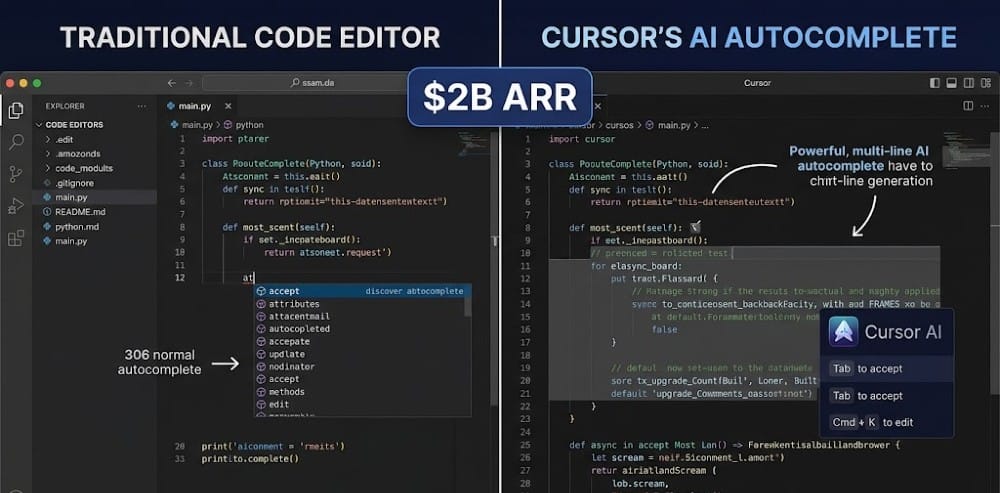
How a 12-person MIT startup became the fastest developer tool in history and what it means for every developer writing code today.
There’s fast growth, there’s hypergrowth, and then there’s Cursor. The Cursor AI coding tool went from $1M to $100M in annual recurring revenue in just 12 months no marketing budget, no enterprise sales team, just a product developers refused to stop talking about.
That $1M-to-$100M sprint happened faster than Wiz (18 months), Deel (20 months), and Ramp (24 months) — the previous benchmarks everyone in SaaS pointed to. And it didn’t stop there. Cursor has now crossed $2 billion in annualized revenue, doubling its run rate in just three months.
This isn’t a funding story. This is a product story.
What Exactly Is Cursor AI?
Short answer: it’s your code editor, but smarter than you expected.
Cursor is an AI-native IDE (integrated development environment) built on top of VS Code. It looks familiar the moment you open it same layout, same shortcuts but under the hood, it’s running a completely different playbook. Instead of waiting for you to ask for help, it’s already thinking three steps ahead.
Key capabilities that actually matter:
- Full-file edits — not just line suggestions. Cursor can rewrite an entire component based on a natural language prompt.
- Agentic debugging — it doesn’t just find the bug, it traces it, explains it, and fixes it across multiple files simultaneously.
- Multi-model integration — it routes tasks between GPT-4o, Claude, and its own proprietary models depending on what the job needs.
- Shadow Workspace — an isolated environment where the AI tests and iterates on code changes without touching your actual workspace, letting it access lints and language server features before presenting any solution.
That last feature alone is the kind of thing senior engineers have been begging for. You don’t want the AI to break your working branch while experimenting. Cursor solved that quietly, and developers noticed.
The Numbers Are Almost Embarrassing
Cursor hit $100M ARR with zero marketing spend. Most freemium SaaS products convert at 2–5%. Cursor converts at 36%.
Sit with that for a second. One in three people who try it pays for it. That’s not a pricing trick. That’s a product so clearly useful that the decision to subscribe feels obvious.
The platform now has over 1 million users, including 360,000 paying customers, and operates with a team of just 12 people. Meanwhile it’s generating nearly one billion lines of code per day and counting over 1 million daily active users.
The valuation arc is equally staggering. Cursor raised its Series B at $2.6B in December 2024, then a Series C at $9.9B four months later, then a Series D at $29.3B five months after that — a 3.8x jump between B and C, then another 3x jump between C and D.
Investors aren’t betting on potential here. They’re chasing a company that’s already proven it can grow faster than anything they’ve seen.
Who’s Actually Using It?
Companies using Cursor include OpenAI, Midjourney, Perplexity, Shopify, and Instacart. These aren’t vanity logos. These are engineering-heavy teams that had every reason to build their own internal tooling — and still chose Cursor.
The majority of Fortune 500 companies now use Cursor, along with elite engineering teams at Stripe, Spotify, and Perplexity.
For individual developers and freelancers, the entry point is low. After a two-week free trial, users choose either a $20/month Pro plan or $40/month for Business — designed for larger teams. For offshore dev teams or agencies building marketing sites in React or Next.js, the Business plan pays for itself inside a single sprint.
Cursor vs. Replit — Which One Is Right for Your Team?
This comes up constantly, especially for remote and offshore teams. Here’s the honest breakdown:
Cursor is better when your team already lives in VS Code, works in complex codebases, and needs deep context-aware edits across multiple files. It’s a local IDE — your code stays on your machine.
Replit wins when you need a shared, browser-based environment — think bootcamp learners, rapid prototyping, or teams that need to spin up an environment without any local setup.
For professional development shops building ReactJS apps, Next.js sites, or API integrations — Cursor is the stronger choice by a wide margin. The agentic debugging alone saves hours on the kind of multi-file refactors that typically eat an afternoon.
Free Trial Tips — Get the Most Out of 14 Days
Don’t waste your trial on small tasks. Here’s how to stress-test Cursor properly:
- Give it a messy legacy file. Ask it to refactor and document it. See how deep the context goes.
- Use Composer for a full feature build. Start from a prompt, let it scaffold the component tree, then push back with changes in natural language.
- Turn on Agent Mode. Let it run autonomously on a small bug — watch how it navigates between files without you directing every step.
- Test the Tab AI feature. The “Fusion” iteration, introduced in early 2025, doesn’t just predict edits near the cursor — it suggests intelligent jumps to the next relevant location in your code.
If you hit the free tier limits before the 14 days end, that’s your answer. You need the Pro plan.
The Bigger Picture: What This Means for AI Coding in 2025
Cursor isn’t just winning market share — it’s redefining what a developer tool is supposed to do.
All the major AI-native dev tools — Cursor, Devin, Windsurf, Anthropic — are converging on a unified vision: human vibe coding augmented by multiple parallel agents. The IDE of tomorrow isn’t a text editor with suggestions. It’s a collaborative environment where agents handle the boilerplate, the refactors, the debugging loops — and you handle the architecture decisions.
The global market for generative AI coding assistants was valued at $25.9 million in 2024 and is projected to reach $97.9 billion by 2030, growing at a CAGR of 24.8%. Cursor is positioned at the center of that explosion.
There are real risks worth naming. The company remains heavily dependent on VS Code, with 94% of Cursor usage flowing through its VS Code fork — a forced API change by Microsoft would pose significant disruption. And GitClear’s research on over 153 million lines of code found AI-assisted coding linked to increased code cloning and copy/paste patterns — a code quality concern the industry is still working through.
Still, the trajectory is hard to argue with. Cursor doubled its ARR from $100M to $200M in just three months, widening its lead over competitors like Bolt.new ($40M ARR) and Vercel’s v0 ($36M ARR).
What Comes Next
Cursor is now building out an enterprise sales team — after hiring their first salesperson in late 2024, they had 7 reps by April 2025 — targeting yearly contracts to compete with Windsurf, which scaled its GTM team from 3 to 75 people in just over a year.
An IPO conversation is already circling. At $2 billion in ARR and this growth rate, Cursor is entering rarefied air — potentially positioning for a major funding round north of $10 billion or exploring public market options.
For developers, the practical takeaway is simple: the free trial is generous, the learning curve is shallow, and the productivity gain is real. Whether you’re a solo engineer building a SaaS product or a team lead managing an offshore React shop — Cursor is worth the 14 days it takes to find out.
The AI coding wars are accelerating. Cursor is currently winning. And it’s not slowing down.
Here you can check about : Best ChatGPT SEO Analysis Tools That Actually Help You Rank in 2026
