


The license finally matches the capability. That’s the real headline.
On April 2, 2026, Google DeepMind launched Gemma 4 — and while the benchmark numbers are genuinely impressive, the bigger story is simpler than that. Gemma 4 is released under a commercially permissive Apache 2.0 license, and that single decision removes the one blocker that’s been sending developers to Qwen and Mistral for the past year.
This isn’t just a model update. It’s a strategic repositioning — Google making a serious, credible play for the open-source AI ecosystem it’s been hovering around the edges of for two years.
What Gemma 4 Actually Is
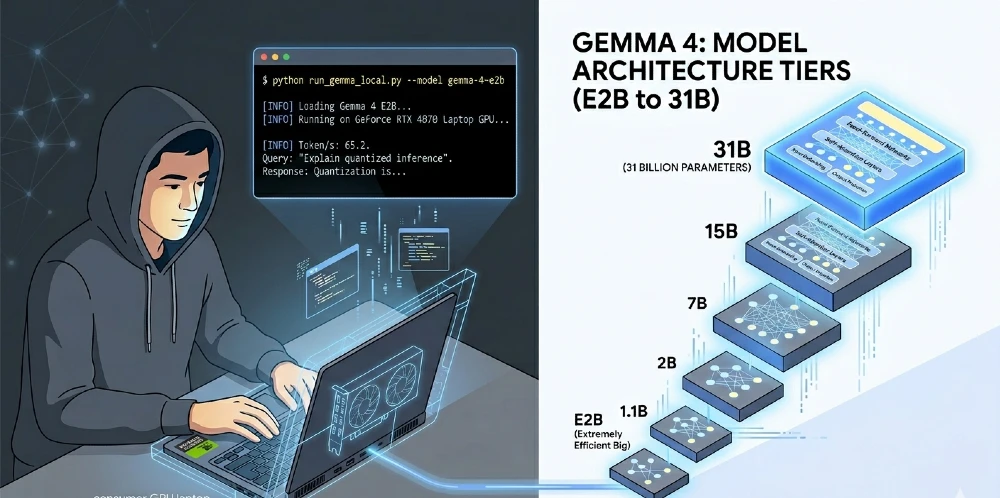
Google DeepMind officially released Gemma 4 on April 2, 2026, built from the same research and technology powering Gemini 3. It comes in four sizes designed to cover the full hardware spectrum — from your phone to a developer workstation — with both dense and Mixture-of-Experts (MoE) architectures in the mix.
The model lineup:
- E2B — Edge model, phone-ready, text + audio input, 128K context
- E4B — Smallest multimodal variant; handles text, image, audio, and video
- 26B MoE — Faster inference, only 3.8B active parameters during inference
- 31B Dense — Flagship; full multimodal, 256K context window, strongest benchmarks
The 26B uses a mixture-of-experts architecture, activating only a subset of 128 experts — about 3.8 billion active parameters — during each inference pass. Translation: it’s faster and lighter on memory than a dense model of the same size, which matters enormously if you’re running this on a consumer GPU or a laptop.
The Apache 2.0 Shift — Why This Is the Real News
Previous Gemma releases were technically “open-weight” but came with Google’s own custom terms. Compliance teams at companies flagged them. Legal reviews dragged on. Teams went elsewhere — usually to Qwen or Mistral — not because those models were necessarily better, but because their licenses were clean.
Previously, Google’s Gemma license had prohibited use in certain scenarios and reserved the right to terminate a user’s access. The move to Apache 2.0 now means enterprises can deploy the models without fear of Google pulling the rug out from under them.
Clement Delangue, CEO of Hugging Face, called it “a huge milestone” when the announcement came out. That reaction makes sense. Apache 2.0 means:
- Commercial use — deploy in paid products, no special agreements
- Modification — fine-tune, adapt, redistribute however you need
- No moving goalposts — the terms can’t change after you’ve built your pipeline around the model
For healthcare, fintech, and government teams who can’t send data to cloud APIs at all, this matters even more. Local deployment with a truly open license is the only viable path. Gemma 4 just became that path.
The Benchmark Jump Is Not Incremental
Let’s put the performance in perspective.
On AIME 2026 math benchmarks, Gemma 3 27B scored 20.8%. Gemma 4 31B scores 89.2%. The 26B MoE reaches 88.3% with only 3.8B active parameters. Even the tiny E4B hits 42.5% — more than double what the previous full-size model could do.
That’s not a generational improvement. That’s a different class of model entirely.
On LiveCodeBench v6, the 31B scores 80.0%, positioning it as a serious local-first coding assistant for offline development scenarios. For developers who want to run a capable code AI without shipping their codebase to an external API — this is a genuine option now.
Gemma 4 demonstrates significant improvements in math and instruction-following benchmarks, and across Arena.ai’s open chat leaderboard, the 31B scores 1452 and the 26B MoE scores 1441, compared to Gemma 3 27B’s 1365. For an open-weight model, that’s competitive territory — not just “good for open source.”
What It Can Actually Do: The Multimodal Upgrade
Every previous Gemma was text-only. That changes completely with Gemma 4.
All models natively process video and images, supporting variable resolutions, and excelling at visual tasks like OCR and chart understanding. The E2B and E4B models feature native audio input for speech recognition and understanding.
No stitching together separate models. No pipeline complexity. One model handles text, image, audio, and video input natively.
The edge models feature a 128K context window, while the larger models offer up to 256K, allowing you to pass full repositories or long documents in a single prompt. And all of this works across 140+ languages, natively trained. Not translated. Not retrofitted. Actually trained on multilingual data.
Where It Runs And That’s the Point
One of the clearest things Google has done with Gemma 4 is design it to run on hardware people actually own.
To run the smallest Gemma 4, you need at least 4 GB of RAM. The largest may require up to 19 GB. That puts the full model family within reach of any modern consumer GPU. You can run it in Google’s AI Studio, via Hugging Face, Kaggle, Ollama, or locally with tools like LM Studio.
At launch, Google claims day-one support for more than a dozen inference frameworks including vLLM, SGLang, Llama.cpp, and MLX. That’s not typical for a launch. That’s preparation. It signals Google actually wants adoption, not just praise.
The Competitive Picture: Who Gemma 4 Is Really Fighting
The launch comes amidst an onslaught of open-weight Chinese large language models from Moonshot AI, Alibaba, and Z.AI many of which now rival OpenAI’s GPT-5 or Anthropic’s Claude.
The open-weight space now includes Qwen 3.5, Kimi K2.5, GLM 5, MiniMax M2.5, GPT-OSS, Arcee Large, and Nemotron 3. It’s crowded. But Gemma 4 earns its place in that list for specific reasons: the Apache 2.0 license is cleaner than Llama 4’s custom terms, the benchmark gains over Gemma 3 aren’t marginal, and the edge models bring genuine multimodal intelligence to consumer hardware.
The open-source models ranked ahead of it on the Arena leaderboard are mainly from Chinese teams. Gemma 4 is Google’s answer to that — a credible domestic alternative for enterprises that want open-weight AI without the data sovereignty concerns that come with models trained by non-US labs.
The 400 Million Download Ecosystem
Since launching in 2024, Gemma models have been downloaded over 400 million times, and the community has built more than 100,000 fine-tuned variants a universe developers call the “Gemmaverse.”
That installed base matters. It means tooling exists, tutorials exist, fine-tuning workflows are established. Gemma 4 drops into a ready community and with a clean license now attached, that community has a real reason to upgrade rather than migrate away.
Gemma is already supporting sovereign digital infrastructure, from automating state licensing in Ukraine to scaling Project Navarasa across India’s 22 official languages. Real deployments, real scale, real use cases that aren’t in anyone’s demo reel.
What’s Next
- A larger MoE model is coming. A model with over 100B total parameters is rumored but not yet released. When it drops, the competitive picture shifts further.
- On-device AI gets serious. The E2B model running on phones means Google is positioning Gemma 4 as the on-device AI layer for Android billions of devices, no cloud required.
- Enterprise adoption unlocked. With Apache 2.0 in place, compliance blockers are gone. Expect rapid adoption in regulated industries healthcare, finance, legal where local deployment and data control aren’t optional.
- Fine-tuning wave incoming. 400 million downloads and 100,000 community variants was Gemma’s old baseline. With better models and a cleaner license, expect that number to accelerate sharply.
Google Gemma 4 is the most complete open-weight release Google has ever shipped better models, better capabilities, and finally, a license that doesn’t require a legal call before you can use it. For developers building real products on open models, the decision just got a lot easier.
Check latest news about: Canva AI Traffic Reaches 870 Million Visits — And It’s Reshaping How the World Creates
