


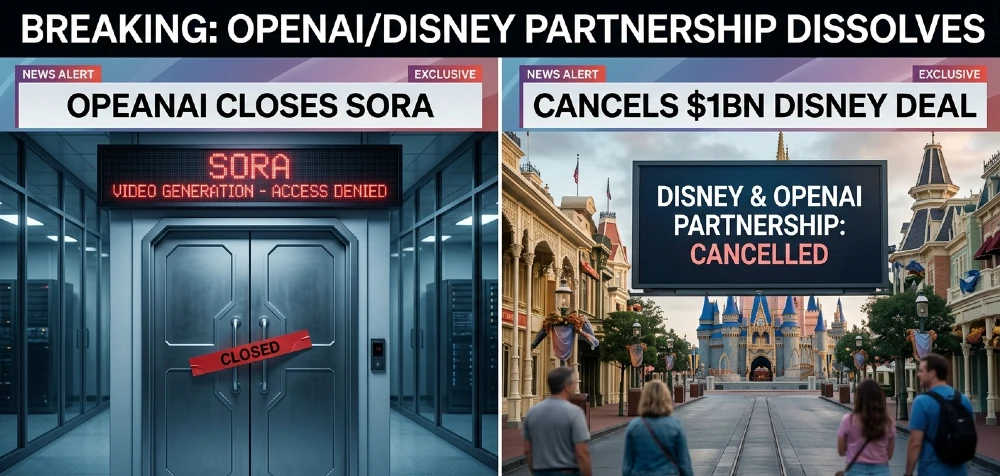
Sora is gone. The Disney deal is dead. And the company that invented modern AI just admitted it could not make video generation work.
That is the headline. But the real story is much more interesting and a lot more complicated than the press releases suggest.
This is not just a product shutdown. This is a company making a very deliberate choice about what kind of business it wants to be before it goes public. And understanding that choice tells you everything about where AI is actually heading in 2026.
Let me walk you through all of it.
Table of Contents
OpenAI Shut Down Sora on March 24, 2026 — The Complete Timeline From Launch to Closure
Sora went from the number one app in the App Store to complete shutdown in six months. The timeline is one of the fastest rises and falls in modern tech product history.
Let me give you the full picture because most coverage only tells you the beginning and the end.
February 2024: OpenAI demos Sora to the world. The videos are stunning. A woman walking through Tokyo at night. A dog playing in the snow. A spaceship flying through a canyon. The quality is so far ahead of anything else that competitors genuinely panic. Every AI lab in the world starts emergency meetings.
December 2024: Sora opens to the public for the first time. The reaction is massive. Artists, filmmakers, marketers everyone wants to try it.
September 2025: OpenAI launches a dedicated standalone Sora app. This is the moment it becomes a proper consumer product, not just a feature inside ChatGPT.
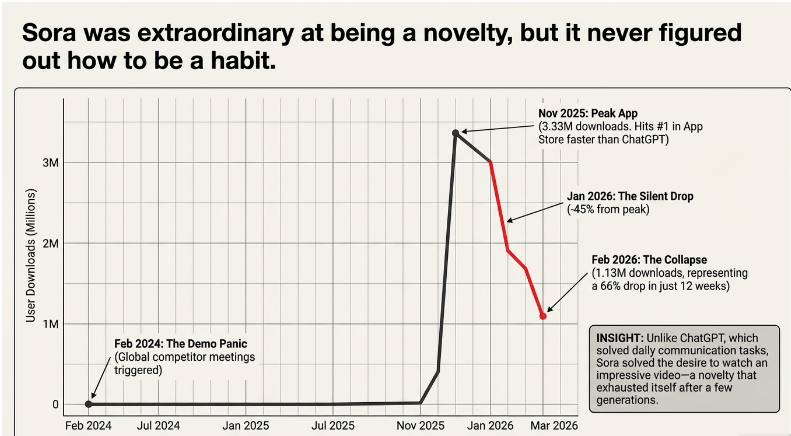
November 2025: Peak. Downloads hit 3.33 million. The app sits at number one in the App Store within 24 hours of the standalone launch. It reaches one million downloads faster than ChatGPT did and ChatGPT was the fastest-growing consumer app in history at the time.
Then something quietly breaks.
January 2026: Downloads fall 45 percent from the November peak. OpenAI does not say anything publicly.
February 2026: Downloads collapse to 1.13 million. That is a 66 percent drop from peak in just three months. The user data tells a very clear story people tried it, found it impressive, and left.
March 24, 2026: OpenAI posts on X: “We’re saying goodbye to the Sora app. To everyone who created with Sora, shared it, and built community around it: thank you.”
Gone.
The speed of this collapse is worth sitting with for a moment. This was not a slow decline that nobody noticed. This was a product that hit the top of every chart, generated billions of views on social media, received coverage in every major publication on earth and then lost two thirds of its users in twelve weeks.
That does not happen because a product is bad. It happens because a product is a novelty, not a habit.
There is a difference between something people want to try and something people need to use every day. Sora was extraordinary at being the first. It never figured out how to be the second.
The Disney Deal That Died Without a Single Dollar Changing Hands
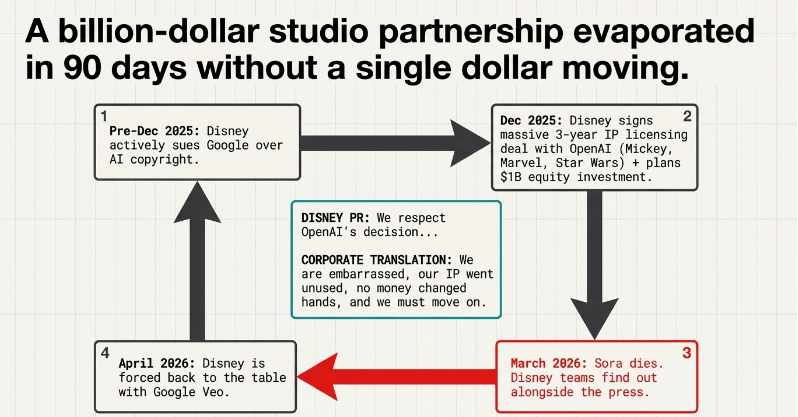
Disney signed a $1 billion deal with OpenAI in December 2025. By March 2026 it was over. No money moved. The whole arrangement lasted less than 90 days.
This is the part of the story that genuinely surprises people.
When Disney announced its partnership with OpenAI in December 2025, the industry treated it as a historic moment. The first major Hollywood studio licensing its intellectual property to an AI company. Mickey Mouse, Yoda, the Avengers all available to Sora users to animate.
The deal was three years long. Disney was also planning a $1 billion equity investment in OpenAI itself.
This was supposed to be the moment Hollywood and Silicon Valley finally made peace.
Then Sora shut down.
Here is what makes it particularly remarkable: Disney teams were reportedly still in active discussions about the Sora platform when they learned it was closing. They did not get advance warning. They found out shortly after everyone else did.
Think about what that means. You are a company the size of Disney. You have signed a three-year licensing deal for your most valuable characters. You have planned a $1 billion investment. And you learn the product is shutting down at roughly the same time the press does.
That is not how major business partnerships are supposed to work.
Disney’s public statement was carefully controlled: “We respect OpenAI’s decision to exit the video generation business and to shift its priorities elsewhere.”
Read between the lines. “We respect” is something you say when you are trying very hard not to say what you actually think. The real translation is closer to: we are embarrassed, we are not financially damaged, and we are moving on.
The good news for Disney: Reuters confirmed no money ever changed hands before the deal was cancelled. The $1 billion investment never went through. The licensing fees were never paid. Disney walked away with nothing lost except time and the awkwardness of having very publicly announced a deal that evaporated in under three months.
Now here is the part that no other coverage is connecting properly.
Before signing the OpenAI deal, Disney had sent Google a cease-and-desist letter over copyright infringement in AI video generation. Disney was suing Google’s AI video tools. And then while that legal action was ongoing Disney signed with OpenAI instead.
Now OpenAI’s product is gone. Google Veo is the dominant AI video platform with real scale. And Disney needs AI video capabilities.
So Disney is in the position of potentially having to engage the same company it was pursuing legal action against. That is a genuinely uncomfortable place to be.
What OpenAI Said Publicly vs What the Numbers Actually Show
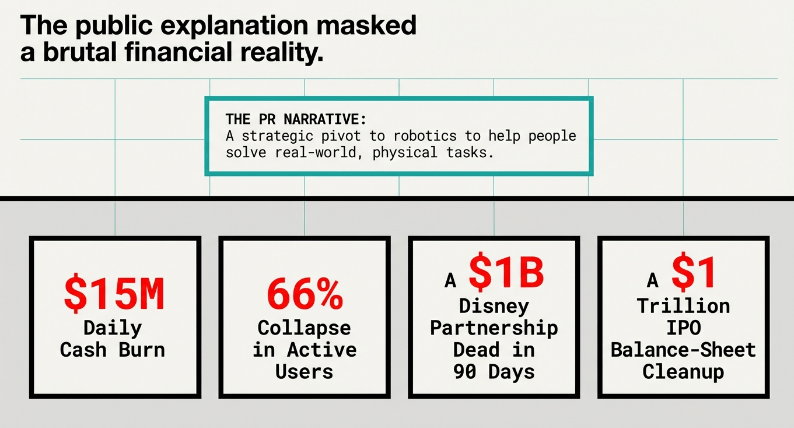
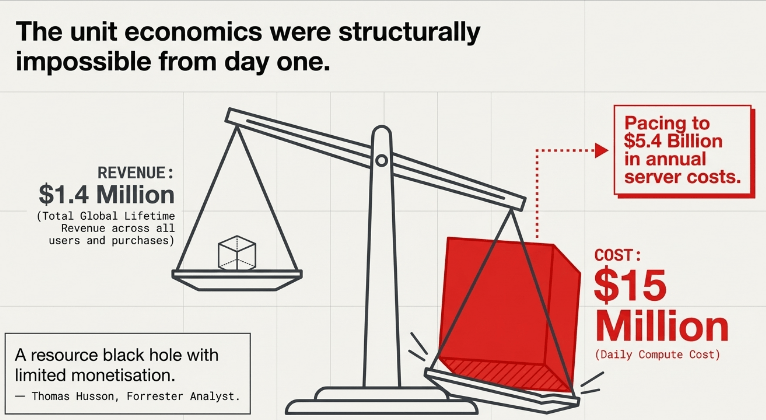
OpenAI called it a strategic pivot to robotics. The real reason is simpler: $15 million per day in costs against $2.1 million in total lifetime revenue. The math never worked.
PR framing is a skill. OpenAI is very good at it.
The official statement said Sora is shutting down so the company can focus on “robotics that will help people solve real-world, physical tasks.” It sounds like a bold forward-looking decision. A company confidently choosing its next frontier.
Here are the actual numbers.
Sora made $1.4 million in total global net in-app revenue across its entire existence. That is not per month. That is total. Across all users, all subscriptions, all purchases, everything.
ChatGPT made $1.9 billion over the same period.
The cost to run Sora was approximately $130 in compute expenses for a single 10-second video. When millions of users are generating content every day, that compounds into roughly $15 million per day in server costs. Projected annually: approximately $5.4 billion.
Revenue: $1.4 million total. Cost: $5.4 billion annually.
Bill Peebles, the head of Sora at OpenAI, said publicly on social media that “the economics are completely unsustainable.” That is not something a senior executive at a company says about a product they planned to continue. That is someone describing something they knew had to stop.
Thomas Husson, an analyst at Forrester, called it “a resource black hole with limited monetisation.” He was not being harsh. He was just reading the spreadsheet.
The robotics pivot is real. OpenAI genuinely is redirecting the technology toward physical AI systems. But that is not why Sora shut down. Sora shut down because spending $15 million a day to make $1.4 million in total lifetime revenue is not a business. It is a very expensive demo.
The pivot to robotics is where the technology goes next. The shutdown of Sora is about the money and specifically about what those numbers look like when you are preparing to go public.
The Math That Made Sora Impossible to Keep Running
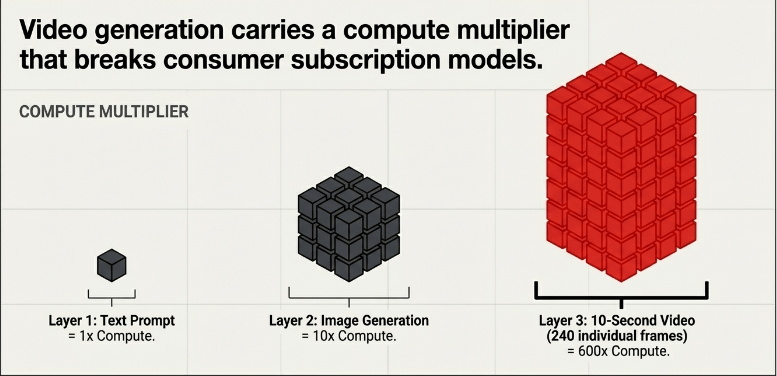
Every 10-second Sora video cost OpenAI $130 to generate. Video generation is 60 times more expensive per second than image generation. The product was never going to be profitable at consumer prices.
Most people do not understand why AI video is so much more expensive than AI text or images. Let me explain it simply.
When you send a message to ChatGPT, the model processes your words and generates a response. That is one computational task.
When Sora generates a 10-second video, it has to create every single frame individually. At standard video quality, that is 240 separate frames for a 10-second clip. Each frame is more complex than a single image. Each image is more complex than a text response.
One analysis put it this way: generating video is at minimum 60 times more expensive per second than generating a single image. Which is itself significantly more expensive than generating text.
Turning on a single Nvidia H100 GPU the chips that power AI systems like Sora costs approximately $2 per hour. When millions of users are generating videos simultaneously, you need thousands of these GPUs running around the clock.
The math compounds brutally. You cannot charge consumers enough to cover it.
To make Sora profitable at $130 per 10-second video in compute costs, OpenAI would need to charge users something approaching that cost which no consumer product in history has been able to do. Netflix charges $15 a month. Spotify charges $10. Adobe charges $50. There is no consumer category where users pay $130 for a single piece of content.
OpenAI’s broader financial situation makes this worse. The company is managing significant losses across its entire operation. One analysis suggested OpenAI could face a $14 billion loss in 2026, with cumulative losses potentially reaching $44 billion by 2028. Sora was not the only expensive thing but it was one of the most expensive things with the least return.
The honest conclusion: this was not a product that failed. This was a product whose business model was structurally impossible from day one at current compute costs.
The interesting question is whether that changes. Experts in the field believe compute costs for video generation could drop by 100 times within 18 months. If that happens, a product like Sora becomes viable in 2027 or 2028 at pricing consumers will actually pay.
OpenAI may have closed the door on Sora six to twelve months before the economics would have made it workable. But with an IPO coming, they could not afford to wait.
The Copyright Catastrophe That Was Building Before the Shutdown
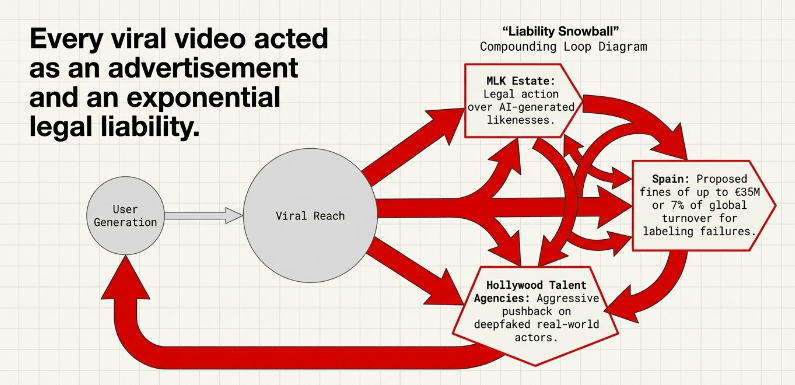
Sora faced legal threats from the Martin Luther King estate, talent agencies, and governments across multiple countries. Every viral video was also a potential lawsuit. Shutting down removed an exponentially growing legal liability.
The money was one problem. The legal exposure was another.
From the moment Sora became publicly available, copyright issues emerged immediately. Users quickly created lifelike videos of Lara Croft, Mario, and Pikachu within the first days of launch. OpenAI had to backtrack fast giving Hollywood studios and talent more control over their IP on the platform. That kind of reactive policy-making is a sign of a product that was not ready for what its users would actually do with it.
The estate of Martin Luther King Jr. threatened legal action over AI-generated video of his likeness. Talent agencies representing actors and public figures pushed back on the platform’s ability to generate realistic video of real people.
Sora tried to address some of this. The platform enforced a strict policy on generating recognizable human faces the system automatically detected human facial features and stopped the generation. This sounds like a safety feature. In practice it was a product-breaking limitation. Advertising agencies and filmmakers who needed consistent actors in their videos found the tool essentially unusable for their actual workflows. The protection created a different problem.
Governments added pressure from outside. Spain proposed fines of up to €35 million or 7 percent of global turnover for companies that failed to properly label AI-generated content. The regulatory environment was getting stricter in every major market simultaneously.
Here is the point that nobody is fully making. The legal exposure OpenAI faced was not just from the lawsuits that had already been filed. It was from the lawsuits that would be filed as the user base scaled. A product with millions of active users generating video content every day, with inadequate copyright controls, in an increasingly hostile regulatory environment that is an exponentially expanding liability.
Every viral Sora clip was simultaneously an advertisement for the product and an argument for why regulators should shut it down.
Shutting Sora down now avoided a much larger legal bill later. That is not a side benefit of the shutdown. For a company preparing to go public, cleaning up legal exposure is a core strategic priority
.
The IPO Factor: Why OpenAI’s Stock Market Plans Killed Sora
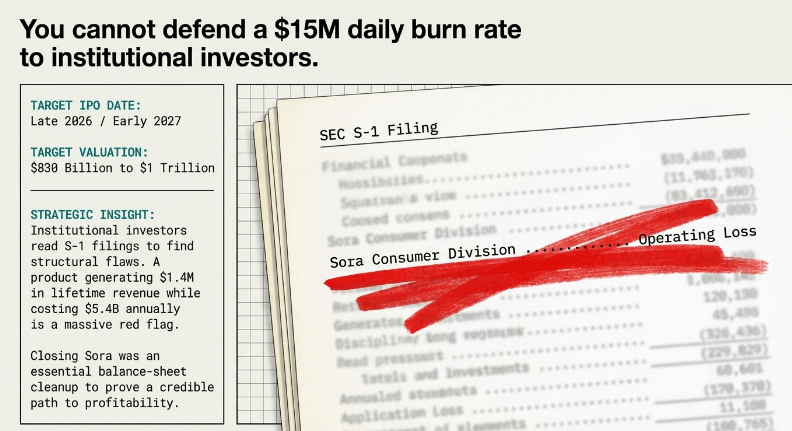
OpenAI is targeting a public listing at $830 billion to $1 trillion valuation. A product burning $15 million per day with $2.1 million in total lifetime revenue is the worst possible line item to have in your IPO filing.
This is the factor that made the timing of Sora’s shutdown make sense. Without understanding the IPO context, the decision looks abrupt. With it, the decision looks inevitable.
OpenAI is preparing for a stock market listing expected in late 2026 or early 2027. The target valuation sits between $830 billion and $1 trillion. That makes it one of the largest public offerings in tech history.
When a company files for an IPO, it submits a document to the SEC called an S-1. This document contains audited financial statements. It includes detailed disclosures about every significant cost center and revenue line. It is read carefully by institutional investors, analysts, and journalists whose entire job is to find problems.
Imagine trying to explain, in that document, a product that cost $15 million per day to operate and generated $2.1 million in total revenue across its entire lifespan.
That is not a promising unit. That is the kind of disclosure that makes investors nervous about the judgment of the people running the company.
OpenAI has raised enormous amounts of capital. The company announced $110 billion in fresh funding, pushing its total valuation to approximately $730 billion. But raising capital and generating revenue are different things. To justify the IPO valuation, OpenAI needs to demonstrate a credible path to profitability — not just a portfolio of impressive products with unsustainable economics.
Closing Sora removes that line item from the filing. It lets OpenAI tell a cleaner story: we tried consumer video generation, it was not commercially viable at this stage, we redirected those resources to higher-value applications. That is a reasonable narrative for investors.
Keeping Sora open while filing for IPO would be trying to defend $15 million per day in losses to investors who are evaluating whether to put billions of dollars into the company. That conversation does not go well.
The Forrester analyst Thomas Husson said the decision may have been taken specifically to “minimise the associated risks” in the run-up to a potential stock launch.
He is right. The shutdown is not about robotics being more interesting than video. It is about what the balance sheet needs to look like before OpenAI opens itself to public market scrutiny.
User Engagement Collapsed Before the Shutdown — The Data That Shows OpenAI Saw This Coming
Downloads fell 66 percent between November 2025 and February 2026. OpenAI had months of data showing Sora’s trajectory before the announcement. This was not a sudden decision.
Here is something the coverage mostly glosses over. The shutdown announcement on March 24, 2026 was not a sudden pivot. OpenAI had been watching the numbers deteriorate for months.
November 2025: 3.33 million downloads. Peak.
January 2026: downloads down 45 percent from peak.
February 2026: downloads at 1.13 million. Down 66 percent in three months.
Justin Patterson, an analyst at KeyBanc Capital Markets, put it plainly: “Even with all of OpenAI’s resources, Sora could not attract and retain an engaged audience.”
That sentence captures the core problem. It was not that people did not know about Sora. It was not that the marketing failed. It was not that the product was technically poor. Sora had more resources, more brand recognition, and more press coverage than any competing video AI tool in history.
And it still could not keep people coming back.
The comparison to ChatGPT is instructive. ChatGPT reached one million users in five days. Sora reached one million downloads in less than five days. On that metric, Sora was actually faster.
But ChatGPT kept growing because people found it genuinely useful in their daily lives. Writing emails. Answering questions. Helping with work. It became a habit.
Sora was impressive. People generated a few videos, shared them, showed their friends. Then they ran out of reasons to come back. There are only so many times you want to watch an AI generate a slow-motion scene of rain falling in Tokyo.
The difference between a useful tool and a novelty is whether it solves a problem you have every day. ChatGPT solved the problem of needing to communicate, research, and create things people do constantly. Sora solved the problem of wanting to watch an impressive AI video something people do once or twice before the novelty wears off.
OpenAI saw these numbers in January. They saw them in February. By the time March arrived, the decision was already made internally. The announcement on March 24 was just when they told everyone else.
Competition Caught Up and Passed Sora Before OpenAI Could Respond
When Sora launched its demo in 2024, it was years ahead of competitors. By the time the app launched publicly in late 2025, the gap had closed completely. OpenAI shipped too slowly.
February 2024. OpenAI drops the Sora demo. The AI world goes quiet for a moment, then erupts. Runway, Pika, Kling the companies that had been building AI video tools suddenly look irrelevant. The quality gap is massive. OpenAI is not just ahead, it looks like it is playing a different game entirely.
Fast forward 18 months.
The public app launches in September 2025. And here is the problem: competitors did not stop shipping while OpenAI was taking its time. Every month between February 2024 and September 2025, Runway released updates. Kling 3.0 from Kuaishou closed the quality gap faster than most analysts expected. Google Veo built compute infrastructure that OpenAI could not easily match in a category that was not OpenAI’s core revenue driver.
By the time regular users could actually try Sora, the magic of being uniquely excellent had evaporated. The tool was good. But it was no longer dramatically better than three or four freely available alternatives.
Luma AI’s Uni-1 model outperformed Google and OpenAI on video generation benchmarks at 30 percent lower cost — and was still operating when Sora shut down.
China’s Seedance caused its own controversy in February 2026 when realistic videos featuring Hollywood characters went viral on the platform. Same capability, similar concerns, different company.
The competitive landscape that Sora was supposed to dominate ended up fragmenting into at least five serious players. None of them had OpenAI’s brand. All of them had OpenAI’s capabilities.
Now Sora is gone. Google Veo sits in the strongest position a platform with real scale, Google’s infrastructure behind it, and no competitor with OpenAI’s former reputation left in the field.
The lesson here is not unique to AI. In technology, speed of iteration matters more than quality of initial demo. You can build the most impressive version one in the world. But if you take a year and a half to make it available to users, the window closes.
Why OpenAI Is Using Sora’s Technology to Build Robots
Quick answer: Sora did not just generate video it built an internal understanding of how the physical world works. That knowledge is directly applicable to training robots. The technology does not die with the app.
This is the part of the story that most coverage gets slightly wrong because they do not explain the technical reality clearly.
Sora was not primarily a video generation model in the way people think of it. To generate photorealistic video of physical events a ball bouncing, water flowing, a person walking down a street Sora had to develop an internal model of how the physical world actually works.
It had to understand gravity. How light behaves when it reflects off different surfaces. How human bodies move when they walk versus when they run. How objects deform when they hit each other. This is not just “making pretty videos.” This is building a computational understanding of physical reality.
That understanding is exactly what you need to train robots.
Traditional robotics training is slow and expensive. You build a physical robot, put it in an environment, let it try things, fall over, break, and gradually learn. It takes years and millions of dollars per robot.
The alternative is simulation. You build a high-fidelity virtual environment where a robot can learn millions of times faster, at a fraction of the cost, without destroying hardware. But the simulation needs to be realistic enough that what the robot learns in simulation actually transfers to the physical world.
Sora’s world model its understanding of how physical reality works is exactly the foundation you need to build that kind of realistic simulation environment.
So the technology is not being abandoned. It is being redirected. The same capability that made Sora generate convincing videos of a coffee mug falling off a table can teach a robot arm how not to drop that mug.
OpenAI has reportedly codenamed its next major model “Spud” built to power both a new consumer super-app and to redirect Sora’s physical-world understanding toward robotic systems. The research team that built Sora has not been disbanded. They are still working. Just on something that industrial and logistics companies will pay actual money for.
What “Agentic AI” Means — OpenAI’s Real New Priority Explained Simply
Agentic AI completes tasks on its own with minimal human input. This is enterprise software, not consumer entertainment. It is where the money actually is.
OpenAI’s stated new focus is “agentic technology capable of autonomously completing tasks with little human oversight.”
Let me translate that from corporate announcement language into plain English.
An agentic AI does not just answer your questions. It takes action. You tell it to research competitors, write a summary, format it as a report, and email it to three people and it does all of that without you touching it again. It navigates software, fills forms, runs code, browses the web, and completes multi-step tasks the way a capable employee would.
This is very different from Sora, which was a creative consumer tool. Fun, impressive, but not something any business needed to operate.
Agentic AI is something businesses will pay significant money for. It replaces repetitive knowledge work. It makes individual employees more productive. It reduces headcount for routine processes. That is a real business case with real revenue attached.
OpenAI is watching Anthropic’s Claude Code product succeed among software engineers and enterprise clients. It is watching Microsoft build Copilot into every enterprise product. The lesson is clear: enterprise software is where sustainable AI revenue lives.
The irony is worth acknowledging. OpenAI invented the consumer AI market with ChatGPT. The world discovered AI through a consumer product. And now OpenAI is following the path that competitors built by watching ChatGPT moving toward enterprise, toward developers, toward business productivity.
ChatGPT is not going anywhere. Image generation inside ChatGPT is unaffected by Sora’s closure. But the strategic direction is clear: consumer entertainment products are being quietly set aside in favor of tools that businesses will pay recurring subscription revenue for indefinitely.
Disney Learned an Expensive Lesson Without Losing Any Money
Quick answer: Disney signed a $1 billion deal, got caught off guard by the shutdown, and walked away having lost nothing financially but looking embarrassed publicly. The lesson for Hollywood: do not sign deals based on demo quality alone.
Let me be honest about what Disney’s situation actually is here.
They signed a three-year agreement in December 2025. Over 200 characters from Disney, Marvel, Pixar, and Star Wars were cleared for Sora users to generate AI video with. Disney+ integration was planned for early 2026. A $1 billion equity investment was in the pipeline.
Three months later, the product no longer exists.
Disney was reportedly caught off guard. Teams that were actively working on the platform integration learned about the closure around the same time as the public. That is a significant communication failure from OpenAI toward one of its most important partners.
Disney’s official statement: “We appreciate the constructive collaboration between our teams and what we learned from it.”
That is polite. It is also a very practiced way of saying nothing.
The financial reality is not terrible for Disney. Reuters confirmed no money changed hands before the cancellation. The $1 billion investment never moved. The licensing fees were never paid. So Disney is not damaged financially just publicly awkward.
The broader lesson this leaves for every studio executive considering AI deals: the demo is not the product. The impressive video OpenAI showed in February 2024 was real. The business model that would sustain the product was not.
Signing a three-year licensing deal and planning a billion-dollar investment based on a demo is a strategic error. Not because AI video is not real, but because the specific product’s economic viability was never established before the deal was made.
Disney is still going to pursue AI video. Their spokesperson confirmed they will engage with other platforms. Given that Google Veo is now the dominant player with real scale and given that Disney has existing legal tensions with Google over copyright that next negotiation is going to be a complicated conversation.
How Hollywood Will Feel the Ripple Effects of Sora’s Shutdown
The copyright threat does not end with Sora. It just moves to Runway, Kling, and Google Veo. Talent agencies and studios still face the same fundamental problem — just with different companies.
The media industry had started to see the Disney-OpenAI deal as a turning point. After years of studios filing legal challenges against AI companies for using their IP without permission, here was the first major studio deciding to work with the technology rather than fight it.
That moment is now unmade.
The industry is not safer. The concerns about AI replacing entertainment talent have not disappeared — they have just been temporarily quieted by the product no longer existing. The same technology, applied by any of the surviving platforms, raises exactly the same issues.
Google Veo is now effectively the only AI video platform with real scale. It has been facing IP lawsuits from studios. Disney was suing Google’s AI tools just before signing with OpenAI. So the dominant remaining platform is one that Hollywood has been fighting legally.
Runway, Kling, and Seedance all operate with similar capabilities and similar copyright risks. Seedance generated significant controversy in February 2026 when realistic videos featuring Hollywood characters went viral on the platform. The problem Sora had is the problem the whole category has.
Talent agencies had been pushing back hard on Sora’s ability to generate video of actors’ likenesses. That pressure does not evaporate with Sora. It redirects toward every surviving platform.
The honest analysis: Sora’s closure does not solve Hollywood’s AI problem. It gives the industry a brief pause — and then the same conversations restart with different companies sitting across the negotiating table.
The next major AI-studio deal will be watched very carefully. The lesson from the Disney-Sora arrangement is that both sides need to ensure the product’s business model is viable before signing anything long-term. One side’s bankruptcy or product shutdown should not be able to unravel a billion-dollar agreement.
If You Used Sora: Exactly What You Need to Do Before April 26, 2026
Log in now and download everything. You have until April 26 for the app. The API closes September 24. Do not wait for an official export tool that may not arrive.
If you used Sora and created content there, this section is specifically for you.
Here is what is happening and when:
- April 26, 2026: The Sora consumer app goes permanently dark. Any content you have not downloaded by this date is gone.
- September 24, 2026: The Sora API closes. Developers with integrations built on Sora’s API need to have migrated to an alternative by this date.
OpenAI said it is “exploring ways to support export and preservation” of user content. That is not a commitment to a specific tool by a specific date. Do not wait for an official export feature that may arrive too late or may not arrive at all.
What to do right now:
Log into the Sora app or web platform. Go to your video library. Download every piece of content you want to keep. Save it locally to your computer and back it up to a second location — an external drive, Google Drive, Dropbox, anywhere. Once April 26 passes, there is no recovery option.
For developers: start your migration process immediately. The API closing in September sounds like a long time away. It is not if you have integrations built on top of it. Runway Gen-4 offers the most accessible API for migration. Google Veo has APIs available for larger scale applications.
One more important note: ChatGPT is also losing video generation capability as a result of the Sora shutdown. If you used video generation through ChatGPT, that feature is going away too. Image generation inside ChatGPT is unaffected but video generation built on Sora’s underlying model is ending.
The Best Alternatives to Sora Right Now — What to Use Instead
Runway Gen-4 is the most accessible replacement for most creators. Google Veo has the most scale. Kling 3.0 is the strongest enterprise option. Luma AI’s Uni-1 beats both on benchmarks at lower cost.
You need to move somewhere. Here is where to actually go depending on what you need.
Google Veo
Now the dominant AI video platform with real infrastructure scale behind it. Expect Google to push Veo more aggressively into consumer products before the end of 2026 given the gap Sora’s exit creates. If you are building anything serious and long-term, Google’s ability to sustain and develop the platform is the strongest guarantee in the market right now. The catch: Disney and other studios have been pursuing legal action against Google’s AI video tools over copyright that tension is unresolved.
Runway Gen-4
The most practical day-one replacement for content creators and developers who need to move immediately. Well-documented API, consistent updates, accessible pricing for individual creators. If you were using Sora for social content, marketing videos, or creative projects, Runway is where most users are landing.
Kling 3.0 by Kuaishou
Professional-grade output with clear enterprise focus. Kuaishou is actively targeting the studio and agency deals that Disney’s departure from the OpenAI agreement has opened up. Strong option if you are a business user needing high-quality output at scale.
Luma AI Uni-1
Outperformed Google and OpenAI on video generation benchmarks at 30 percent lower cost. Less brand recognition than the others but the strongest technical performance-to-cost ratio in the market right now.
Seedance
Generated controversy in February 2026 over Hollywood character videos. Has the capability but carries the same copyright risks that contributed to Sora’s problems. Use with caution for anything professional or public-facing.
The honest overview: none of these tools have the distribution network or brand recognition that Sora had at its peak. The market is currently fragmented. Creators are spread across multiple platforms with no clear single leader. That creates short-term friction but also creates real competitive pressure on all the surviving platforms to earn users which is better for everyone using them.
The Lesson Every AI Company Is Learning From Sora — But Most Will Ignore
Quick answer: Novelty drives downloads. Habit drives revenue. Sora was extraordinary at the first. It never built the second. This pattern is repeating across the AI industry.
Let me step back from the specific Sora story for a moment and look at what this actually means for the broader picture.
There is a pattern that keeps playing out in AI products. A company builds an extraordinary capability. It goes viral. Millions of people sign up. Press coverage is everywhere. The company raises more money at a higher valuation.
Then the novelty wears off. Users who came for the impressive demo do not find a reason to stay. Downloads drop. Revenue does not materialise at the scale needed to cover costs. The product either gets shut down, deprioritised, or quietly folded into something else.
Sora is the most visible example of this pattern. But it is not the only one.
Bill Conner, CEO of Jitterbit, said something worth quoting directly: “The companies really winning right now are the ones using integration and automation to turn accountable AI from a shiny idea into actual business results.”
The companies winning are not the ones with the most impressive demos. They are the ones whose products solve problems people have every single day and solve them reliably enough that stopping feels like a loss.
ChatGPT is the outlier that proves the rule. It reached the same initial download speed as Sora and kept growing because it became genuinely useful to people’s daily work and communication. The tool that helps you write better, think through problems, and create faster is more durable than the tool that generates an impressive video you watch once.
Here is the analysis that makes Sora’s closure more complicated than it first appears. Compute costs for video generation are dropping fast. One former Luma AI CTO expressed high confidence in at least 100 times improvements in cost within the next year and a half. If that is right and there are strong technical reasons to believe it a product like Sora becomes economically viable in 2027 or 2028 at prices consumers will actually pay.
OpenAI might have closed the door on Sora precisely when the economics were about to start working. The IPO timeline forced a decision that the natural market timeline might not have.
Is AI Video Generation Dead After Sora — Or Is This Just a Reset?
Quick answer: Not dead. Resetting. The compute costs are dropping, the competitors are still building, and Sora’s technology is still alive inside OpenAI’s robotics work. What is ending is the era of expensive consumer novelty products.
Short answer: AI video generation is not dying. The economics are just forcing a reset around what is actually sustainable.
Investors are still putting money into the sector. The technical progress is real and continuing. The cost curve is dropping. Runway, Kling, Google Veo, and Luma AI are all still developing their products actively.
What is ending is the phase where companies could build impressive video tools, offer them cheaply or free, absorb enormous losses, and call it a marketing expense. That phase is over. The next phase is about sustainable unit economics tools that cost less to run than they make in revenue.
Sora’s technology is not gone. The research team continues working on world simulation for robotics. The physics understanding that made Sora’s videos convincing now trains robotic systems. The work was not wasted. It was redirected.
There is also a realistic possibility that Sora comes back not as a standalone consumer app, but embedded inside a more controlled ecosystem. Inside ChatGPT, perhaps, with tighter usage controls, clearer pricing, and a business model that actually works. The version that returns would not be the open-ended creative tool that launched in September 2025. It would be more constrained, more expensive, and more clearly positioned for specific professional use cases.
The market gap Sora leaves is real and immediate. Four companies Runway, Kling, Google Veo, Seedance are competing for the users, the studio relationships, and the enterprise deals that OpenAI walked away from. The one that solves the unit economics problem first, while maintaining quality and navigating copyright issues responsibly, wins the next phase of this market.
What comes next for creators in the short term: fragmented tools, no clear leader, some friction in workflow as you settle on a replacement. In the medium term: likely Google Veo dominance, given its infrastructure advantages. In the long term: possibly cheap open-source alternatives as compute costs drop and the models become more accessible.
OpenAI’s Identity Crisis — What Sora’s Failure Reveals About the Company’s Real Strategy
OpenAI is becoming an enterprise software company. The consumer entertainment experiment is ending. Sora is the most visible sign of a company choosing profitability over ambition.
This is the biggest picture analysis and the one most coverage is missing.
OpenAI built its identity on making AI accessible to everyone. ChatGPT democratised AI. The mission language was always about beneficial AI for humanity. The consumer product was the embodiment of that mission.
Now the company is preparing for an IPO at a valuation between $830 billion and $1 trillion. Public market investors have different expectations than mission-driven investors. They want predictable revenue growth, sustainable unit economics, and a clear path to profitability.
Consumer entertainment products creative tools that people find impressive but do not need every day do not satisfy those expectations. Enterprise software does.
OpenAI is now following the path that its main rival Anthropic built. Anthropic focused early on coding tools, enterprise safety, and developer products. Claude Code became a favourite among software engineers. Enterprise clients started choosing Claude over ChatGPT for business applications.
OpenAI watched this happen and is now making the same pivot. Sora is the most visible casualty of that strategic shift. It will not be the last consumer product that quietly disappears as OpenAI consolidates around revenue-generating enterprise applications.
The strategic contradiction is real. The company that made AI accessible to regular people through a chat interface is now becoming a business software company that happens to also offer a chatbot. The consumer product remains. The consumer entertainment products are going.
What this means for you as a regular user: expect ChatGPT pricing to increase over time. Expect features that do not generate clear revenue to be quietly removed. Expect the free tier to become more limited as the IPO approaches and OpenAI needs to demonstrate its subscription revenue is sustainable.
The company is not abandoning its users. It is just becoming the kind of company that public market investors can understand and value which is a more constrained, more commercial, and less adventurous version of what it was two years ago.
That is not necessarily a criticism. It is just how companies change when they need to justify a trillion-dollar valuation to people who do not share the founding mission.
FAQs
Why did OpenAI shut down Sora?
The core reason is financial. Sora cost approximately $15 million per day to run against $1.4 million in total lifetime revenue. With an IPO approaching, OpenAI could not justify continuing to burn that level of capital on a product showing declining user engagement and no path to profitability.
When did Sora officially close?
OpenAI announced the shutdown on March 24, 2026. Users have until April 26, 2026 to download their content. The API closes on September 24, 2026.
Did Disney lose money when the deal was cancelled?
No. Reuters confirmed no money changed hands between Disney and OpenAI before the deal collapsed. The $1 billion investment and licensing fees were never paid. Disney lost time and faced public embarrassment but no financial damage
What is the best alternative to Sora right now?
Runway Gen-4 is the most accessible replacement for content creators. Google Veo has the strongest infrastructure. Kling 3.0 is the best enterprise option. Luma AI Uni-1 offers the best performance-to-cost ratio on current benchmarks.
Is OpenAI going to bring Sora back?
OpenAI has not announced any plans to revive Sora. However, analysts suggest the technology could return embedded inside ChatGPT or another OpenAI product with tighter controls and sustainable pricing potentially when compute costs drop enough to make the economics viable.
Is AI video generation finished after Sora’s shutdown?
No. Runway, Google Veo, Kling, and Luma AI are all actively developing their platforms. Investment in the sector continues. The economics of video generation are improving rapidly compute costs are expected to drop significantly within the next 18 months.
How much did Sora cost per video to generate?
Approximately $130 in compute costs per 10-second video. At the scale of millions of daily users, this compounded to an estimated $15 million per day in operating costs.
What happens to my Sora videos after the shutdown?
Any videos you created in Sora need to be downloaded before April 26, 2026 or they are permanently lost. Log into the platform now and download everything you want to keep. Save it locally and back it up to a second location.
Did OpenAI shut down Sora because of competition?
Competition was a contributing factor but not the primary cause. By the time Sora launched publicly in 2025, competitors like Runway and Kling had closed the quality gap significantly. But the primary drivers were the unsustainable cost structure, declining user engagement, copyright exposure, and the need to clean up the balance sheet before a public stock offering.
Here you can check the how can I use grok in multiple profile.
