


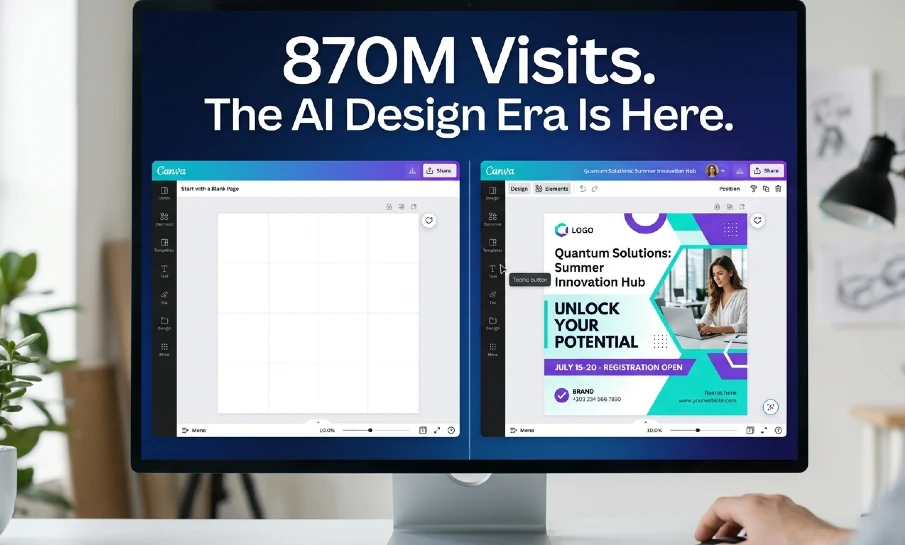
The design world just got a new ruler. Canva AI has quietly done something that most AI-native startups only dream about — it pulled 870 million monthly visits, landing the #2 spot globally among all web platforms. And AI is the reason why.
This isn’t just a traffic milestone. It’s a signal that the AI-powered creative tools market has a dominant force — and it isn’t Adobe, DALL-E, or Runway.
What Just Happened With Canva AI Traffic?
Canva AI traffic has surged to 870 million monthly visits, making it the second most visited platform on the internet by overall traffic. That’s not second in the “design tool” category — that’s second, full stop, across all digital platforms.
The engine behind this? Canva’s deeply integrated AI suite.
In the past 18 months, Canva has shipped a stack of AI features that would make most standalone AI companies blush:
- Prompt-to-template generation — type what you need, get a ready-to-publish design in seconds
- Magic Write — AI-powered copy generation built directly into the canvas
- AI image generation — on-brand visuals without leaving the app
- Background remover, magic eraser, and smart resize — all AI-driven, all one-click
- Mobile-first collaboration — social media creators can ideate, iterate, and publish from their phone
These aren’t bolt-on features. They’re woven into the actual design workflow, which is why users keep coming back. Retention is what builds traffic — not just acquisition.
Why This Should Worry Adobe, DALL-E, and Runway
Here’s the uncomfortable truth for legacy players: Canva doesn’t just generate images. It generates finished work.
DALL-E gives you a picture. Runway gives you a video clip. Adobe Firefly gives you a layer. Canva gives you a social media post, a pitch deck slide, a campaign banner — output that’s ready to publish or send.
That’s a fundamentally different value proposition.
“The shift is from AI as a creative tool to AI as a creative workflow,” as analysts across the design industry have framed it. Canva landed on the right side of that distinction early.
For marketers, this is huge. Small business owners and solo creators who couldn’t afford a design team now produce content at agency speed. Canva democratized design first — then dropped AI into it at scale.
The Real ROI for Marketers (It’s Not What You Think)
Yes, Canva AI saves time. But the more interesting ROI story is what happens to output volume and campaign velocity.
Before Canva AI, a typical content team might:
- Brief a designer (1–2 days)
- Wait for revisions (another day)
- Export, resize, and reformat for different platforms (half a day)
- Total time to publish: 3–5 days
With Canva AI today:
- Prompt → template → edit → publish: under 30 minutes
- One design resized for Instagram, LinkedIn, and Twitter simultaneously
- On-brand copy generated in the same session
That’s not a 20% efficiency gain. That’s a 10x change in campaign velocity. For brands running time-sensitive promotions, product launches, or trend-responsive content — this is a genuine competitive edge.
The virality angle matters too. Creators who show their Canva AI workflow — the “before the prompt” versus “after the template” — consistently perform well across YouTube Shorts and TikTok. The before/after format is natively engaging, and Canva AI makes that story easy to tell.
Who Is Actually Using This?
The user base is broader than most people assume.
Canva’s traffic spike isn’t driven by enterprise marketing departments alone. The platform has become a daily tool for:
- Social media managers handling content calendars for multiple clients
- Small business owners building their own brand without a budget for designers
- Educators and nonprofits creating engagement materials fast
- Freelancers using AI to increase their output and take on more clients
- Students using it for presentations and project visuals
Mobile collaboration is a particular growth driver. Canva’s mobile experience is genuinely good — unusual in a design tool — and social-first creators often work entirely on their phones. Canva AI meeting them there, rather than asking them to move to desktop, has been a quiet but significant advantage.
The Competitive Landscape Isn’t Standing Still
To be fair: DALL-E, Runway, and Adobe Firefly aren’t sitting still.
Adobe has deep enterprise relationships and the trust that comes from decades of creative software. Runway is pushing hard into AI video — a space Canva hasn’t yet meaningfully entered. OpenAI’s image generation continues to improve with each model iteration.
But Canva has something none of them have yet fully replicated: distribution at consumer scale combined with a complete end-to-end workflow.
Getting to 870 million visits means Canva has already won the distribution war for this cycle. The challenge now is whether it can defend that position as Adobe deepens its AI integrations and as AI-native design startups continue to emerge.
There’s also the question of monetization. Canva has a freemium model that converts well, but as AI inference costs remain significant, the economics of serving hundreds of millions of AI-assisted designs every month will require either premium pricing, smarter tiering, or both.
What’s Coming Next
Several things are already in motion:
Canva has been expanding its video editing capabilities — a direct move toward Runway’s territory. If it can bring the same prompt-to-output simplicity to short-form video, the traffic numbers could climb further.
The enterprise segment is also a priority. Canva for Teams already exists, but the AI layer — specifically, brand-consistent AI output and approval workflows — is what will determine how far it can go upmarket against Adobe’s suite.
Finally, regional expansion matters here. Canva’s traffic isn’t solely Western. Its mobile-first, affordable model has strong traction in Southeast Asia, Latin America, and Africa — markets that are underpenetrated by Adobe and actively growing in smartphone-based creative work.
The Bottom Line
Canva AI traffic hitting 870 million visits and landing the #2 spot globally isn’t a lucky accident. It’s the result of a company that understood — earlier than most — that AI’s real value in design isn’t generating images. It’s compressing the entire creative process from brief to publish.
For marketers, the practical takeaway is simple: if your team isn’t already using Canva AI for campaign visuals and content at scale, your competitors probably are.
The AI design race has a current frontrunner. Whether it stays there depends on what happens in video, enterprise, and the next generation of multimodal AI tools. But for now, 870 million people have already voted with their clicks.
check out our latest news
Claude AI Is the Fastest-Growing Enterprise Tool — And the Numbers Prove It
