


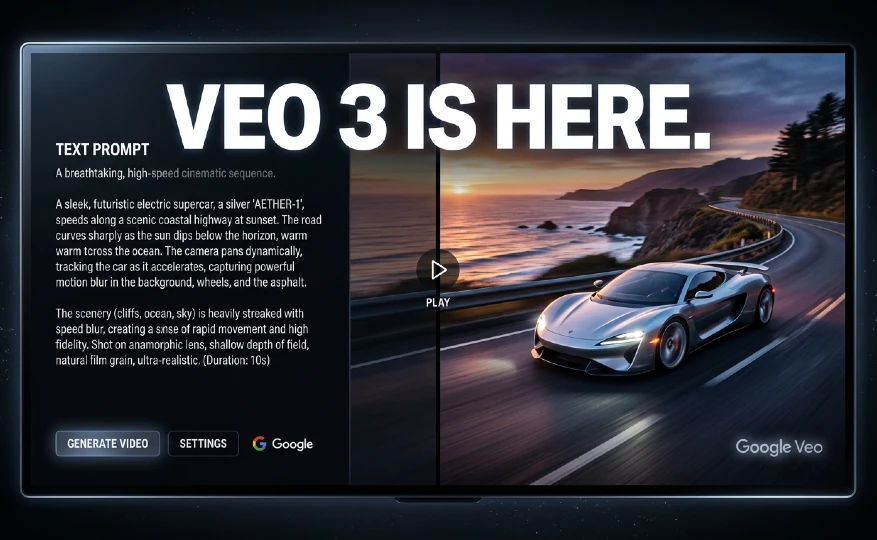
The AI video generation race just got a serious shake-up. Google’s Veo 3 has quietly climbed to the top of industry rankings for creative video production from text and image prompts — and if you work in marketing, content creation, or media, this affects your workflow right now.
This isn’t another incremental update. Veo 3 represents a meaningful leap in what AI can do with motion, coherence, and visual storytelling. And the competition? It’s rattled.
What Exactly Is Veo 3?
Veo 3 is Google DeepMind’s third-generation AI video generator, built to produce high-fidelity video content from natural language prompts or image inputs. You describe a scene — or upload a reference image — and Veo 3 generates cinematic-quality video in seconds.
It’s fast. It’s detailed. And increasingly, it’s accurate to the prompt in ways earlier models simply weren’t.
The model currently tops independent creative benchmarks for text-to-video and image-to-video tasks. Evaluators cite its motion consistency, realistic physics simulation, and coherent scene transitions as standout qualities that competitors haven’t matched at scale.
Why Motion Quality Is the Real Story
Most AI video tools struggle with one specific thing: motion. Objects blur incorrectly. People move like marionettes. Water doesn’t behave like water.
Veo 3 reportedly solves much of this. Its high-fidelity motion engine — trained on vastly more temporal data than previous generations — handles:
- Fluid object movement — no more robotic panning or jittery transitions
- Accurate lighting changes across time within a single clip
- Scene continuity — characters and objects stay consistent frame to frame
- Realistic secondary motion — hair moves, fabric shifts, water ripples
For marketers producing explainer videos or social content, this isn’t just a nice-to-have. It’s the difference between something that looks professional and something that looks generated.
It Plugs Into Gemini and ChatGPT Workflows — That’s a Big Deal
Here’s where Veo 3 gets strategically interesting.
Google has integrated Veo 3 into Gemini-powered workflows, which means users can prompt video generation directly through conversational AI interfaces they already use. More notably, it also integrates with ChatGPT-adjacent workflows through API access — giving it a foothold in the OpenAI ecosystem without requiring users to switch platforms.
This dual integration approach is smart. Most creative professionals don’t want to leave their existing tools. By meeting them where they are, Veo 3 reduces friction and accelerates adoption in ways that a standalone platform would struggle to achieve.
Think about it from a workflow standpoint: a content team running ChatGPT for copy can now pipe that same workflow into Veo 3 for the visual layer. No export. No re-prompting from scratch. One connected pipeline.
Going Head-to-Head With Runway ML and Synthesia
Runway ML and Synthesia have dominated the AI video market for the past two years. Runway built its reputation on creative freedom and filmmaker-grade outputs. Synthesia carved out the enterprise explainer video space with avatar-based presentations.
Veo 3 is now competing directly on both fronts.
Against Runway ML: Veo 3 offers comparable or superior motion realism at potentially lower computational cost, especially for shorter clips under 30 seconds. Runway still leads in timeline editing and fine-grained control, but for pure generative output quality, the gap has narrowed sharply.
Against Synthesia: Veo 3 doesn’t use avatar-based video — it generates full scenes from scratch. This is a different product philosophy, but for brands that want genuine visual storytelling rather than a talking head, Veo 3 wins on creative range.
Neither competitor has been standing still. But Veo 3’s integration with Google’s broader AI ecosystem gives it distribution advantages that pure-play video startups can’t easily replicate.
What Marketers Actually Need to Know About Prompting Veo 3
Getting great results from Veo 3 isn’t just about having access — it’s about how you prompt it. Here are practical tips that work:
- Be cinematic in your language. Instead of “a man walking,” write “a man in a gray coat walking through a foggy street at dusk, slow tracking shot.” The model responds to filmmaking vocabulary.
- Specify camera movement. Terms like “dolly in,” “overhead shot,” “handheld footage,” or “static wide angle” dramatically shape the output.
- Use reference images for product shots. Upload a product image and describe the environment around it. Veo 3 handles this better than pure text prompts for branded content.
- Keep clips short for quality. The 5–10 second range produces the most coherent results. Longer clips still have consistency challenges.
- Iterate fast. Treat your first output as a draft. Refine the prompt based on what the model misunderstood, not just what looked bad.
Marketers who approach Veo 3 like a scriptwriter — not a search engine — will get dramatically better results.
Quality vs. Cost: The Honest Benchmark
Veo 3 isn’t free to run at scale. API costs, while competitive, still factor into ROI calculations — especially for agencies producing high volumes of short-form video.
Current cost benchmarks suggest Veo 3 sits in a mid-to-premium tier compared to alternatives. It’s cheaper than professional video production, obviously, but more expensive per clip than some open-source alternatives like ModelScope or older Runway tiers.
The quality-to-cost ratio makes sense for:
- Social media campaigns needing 10–30 unique clips
- Product explainer videos for e-commerce
- B2B marketing teams replacing stock footage
It’s overkill for simple motion backgrounds or low-stakes content where cheaper tools do the job fine.
The Bigger Picture: AI Video Is Becoming Infrastructure
Here’s what this really signals: AI video generation is no longer a novelty feature. It’s becoming core creative infrastructure — the same way AI writing tools became standard for content teams.
Veo 3 sitting at the top of rankings isn’t just a product win for Google. It’s a signal that the market is consolidating around quality, integration, and workflow compatibility — not novelty alone.
Brands and agencies that treat AI video as a core part of their production stack now will have a compounding advantage over those that wait.
What Comes Next
Google DeepMind has not publicly announced a release date for Veo 4 or what features are in development. But the pattern suggests continued improvements in:
- Longer coherent video generation (60+ seconds without drift)
- Audio synchronization — voice and ambient sound matched to visuals
- Fine-tuning on brand assets — training Veo on your own visual identity
Regulatory questions around AI-generated video — particularly around deepfake detection and content provenance — will also shape how tools like Veo 3 evolve. Google has indicated support for content watermarking standards, but industry-wide enforcement remains fragmented.
Bottom Line
Veo 3 is the AI video generator to benchmark against right now. It leads on motion quality, integrates cleanly into existing AI workflows, and is putting real pressure on Runway ML and Synthesia in the creative and enterprise video space.
If you’re in marketing, content production, or AI tooling — this is not a tool to monitor from a distance. It’s one to test, evaluate for your stack, and build prompting fluency with before your competitors do.
check out our latest news
LiveRamp Agentic AI Upgrades Are Quietly Changing How Marketers Work — And It’s a Big Deal
