


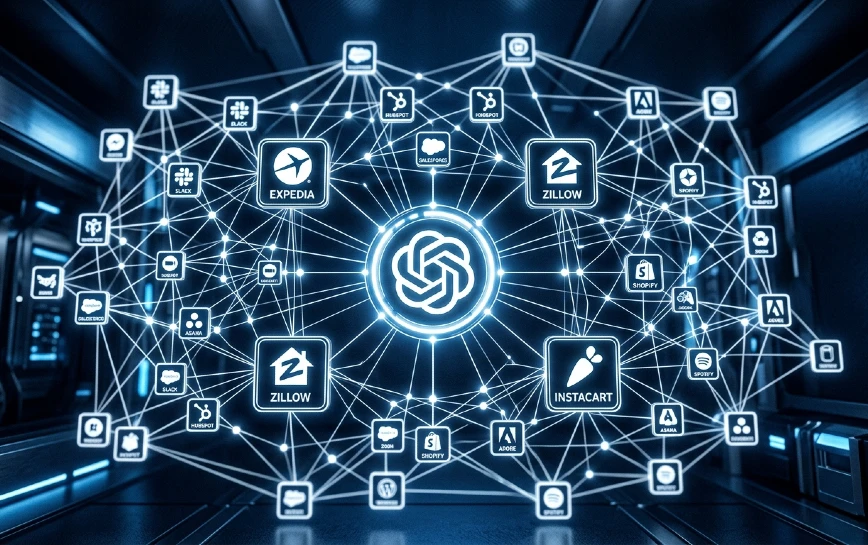
OpenAI just flipped a switch that most people haven’t fully processed yet. ChatGPT app isn’t just a chatbot anymore. It’s becoming the operating system for how people interact with the internet — and 220+ apps are now plugged directly into it.
This isn’t a minor update. It’s a fundamental repositioning.
What the ChatGPT App Ecosystem Actually Means
The ChatGPT app ecosystem now supports over 220 third-party applications — including household names like Expedia, Instacart, and Zillow. On the surface, it sounds like a features list. In practice, it means you can ask ChatGPT to find a flight, order groceries, or check home listings — all without leaving the chat window.
The technical backbone making this work is “Sign in with ChatGPT.” Think of it the way you think about “Sign in with Google” — except instead of just authenticating, it gives ChatGPT persistent context across services. You’re not just logging in. You’re letting AI act on your behalf across an entire app layer.
That’s a meaningfully different thing.
The Super-App Ambition Is Real
OpenAI is building something that resembles WeChat in architecture — a single interface where commerce, travel, real estate, and content creation all live together. The difference is that ChatGPT uses natural language as the interface, not menus or icons.
Here’s what that looks like in real life:
- Expedia integration: Ask ChatGPT to plan a trip and it pulls live prices, availability, and booking — no tab-switching.
- Instacart integration: “Order ingredients for tonight’s dinner” becomes an action, not a search.
- Zillow integration: Property discovery through conversation — “show me 3-bed homes under $400K in Austin” works in plain English.
Each of these is a Trojan horse. The user thinks they’re using ChatGPT for convenience. What’s actually happening is OpenAI is capturing the transaction layer — the most commercially valuable part of the internet.
Why Businesses Should Be Paying Attention Right Now
For marketers and ecommerce operators, this is both an opportunity and a threat — depending on whether you’re inside the ecosystem or outside it.
Inside the ecosystem, you get access to ChatGPT’s massive and growing user base with intent already primed. Someone asking “what’s the best hotel in Lisbon in May” is a buyer, not a browser. That’s premium placement with zero extra ad spend.
Outside the ecosystem, you risk being invisible. If ChatGPT consistently recommends integrated partners for travel, shopping, and real estate queries, non-integrated businesses may simply not exist in that conversational layer.
Some things businesses can do right now:
- Explore ChatGPT plugin development to get inside the ecosystem early
- Review OpenAI’s partner documentation for integration eligibility
- Treat conversational AI presence the same way you treated SEO circa 2012 — it’s early, and early movers will win
The “ChatGPT as Marketing Hub” Angle
There’s an interesting convergence happening. Tools like Copy.ai built entire businesses around AI-powered marketing content. ChatGPT with 220+ integrations is now quietly doing what Copy.ai does — but as a default behavior inside a platform people already use daily.
This doesn’t necessarily kill Copy.ai. What it does is compress the space between “AI writing tool” and “AI action tool.” The next generation of marketing won’t be about generating copy in isolation. It’ll be about AI that generates, publishes, A/B tests, and optimizes — all within one connected workflow.
The ChatGPT ecosystem is a skeleton for exactly that.
How Does This Stack Up Against Gemini?
Google’s Gemini ecosystem is the most direct comparison, and the race is genuinely interesting to watch.
Gemini has structural advantages ChatGPT doesn’t — it’s baked into Android, deeply wired into Google Search, and has native ties to Gmail, Docs, and Maps. If you’re a Google-native user, Gemini’s integrations feel frictionless in ways ChatGPT has to earn.
But ChatGPT has something Gemini is still building: trust and habitual use. Hundreds of millions of people already use ChatGPT daily. The app ecosystem isn’t convincing them to try a new platform — it’s expanding what they already do on one they trust.
The real question isn’t which AI has more integrations. It’s which AI becomes the default reflex when a user needs to do something — book, buy, find, create. Right now, for a lot of people, that reflex is ChatGPT.
What Developers Should Build Right Now
If you’re a developer or product team, the plugin economy OpenAI is building is a legitimate distribution channel — and it’s early.
Building a ChatGPT plugin today gives you:
- Discoverability inside a high-intent AI interface
- Conversational UX without building your own chatbot
- OpenAI’s credibility as a trust signal for users
The analogy isn’t perfect, but it rhymes with the early App Store. The apps that shipped in 2008 with barely adequate functionality still had first-mover advantages that mattered for years. Custom ChatGPT plugins for niche verticals — legal, medical, logistics, education — remain wide open territory.
The Risks Worth Naming
No serious analysis of this skips the tension.
Platform dependency is real. Building on ChatGPT’s ecosystem means building on OpenAI’s rules. Monetization terms, data policies, and access can change. Any business that lets ChatGPT become a primary distribution channel takes on OpenAI as an invisible business partner.
Data and privacy are live questions. When ChatGPT handles a booking through Expedia, what data persists? Who owns the user relationship? These aren’t hypothetical — they’re the kinds of questions regulators in the EU are already asking.
Competitive dynamics inside the ecosystem could get messy. When multiple real estate apps integrate with ChatGPT, what determines which one gets recommended? Relevance? Revenue share? Algorithmic factors users can’t see? OpenAI will need transparent answers to these as the ecosystem scales.
What Comes Next
The trajectory here is clear. More integrations are coming — OpenAI has signaled that the 220 number is a floor, not a ceiling. Industry observers expect deeper action capabilities (not just recommendations, but completed transactions), more developer tooling, and eventually tighter enterprise integrations.
The longer-term picture: ChatGPT becomes the interface layer between users and the internet. Not a search engine. Not a browser. An agent that understands what you want and executes it — across whatever platforms are plugged in.
Whether that future is five years away or fifteen, the foundation is being built right now. The ChatGPT app ecosystem expansion isn’t a product update. It’s the first serious version of something much bigger.
check out our latest news
NVIDIA Nemotron Ultra 120B: The Open-Weight AI Model Rewriting Enterprise Intelligence
