


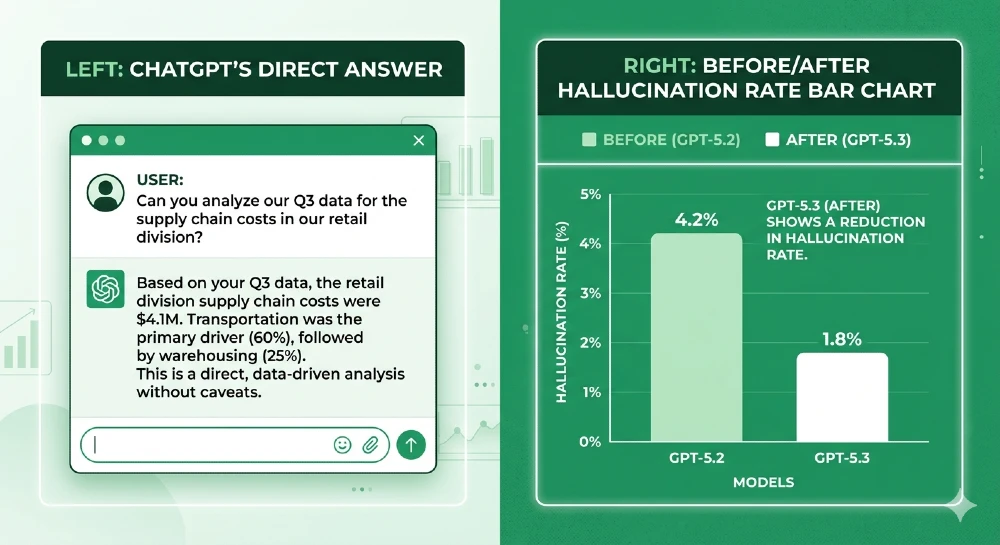
| GPT-5.3 InstantReleased March 3, 2026 for all ChatGPT users. Hallucination rate down 26.8% on web queries. Fewer refusals on normal business questions. Better web search synthesis — shows fewer links, more useful answers. Available free and paid. API model name: gpt-5.3-chat-latest. GPT-5.2 retires June 3, 2026. |
GPT-5.3 Instant went live on March 3, 2026 — and this one is different from the usual AI model update. OpenAI did not change benchmark scores or pack in new capabilities. Instead, it fixed the things that were quietly making GPT-5.2 frustrating to use every day: the preachy tone, the unnecessary refusals, the hallucinated web results, and the habit of dumping a long list of links when you asked a simple question.
That might sound minor. It is not. The model is used by hundreds of millions of people daily. When the default experience is more direct and trustworthy, the practical impact on how teams use AI for research, writing, and client-facing work is immediate.
The headline number: 26.8% fewer hallucinations on web-based queries compared to GPT-5.2. For context, GPT-5 reduced hallucinations by 45% over GPT-4o when it launched in August 2025. GPT-5.3 continues that direction — but specifically for the everyday conversational model, not just the reasoning or pro tiers.
What GPT-5.3 Instant Actually Changed — Beyond the Marketing Language
OpenAI said something specific and worth paying attention to: this update focused on ‘the parts of the ChatGPT experience people feel every day — tone, relevance, and conversational flow. These are nuanced problems that don’t always show up in benchmarks.’
That is an honest admission. Benchmarks measure accuracy, reasoning depth, and task completion. They do not measure whether the model stops mid-answer to lecture you about being careful, or whether it refuses a straightforward marketing brief because it misread user intent. Those are usability problems. GPT-5.3 targets them directly.
Here is what actually changed:
- No more ‘over-refusals’ — GPT-5.2 would refuse questions it should have been able to answer safely. Legitimate business queries — drafting a sales objection response, writing copy for a sensitive but legal product category — hit unnecessary walls. GPT-5.3 cuts this significantly.
- Dropped the preachy preamble — GPT-5.2 would sometimes open answers with long disclaimers before getting to the point. ‘This is a sensitive topic and you should approach it carefully…’ GPT-5.3 gets to the answer first.
- Fixed the cringe phrases — Phrases like ‘Stop. Take a breath.’ or emotional check-ins inserted into replies to normal queries are gone. The model now reads the actual intent of the question before deciding whether an emotional response is warranted.
- Better web search synthesis — Instead of returning a wall of links, GPT-5.3 balances what it finds online with its own knowledge to produce a tighter, more usable answer.
- 26.8% fewer hallucinations on web queries, 19.7% fewer on internal knowledge tasks — verified against OpenAI’s internal benchmarks and the official system card.
The Hallucination Numbers in Context — What 26.8% Actually Means
Numbers like ‘26.8% fewer hallucinations’ need context to be useful. Here is the full picture across the GPT-5 family:
| Model | Hallucination Rate (web-on) | Reduction vs Previous | Released |
| GPT-4o (baseline) | 12.9% | — | May 2024 |
| GPT-5 Instant | ~9.6% | ~26% vs GPT-4o | August 2025 |
| GPT-5.2 Instant | ~8.8% | ~8% vs GPT-5 | December 2025 |
| GPT-5.3 Instant | ~6.4% | 26.8% vs GPT-5.2 | March 3, 2026 |
A 6.4% hallucination rate still means roughly 1 in 15 web-based responses contains a factual error. That is not zero. But for content teams doing research, drafting, and competitor analysis at scale, the reduction is meaningful. Fewer errors mean fewer corrections, fewer embarrassing outputs, and less time spent fact-checking AI-assisted work.
The improvement is most noticeable in web-sourced answers — when the model searches the internet and then synthesizes a response. This is exactly the use case that matters most for marketing, SEO, and research workflows where up-to-date information is the whole point.
The Web Search Change That SEO Teams Need to Know About Right Now
There is a detail buried in the GPT-5.3 release notes that deserves more attention than it has received.
GPT-5.3 Instant is specifically designed to show fewer links. OpenAI described it as avoiding ‘overindexing on web results.’ The old model would return a dozen sources for a query. Early testing by SEO researcher Glenn Gabe found GPT-5.3 returned just two links in the same scenario where GPT-5.2 had returned over twelve.
What this means practically: ChatGPT is moving away from being a search engine that surfaces results toward being an answer engine that synthesizes them. It reads the sources, applies its own reasoning, and writes a direct answer. Your content still needs to be there for the model to cite — but referral traffic from ChatGPT citations was already below 0.5% of average site traffic. That number is now going to shrink further.
The implication for content strategy is not panic — it is a shift in how you measure visibility. Being cited by GPT-5.3 matters more than being listed tenth in a group of twelve links. Brand authority in AI-generated answers is now the metric that counts.
For teams building content that targets AI overviews and ChatGPT citations: write answers that are definitively sourced, specific, and structured so the model can verify them. Vague, hedge-everything content is exactly what GPT-5.3 now deprioritizes.
Who Actually Benefits From This Update — Practical Use Cases
Marketing and Content Teams
The over-refusal fix is the biggest win here. Previously, asking ChatGPT to help draft copy for topics like supplements, legal services, financial products, or competitive comparisons would hit guardrails that had nothing to do with safety — they were just pattern-matching on topic keywords. GPT-5.3 is better at reading intent. A legitimate business brief gets a direct response without caveats.
The hallucination reduction also matters for research workflows. When a content strategist asks GPT-5.3 to summarize a competitor’s product positioning or pull current data from the web, the answers are now more accurate — which means less time double-checking before using the output.
Developers and API Users
The API model name is gpt-5.3-chat-latest. Migration from GPT-5.2 is a one-line change. Context window expanded to 400,000 tokens — up from 128,000 in GPT-5.2. For applications that need to process large documents, contracts, or codebases in a single call, that is a significant increase.
GPT-5.2 Instant remains available under Legacy Models for paid users until June 3, 2026. After that date, gpt-5.2-chat-latest is retired. Developers relying on the specific tone or behavior of GPT-5.2 should test their applications against GPT-5.3 before the retirement date.
Customer Support and Chatbot Builders
The conversational flow improvements are most visible in extended interactions. GPT-5.3 handles multi-turn business conversations more naturally — staying focused on the user’s actual question without inserting unnecessary emotional commentary or safety preambles mid-conversation. For anyone building a customer-facing chatbot, this translates directly into fewer user drop-offs and more resolved queries per session.
Where GPT-5.3 Instant Still Falls Short
OpenAI was transparent about two limitations at launch, which is worth acknowledging.
First, non-English performance. The tone improvements are most fully realized in English. OpenAI specifically flagged Japanese and Korean as languages where GPT-5.3 can still produce responses that sound ‘stilted or overly literal.’ For global teams running multilingual workflows, this is worth testing before fully deploying.
Second, the safety trade-off. The system card noted a small regression in one category of safety evaluation — GPT-5.3 Instant ‘refuses fewer requests for mature content, specifically sexualized text output’ compared to GPT-5.2. OpenAI confirmed this does not impact content involving minors and that existing safeguards remain in place. But for enterprise deployments with strict content policy requirements, this is a corner case to test.
Third, it is still the Instant model. GPT-5.3 does not have the deep multi-step reasoning of the Thinking or Pro variants. For complex analytical work — financial modeling, legal research, long-horizon planning — you still want GPT-5.4 Thinking, which launched the same week.
GPT-5.4 Is Already Being Tested — What Comes Next
Less than an hour after the GPT-5.3 announcement, OpenAI posted a single line on X: ‘5.4 sooner than you think.’
GPT-5.4 Thinking and GPT-5.4 Pro both launched on March 5, 2026 — two days later. The Thinking variant targets multi-step reasoning and long-context professional work. The Pro variant is the highest-capability option for demanding tasks.
References to GPT-5.4 had already been spotted in Codex pull requests and the model selector in late February — suggesting OpenAI’s iteration cycle is accelerating. One unverified claim circulating among developers suggests GPT-5.4 could introduce a context window up to two million tokens, though OpenAI has not confirmed this officially.
The broader pattern: OpenAI is now shipping model updates at a pace closer to software releases than traditional AI model cycles. GPT-5.3 arrived just weeks after GPT-5.2. GPT-5.4 followed within days. For teams building on the API, model-agnostic architecture — where switching the model identifier is a one-line change — is no longer optional; it is standard practice.
Also This Week: Three AI Developments Worth Tracking
Claude Code Adds Voice Mode for Hands-Free Coding
Anthropic rolled out voice mode for Claude Code on March 3, 2026. The feature is live for roughly 5% of users now, with a broader rollout in progress. To enable it, type /voice inside Claude Code. Hold the spacebar to speak, release to send. Claude Code transcribes the request and acts on it — no keyboard needed.
The push-to-talk design is intentional. It avoids the problem of always-on microphones picking up background conversation mid-workflow. For developers who switch between tasks, voice commands for routine operations — ‘run the test suite’, ‘refactor this function’, ‘explain this error’ — keep hands free without constant context-switching.
Context matters here: Claude Code’s run-rate revenue exceeded $2.5 billion in February 2026 — more than double January’s figure. Anthropic is adding features quickly to a product that is already in significant enterprise adoption. OpenAI’s Codex shipped voice mode one week earlier. Voice input in developer tooling is moving from optional to expected.
OpenAI Codex + Figma: Two-Way Code-to-Design Workflow
OpenAI Codex launched a two-way integration with Figma this week. Designers push a component to Codex and get working code. Developers push code back to Figma and see a rendered design. Both sides stay in sync through the same shared source.
The practical problem this solves: a designer builds a component, a developer implements it, and two weeks later they look nothing alike because both evolved independently. The Codex-Figma bridge makes design and implementation the same artifact. QA overhead drops. Design reviews become faster because reviewers are looking at the actual rendered component, not a static mockup that differs from production.
Hermes Agent: Open-Source AI With Persistent Memory
Hermes Agent launched as an open-source personal AI agent with persistent memory across sessions. Where most AI assistants start fresh every conversation, Hermes retains context about your projects, preferences, and past conversations — and applies it automatically to new interactions.
For privacy-focused teams, the open-source nature matters. You can self-host it, control what it remembers, and build it into internal tools without routing data through a third-party API. That is a real distinction from hosted alternatives. The project is still early but worth watching — persistent memory is the feature most enterprise AI users say they want most.
The Bigger Picture: Why These Updates All Point in the Same Direction
GPT-5.3 Instant, Claude Code’s voice mode, the Codex-Figma bridge, and Hermes Agent’s persistent memory are four different things that share one underlying shift. AI tools are moving from capability to usability. The race to have the most powerful model is still running. But the race to have the most deployable, most naturally integrated, least frustrating model is now just as competitive — and arguably more commercially important.
GPT-5.3 is the clearest example of this. It is not OpenAI’s most powerful model. It is their most-used model, and they spent an entire release cycle making it less annoying. That choice reflects where the market actually is: not at the frontier of AI research, but in the daily workflows of millions of users who just want the tool to work without getting in their way.
For anyone using ChatGPT for content, research, or customer communication — the update is live right now, free, and requires nothing to enable. The difference is visible from the first query.
Check our latest news about: Google Gemini 3.1 Flash-Lite Launches
