


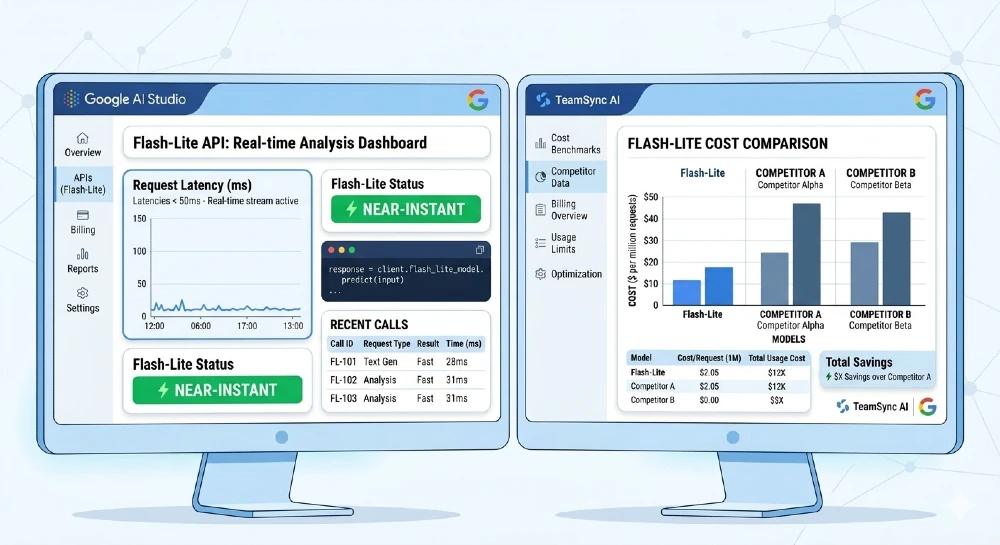
Google Gemini 3.1 Flash-Lite is the most cost-efficient model in the Gemini 3 series — priced at $0.25 per 1M input tokens and delivering 2.5x faster response times than its predecessor. It is now live in preview on Google AI Studio and Vertex AI. For enterprises running millions of API calls daily, this changes the cost equation significantly. |
Google Gemini 3.1 Flash-Lite Is Live — And Enterprise AI Just Got a Lot Cheaper
Google just made enterprise-scale AI noticeably more affordable. Gemini 3.1 Flash-Lite, the newest and most cost-efficient model in the Gemini 3 family, is now rolling out in preview — and the numbers are hard to ignore.
The model is priced at $0.25 per one million input tokens and $1.50 per one million output tokens. That puts it well below competitors in the same tier. For context, Anthropic’s Claude Haiku — which targets a similar market — costs $1.00 per million input tokens. Flash-Lite is four times cheaper on input alone.
Speed is the other headline. Google reports a 2.5x improvement in time to first answer token compared to Gemini 2.5 Flash, with 45% faster overall output. For real-time applications — customer support bots, live content moderation, instant UI generation — that latency gap is the difference between a tool that feels responsive and one that feels sluggish.
Available now: Google AI Studio (Gemini API) and Vertex AI, in preview. Wider enterprise rollout follows.
What Google Gemini 3.1 Flash-Lite Actually Does — Beyond the Press Release
Most AI model announcements describe capability in the abstract. Here is what Flash-Lite is specifically built to handle:
- High-volume translation — processing thousands of documents simultaneously without the cost overhead of a larger model
- Content moderation at scale — reviewing user-generated content across platforms in real time
- Dynamic UI generation — filling a product wireframe with hundreds of items instantly, as Google demonstrated in its launch material
- Intent routing — directing user queries to the right system with 94% accuracy, according to early enterprise testers
- Dashboard generation — building live data dashboards from real-time inputs without manual templating
The practical framing is this: Flash-Lite is not trying to reason through complex problems. It is built to do repetitive, high-frequency tasks reliably and at very low cost. Think of it as the workhorse model you run on every support ticket, every log file, every product description — tasks where you need consistent output but not frontier-level reasoning.
Google’s benchmarks back this up. Flash-Lite scored 86.9% on GPQA Diamond (complex reasoning), 76.8% on MMMU-Pro (multimodal understanding), and 88.9% on MMMLU (multilingual Q&A). On the Arena.ai leaderboard, it holds an Elo score of 1432 — placing it ahead of several comparable-tier models from earlier generations.
The Real Cost Math: Why Enterprises Are Paying Attention
Here is the comparison that enterprise teams care about most:
| Model | Input (per 1M tokens) | Output (per 1M tokens) | Speed vs Flash-Lite |
| Gemini 3.1 Flash-Lite | $0.25 | $1.50 | Baseline (fastest) |
| Gemini 2.5 Flash | $0.30 | $2.50 | 2.5x slower |
| Gemini 3.1 Pro | $2.00 | $8.00 | Significantly slower |
| Claude Haiku (Anthropic) | $1.00 | $5.00 | Comparable |
| GPT-4o Mini (OpenAI) | $0.15 | $0.60 | Comparable |
The number that stands out: when comparing Flash-Lite to Gemini 3.1 Pro for high-context workloads above 200,000 tokens per interaction, Flash-Lite is between 12x and 16x cheaper. That is not a marginal efficiency gain — that is the difference between AI being a cost center and AI being affordable infrastructure.
The practical setup many enterprises are moving toward is a cascading architecture. Gemini 3.1 Pro handles the initial complex reasoning and planning. Flash-Lite handles the high-volume, repetitive execution. One model for depth, one for scale. Google has clearly designed the Gemini 3 family with this split in mind.
Adjustable Thinking Levels: The Feature Developers Will Actually Use
One detail that has not received enough attention: Flash-Lite ships with adjustable thinking levels in AI Studio and Vertex AI. Developers can configure how much reasoning the model applies before generating a response.
This is genuinely useful. A content moderation task does not need deep reasoning — it needs fast classification. A UI generation task needs more structured thinking before it produces valid code. Being able to dial this up or down per task type means teams can optimize for speed or accuracy depending on what each individual use case requires.
It also has direct cost implications. More thinking = more tokens = higher cost. Being able to cap reasoning for lightweight tasks keeps bills predictable in high-frequency deployments.
What This Launch Means for the Broader AI Market
Flash-Lite is not trying to be the most capable model. It is trying to be the most deployable one. That is a different kind of competition — and arguably a more important one for the 90% of businesses that do not need frontier AI, just reliable AI they can afford to run everywhere.
Google’s broader play here is clear. By pricing the efficiency tier aggressively and building it into the same Google Cloud ecosystem that enterprises already use for storage, analytics, and compute, the barrier to adoption drops significantly. Companies that are already on Google Cloud can start running Flash-Lite on their workflows without switching providers, renegotiating contracts, or learning a new platform.
That is the real competition — not model capability benchmarks, but ecosystem integration and switching costs. OpenAI, Anthropic, and Meta are all building capable models. But Google is building a model family that fits into where enterprise infrastructure already lives.
Also This Week in AI: Three Developments Worth Tracking
Claude Code Adds Voice Mode for Hands-Free Coding
Anthropic began rolling out voice mode for Claude Code on March 3, 2026 — announced directly by engineer Thariq Shihipar on X. The feature is live for approximately 5% of users right now, with a wider rollout planned over the coming weeks.
The setup is simple: type /voice to toggle it on, hold the spacebar to speak, and Claude Code converts your spoken request into a coding action. You can ask it to refactor a module, debug a failing test, or generate a new endpoint — all without touching the keyboard. The push-to-talk design (rather than always-on listening) keeps it precise and professional, avoiding the problem of the mic activating mid-thought.
What makes this significant is the context: Claude Code’s run-rate revenue crossed $2.5 billion in February 2026, more than doubling since January, with enterprise customers now accounting for over half of total revenue. Voice is not a gimmick here — it is Anthropic adding a feature to one of its fastest-growing products at a moment of rapid developer adoption. OpenAI’s Codex shipped its own voice mode one week earlier, on February 26. Voice input is quickly moving from differentiator to baseline expectation in developer tooling.
- Available to: Pro, Max, Team, and Enterprise Claude subscribers — no extra charge
- How to enable: Type /voice in Claude Code to toggle on
- Current rollout: 5% of users, expanding through March
OpenAI Codex Launches Two-Way Integration With Figma
OpenAI’s Codex now connects directly with Figma, creating a two-way workflow between design and code. Designers can push a Figma component to Codex and get working code back. Developers can push code to Figma and see a rendered design representation.
This closes a gap that has existed in product teams for years. Currently, a designer creates a component in Figma, a developer interprets it and writes code manually, and the two outputs often diverge as both sides continue to iterate. The Codex-Figma integration aims to keep design and code in sync without either side having to manually translate the other’s work.
For product teams, this has practical implications beyond speed. When design and code are the same source of truth, QA overhead drops. Design reviews become faster because the rendered component is the actual component, not a static mockup that will differ from implementation.
Hermes Agent: Open-Source Personal AI Agent With Persistent Memory
A new open-source project called Hermes Agent launched this week, built as a personal AI agent with persistent memory. Unlike chat-based AI assistants that reset context between sessions, Hermes retains information about projects, preferences, and past conversations across time.
The persistent memory angle is what makes Hermes worth watching. Most AI agents today are stateless — each session starts fresh, requiring the user to re-establish context every time. Hermes stores what it learns about your work, writing style, project structure, and preferences, then applies that context automatically in future interactions.
Being open-source means teams can self-host it, modify the memory architecture, and build it into internal tools without sending data to a third-party API. For privacy-conscious organizations, that is a meaningful distinction from cloud-based agents.
What to Watch Next
- Flash-Lite general availability date — currently in preview; Google has not set a GA timeline
- Whether Gemini 3.1 Flash-Lite gets image generation capabilities paired with Nano Banana 2 for marketing-scale creative production
- Claude Code voice mode expansion beyond the initial 5% — Anthropic has not given a full rollout deadline
- Figma’s response to the Codex integration and whether Adobe or Sketch follow with similar AI partnerships
- How Hermes Agent’s persistent memory architecture compares when enterprise teams test it against hosted alternatives like Mem.ai
The pattern across all three of this week’s major developments — Flash-Lite’s cost efficiency, Claude Code’s voice mode, and Codex’s Figma bridge — points in the same direction. AI tools are moving from capability demonstrations to workflow integration. The question is no longer what AI can do in isolation. It is how quickly it slots into the tools teams already use, at a price they can afford to run continuously.
Flash-Lite is the clearest example of that shift. It is not the most powerful model Google has released. It is the most deployable one. And in enterprise AI right now, deployability is winning.
Check Latest news about: Claude vs ChatGPT: Enterprise Market Share Shift 2026
