


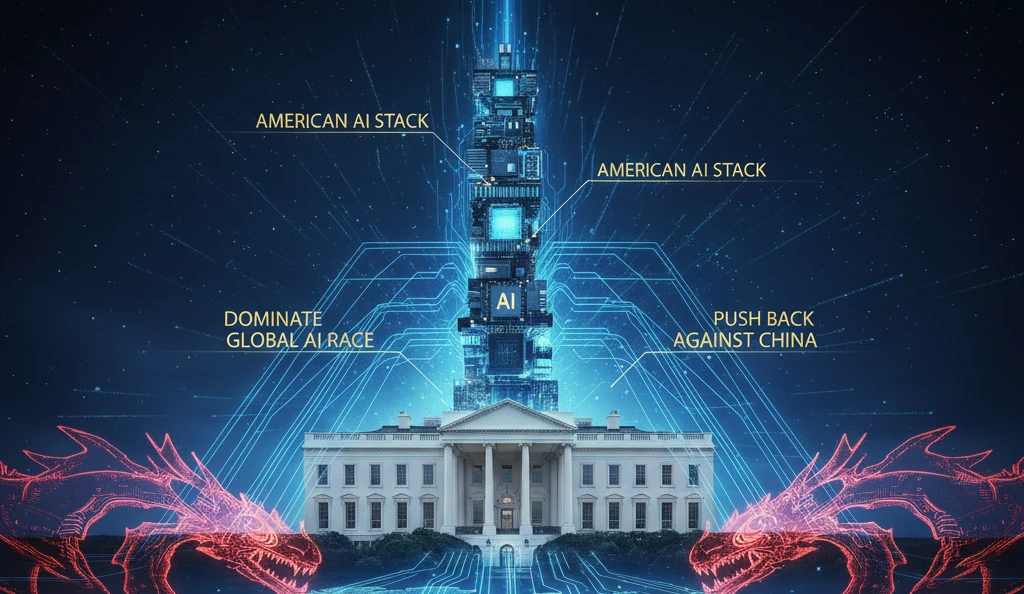
The U.S. isn’t just building AI at home anymore — it’s exporting the entire playbook. In a sweeping set of announcements tied to the India AI Impact Summit 2026, the White House unveiled a cluster of aggressive global AI initiatives designed to make American technology the default infrastructure for AI adoption worldwide. The message was direct: take American AI, or risk falling into China’s orbit.
This isn’t a research paper or a policy draft. These are live programs, signed executive orders, and budget-backed initiatives — already in motion.
What Actually Got Announced (And Why It Matters)
White House OSTP Director Michael Kratsios made the announcement at the India AI Impact Summit 2026, framing it around the concept of the “American AI stack” while explicitly rejecting centralized global AI governance models. GovInfoSecurity
The core of the announcement breaks down into five concrete programs:
- American AI Exports Program — full-stack AI packages for partner nations
- U.S. Tech Corps — volunteer technologists deployed overseas
- National Champions Initiative — integrates foreign AI firms into U.S.-built export stacks
- World Bank AI Fund — Treasury-backed fund to remove adoption barriers
- NIST AI Agent Standards — interoperability and security standards for agentic AI
Let’s go through each one, because the details actually matter here.
The American AI Exports Program: More Than Just Selling Software
The Secretary of Commerce, in consultation with the Secretary of State and OSTP Director, has 90 days to establish and implement the American AI Exports Program, which supports the development of United States full-stack AI export packages. White House
Think of it as a franchise model for national AI infrastructure. A partner country doesn’t just get a chatbot or a cloud contract — they get chips, servers, cloud infrastructure, AI models, data pipelines, and cybersecurity controls bundled into one modular offering. It’s a complete ecosystem.
The program targets critical sectors — healthcare, energy, agriculture, and citizen-facing government services — positioning U.S. technology as the default foundation for national AI deployments abroad. GovInfoSecurity
That last part is the strategic goal. Default foundation. Not just preferred vendor. Default.
U.S. Tech Corps: Peace Corps, But for AI Deployment
Here’s one that flew under the radar. The U.S. Tech Corps envisions engineers and data specialists embedded with foreign ministries and public agencies to help operationalize AI systems in areas such as digital identity, fraud detection, and public health analytics. GovInfoSecurity
This is smart, quiet geopolitical work. Embedding American technologists inside foreign governments means they build familiarity with U.S. tools, frameworks, and approaches at the ground level. By the time a procurement decision comes around, the choice feels natural.
It’s technical diplomacy. And it scales in ways that trade deals don’t.
National Champions Initiative: Bringing Local Firms Into the U.S. Orbit
The National Champions Initiative is a Commerce Department-run program integrating leading AI firms from partner countries into customized export stacks built around U.S. components. Officials said the goal is to demonstrate that American platforms can strengthen domestic innovation ecosystems instead of displacing them. GovInfoSecurity
This is the White House’s answer to the loudest criticism of American tech expansion: that it crowds out local players. By folding partner-country firms into the American stack rather than replacing them, the initiative tries to make U.S. dependency feel more like a partnership.
Whether that framing holds up in practice — especially in markets with strong local AI ambitions — remains the real test.
Treasury’s World Bank Fund and NIST Agent Standards
Two supporting moves worth noting:
Treasury will launch a new World Bank fund focused on overcoming AI adoption barriers, while additional programs at the Export-Import Bank, the U.S. International Development Finance Corporation, the State Department, and the Small Business Administration will be aimed at “de-risking” American AI exports in the private sector. GovInfoSecurity
Basically: financial tools to remove the cost friction that stops developing nations from adopting American AI infrastructure. If the tech is free or subsidized at the entry point, the long-term dependency becomes the real product.
On the standards side, NIST previewed its AI Agent Standards initiative — a move to define interoperability and security protocols for agentic AI systems. Get your standards adopted globally, and you don’t just win today’s market. You shape the rules of every market that comes after.
The Real Tension: Speed vs. Safety
Not everyone is cheering. Cybersecurity experts warned that rapid AI expansion without guardrails could amplify systemic risks. GovInfoSecurity
The AI Action Plan marks a decisive pivot toward deregulation as a key driver for rapid innovation — but its long-term impact hinges on uncertain state-federal dynamics and the practical outcomes of policies that prioritize speed over safeguards. Workforcebulletin
That’s the honest tension embedded in this whole strategy. Moving fast is the stated priority. But deploying AI infrastructure across dozens of foreign governments, in healthcare and energy systems, without robust security standards in place — that’s a large attack surface opening up in real time.
Check news: OpenAI GPT-4.5 “Orion” Is Here — And It Might Be the Most Human-Feeling AI Yet
The Geopolitical Pushback: Europe and India Aren’t Fully Buying It
This initiative lands in a world where several major players are actively building alternatives. Europe has been backing Mistral AI and pushing for sovereign AI models that aren’t beholden to American cloud providers. India, hosting the very summit where these announcements were made, has its own ambitions around homegrown AI infrastructure and data localization.
The White House approach assumes that American tech is good enough, cheap enough, and trusted enough that partner nations will choose it over building their own. That’s a reasonable bet in many markets. It’s a harder sell in others.
The Plan’s international pillar explicitly focuses on countering Chinese influence in international governance bodies and strengthening AI compute export control enforcement — including plugging loopholes in existing semiconductor manufacturing controls. Wiley
China isn’t passive in this either. Huawei, state-backed AI labs, and aggressive infrastructure financing through the Belt and Road Initiative all offer alternatives to American AI stack adoption, particularly in Africa, Southeast Asia, and parts of Latin America.
Check Lates news: Grok 3 ‘Smartest AI’ Claim Under Fire: Musk’s xAI Accused of Political Bias
What’s Next
The Commerce Department was directed to establish and implement the American AI Exports Program by October 21, 2025, with a public call for proposals from industry-led consortia already required. Wiley
That timeline has passed — meaning the program is either live or behind schedule. Either way, 2026 is the year these initiatives move from announcement to implementation. Watch for:
- First batch of partner countries formally adopting American AI stack packages
- NIST releasing draft agentic AI standards for public comment
- Tech Corps pilot deployments in South and Southeast Asia
- Pushback from the EU on sovereignty grounds
The American AI Stack isn’t just a product line. It’s a foreign policy doctrine dressed in silicon. Whether it works depends on whether partner nations see it as a partnership — or a dependency they’d rather avoid.
The White House AI Action Plan is publicly available at whitehouse.gov. The full export executive order was signed July 23, 2026.
