


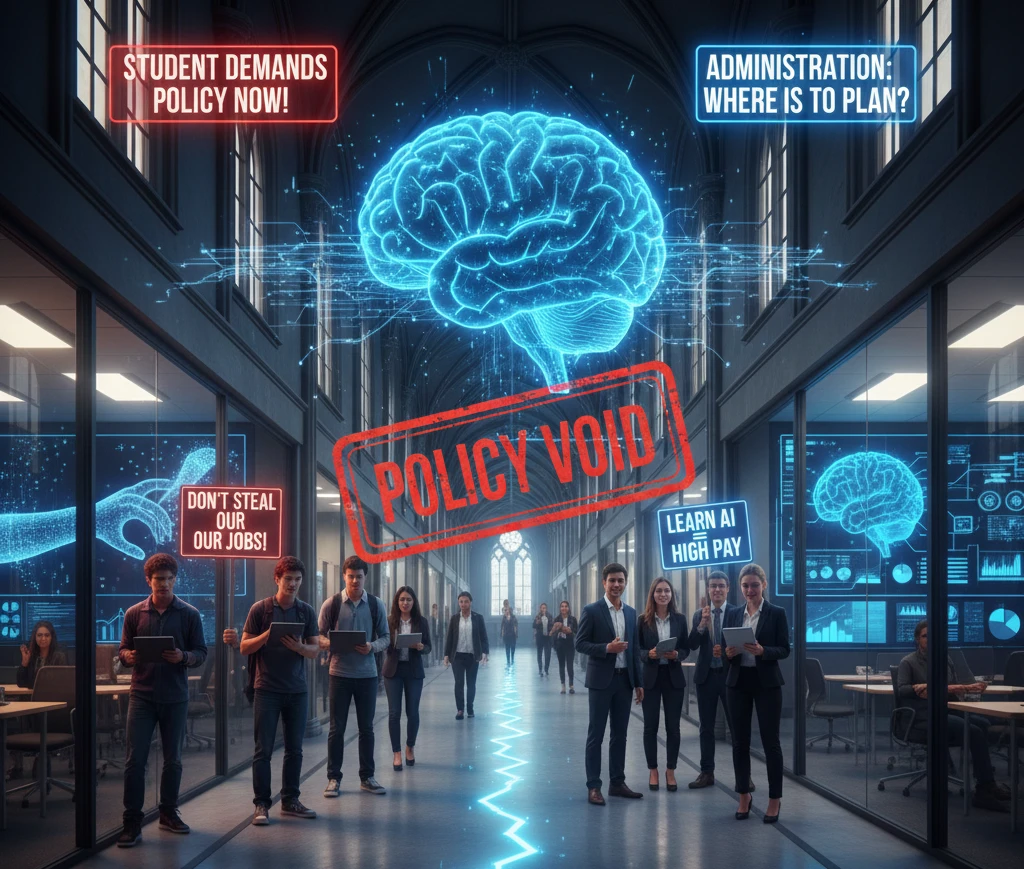
The biggest lie in higher education today is the phrase, “We have a plan for AI.”
Most universities, despite the glossy press releases and the creation of toothless “Working Groups,” are operating on a policy framework written in 2019—a digital Stone Age when ChatGPT was still a corporate research project. The technology moved from zero to industrial scale in 18 months, yet the institutions charged with educating the next generation are still debating plagiarism rules.
This disconnect is the new crisis.
The real friction is not between students and technology, or even between faculty and cheating. It’s between a rapidly digitizing, AI in College Classrooms job market demanding proficiency, and academic administrations stuck in a three-year committee cycle.
The noise coming out of Ithaca College—a small liberal arts school—is a perfect microcosm of this global policy vacuum. When the Student Governance Council (SGC) has to form its own ad hoc committee to wrangle student opinions on AI, you know the official chain of command has fundamentally failed. The students are now the policy architects. That is a pattern interrupt that should alarm every university president and every hiring manager watching the output quality of new graduates.
The Policy Vacuum: When Administration Fails to Lead
The core finding from Ithaca is not that students are using AI. We knew that. The key takeaway is the sheer lack of guidance from the top.
Ithaca’s Presidential Working Group on AI was established in July 2024 and disbanded in May 2025—a ten-month run that failed to issue any binding instructions on how AI should be used in instruction. The authority was simply delegated back to the faculty.
This is the standard institutional policy default: ambiguity.
Delegating to faculty is not a strategy; it’s an abdication of leadership. It creates chaos:
- The Syllabus Lottery: Students face wildly different rules semester-to-semester, professor-to-professor, department-to-department. One class bans ChatGPT entirely; the next requires it. This inconsistency is unfair and counterproductive.
- The Integrity Trap: How can a university uphold “academic integrity” when the definition of cheating changes weekly? Without a unified campus policy, every cheating allegation becomes a subjective fight.
- The Lag Time: By the time a decentralized faculty body agrees on a common standard, the large language models (LLMs) have iterated twice, and the tools being regulated are already obsolete.
According to a 2025 UNESCO global survey, while two-thirds of higher education institutions are either developing or have guidance, the confidence in effective pedagogical application remains uneven. Institutions know they need a policy, but they are terrified of committing to a technical standard that will embarrass them six months later. So, they stall.
The AI Job Anxiety
The most visceral resistance to AI in College Classrooms doesn’t come from calculus; it comes from the creative departments. This is where the debate transitions from plagiarism to livelihood.
Sophomore Devon Masterson, a digital media major, articulated the problem perfectly: forced assignments using generative visual AI felt like training students to outsource their own future jobs.
This isn’t philosophical resistance; this is economic reality.
The Creatives’ Calculation
Students in visual arts, graphic design, and animation are watching their entry-level job security vaporize. Data from the 2025 AI Index Report shows that entry-level workers, particularly those aged 22–25 in AI-exposed fields, are already facing employment decline in companies that have aggressively adopted AI.
The concerns boil down to three engineering-grounded points:
- Devaluation of the Skill: When a CEO sees an AI tool generating web illustrations or basic ad jingles in 30 seconds for near-zero cost, the perceived value of a human artist’s time collapses. Creatives are increasingly asked to “review” or “edit” AI output rather than creating original work, diminishing their skill and agency.
- The Training Data Theft: Generative AI models are trained on billions of images, often scraped without consent or attribution from platforms where artists displayed their work. Students are correctly pointing out that using these tools means participating in a system built on unauthorized data extraction. Why should they be required to use a tool that is actively displacing the community they hope to join?
- The Cost Curve: DreamWorks Animation co-founder Jeffrey Katzenberg once predicted that animation film costs could drop by 90% due to generative AI, requiring fewer than 10% of the artists needed previously. This isn’t hype; it’s a cold-hard CapEx calculation. For an aspiring animator, this forecast means the job market has shrunk by an order of magnitude before they even graduate.
This is why forced assignments are toxic. The university risks being seen as complicit in the very automation process that is threatening its students’ careers.
The Learning Bypass: When AI Becomes a Conceptual Crutch
The second major conflict over AI in College Classrooms exists in technical fields, specifically STEM.
Ayush Sharma, a computer science major, spoke about his experience in a calculus class where AI was used to solve differential equations. The core student complaint was simple: You must learn the mechanism before you use the shortcut.
The Danger of Automated Mastery
A large language model (LLM) can flawlessly solve a complex differential equation, but it cannot explain why it chose that specific solution method, nor does it grasp the physical reality the equation models.
If you let a student use an LLM to solve the problem before they have internalized the concepts (the method of variation of parameters, integrating factors, etc.):
- The Illusion of Competence: The student receives an A on the assignment, falsely believing they have achieved mastery. The only thing they mastered was prompt engineering.
- The Degradation of Formative Years: The most valuable part of a computer science or engineering degree is the painful process of debugging, deriving, and failing until the underlying mechanism clicks. AI bypasses the pain and, therefore, bypasses the learning.
- The Skills Deficit: When that student enters a research lab or a specialized industry role, they cannot pivot when the AI fails, because they never built the conceptual foundations. They are dependent on the tool for basic execution.
This is not a uniquely academic problem. It mirrors the corporate mistake of relying on augmented analytics tools to democratize data—giving someone a dashboard without training them on the data governance, ethics, or statistical rigor underpinning the numbers. The output is only valuable if the human can validate the inputs and the methodology.
For technical fields, the policy should be simple: AI as a tool for scale, not a substitute for derivation. Use it to check your final answer, not to generate the first line of the solution.
The Real ROI: Preparing for the $109 Billion AI Economy
While the ethical and academic integrity issues are critical, the university’s primary function remains to position students for economic success. Here, the case for embracing AI in College Classrooms becomes undeniable.
First-year marketing student Tatianna Lagares highlighted the shift in the School of Business, where a new analytics class focuses specifically on AI. This is where academic policy finally aligns with market reality.
The Business School Mandate
Businesses are all-in on AI. The 2025 AI Index Report noted that U.S. private AI investment hit $109.1 billion in 2024, and 78% of organizations now report using AI in some capacity—up from 55% the year prior.
This massive investment translates into a change in required skills for entry-level positions:
- Consulting Firms: Top-tier consulting groups like McKinsey and Deloitte now require AI proficiency for an estimated 20% of advertised positions.
- Finance and Accounting: AI tools are automating repetitive data entry, risk modeling, and fraud detection. Graduates must know how to use these tools to move from data entry to data analysis and advising.
- Marketing Analytics: AI is instrumental in customer segmentation, A/B testing, and predictive marketing. Graduates who can wield a custom GPT to pull insights from a massive SQL dataset have a massive market edge.
The goal is not to teach students how to use ChatGPT to write an essay. The goal is to teach them AI literacy:
- Prompt Engineering: Asking the right question to get an actionable result.
- Data Validation: Critically evaluating the output for hallucinations, bias, and source material.
- Ethical Application: Understanding the legal and moral ramifications of using AI in customer-facing or data-sensitive roles.
The student quoted the harsh reality: “Do you want to learn AI because if not, you’re going to get left behind…?” This isn’t a threat; it’s a career path projection. The university must teach AI, not as a cool future concept, but as the essential, immediate operating system of the modern business world.
The Engineering Challenge: Policy vs. Reality
The policy debate often ignores the fundamental engineering challenge facing every institution: The Data Quality Problem.
Professor Ali Erkan, the Computer Science Chair, pointed out the institutional flaw: educators are “throwing this and hoping for the best” without policy guidance. This blind adoption is dangerous because university infrastructure is notoriously fragile and siloed.
Why University Systems are Brittle
The same data integration issues that plague the Food and Beverage Supply Chain (as previously covered) cripple academic institutions:
- Legacy ERP: Most universities run on decades-old Enterprise Resource Planning systems that barely talk to one another. Admissions data, library logs, and grade books live in separate, poorly structured databases.
- Garbage In, Garbage Out (GIGO): Any AI initiative launched at the institutional level—say, an AI tutor for every student—will be fed garbage data about student performance, retention rates, and past pedagogical results. The AI will then optimize based on institutional nonsense, potentially making discriminatory or nonsensical recommendations.
- The Cost Wall: Implementing a true, campus-wide AI integration—meaning installing new hardware, updating network infrastructure, standardizing data formats, and training thousands of faculty—is a capital expenditure project measured in the tens of millions. The initial cost wall is what prevents all but the wealthiest institutions (like Oxford, Monash, or Stanford, who have released guidelines) from leading.
The failure to create a policy is often just a symptom of the failure to standardize and clean the underlying data infrastructure. You cannot automate what you cannot measure accurately. And most universities cannot measure learning outcomes or resource utilization with any real precision yet.
The Policy Delay Is a Feature, Not a Bug
I’ve spent years watching technology move from the proof-of-concept stage in a Silicon Valley garage to the boardroom. The current situation in higher education is classic: panic leads to paralysis.
The fact that the Ithaca College students are running a three-year committee to fix the administration’s policy failure is cynical, but deeply necessary. It proves that the students are demanding a policy that serves their interests, not merely one that protects the institution’s integrity (i.e., preventing cheating).
Here is the inevitable future of AI in College Classrooms, whether administrators like it or not:
- The Great Bifurcation is Underway: We will see a rapid split between institutions. The top-tier schools will embrace AI, requiring it for graduation (especially in business, engineering, and law), and market their AI-fluency. The mid- and lower-tier schools will mostly ban it, trying to preserve traditional academic models. This creates a competitive chasm that severely limits job mobility for graduates of the latter group.
- The Tool is the Textbook: Professors who cling to “no AI” policies are handicapping their students. The job market is asking, “Do you know how to use Microsoft Copilot to summarize this regulatory filing and generate a client email?” The answer cannot be “I was taught in a Luddite-friendly environment.” We must teach AI not as a subject, but as a mandatory utility layer.
- Transparency > Trust: The student-driven policy must demand transparency. When an AI tool is used for grading, feedback, or administrative decisions (like course enrollment or advising), the model, its data source, and its decision logic must be auditable. The fear of bias is real, and the only antidote is rigorous data governance and open-source methodology—something universities rarely embrace.
The entire “AI for accelerated learning” hypothesis, as Professor Erkan noted, was unjustifiable fluff. AI is not here to make learning faster; it’s here to make human professionals more powerful and, critically, to make the entry requirements for every field dramatically higher.
The debate is over. The only policy that matters is the one that prepares students to compete in a world where the ability to derive a calculus solution by hand is secondary to the ability to verify an AI-generated solution at industrial scale.
AI is transforming business growth, from building passive income streams to choosing the best AI tools for success. Stay ahead with top AI infrastructure trends and enhance sales using AI for ecommerce product descriptions. Explore the state of AI for small business 2026 and discover AI tools for solopreneurs to maximize efficiency and innovation.
The BizAIHub FAQ (People Also Ask)
Q1: Is AI making college degrees obsolete?
A: No, but it is rapidly making unspecialized degrees obsolete. AI handles generalized tasks (writing first drafts, basic coding, summarizing). The value of a degree is shifting from rote memorization and generic skill acquisition to conceptual mastery, complex synthesis, and judgment. The degree now signifies that you are trained to operate AI at a professional level and possess the critical thinking skills to correct its errors—a skill AI cannot replicate.
Q2: What is the main ethical dilemma regarding AI in art education?
A: The primary dilemma is the economic ethics of displacement and data theft. Students are worried that required use of generative AI (like Midjourney or DALL-E) forces them to rely on tools trained on uncompensated work scraped from human artists. This participation undermines their own industry’s value and their future income potential, creating a moral conflict between achieving a passing grade and upholding professional ethics.
Q3: How should universities handle the initial cost of integrating AI?
A: AI integration must be treated as mandatory infrastructure upgrade (CapEx), not a discretionary IT purchase. Institutions should prioritize low-cost, high-impact integrations first, such as:
- LLM Bridge for Administrative Tasks: Using generative AI to process and categorize unstructured internal data (invoices, grant applications) to free up human staff.
- Basic AI Literacy Mandate: Requiring all students and faculty to complete a certified course in prompt engineering and data validation.
- Focus on Business/STEM: Investing first in departments (like analytics, finance, and engineering) where the immediate job market ROI justifies the heavy investment.
Q4: Will AI solve academic plagiarism entirely?
A: No. AI detection software is caught in an endless arms race with AI generation software. The best way to mitigate academic dishonesty is not through detection tools, which are prone to false positives, but through assessment redesign. Move away from simple take-home essays that can be outsourced to AI, and toward high-value, real-world assessments that require synthesis, proprietary data analysis, oral defense, and integration of real-time, non-public information.
The committee has been formed, the data is clean, and the business case is closed. The technology has calculated the optimal path for academic excellence and career readiness.
The only remaining question is whether academic leadership has the engineering courage to execute the plan.
