


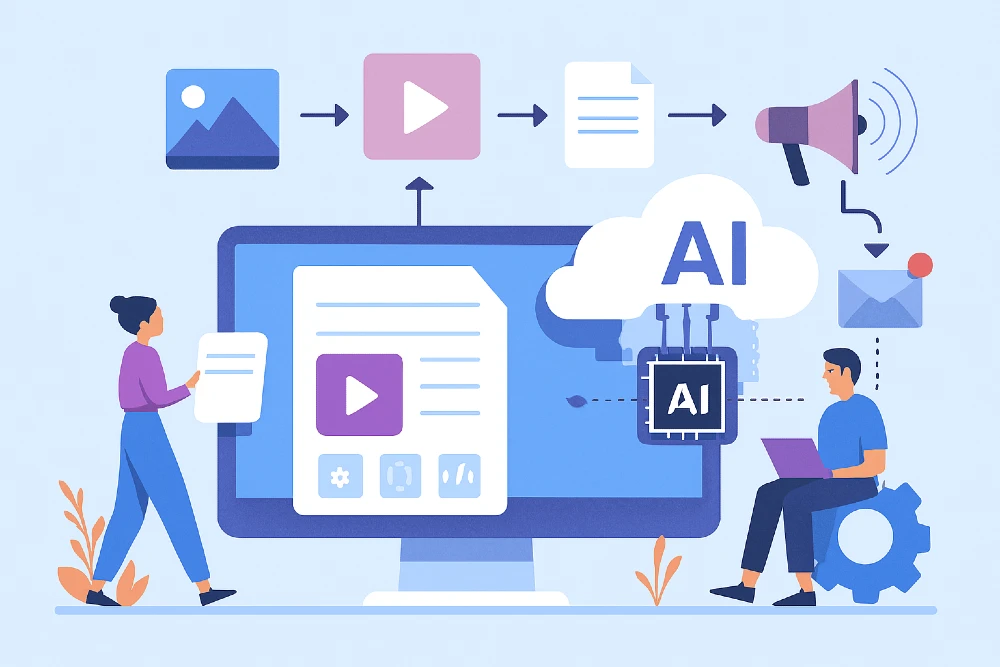
The AI-powered content repurposing workflow is the process by which you convert your existing content into new formats or versions so that you can reach new audiences or use the content in different contexts. By using AI content repurposing workflow, the process saves time and resources and gives your content greater reach and value. In this post, we will be discussing an AI-powered content repurposing workflow that will enable you to efficiently repurpose your content.
Here is an approach for the AI content repurposing workflow:
AI content repurposing workflow is the process of reusing your already existing content in different forms. This allows your content to reach an even bigger audience, and it’s a great way of using your resources efficiently. Here’s a basic workflow to help you do that with AI.
1. Content Audit & Selection
First, you audit your existing content. This is the first, yet crucial, step in repurposing content, as you should make sure that only high-performing or evergreen content is used. Analyze your content based on traffic, engagement, SEO rankings, and more to determine where your best content lies.
You will also need to curate the content that serves your current goals, whether lead generation, brand awareness, or sales. Then you pick the type of content that you would update or reformulate, such as blog posts, videos, or social media posts.
2. Content Extraction & AI-Assisted Summarization
This is the step in which you employ the power of AI tools to extract key points and insights from your content. These tools help summarize long-form content. For text-based content, use AI-driven tools for summary generation with key quotes and important statistics included.
For video content, one can utilize transcription services such as Otter.ai or Descript, providing you with a summary of the video and key highlights that are drawn out. If you have image and graphics content, AI tools can analyze image metadata to generate descriptive captions and alt text that help repurpose the content.
3. Repurposing Formats
Once you’ve summarized your content, now is the time to turn it into different formats suitable for a number of platforms. AI can help you transform blog posts into social media posts, such as using Jasper or ChatGPT to create an engaging caption or carousel.
You can change long-form articles into short-form, like Twitter threads, LinkedIn posts, or TikTok videos. If you have video content, you can convert its scripts into blog posts or articles. You can repurpose audio content into key quotes or highlights and use them in blog posts, social media content, or newsletters.
4. Content Enhancement & SEO Optimization
Now, you have to optimize your repurposed content for SEO in such a way that it will be perfectly optimized on each of the platforms. You can enhance keyword optimization with meta descriptions and internal linking strategies using AI tools.
You may grammar-check your content, either using Grammarly or readability tools like Hemingway. Moreover, you have to adjust the tone and style according to the platform. For example, the tone should be professional on LinkedIn and casual on TikTok.
5. Scheduling & Distribution
Now that your content is prepared, you have to distribute it effectively. You can plan when to post your content with the help of social media scheduling tools like Buffer and Hootsuite.
You can use AI tools, such as SocialBee or CoSchedule, to help you determine the best times to post. You have to tailor the content according to each different platform in terms of format, size, length, or style of posts.
6. Performance Tracking & Iteration
Tracking repurposed content is also essential to understand how it is engaging. Using analytics tools like Google Analytics and Social Media Insights, you track the engagement rate, click-through rates, and conversions of the content.
You can even analyze performance using AI-based tools such as predictive analytics and sentiment analysis. If the content is performing well, you can repurpose it, or if the engagement is low, you might want to tweak it.
Tools You Can Use in the Workflow:
AI Content Creation: ChatGPT, Jasper, Copy.ai, Writesonic, and Rytr
- SEO Tools: Surfer SEO, SEMrush, Ahrefs.
- Transcription Tools: Otter.ai, Descript, Rev. Social Media Scheduling: Buffer, Hootsuite, Later, SocialBee.
- Analytics Tools: Google Analytics, social media insights, BuzzSumo.
Example Repurposing Workflow:
- Step 1: You have a 2,000-word blog entitled “10 Tips for Effective Time Management.”
- Step 2: You summarize this post in five major points using AI tools.
- Step 3: Now, with these key points, create multiple social media posts-a Twitter thread, a LinkedIn post, an Instagram carousel, among others.
- Step 4: Turn the blog post into a short video script or TikTok series.
- Step 5: Schedule the content on various platforms.
- Step 6: Monitor engagement for all posts and adjust the strategy for the next cycle.
You can tailor these workflows to your needs. The key objective is to have your content used in as many channels as possible with minimal effort.
FAQs
1. What are the advantages of repurposing content through AI?
With AI content repurposing, you can increase the reach of your pre-existing content by transforming it into new formats. This saves you a lot of time and resources and optimizes the full value of your content.
2. Are AI tools useful for all types of content?
Yes, AI applications can be used to repurpose all kinds of content: text, video, audio, and images. Each type of content has its own specific AI tool, like Jasper for text, Descript for video, and Otter.ai for audio.
3. On which platforms should the repurposed content be distributed?
Repurposed content should be distributed on every platform where your target audience is. These platforms may include social media: Facebook, Instagram, LinkedIn, Twitter; blogs; YouTube; TikTok; and newsletters.
4. Do AI tools require a manual supervisor?
Of course, AI tools require manual supervision. Sometimes, AI misunderstands the tone or context of content. You have to edit and review the content.
5. Which AI tools are best for SEO-optimization?
Tools like Surfer SEO, SEMrush, and Ahrefs give you AI-powered insights for search engine optimization. These tools will help you make your content keyword-friendly and SEO-friendly.
6. What is the impact of content repurposing on SEO?
Repurposing your content and making it SEO-optimized would increase its visibility and ranking. Having content across different platforms helps with SEO.
7. How does repurposed content improve audience engagement?
Repurposing content means content engages audiences in varied formats. So, long-form to short-form transitions, or even developing social media posts keeping in mind the interest and preference of the audience, increases engagement.
8. How time-consuming is content repurposing?
If you use the right AI tools, content repurposing can become pretty efficient and quick. When you are just starting to implement the process, of course, selecting the right content takes time. Once the workflow gets set, the process is way faster.
9. Does AI content repurposing affect creative quality?
AI tools enhance creativity, but their scope is limited. While AI content repurposing allows you to reinvent ideas, you will need to add a creative touch and human perspective, which AI is not really able to provide.
10. Does using AI tools make content less original?
By reusing your content with AI tools, the core idea of the content remains the same. But when you summarize or transform this content with AI, it does add originality, tailored to your brand.
Explore the AI Playbook to master strategy, then dive into top AI infrastructure trends shaping innovation. Discover the best AI tools for business and learn how to use AI for passive income. Finally, boost your content game with the best AI video generators for 2026. Unlock growth with smart, integrated AI solutions.
