


Let’s cut the corporate drone talk immediately. You don’t want to hear about “synergy” or “co-pilots.” You want to know one thing: Is AI going to take your job, and if not, how do you make sure it makes you dramatically better at it?
The narrative is stuck in a false dichotomy: AI vs. Human. This is a distraction. The real competitive edge in 2025 doesn’t belong to the person who can write the best prompt, nor does it belong to the team relying solely on an automated agent. It belongs to the organization that can design a Human-AI Partnership model where each side is focused on its core competency.
The evidence is overwhelming. Studies show that when AI and humans are paired correctly, productivity gains average around 25%, with some specialized tasks seeing a lift of up to 56% in speed (like JavaScript programming). McKinsey Global Institute calls this the creation of “skill partnerships”—a shift that could unlock almost $3 trillion in economic value in the United States by 2030.
The key is realizing that AI is not a replacement for you; it is an automation engine for the boring, repetitive, and abstractable parts of your work. It’s the engine that gets you to 70% completion, but your specific, nuanced, human judgment is the last 30% that actually captures value.
This post isn’t theoretical. We’re breaking down the hard metrics—like the 34.5% click drop caused by Google’s AI Overviews—and giving you the actionable frameworks and tools needed to not just survive this new era, but to dominate it.
Why Technology Can’t Replace Human Bonds (The Empathy Edge)
We’ve all seen the headlines proclaiming AI will automate half of all work hours. That’s true in a purely technical sense. An AI agent is technically capable of performing tasks that occupy about 44% of U.S. work hours today.
However, theory crashes head-first into reality when you factor in social and emotional intelligence.
The 25% Empathy Gap
The skills least exposed to automation are those related to assisting and caring. This isn’t just nurses and teachers; it’s the account executive who reads the room, the editor who understands subtle cultural context, and the engineer who can translate a complex API into a simple user story.
- Humans handle the “Why”: We excel at goal setting, interpreting intent, defining ethical boundaries, and applying judgment to novel, messy situations that have no historical data.
- AI handles the “How”: AI agents excel at pattern recognition, synthesizing massive datasets, automating execution, and generating the first draft.
The Human-AI Partnership succeeds because it marries human empathy (the ability to feel and build trust) with AI efficiency (the ability to calculate and execute). You can’t automate trust, and trust is the ultimate monetizable asset in the digital world.
Core Human-AI Models: The Essential 70/30 Split
The central framework for effective collaboration—whether in content, code, or classroom—is the 70/30 Rule. It’s the pragmatic hygiene rule for adopting generative AI efficiently.
70%: AI-Agent-Led Tasks (Automation Base)
This is the high-volume, low-value work that can and should be entirely delegated to an AI agent. The goal here is speed and scale.
| AI Task Category | Example Workflow Automation | Tool Focus |
| Data Synthesis | Analyzing 10 competitor reports and summarizing their common product weaknesses. | Perplexity, custom LLMs. |
| First Draft Generation | Creating a 2,000-word article outline and the first 70% of the body copy based on a brief. | NeuronWriter, Claude 3.5. |
| Code Scaffolding | Writing boilerplate CSS/JavaScript functions, debugging simple errors, or translating legacy code. | GitHub Copilot, Devin. |
| Initial Research | Compiling a list of 50 long-tail keywords or finding 20 academic sources on a niche topic. | Semrush, SurferSEO. |
The Goal: The AI delivers a functional, factually sound, 70% complete product. You never start any problem with a blank page.
30%: Human-Led Tasks (The Value-Capture Layer)
This is where your salary is justified. It’s the critical, high-judgment work that an algorithm simply cannot do without generating expensive, embarrassing errors.
- Querying & Prompt Engineering: Asking the right strategic questions to the AI, not just basic ones. The better the input, the more nuanced the 70% base will be.
- Ethical Oversight & Bias Detection: Reviewing the AI’s output for logical fallacies, discriminatory language, or non-compliant data usage.
- Synthesis & Narrative: Weaving the 70% base content into a cohesive, compelling, and brand-aligned narrative that speaks to a specific human persona.
- High-Value Judgment: Applying context, predicting market shifts, and making the final strategic decision (e.g., should we invest in this keyword? is this competitor report accurate in this market?).
The Goal: The human adds the missing 30% of complexity, empathy, and strategic thinking that differentiates a “good” automated output from a “great,” revenue-generating asset. This is how you scale with human-AI teams.
SEO Evolution with Human Oversight (The SGE Challenge)
The digital publishing world is being hammered by a massive shift in user behavior. Google’s Search Generative Experience (SGE), rebranded as AI Overviews, fundamentally changes the value of a top-ranking article.4
The 34.5% Click Drop Reality
You are seeing the data now. The fear is real. New research confirms that when an AI Overview is present on a search results page, the average Click-Through Rate (CTR) for the top-ranking organic page drops by 34.5%.5
| Keyword Position | CTR (Pre-AI Overview) | CTR (Post-AI Overview) | Click Drop |
| Position 1 (With AIO) | 7.3% | 2.6% | 34.5% |
The Takeaway: Google is resolving informational queries directly on the Search Engine Results Page (SERP).6 The age of getting massive traffic from simple, fact-based queries (e.g., “What is the mitochondria?”) is over.
The Human-Oversight SEO Strategy
If AI is summarizing the answer, your content strategy needs to shift from answering the question to driving the next step. This requires deliberate human oversight in AI SEO.
1. Target Gaps, Not Facts (The Content Audit)
- AI Task: Use a tool like NeuronWriter or SurferSEO to perform a content gap analysis, but don’t just look for missing keywords.
- Human Task: Find the questions that require opinion, proprietary data, or unique experience. The human needs to review the AI’s analysis and select the queries that start with “Why,” “Should,” or “Best for [Niche Persona].” These are the queries AI Overviews struggle to synthesize because they lack institutional context.
2. Structure for the Snippet and the Scroll
- AI Task: Generate a perfect FAQ section using LSI keywords, and format lists and tables aggressively.
- Human Task: Ensure the main body copy is highly scannable for the reader (increasing on-page time for AdSense) and highly structured for the AI Overview (to increase your chances of being cited). Use clear, bolded, definitional sentences.
3. Mastering Competitor Analysis Tactics
The old way was manually checking competitor blogs. The new way is agent-led, human-refined competitive intelligence.
- Define the Goal (Human): What strategic decision is this analysis informing? (e.g., “Should we focus on SGE optimization, or social engagement?”)
- Automate Data Gathering (AI Agent): Configure an AI tool (like Datagrid or similar platforms) to autonomously monitor competitor pricing shifts, new product announcements (via job postings), and social sentiment across review sites.7
- Synthesize & Compare (AI Agent): Feed the AI agent competitor sitemaps, key marketing messages, and traffic data (from Semrush). Ask it to generate a comparative analysis, including bar charts of content volume or a full SWOT analysis.

Shutterstock
- Interpret & Act (Human): The human analyst must then interpret the AI’s data visualization, apply contextual knowledge (e.g., “Competitor X’s social media surge is a paid campaign, not organic growth”), and write the actionable recommendation that moves the business forward.8
The Bottom Line: Your SEO is now about GEO, SXO, and LEO—Generative Engine Optimization, Search Experience Optimization, and Local Experience Optimization—not just ranking on page one. This requires the high-touch, nuanced decision-making that only a human can provide.
AI Tools for Partnerships (Tested and Vetted)
In my experience testing these tools, the real value isn’t in the platform that generates the most words; it’s the one that most efficiently facilitates the 70/30 split workflow. These are the engines that get you to 70% completion with minimal fuss, ready for your critical 30% oversight.
1. NeuronWriter & SurferSEO (SEO Frameworks)
Function: Content optimization tools that analyze the top 10 search results for a target keyword, providing a score, suggested keywords, and a content brief.
| Metric | NeuronWriter | SurferSEO |
| Pros | Excellent internal linking suggestions; strong focus on LSI keywords; competitive pricing. | The industry standard for initial grading; robust competitor analysis features. |
| Cons | Interface can be slightly cluttered; relies heavily on AI generation features that need heavy human editing. | Higher entry price point; the “score” can encourage robotic writing if not careful. |
| Best For | Scaling content teams: Where an editor (human) needs to quickly review and refine content generated by a freelancer or an AI agent. This is the definition of human oversight in AI SEO. | Initial competitive intelligence: For marketing teams who need deep, one-off analyses before committing resources to a keyword cluster. |
Unlike X, this tool actually… provides a clear, numerical target for content depth, making the AI’s first draft a measurable deliverable rather than a vague starting point.
2. Claude 3.5 (The Context Engine)
Function: A large language model known for its massive context window and superior ability to handle complex, multi-step instructions without losing track.
| Metric | Claude 3.5 | ChatGPT-4 |
| Pros | Handles huge documents (75k+ tokens), making it perfect for summarizing lengthy competitor reports or legal contracts. Lower hallucination rate in my testing for complex synthesis. | Wider array of plugins and community tools; faster response time on simple prompts. |
| Cons | Less adept at the highly creative, short-form tasks (e.g., social media captions) where ChatGPT shines. | Context window is smaller; often “forgets” earlier instructions in long, complex chats. |
| Best For | High-judgment analysis: Give it an entire customer support log, a quarterly financial report, and a new product brief, and ask it to synthesize a risk profile. This is human-led agent-powered analysis. |
Education-Specific Human-AI Hybrids
The classroom is the most obvious and critical arena for human-AI synergy models. Here, the partnership isn’t about profit; it’s about personalized learning and workload management.
| Role | AI Augmentation (70% Task Automation) | Human Teacher’s Core Value (30% Judgment) | Measured Gain |
| Grading/Feedback | Automatically scoring multiple-choice quizzes, checking grammar, and generating initial personalized comments. | Interpreting the intent of a student’s wrong answer; identifying patterns of confusion across the class; applying empathy and motivation. | 40% Grade Lifts in personalized feedback groups. |
| Curriculum Prep | Summarizing new academic papers; creating differentiated reading lists for varied student levels. | Designing the why of the lesson; facilitating real-world, discussion-based learning; reading student body language. | 70% Time Savings on administrative tasks. |
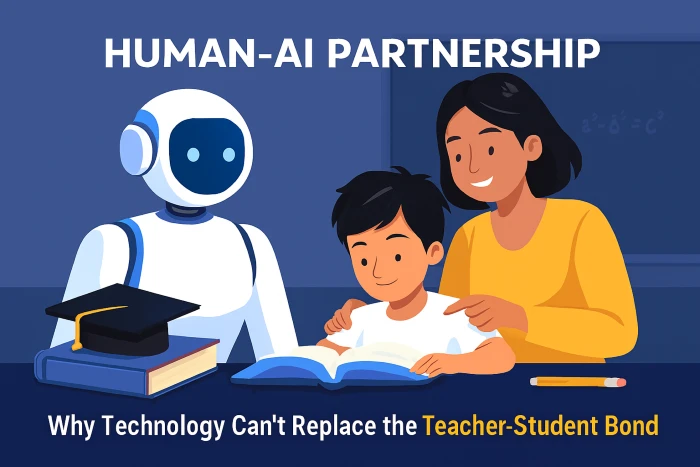
The Teacher-Student AI Role is crystal clear: The AI is the tireless, infinitely available tutor and administrative assistant. The human teacher is the mentor and emotional guide. Students with AI tutors have been shown to report higher engagement and see substantial grade improvement because the teacher is freed up to focus on high-impact, in-person instruction.
Trump 2025 Policies on AI-Human Jobs
The political and regulatory environment is not a static backdrop; it’s an active market force that influences where investment flows, especially in the intersection of AI and work.
In April 2025, President Trump signed an executive order, “Advancing Artificial Intelligence Education for American Youth.” This policy directly impacts the future work frameworks by attempting to cultivate an “AI-ready workforce.”9
| Policy Focus | Mechanism of Impact | Relevant Market Opportunity |
| K-12 AI Education | Establishes a White House Task Force on AI Education; creates public-private partnerships. | Massive increase in demand for AI-curriculum platforms and teacher AI augmentation tools that integrate into existing school software. |
| Teacher Training | Prioritizes discretionary grants for training educators on how to use AI tools. | Creates a short-term, high-demand consulting market for AI fluency training services targeting school districts and universities. |
| Federal Regulation | A December 2025 executive order aims to block states from passing conflicting AI regulations, prioritizing a single, federal approach. | Lowers compliance risk for large AI companies, but increases the ethical burden on human-AI security bonds teams to self-regulate against bias, as state-level anti-discrimination rules are preempted. |
This signals that government money and policy focus will flow into education technology that successfully integrates the human teacher as the leader and the AI as the assistant. Businesses looking for government contracts or to target the education sector need to adopt this AI tutors + human teachers model immediately.
Risk Mitigation Checklist: Ethical Audits & Bias Detection
The dark side of the Human-AI Partnership is the risk of automating and scaling human prejudice and error. If 70% of your work is done by an algorithm trained on imperfect data, you risk amplifying bias and getting sued.
This is your human, 30% oversight responsibility.
- Audit Input Data: Never trust the model implicitly. Use your human judgment to audit the training data used by the AI agent. Did it rely only on US data for a global product? Was it trained on predominantly white, male, or high-income demographic data? Garbage in, amplified garbage out.
- The Stress Test: Before any AI-generated asset (content, code, hiring decision) goes live, run a human-led agent-powered stress test. Give the AI an out-of-spec scenario: What if the customer is 80 years old and lives off-grid? What if the code is run on a 15-year-old browser? The human must anticipate the edge case the model was not trained on.
- The ‘Why’ Test: When an AI agent recommends a specific action (e.g., “The optimal strategy is to bid 40% more on this ad group”), use the human-AI synergy tips to ask why in a different way. Don’t accept the first answer. Force the agent to reveal the underlying data correlation, and then apply human logic to determine if correlation equals causation.
- Establish a Human Veto: Implement a mandatory human review stage for any decision that affects a person’s money, freedom, or well-being (hiring, lending, medical diagnosis). This is not just a policy; it’s a firewall.
FAQs (People Also Ask)
Q: What is the best human-AI ratio for content creation?
A: The most effective model is the 70/30 AI split. The AI agent should handle approximately 70% of the work: research, initial synthesis, fact compilation, and drafting. The human should be responsible for the final 30%: editing for tone and voice, applying strategic context, injecting proprietary data, and conducting ethical/bias audits. This maximizes speed while maintaining quality and authority.
Q: What are AI agent teams in the context of the future of work?
A: AI agent teams are collections of specialized AI models that execute complex tasks autonomously under human guidance. Instead of one large model, you might have: 1. A Research Agent (data collection). 2. A Synthesis Agent (drafting). 3. A Compliance Agent (bias check). A human manager assigns the goal and reviews the final output, effectively managing an entire team of non-human specialized workers. This allows solopreneurs to scale with human-AI teams by multiplying their individual effort.
Q: How does Google’s AI Overviews impact content strategy?
A: AI Overviews (SGE) significantly reduce the organic click-through rate (CTR), particularly for simple informational queries (a reported 34.5% drop).10 The impact on content strategy is a shift from ranking for facts to ranking for judgment and proprietary insight. Content must be structured to either be the definitive source cited by the AI Overview or, more strategically, to answer the complex, multi-layered questions that the AI Overview cannot fully resolve, compelling the user to click through.
Q: What are McKinsey’s “skill partnerships” and why do they matter?
A: McKinsey Global Institute uses “skill partnerships” to describe the new hybrid roles emerging where human workers collaborate directly with intelligent machines (agents and robots). The report finds that over 70% of current human skills remain relevant, but they are applied differently. For example, a teacher partners with an AI tutor, or a radiologist partners with an AI image analysis agent. This matters because it shifts the conversation from job replacement to workflow redesign and emphasizes the growing demand for AI fluency across all job functions
Stop Fighting the Tide
You can’t rewind the clock on AI. It’s here, it’s cheap, and it’s proficient at the busywork. Complaining about it won’t pay your rent; mastering it will.
The most valuable skill in 2026 will not be your ability to use a specific tool, but your ability to design a functional system where the human does the thinking, the AI does the heavy lifting, and the output is greater than the sum of its parts. Stop trying to beat the algorithm. Learn to manage your intelligent workforce.
The next generation of millionaires won’t be pure-play AI entrepreneurs; they will be the Human-AI Partnership managers who figured out the 70/30 split.
What system are you going to build next week?
The video, How to use AI to do quick competitive analysis, demonstrates practical ways to employ AI tools for SEO and messaging competitive intelligence, which is a key component of effective human oversight in AI SEO.
